The gymnasium at Oak Creek Elementary smelled like fruit punch and desperation.
Pink and blue streamers hung from the ceiling. Balloon arches framed the entrance. A DJ in the corner was playing something bouncy that I couldn’t identify because my blood was too loud in my ears.
It was the Annual Father-Daughter Dance. The event in the flyer had a little cartoon dad holding a little cartoon daughter’s hand. Hearts everywhere. I’d stared at that flyer on the fridge for three weeks before I convinced myself we should come.
David would have wanted us here.
That’s what I kept telling myself. My husband—Marine Sergeant David Miller—died eight months and eleven days ago in the Kunar Valley, Afghanistan. I know the exact number of days. I count them every morning when I wake up and look at his photo on the nightstand. Eight months and eleven days since a uniformed officer knocked on my door at 7:14 in the morning and said words I will never unhear.
Lily was seven years old. She didn’t fully understand. She understood enough.
“Mom,” she said, tugging my sleeve the moment we walked in. “Where are we supposed to stand?”
She’d worn her best dress—the navy one with the white collar that David had picked out for her birthday. She’d asked me to braid her hair the way Daddy used to, so I’d watched a YouTube tutorial three times and done my best. She looked perfect.
The room, however, was not built for us.
Every square inch of that gym was filled with fathers. Dads in khakis and button-downs, spinning their daughters in circles. Dads crouching down to fix a strap. Dads recording on their phones, grinning like lottery winners. The whole room hummed with a specific kind of joy I hadn’t felt in eight months and eleven days.
“Let’s find a spot,” I said.
We found a spot in the corner, near the folding table with the punch bowl and the plate of cookies that nobody was touching because everyone was too busy dancing.
Lily sat down on the gym mats. She pulled her knees to her chest.
“Mom,” she said, very quietly. “Can we just go home?”
Her eyes were huge and glassy. She was trying so hard not to cry. I had raised a brave girl.
“No, sweetheart.” I crouched down to her level. “Dad would want you here. He’d want you to have this.”
“But he’s not here.”
I didn’t have an answer for that. So I just squeezed her hand and tried to hold my own face together.
That’s when I heard heels clicking on the gym floor. Precise, purposeful clicking. Like a woman who has never once apologized for taking up space.
Brenda Collins materialized out of the crowd.
She was the PTA president—had been for three consecutive years, a fact she mentioned in every conversation within the first ninety seconds. Lawyer’s wife. The kind of woman who wore white pants to a children’s event and somehow never got a single stain on them. She was holding a wine glass. At a school function. For seven-year-olds.
She looked down at Lily with an expression that I can only describe as theatrical sympathy—the kind of pity that’s really just superiority wearing a costume.
“Oh, you came,” she said, looking at me. “That’s… brave.”
“We were invited,” I said carefully.
Brenda’s gaze drifted to Lily, still curled up on the mat, and she made a soft sound in the back of her throat. A tsk. A stage tsk, designed to be heard by the three other mothers who had drifted over to stand near her.
“Poor little thing,” she said, loud enough to carry. “I always think these events must be so hard for children from… well. You know.”
I stared at her. “No. I don’t know.”
“Incomplete families.” She took a sip of her wine, perfectly composed. “Events built around complete family structures are simply difficult for children who don’t have that foundation. It’s developmentally challenging.”
The room didn’t go quiet. Life continued. The DJ kept playing. Dads kept spinning. But in that little triangle of space between me and Brenda and my daughter—everything froze.
I felt the blood drain from my face and then rush back in, hot.
“What,” I said, “did you just say?”
“I’m just saying that maybe some events are better suited for certain family configurations.” She tilted her head with a practiced look of compassion. “It’s nothing personal. It’s simply that Lily doesn’t have—”
“She HAS a father.” My voice came out quieter than I expected, which was somehow more dangerous than shouting. “He gave his life defending this country. He died so that people like you could stand in gymnasiums like this and drink wine and say whatever you want without consequence.”
Brenda didn’t even flinch. She had the composure of someone who had never once been truly checked in her life.
“Well,” she said, a cold little smile on her lips. “Technically she doesn’t have a father anymore, does she? I’m not trying to be cruel. I’m just being honest.”
Lily made a small sound behind me. I didn’t turn around. I was afraid of what I’d see on her face.
“Mom.” Lily’s voice was tiny. “It’s okay. We can go.”
“We are not going anywhere,” I said.
I was about to say something else—something I would probably not regret but that would absolutely have consequences for Lily’s school career—when it happened.
BANG.
The gym doors didn’t open. They detonated.
Both double doors flew wide and slammed against the walls with a concussion that rattled the balloon arches and sent a shockwave through the music. The DJ’s track cut off mid-beat. Every conversation in the room died simultaneously.
Three hundred people turned toward the entrance.
Eleven men stood in the doorway.
Ten Marines in dress blues—the full uniform, blue jacket with gold buttons, white trousers, white gloves, covers perfectly level, boots polished to an impossible mirror shine. And at the front—a step ahead of all of them—a man with silver stars on his shoulders.
A General.
He was in his fifties. Face like something cut from granite—not handsome exactly, but commanding, the kind of face that made you want to stand up straighter just from being in the same room. There was a scar on his left cheekbone. His eyes were the gray of winter sky at dawn. He wore his uniform the way some men wear their skin—like it had always been there and always would be.
He didn’t look around the room the way a newcomer looks around a room.
He scanned it.
Like a man who, upon entering any space, immediately identifies every exit, every threat, every person who needs protecting. His gaze moved with purpose and then—it stopped.
It stopped on Lily.
My seven-year-old daughter in the corner, on the gym mat, knees still pulled to her chest, tear tracks drying on her cheeks.
The General took one step forward. His men moved with him—not following him, exactly, but extending from him, like fingers from a fist. They moved in absolute silence until their boots touched the gym floor, and then—
Left. Right. Left. Right.
The sound of eleven pairs of dress boots on a gymnasium floor is not a sound you forget. It wasn’t loud. It was resonant. It went through the floor and into your chest and stayed there.
The crowd parted. Nobody decided to part. It just happened. People stepped back automatically, the way you step back from a wave without thinking about it.
The Marines fanned out as they reached the center of the floor, forming a deliberate arc. A semicircle. A human wall facing outward, hands clasped behind their backs, chins level, chests out.
They enclosed Lily.
Not trapping her—protecting her. There is a difference, and the room understood it immediately.
The General stopped in the center of the arc. He looked at Brenda Collins for precisely three seconds.
Just three seconds. He didn’t say anything. He didn’t need to. His eyes dropped to the wine glass, moved to Lily in the corner, and then came back to Brenda’s face. In those three seconds, something happened to Brenda. Her spine seemed to compress. Her chin dropped. The wine glass tilted in her hand and she stumbled backward, stepping directly onto the shards of glass she’d dropped earlier, and she didn’t even notice because she was too busy trying to be invisible.
Then the General turned his back on her entirely.
He walked to Lily.
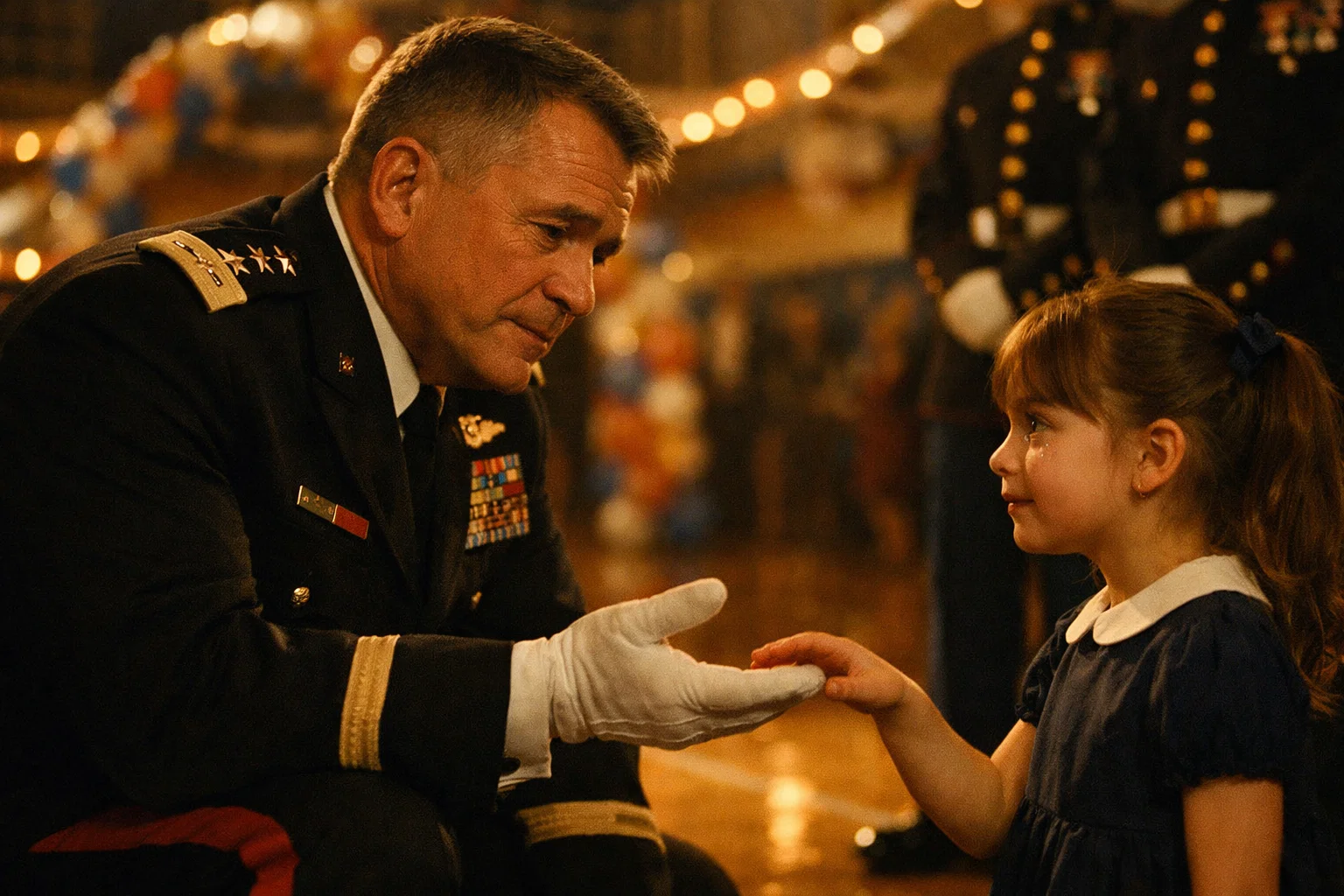
He stopped about two feet away. He looked at this small, tear-streaked girl in her navy dress, and he did something that nobody in that gym expected.
He got down on one knee.
A General of the United States Army—a man who commanded battalions, who had held the line in places most of us have never heard of, who had medals on his chest for things that would make you weep if you knew the full story—knelt on a gymnasium floor so that his eyes were level with those of a seven-year-old girl.
The room was absolutely silent. The DJ’s hand was frozen over his laptop. No one breathed.
“Lily,” the General said.
His voice was not soft, exactly. It was controlled. It was the voice of someone who knew precisely how much force to put into every word.
Lily looked at him. Her eyes went very wide.
“I’m General Sterling,” he said. “I’m sorry I’m late. Traffic from the base was…” he paused, just slightly, “significant.”
Lily blinked. “You… you know my name?”
“I do.” There was something in his eyes—a grief, held back by discipline, contained but not gone. “I knew your father very well. Sergeant David Miller was the finest soldier I served with in twenty-eight years of active duty. We were together in the Kunar Valley.”
Lily didn’t say anything. Neither did anyone else in the gym.
“There was an ambush,” the General continued, his voice steady and even. “It was a bad one. The kind where you know, very quickly, that not everyone is going to make it out. And your father—” he paused here, and I saw his jaw tighten for just a moment— “your father stood up. When everyone else was down. He pulled three men out of the line of fire. He drew the attack away from my position. He saved my life, Lily. And the lives of every man standing behind me right now.”
He gestured behind him without turning. Nine Marines. Nine of the ten raised one hand—a subtle, quiet acknowledgment. The tenth bowed his head.
Lily’s lips were trembling. “He… he did?”
“He did,” Sterling said. “And I want you to know something else. He talked about you. Every day. He had a picture of you on the inside of his helmet cover. He showed your drawings to anyone who would look at them. He told us you love butterflies.” A faint, sad smile. “He said you’re afraid of the dark.”
Lily made a small sound. Her hand came up to cover her mouth.
“He made us promise something,” the General said. “He made all of us promise that if he ever couldn’t be somewhere for you—if something ever happened and he couldn’t make it—we would make sure you were never left standing alone in the dark.”
He held her gaze.
“We made that promise,” he said. “All of us.”
Behind him, ten Marines—ten grown men in dress uniforms—nodded once, in unison.
I was pressing both hands over my mouth and shaking. I didn’t know I was crying until I felt it on my wrists.
The General stood. He turned toward Brenda Collins, who had backed herself against the refreshment table and looked like she genuinely wanted to evaporate.
“I caught some of what was said when we entered,” Sterling said.
He didn’t raise his voice. He didn’t have to. His voice filled the room the way his presence filled the room—not by being loud, but by being undeniable.
He walked to Brenda. Slow, measured steps. He stopped three feet from her. She looked, suddenly, very small.
“You spoke about complete families,” he said.
Brenda opened her mouth.
“Ma’am.” One word. She closed her mouth.
“Let me tell you what I know about that little girl’s family.” He didn’t gesture toward Lily. He kept his eyes on Brenda. “Her father chose his unit, his country, and the people standing next to him over his own life. He made a decision to die so that other people—strangers—could come home to their families. He made that decision knowing he had a wife and a daughter who needed him.” He let that land. “That is not an incomplete family. That is a family that gave more than any of us in this room will ever be asked to give.”
The silence was total.
“Her father is not absent,” Sterling continued. “He is present in every man behind me who kept his word. He is present in this room tonight because we are here, in dress blues, at a school dance, on a Tuesday, because Sergeant David Miller asked us to be, and we do not break our word.”
He looked away from Brenda. He swept his gaze across the entire gym—across the dads with their daughters, the mothers with their phones, the DJ with his laptop, the principal by the door.
“There is no family in this room more complete than that one,” he said. “And I’d like everyone here to sit with that.”
He didn’t wait for a response. He turned his back on Brenda—a final, deliberate dismissal—and walked back to Lily.
He knelt down again.
“Your dad can’t be here physically tonight,” he said, his voice quieter now, just for her. “That is a loss I don’t have words for, and I’m not going to pretend otherwise. But he’s not gone. He lives in every one of my men. He lives in me. And tonight—if you’ll allow us—the General and this entire unit would like to stand in for your dad.”
He glanced back at his men. They snapped to attention. A sharp, single click of eleven pairs of heels.
When he turned back to Lily, he extended one large white-gloved hand, palm up.
“May I have this dance, Princess?”
Time did something strange. It didn’t exactly stop—it stretched, the way it stretches in the seconds before something you know you’ll remember for the rest of your life.
Lily stared at the hand. She was looking at it the way you look at something you thought was impossible.
Then—slowly, slowly—the slump went out of her small shoulders. Her chin came up. The fear in her eyes didn’t disappear; it transformed, the way a storm transforms into stillness. A smile broke across her face. Not a polite smile. Not a brave-little-girl smile. A real one, from somewhere deep, the kind that crinkles the corners of eyes and shows all the teeth, the kind that, when you see it on your child’s face, you feel it physically in your sternum.
She placed her hand in his.
“Yes,” she whispered.
General Sterling nodded once at the DJ—a single, authoritative nod.
The DJ scrambled. For a moment, there was only the sound of nervous laptop clicking. Then—
The opening piano chords of “My Girl.”
I made a sound I didn’t intend to make. Because that was David’s song. I didn’t know how they knew. I found out later that David had a playlist he’d made for Lily—a playlist he’d talked about with his unit, songs he planned to play for her at her wedding someday. “My Girl” was first.
They knew because David had told them.
General Sterling led my daughter to the absolute center of the gymnasium floor. The crowd parted before them without a word—fathers stepping back, pulling their daughters with them, opening a wide, respectful circle in the middle of the room.
And he danced with her.
Not in a formal, awkward way. Not in a let’s-get-through-this way. He danced with her the way you dance with someone precious. He held her hand up and guided her in slow circles. He made her spin—and caught her when she came back around, grinning. She stood on his boots, and he walked her through the steps, and she was laughing. Actually laughing, this kid who twenty minutes ago was sitting in a corner counting down the minutes until she could go home.
Then the others joined.
The ten Marines didn’t partner with other girls. They didn’t spread out through the crowd and make small talk and blend in. They walked—in formation, in step—onto the dance floor. They formed a circle around Lily and the General. A ring. A fortress.
And they danced.
Military men in full dress blues, clapping softly to the Motown beat, swaying, grinning down at a seven-year-old girl who was spinning in the middle of their circle. They made silly faces at her over the General’s shoulder. One of them—a young sergeant with a wide face and honest eyes—gave her an exaggerated thumbs-up, and Lily burst out laughing so hard she almost lost her footing.
Sterling caught her, of course.
The fathers in the room stopped dancing. One by one, they stopped. You could see the moment it hit each of them—the realization of what they were watching, the weight of it. A father who could not be there, who had arranged—somehow, impossibly—to send an army in his place.
The clapping started with one man. Then another. Then someone’s mother. Then another.
And then the whole gymnasium was clapping in rhythm to “My Girl,” and then the clapping wasn’t in rhythm anymore because people weren’t clapping to the music, they were clapping because they didn’t know what else to do with what they felt. Fathers wiped their eyes with the backs of their hands. Mothers pressed their palms to their mouths. I could hear sobbing from somewhere to my left.
I was sobbing.
I was standing at the edge of the dance floor with both hands over my face and tears running down my wrists and I was not even slightly embarrassed about it.
Brenda Collins slipped out through the side emergency exit. I watched it happen from the corner of my eye—watched her set her wine glass down on the table, look at the floor, and walk out. The door closed quietly behind her. No one called her name. No one asked where she was going.
She just went.
For “My Girl,” and the song after that, and the song after that.
The Marines didn’t leave. They stayed for every song. They took turns—when the General was spun out, one of the sergeants swept in. When Lily got tired, another one offered his back for a piggyback ride around the circle while the others cheered. They ate the stale cookies from the refreshment table. They drank paper cups of fruit punch. They laughed.
They were, I realized slowly, having an excellent time.
Lily had never looked less like a girl whose father wasn’t there.
When the DJ finally gave the signal for last dance, General Sterling found me at the edge of the room.
“Mrs. Miller,” he said.
I barely managed, “General.”
He extended his hand.
I danced the last dance with a General of the United States Army. He held my hand correctly—formal, respectful, the posture of a man who was raised right—and we moved slowly in the circle while Lily danced with three Marines simultaneously, arguing about who got to hold her hand.
“He was one of the best men I’ve ever known,” Sterling said quietly, looking past me at Lily. “I need you to know that’s not something I say.”
“I know,” I said. “He talked about you too. He admired you.”
“The feeling was mutual.”
There wasn’t much more to say after that. We just danced.
The lights came on at 9:00. The DJ packed up. Parents gathered coats and tired children. Lily, sugar-crashed and heavy-eyed, was half-asleep on the shoulder of the young sergeant with the wide honest face, who was carrying her toward the exit like she weighed nothing, which—compared to what he’d probably carried in his career—she didn’t.
In the parking lot, under the white-yellow buzz of the lot lights, General Sterling knelt down one final time.
He reached into his breast pocket.
“Lily.” He held out a coin—gold, heavy, the size of a half-dollar, with an eagle on one face and an insignia I didn’t recognize on the other. A challenge coin. His command’s coin.
Lily took it with both hands and looked at it seriously.
“If anyone ever—ever—tells you that you don’t belong somewhere,” he said, “you show them that. And you tell them you have a direct line to the General. Understood?”
Lily looked up at him. Her eyes were barely open. She was exhausted and happy and still wearing the remnants of a smile.
“Understood, sir,” she said, and offered a salute so sloppy and adorable that two of the Marines behind him had to look away.
Sterling returned the salute with complete solemnity.
I buckled Lily into her car seat. She was asleep before I started the engine—the coin held against her chest in both hands, the way you hold something you intend to keep.
I looked in the rearview mirror as I pulled out of the lot.
Eleven men in dress blues, standing in formation under the parking lot lights, holding a salute.
They held it until we turned the corner.
I drove home in the dark and I didn’t feel lonely. Not once. Not even for a second.
Two days later, Brenda Collins resigned from the PTA presidency. The official statement cited “health reasons.” Everyone who had been in that gymnasium understood the nature of the health problem.
Her reputation in Oak Creek took approximately four hours to fully collapse, which is about how long it takes for a story to travel from one school parking lot to every WhatsApp group in a suburb.
Lily still has the coin.
She keeps it in her blazer pocket on school days. She showed it to her teacher the week after the dance. She has shown it to exactly three kids who said something unkind, and each time she’s pulled it out of her pocket and explained, with complete seriousness, that she has a direct line to the General.
She walks differently now. Not arrogantly—not with Brenda’s strutting, brittle confidence—but with something quieter and sturdier than that. With the particular posture of someone who has been told, by multiple credible sources, that they are not alone.
There is a photo on my refrigerator now. Not the dance flyer. A photograph, taken by one of the other mothers that night, of Lily dancing in the center of the ring. Ten Marines swaying around her, and the General’s hand clasped in hers, and Lily mid-laugh, head thrown back, her navy dress spinning out.
David isn’t in the photo.
He’s everywhere in it.
They said she didn’t have a father.
She had an army.
Original fictional stories. AI-assisted creative content.