
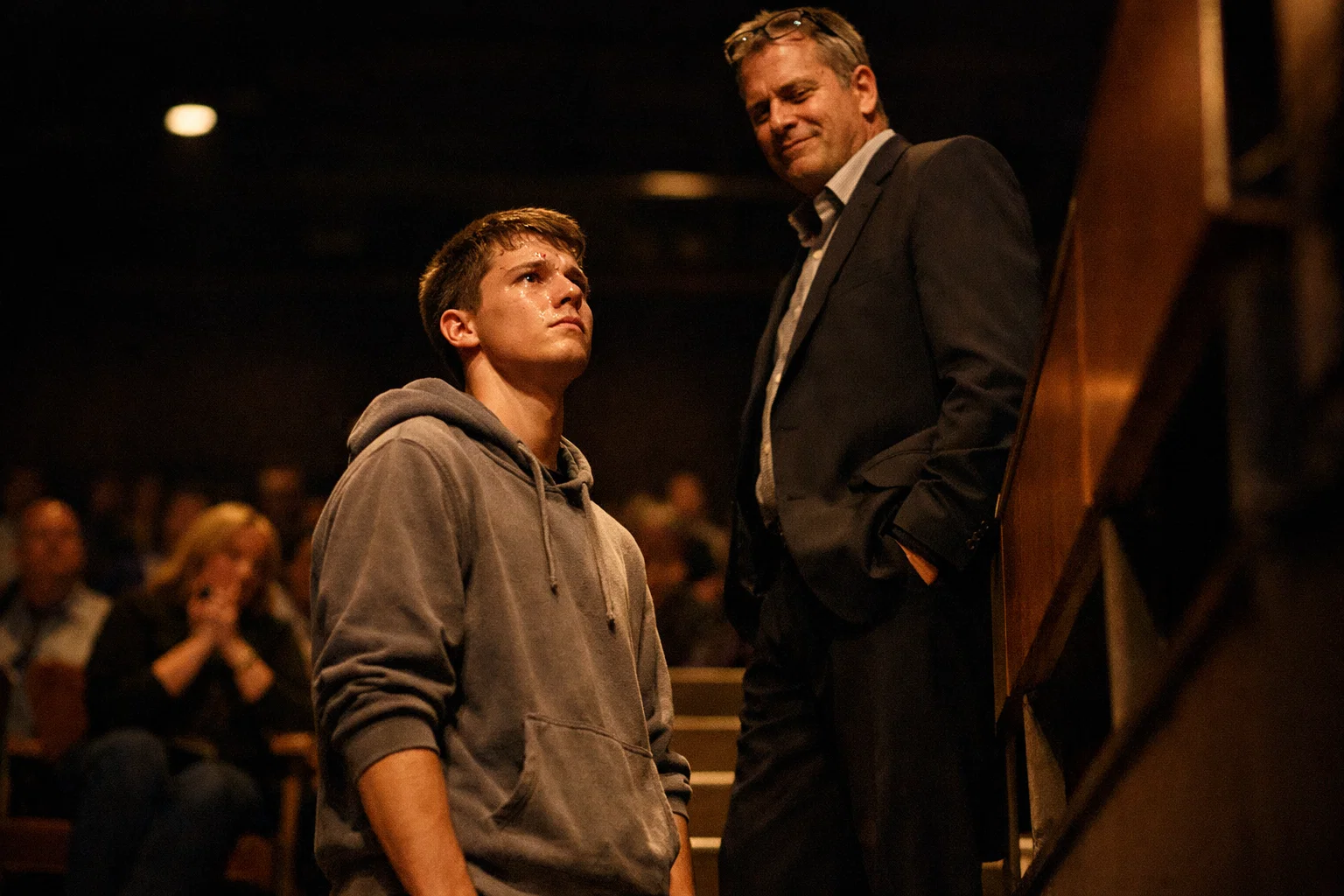
The program sat in Diane Halloway’s lap, edges curled from the drive over. She had read it twice in the parking lot — not because she was nervous, but because she was proud. Ethan Miller’s name was on page four, printed in bold: State Academic Excellence Award Recipient.
She found her seat in the third row. She smoothed her skirt. She waved across the aisle at her neighbor Carol, who mouthed, Is Laura here?
Diane pointed toward the back.
Carol turned, spotted Laura near the far wall, and gave a small approving nod.
Laura sat alone in the second-to-last row. Navy cardigan. Hair pinned back. She had a copy of the program, too, but she wasn’t reading it. She was watching the stage with quiet, practiced patience — the kind that doesn’t come from calm, but from years of learning that calm is the only option left.
The ceremony opened with a welcome from Principal Gerald Marsh. He had held the position for eleven years. He was good at these evenings — composed, resonant, just formal enough to feel earned. The lights were warm. The auditorium smelled faintly of floor polish and carnations from the bouquets near the entry table.
“Tonight,” Marsh said, leaning into the microphone, “we celebrate the students who represent the very best of what this community produces.”
Applause. A few whistles from the back.
Diane watched the stage. She watched the other award recipients sitting in the reserved front row — blazers, blouses, one boy in a tie that looked slightly too large for him.
She noticed Ethan was not among them.
She turned, scanning the rows. She found him three seats down from her. Faded gray hoodie. Dark jeans. Sneakers that had logged serious mileage. He sat with his arms resting on his knees, elbows forward, eyes on the stage.
Clean. Utterly calm.
Diane felt the first small tug of unease.
Oh, Ethan.
They worked through the lesser awards first — service recognition, arts, athletics. The crowd was warm and generous. Parents leaned over to photograph. Teachers clapped from the side aisles.
When the academic awards began, Gerald Marsh read each name with the same steady cadence. Each student rose, walked the short aisle, ascended the four steps to the stage, shook hands, accepted the certificate, posed for a photograph.
Then Marsh said, “Our final recipient for the State Academic Excellence Award — Ethan Miller.”
The applause started immediately.
Then stopped.
Not dramatically. It didn’t collapse all at once. But it thinned, the way applause does when the crowd notices something and isn’t sure yet what it means. A ripple. A hesitation.
Ethan stood. He moved into the aisle without hurry. His sneakers made no sound on the carpet.
Marsh watched him approach. His smile stayed in place, but the warmth behind it shifted — recalculated.
When Ethan reached the base of the stage steps, Marsh stepped away from the podium. He leaned toward Ethan. The microphone was still live.
“Son,” he said quietly. “We encourage formal attire for recipients.”
The word encourage hung in the air like a threat dressed in a cardigan.
Ethan looked at him. Not angry. Not embarrassed. He tilted his head slightly, like a person listening for something specific.
“I understand,” he said.
Marsh nodded once — as though the matter were settled. “We’d be happy to recognize you after the ceremony, when you’re dressed appropriately.”
From the front row: “It’s about setting an example.”
The voice belonged to Renee Dalton — mother of two former graduates, president of the school’s Parents’ Association, owner of what Diane privately thought of as the most exhausting opinions in three counties. She didn’t lower her voice when she said it.
A few heads turned to affirm her. A few more stared at their programs.
Diane felt her jaw tighten.
This is happening. In front of everyone. This is actually happening.
Laura had not moved.
She sat with the program folded across her knees and looked at her son from across the auditorium with the expression she had worn the night she told him his father wasn’t coming home. Steady. Clear. Not broken.
Ethan glanced toward her.
Something passed between them — brief, private, like a code only the two of them held.
Then he looked back at Marsh and said, “Could I have one moment?”
Marsh blinked. “I—”
“Please,” Ethan said. Quiet. Not a request so much as a courtesy warning.
Marsh stepped back.
And Ethan did something no one anticipated.
He didn’t go to his seat. He didn’t leave the stage. He stepped sideways, off the three-step riser, and moved into the center aisle — right under the overhead lights. He turned to face the audience.
Renee Dalton sat up straighter. Two rows behind her, Diane felt her breath lock in her throat.
Ethan reached into the front pocket of his hoodie.
There was a soft rustling sound.
Someone near Diane whispered, “What is he doing?”
Someone else answered, “I don’t know.”
The auditorium fell quiet with the particular silence of a room that has decided to pay attention — not because it was asked to, but because it couldn’t look away.
He drew out a folded piece of paper.
Not a note. Not a letter. He unfolded it carefully, with both hands, the way you handle something that matters.
“I wasn’t going to do this,” he said. His voice was even. Calm. “But since tonight is about standards—”
He let the word land.
A cough from somewhere. The soft clink of a bracelet.
“My name is in that program,” Ethan continued, “because I have a 4.1 GPA and I scored in the 99th percentile on my state boards. I’ve also been working evenings in the maintenance department at St. Mary’s Medical Center for the past fourteen months. Cleaning floors. Changing lightbulbs. Fixing whatever breaks overnight.”
A stir through the audience. Marsh stood perfectly still beside the podium.
“I saved up enough to buy a suit.” Ethan paused. “A real one. Not secondhand. I had it picked out.”
He held up the paper so the first several rows could see.
It was a receipt.
Not from a clothing store.
From a funeral home.
The silence was instant and total.
“The woman who runs the hospital kitchen — her name is Margaret. She’s worked at St. Mary’s for twenty-two years. Her husband died six weeks ago.” Ethan looked down at the paper briefly, then back up. “She couldn’t cover the burial costs. She didn’t ask anyone for help. She just got quieter. Stopped eating at break. Started coming in earlier than her shift.”
A woman in the fourth row pressed her fingers to her mouth.
“I used the suit money for that instead,” Ethan said simply.
No performance in it. No tremor. Just the fact, placed in the room like something set carefully on a table.
“These clothes are clean,” he said. “They’re honest. And they’re paid for.”
He folded the receipt back along its original creases. Slid it into his pocket.
“I thought tonight was about achievement,” he said. “Not fabric.”
Nobody moved.
Nobody spoke.
From somewhere in the middle rows, a man cleared his throat. A child near the front shifted in her seat. Those were the only sounds.
Diane looked at the receipt. She looked at the stage table, where the certificate still sat.
She looked at Gerald Marsh.
He had the expression of a man who had walked into the wrong room and was now calculating whether he could reach the exit before anyone looked directly at him.
He couldn’t.
Renee Dalton had gone very still. The Parents’ Association program lay across her knees at a slight angle, as though she’d forgotten she was holding it.
Gerald Marsh stood at the podium. His hand rested on the edge of it. He looked like a man who had arrived at the correct destination but had planned the wrong speech.
Then, from the far end of the row reserved for district staff, a man stood.
He was in his mid-sixties. Silver hair, dark suit, no name tag — though most of the room knew who he was. Superintendent Leonard Graves seldom attended building-level events. When he did, it meant something.
He walked the length of the side aisle slowly. He climbed the stage steps. He picked up the award certificate from the table, turned, and descended back to the floor.
He walked to where Ethan stood in the center aisle.
He extended the certificate.
“No young man who understands character like this,” Graves said into the auditorium’s silence, “should ever be turned away from this stage.”
Ethan took the certificate with both hands.
For a moment the two of them stood there — a superintendent in a dark suit and a seventeen-year-old in a gray hoodie — and neither moved.
Then Graves said, more quietly, almost just to Ethan: “I’ll be in touch.”
Ethan nodded once.
The first applause came from a man in the back who Diane had never seen before — older, a hospital visitor lanyard still around his neck from an earlier errand. He stood and clapped without looking around to see who would join him.
Then others rose. Slowly at first. Then faster.
By the time the sound fully built, the entire room was standing — except for Renee Dalton, who rose two beats later than everyone else and did not meet anyone’s eyes.
Afterward, in the lobby, Diane overheard something she wasn’t meant to hear.
Renee Dalton was talking to another parent — a woman in a green blazer whose name Diane could never remember.
“It was still inappropriate,” Renee was saying. “You don’t turn a school event into a performance.”
“Renee.” The woman in the green blazer looked uncomfortable. “He showed a receipt.”
“He made a scene.”
“He showed a receipt,” the woman repeated, more firmly this time. “That’s not the same thing.”
Renee’s mouth tightened. She looked across the lobby to where Ethan was talking with the superintendent near the entry table.
“It was calculated,” she said finally.
The woman in the green blazer picked up her purse. “Good night, Renee.”
She walked away.
Renee stood alone for a moment, holding her program, watching the far end of the lobby.
Diane watched her from where she stood by the water fountain.
No, she thought. It wasn’t calculated. That’s exactly what you can’t forgive about it.
Marsh didn’t speak again that night.
After the ceremony, he stood near the entry table shaking hands out of professional habit. His smile had a smaller radius than it had two hours before.
Diane watched him from across the lobby.
She watched Laura navigate the crowd toward her son — not rushing, not triumphant, just moving through the space that was finally making room for her.
When she reached Ethan, she didn’t say anything. She put her hand on his shoulder for a moment. He covered it briefly with his. That was all.
Diane looked away, because some things aren’t meant to be witnessed too directly.
She caught up with them near the parking lot.
“Ethan.” She stepped forward and shook his hand. “That was— I don’t have the right word.”
“Thank you, Ms. Halloway,” he said.
She turned to Laura. “Did you know? About the money?”
Laura looked at her son, then back. “I found out a few days after.”
“What did you say to him?”
“I told him he should have let me help.”
“And?”
“He said Margaret didn’t know anyone was helping. He said he wanted it that way.”
Diane stood there with that for a moment.
“He said if he wore a suit,” Laura added quietly, “it wouldn’t be for him. It would be for them.”
The word them settled between the three of them.
The unseen jury. The room that decided who you were before you opened your mouth.
In the days that followed, it didn’t go viral the way people imagine these things do. There were no cameras waiting at the school entrance. No local anchors. Just the particular velocity of small-town conversation — a parent mentioning it to a neighbor, a teacher pausing longer than usual after class to say something quiet and personal to Ethan in the hallway, a woman at the pharmacy counter who said to Laura, out of nowhere, “I heard about your boy.”
Laura had simply nodded. “He’s a good one.”
Diane went by the hospital cafeteria three mornings later. She ordered coffee she didn’t need. She watched Laura pour it.
A cardiologist came up with two colleagues. They ordered without looking up from a chart.
“Black, one sugar, and a large drip.”
Laura filled the cups without a word. One of the colleagues glanced up briefly — and paused. Looked at Laura more carefully.
“Are you — is your son Ethan Miller?”
Laura looked at him. “I am.”
The man nodded, almost to himself. “I was there. At the ceremony.”
A beat passed.
“He’s a good kid,” the cardiologist said.
“He is,” Laura said simply.
They took their coffees and left.
Laura wiped the counter.
Diane watched from her table.
A nurse coming off shift stopped at the register and said, “I saw what your son did.” She didn’t wait for an answer. She just touched Laura’s hand and walked past.
Laura stared at the space the nurse had just occupied.
Then she pressed her lips together and went back to work.
One week after the ceremony, Gerald Marsh addressed the school over morning announcements. He said that the district would be reviewing how it communicated dress expectations for formal events. He said that “character and contribution must never be eclipsed by presentation.” He was careful with the words. Deliberate. The kind of careful that takes overnight to construct.
Some of Diane’s friends called it damage control.
Maybe it was.
But Diane was there in the parking lot that afternoon when Marsh spotted Ethan near the bike rack. He walked over. Extended his hand. Ethan shook it without hesitation.
Marsh said something. Short. Direct. No one was close enough to hear.
Ethan nodded once.
That was it. No crowd. No microphone.
But the handshake lasted a beat longer than formality requires, and when Marsh walked away, his shoulders were lower than they’d been the week before — not defeated, but lighter. The way a person moves when they’ve returned something they’d borrowed too long.
Two months before graduation, the school district announced the creation of a new scholarship — the Miller-Graves Integrity Award. Named jointly after Ethan and the superintendent who had stood up when it counted. It would be awarded annually to a graduating senior who had demonstrated “exceptional integrity in the face of public pressure.”
The language was Graves’ own. He had written it himself.
They didn’t advertise it widely. It appeared in the spring program like something that had always been there.
Diane attended that graduation ceremony too, a year later. She watched the first recipient climb the stage — a junior-year transfer student, a girl in a simple dress, hair pulled back, shoes plain and scuffed at the toe.
Nobody looked at her shoes.
Not one person in that auditorium looked at her shoes.
After the ceremony, Diane called Laura. They met for coffee at the diner two blocks from the hospital.
Laura stirred her cup. She had graying temples now that she wasn’t hiding. She looked more like herself than she had in years.
“Did you see it?” Diane asked. “The scholarship. Her walking up.”
“I saw.”
“How’d that feel?”
Laura was quiet for a moment. She watched the traffic pass outside the window.
“Like something made sense,” she said finally.
Diane leaned forward. “Do you think he knows what he did? Not just that night — I mean what it did afterward?”
Laura smiled. A real one. Not performance, not relief — just warmth.
“He doesn’t think of it that way.”
“No?”
“He thinks he just said something true.” She set down her spoon. “He told me after — he said, ‘I didn’t speak up, Mom. I just didn’t stay quiet.’“
Diane felt the words settle in her chest the way sentences do when they’re actually worth keeping.
I didn’t speak up. I just didn’t stay quiet.
Ethan left for State in late August on a partial engineering scholarship. He found a job the second week — facilities management at the campus medical center, late shift.
Some things stay consistent.
He called every Sunday. He sent money home the first month. Laura put it in an envelope and mailed it back with a note that said “Your rent.” He called the next Sunday and they argued about it for eleven minutes, according to Laura, and then they both laughed, and the money stayed in his account.
On his last night home before leaving, they sat at the kitchen table under the lamp that was always on when he studied. Laura had made the pasta he liked — the one she’d been making since he was nine.
Neither of them mentioned the ceremony.
They talked about the drive. About his roommate. About whether the dining hall would be any good.
“Engineers are kind of intense,” Laura said, twirling her fork. “Is that going to bother you?”
“I am kind of intense.”
“You’re focused,” she said. “That’s different.”
He looked up. “How is that different?”
“Intense people need everyone around them to match.” She pointed her fork at him briefly. “Focused people don’t care what everyone else is doing.”
He considered that. “That’s actually useful.”
“I know,” she said. “I’ve been saving it.”
He smiled — a real one, not polite. Just genuine amusement.
“You should’ve given that speech instead of me.”
She shook her head. “You did fine.”
“You weren’t nervous?”
She looked at him across the table. “I was terrified,” she said plainly. “Not because of what might go wrong. Because of what you might have to carry afterward. I didn’t want you to have to carry it.”
A pause.
“And?” he asked.
“And you carried it just fine.” She picked up her glass. “Better than fine.”
Just before eleven, Ethan pushed back from the table and said, “I’m gonna miss this kitchen.”
Laura looked at him across the table. “It’ll be here.”
“I know.”
“So will I.”
A pause.
“I know that too,” he said.
He helped her wash the dishes. They turned off the light.
And that was that.
There’s something Diane has thought about many times since that evening in the auditorium — not the applause, not the superintendent handing over the certificate — but the moment just before any of it happened.
The moment when Ethan stood in the aisle under the overhead lights with a folded receipt in his hand and a room full of people who had already made up their minds about him.
He could have gone to his seat. He could have walked out. He could have accepted the “after the ceremony” offer that would have made everyone comfortable and cost him everything.
He did none of those things.
He just stood there and told the truth.
No raised voice. No performance. No demand for anything — not applause, not an apology, not a reversal.
Just the truth, placed carefully in the room.
Diane thinks about that whenever she’s in a meeting or a hallway or a parking lot and the room is leaning a certain way and it would be easier to let it.
She thinks about a seventeen-year-old in worn sneakers who understood something most adults spend a lifetime misplacing:
That dignity isn’t conditional on the room’s approval.
That telling the truth isn’t the same as making noise.
And that sometimes the most powerful thing you can do — the thing that actually changes what a room is capable of — isn’t standing up louder.
It’s simply refusing to sit back down.
Original fictional stories. AI-assisted creative content.



This story reminds me of a true episiode that occurred to me:
I was a freshly graduated medical intern, working in a small rural hospital in Maine. We were required to take emergency call every now and then. It was a Saturday evening and I had been working in my garden most of the day. I got an emergency call to care for a patient in our ICU. I drove right in and ran up to the 3rd floor heading to the ICU. As I passed a nurse’s station someone called out: Dr Hurst – YOUR PANTS!! (Which were probably covered in garden dirt.)
I replied: “Dear: They are not paying me for WHAT IS IN MY PANTS!!”