The folder was yellow. That was the first thing I noticed — a bright, almost cheerful yellow, completely wrong for what was inside it.
I had found it taped to the front door of my father’s house — technically, the house I had assumed would be mine — the morning a bulldozer showed up at the end of the driveway.
I didn’t understand. I literally did not understand.
“Sir, you need to step back,” the man in the dark suit said. He was standing on the front walk with a clipboard, flanked by two men in reflective vests. Behind them, idling at the curb, was a machine the size of a small building.
“What is happening?” I asked. My voice came out wrong. Too quiet, too confused.
“Demolition order. City-approved.” He held out a document. “The property was transferred last month.”
“Transferred to who?”
He just nodded at the folder in my hands. “It’s all in there.”
I tore it open right there on the front steps.
The first page was a property deed. The estate — the land under my feet, the house behind me — now belonged to something called “The Stray Dog Trust.” A corporate entity I had never heard of.
The second page was the demolition order. Stamped, signed, expedited.
My hands were shaking.
Then I reached the personal items.
Three of them, tucked beneath the legal papers like they were being kept safe inside an envelope of ruin.
The first was a Polaroid photograph. Old, faded at the edges. Me and my dad at the lake, when I was ten years old. I was holding up a tiny trout, beaming like I had caught a whale. My dad was looking at me — not at the fish, at me — with this expression I hadn’t thought about in years. Pure pride. The uncomplicated kind.
I turned the photo over.
On the back, in his handwriting — that shaky, slanted script I knew as well as my own name — four words:
“The last time I recognized my son.”
My stomach dropped so hard I nearly sat down on the step.
The second item was a single, crisp one-dollar bill.
The third was a letter.
“Dear son. If you are reading this, it means the walls of the house you loved more than your own flesh and blood are about to come down. You thought I was broke. You thought I was a sinking ship. But the truth is, my wealth never dried up. Only your humanity did.”
I had to stop reading. The diesel exhaust from the bulldozer was burning my eyes, or maybe something else was. I pressed the back of my hand against my face and told myself to breathe.
The letter explained everything.
For eight months, my father had been running a test.
He had hired an actor to call the house pretending to be a debt collector. He had hidden his real mail and planted fake red-stamped past-due notices on the kitchen counter — the kind you couldn’t miss if you were looking for them. He’d worn the same three shirts on rotation. He’d pretended to sell his watch.
And I had believed every single word of it.
Because, the letter said, I hadn’t been paying attention to him. I’d been paying attention to what he owned.
“Ever since your mother passed, you changed. You stopped asking how I was sleeping. You started asking about the portfolio. You brought up the will at Thanksgiving dinner while I was still chewing. You complained about the cost of my medications. You were practically measuring the windows while I sat in the same room.”
I remembered that Thanksgiving dinner. I had told myself it was practical. Just being realistic. Just planning ahead.
“A father always knows when his child stops seeing him as a person and starts seeing him as a transaction.”
The letter shifted. The handwriting got smaller, tighter — like he was pressing harder on the pen.
“So I decided to find out what you would do if the money disappeared. Would you get a job to help cover the bills? Would you ask me if I needed anything? Would you take care of the man who spent thirty years taking care of you?”
I thought about what I had actually done.
I had complained, loudly, about the financial drain. I had stopped bringing dinner on Sundays because, I told myself, I was busy. I had started researching real estate values in the neighborhood — just casually, I had told myself that too.
And then came the night.
The fight.
He had asked me, one more time, if I could help cover a utility bill. A single utility bill. And I had snapped. I had said things I couldn’t take back. I had told him this couldn’t keep going on forever. I had said — God, I had actually said — that maybe it was time to think about selling.
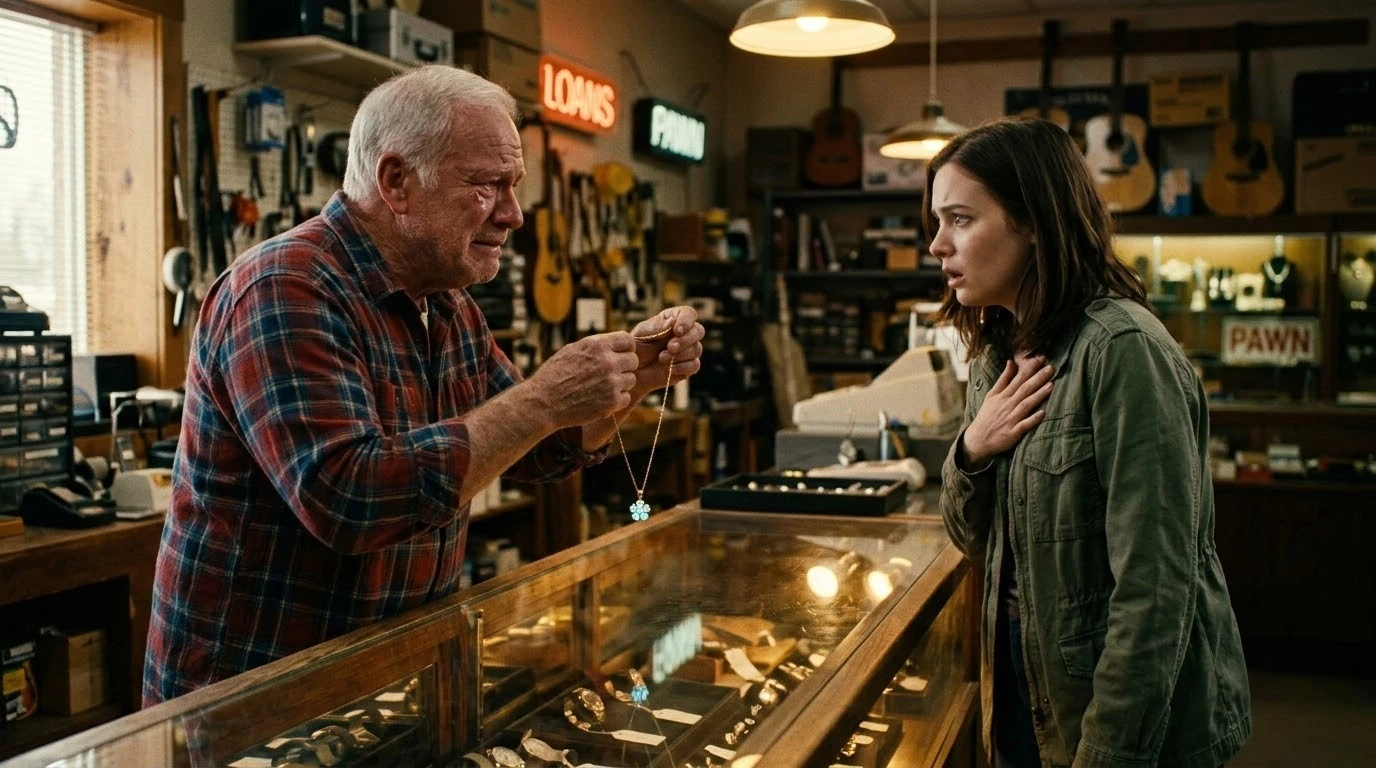
He had looked at me for a very long moment. Then he had gone to his room and come out twenty minutes later with a packed suitcase.
“Where are you supposed to go?” I had asked, and I hadn’t even meant it with care. I had meant it as a logistical problem.
“Away from here,” he had said. “Away from you.”
The suitcase had hit the icy concrete of the porch with a heavy thud.
I had watched him leave and told myself I had done the right thing.
“You failed, son,” the letter continued. “You threw me to the wolves without a second thought. You protected the bricks of this house, but you destroyed our home. And so I am returning the favor.”
“Sir.” The man in the dark suit appeared in the doorway. “Nine minutes.”
“You can’t do this,” I said. I wasn’t even angry anymore. I was hollow. “This is my house.”
“Read the deed.” His voice had no heat in it. No cruelty, just fact. “You don’t own a single nail in those floorboards. Nine minutes.”
I ran inside.
What do you take when everything is being erased? My hands didn’t know what to grab. I found a duffel bag in the hall closet and shoved clothes into it without looking at them. Phone. Charger. Boots. I saw the silver candlesticks my mother had loved and knew I couldn’t carry them. I saw the paintings on the staircase wall — one of them was worth more than my car — and I left them there.
I stumbled out the front door just as the signal was given.
The yellow machine swung forward.
The first impact took out the columns on the front porch. The sound was something I will never get out of my head — deep and splintering, followed by a groan from the whole structure, like the house was breathing its last. The stained-glass window in the study — the one my mother had found at an antique market the year before she got sick, the one she had been so proud of — detonated into fragments that caught the morning light as they fell.
Dust rolled over me in a wave.
I stood on the sidewalk with a duffel bag that weighed less than a laptop and watched my entire future come down.
He hadn’t just left me with nothing.
He had made sure I understood why.
That was three weeks ago.
When you’ve spent your whole adult life assuming a safety net exists, you don’t notice how thin your real skills are. I had a degree I had coasted through and a network built entirely on the money attached to my name.
The money was gone. The network followed in about forty-eight hours.
I called three friends the first night. Two didn’t answer. One answered, listened for thirty seconds, and said, “That’s rough, man. Look, I’ve got to go.”
I ran out of cash in four days.
On the fifth night, I spread a flattened cardboard box behind a grocery store and lay down in the same freezing air I had watched my father walk out into.
The cold was specific. It had a texture. It got into your joints and stayed there.
I had been afraid of poverty my entire adult life, and in running from it, I had sprinted straight into its arms.
But the worst moment — the one that will follow me into whatever comes next — happened two days ago.
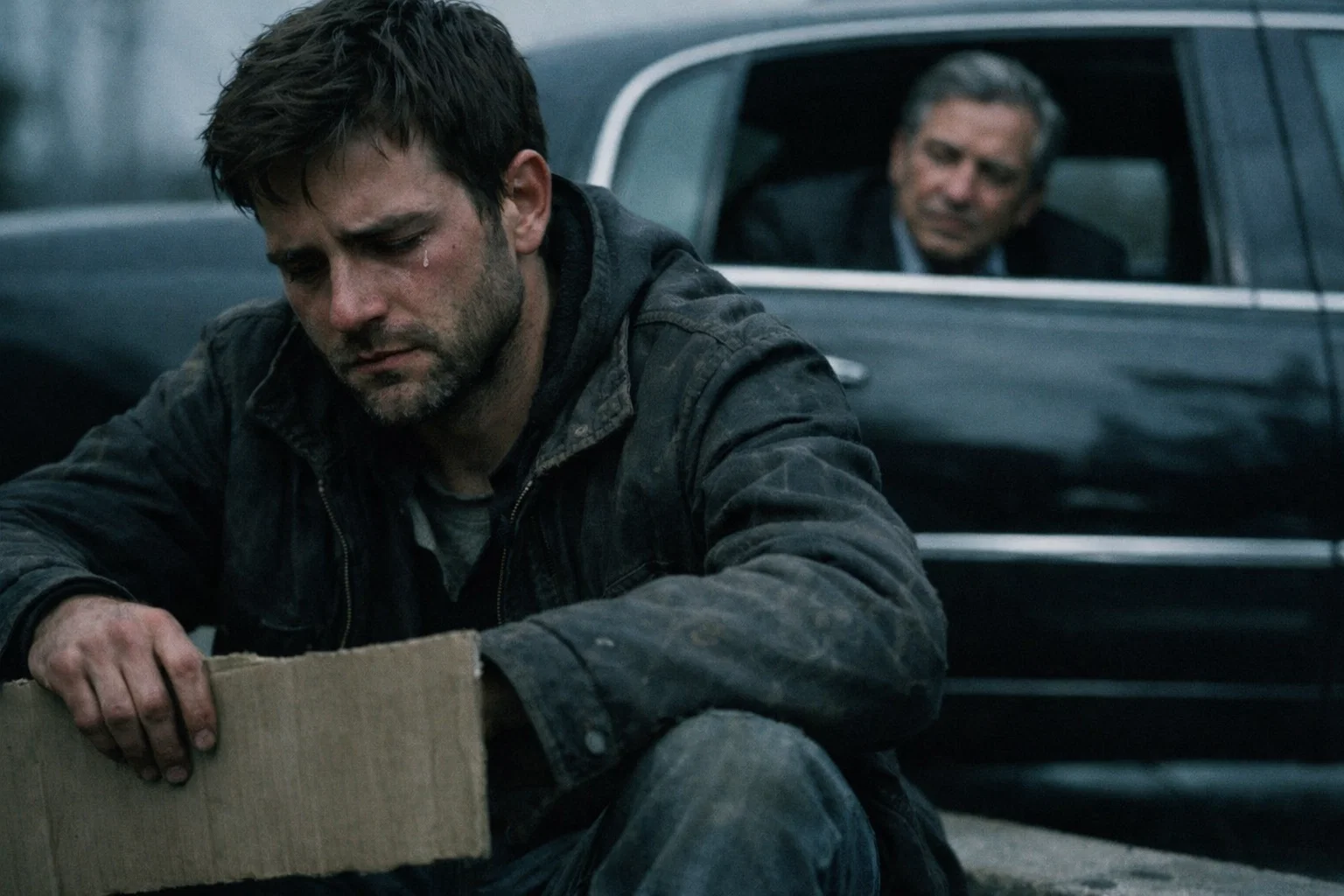
I was on a downtown corner, holding a piece of cardboard, trying not to make eye contact with the morning foot traffic. A black town car stopped at the red light directly in front of me.
The tinted rear window came down.
My father was in the back seat.
He wasn’t wearing the old gray sweater from that last night. He was in a suit that fit him the way good suits are supposed to fit — like it was made for his shoulders, which it probably was. He looked rested. He looked well. He looked like exactly what he had always been, and what I had spent the last year pretending he no longer was: a man of extraordinary dignity.
Beside him sat the lawyer in the dark suit.
My father looked at me.
I opened my mouth. I don’t know what I meant to say. Sorry, maybe, though the word felt like something I had forfeited the right to. I wanted to say I understood, now, what I had traded away. I wanted to say the photograph on the back of the Polaroid — the last time he recognized me — had not left my hands since I found it.
But nothing came out.
He didn’t smile. He didn’t look angry. He didn’t look sad.
He looked at me the way you look at a stranger on a street corner. With simple, quiet distance. With the polite nonrecognition you give to someone who is not part of your life.
Then the window rolled up, and the car moved on.
I found out later — through a family friend who still took my calls out of some residual obligation — what the Stray Dog Trust actually was.
My father had liquidated everything. The portfolio, the investments, the rental properties — years of accumulated wealth, quietly moved through legal channels over the past eight months while I had been convinced he was drowning.
All of it went into the Trust.
The Trust’s stated purpose: building facilities and funding job-placement programs for homeless youth in the city. Young people who needed a real start and had never gotten one.
He gave my inheritance — every dollar of it — to strangers on the street.
People exactly like me.
Except they hadn’t chosen to be there.
I’m writing this now from a public library computer. I have an hour of free access and a line forming behind me.
The one-dollar bill is in my jacket pocket. I haven’t spent it. I don’t know that I ever will.
His letter explained it at the end:
“I leave you exactly one dollar. Because that is what you are worth as a son. Use it to buy a mirror, so you can look at the man who traded a father’s love for a pile of bricks that don’t even exist anymore.”
There is no reunion waiting at the end of this story. No phone call where he forgives me and we start over. My father is living his final years doing something that will outlast him, surrounded by people who see him clearly.
And I am wearing the clothes I had on the morning the house came down.
I know what I lost now. I understand it with a completeness that is almost physical — the way you understand cold when you’re sleeping in it. I had the one thing no amount of money can manufacture: a father who would have given me everything, freely, without condition, for the rest of his life.
I looked at the numbers instead of the man.
Now I am the stray dog. I am what the Trust was built for.
And the most honest thing I can tell you — the thing that will stay with me through every cold night that follows — is that I know exactly how I got here.
And I deserved it.
Original fictional stories. AI-assisted creative content.