The ceremony was supposed to start at two o’clock.
By two-fifteen, everything was still on schedule. White chairs. Soft guitar. The kind of garden wedding that looked like it came out of a magazine—except this one was real, right in the middle of a quiet American town where everybody knew everybody.
Or thought they did.
Maya squeezed her bouquet and tried not to cry before she even got to the altar. Her hands shook. She exhaled slowly. Behind her, her mother whispered, “You look perfect.”
She almost believed it.
At the front of the garden, her fiancé Daniel stood with the officiant, shoulders loose, hands clasped. He looked calm. He always looked calm. That was one of the things she loved about him.
He wasn’t calm for long.
The sound came from the back row.
A chair scraped. Heads turned.
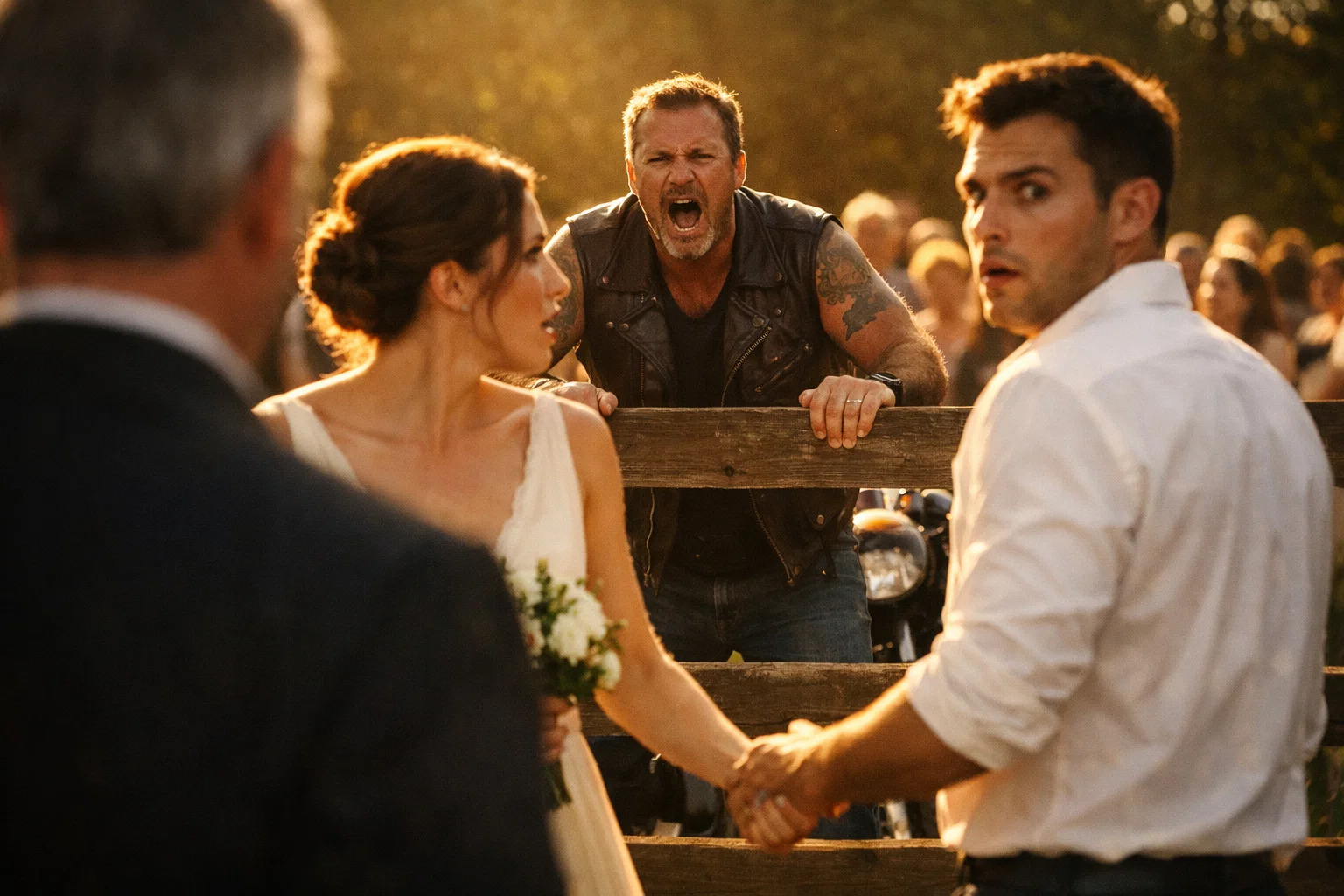
A man stood up—late forties, wide shoulders, sleeveless black shirt under a worn leather vest. Gray streaking through his beard. Tattoos up and down both arms, the kind that had softened with age, shapes bleeding slightly at the edges. He looked like he’d ridden straight out of a highway and walked into the wrong event.
Whispers started immediately.
“Who is that?”
“Did anyone invite him?”
“Why is he standing up?”
He wasn’t standing up to object. He wasn’t drunk. He didn’t look lost or hostile. He just stood, and then—without hesitation—he started walking forward.
Down the aisle.
A groomsman stepped sideways fast, nearly knocking over a flower arrangement. “Hey—” he started.
The biker didn’t stop.
He reached the front of the garden in six long strides, stepped up onto the small wooden platform, and stood beside the couple. Not aggressively. Not theatrically. He just stopped there, like he had every right to be.
Daniel turned.
His jaw went tight.
“What the hell—” he started.
The officiant raised a hand, voice careful and measured. “Sir. Sir, I need you to step down. This is a private ceremony.”
“I heard you,” the biker said.
He didn’t move.
Daniel’s voice dropped to something sharper. “I don’t know who you are. But you need to leave. Right now.”
The biker finally looked at him—really looked at him—and something shifted in his expression. Not anger. Not threat. Something that didn’t have a clean name.
“I won’t take long,” he said quietly.
That was the wrong answer.
Three groomsmen were on their feet now. An uncle near the front row had his phone out, thumb hovering. Several guests stood, uncertain whether to intervene or run.
Maya hadn’t moved. She stood perfectly still, bouquet pressed to her sternum, watching the biker’s face. There was something in it she couldn’t read.
“You’re ruining this,” Daniel said. His voice cracked slightly on the last word. “You understand that? You’re ruining my wedding.”
“I know,” the biker said.
He reached into the front pocket of his vest.
Half the crowd flinched.
He pulled out a phone. Unlocked it with one thumb. Found a contact. And pressed send.
“What are you doing?” Daniel demanded.
“Making sure I don’t stand here alone.”
Nobody understood what that meant.
Nobody understood anything for the next two minutes.
The sound arrived before the explanation.
A low, distant rumble. The kind you feel in your chest before you hear it with your ears. Guests exchanged glances. Someone said, “Is that thunder?”
It wasn’t thunder.
Motorcycles appeared at the end of the street—slow, deliberate, controlled. They rolled in single file, then spread out, filling the curb in front of the garden. One by one, engines cut off. Men dismounted.
Dozens of them.
American men, mostly in their forties and fifties. Some older. Leather vests over sleeveless shirts. Tattoos. Sunglasses taken off and held at their sides. They didn’t shout. They didn’t push through the gate. They stood in a line along the fence, quiet and still and present.
Like a guard of honor.
Like a wall.
Like a promise kept.
An elderly woman in the third row pressed her hand to her mouth. Beside her, her husband gripped her arm.
Daniel had gone very still.
The biker on the stage looked at him—not triumphant, not challenging. Just direct.
“I rode with your father,” he said. “For eleven years.”
Daniel didn’t speak.
“He passed four months ago. You know that.” The biker’s voice didn’t waver. “What you don’t know is that he spent the last year of his life terrified he wouldn’t be welcome here. At your wedding. At your life.” He paused. “He thought you hated him for leaving.”
The groomsmen had sat back down. No one was standing anymore except Daniel and Maya and the biker.
“He asked me,” the biker continued, “to come. If he couldn’t. To stand where he would have stood. To give you what he couldn’t give you himself.”
He reached into his vest again—the other pocket this time—and produced a folded piece of paper. White. Worn at the creases. Like it had been folded and unfolded more than once.
He held it out.
Daniel didn’t take it immediately.
“He wrote it himself,” the biker said. “Took him three weeks. He kept throwing them away and starting over.”
Daniel’s hand came up slowly. He took the note.
The garden was absolutely silent.
He read it.
Nobody spoke. Nobody moved. The motorcycles along the fence gleamed in the afternoon light. A bird somewhere in the nearby elm tree made a single sound and then went quiet.
Daniel read the note twice.
Then he folded it very carefully, exactly on its original creases, and pressed it against his chest with both hands.
His shoulders dropped.
Not in defeat. In release.
“I didn’t hate him,” he said. His voice broke on the last word, not dramatically, not for effect—it just broke, the way voices do when something has been held too long. “I just didn’t know how to—I didn’t know how to—”
He stopped.
Maya stepped forward and put her hand on his back.
“I know,” the biker said. “He knew too. That’s in the note.”
Daniel turned to look at the men standing along the fence.
Forty-three of them, it would turn out. Some had driven eight hours. One had flown in from Colorado. They stood without fuss, without performance—just present, the way men who have buried someone together learn to be present.
“He talked about you,” Daniel said. It wasn’t really a question.
“Constantly,” the biker said. “Every single ride.”
Daniel laughed—sharp and sudden, not quite a sob. He pressed his knuckle against his mouth. Maya was crying now. Several guests were crying. The flower girl in the front row looked around, confused, and then started crying because everyone else was.
The officiant waited.
The biker stepped back down from the platform. He straightened his vest, nodded once at Daniel, and walked to the back of the garden. He sat down in the last row.
He didn’t ask for acknowledgment. He didn’t look for applause.
He just sat.
“Are you—” the officiant started gently.
Daniel turned to Maya. He looked at her the way people look at each other when something real has just happened—not romantic, not polished, just honest.
“I want to say something,” he said.
She nodded.
He turned to face the guests.
“My dad couldn’t be here today. Some of you knew him. Most of you didn’t.” His voice was steady now, or close to it. “He wasn’t easy to know. He left when I was twelve, and for a long time I was so angry I couldn’t see past it.” He exhaled. “I didn’t reach out. Neither did he. We just—kept the distance.”
He held up the folded note.
“But he was thinking about today. He planned for today.” A pause. “There are forty-something men parked outside this garden who drove here to stand in for him. Because he asked them to.”
The garden was so quiet that someone’s chair creaking sounded like a gunshot.
“I spent twenty years thinking he didn’t care,” Daniel said. “Turns out, I was wrong.”
He looked at Maya.
“I want to marry you with that on the table. I want you to know I’ve got some things to let go of. And I’m going to.”
Maya reached up and touched his face.
“I know,” she said. “Now marry me.”
The ceremony resumed.
The vows were the same words they’d prepared—but they landed differently now. Heavier. More earned. When Daniel said “for better or worse,” he meant something specific. When Maya said “I choose you,” she was choosing him including this.
The officiant pronounced them married.
The guests clapped—and then, from outside the fence, something unexpected: a low, rolling sound. Not engines. Not shouts.
The forty-three men along the fence clapping. Slowly. Steadily. Together.
Like a salute.
Like a father saying well done from a distance he couldn’t close in time.
Afterward, during the cocktail hour, Daniel walked to the fence.
The biker was the last one there—the others had already mounted up and were beginning to leave.
“I don’t know your name,” Daniel said.
“Hank.”
“Hank.” Daniel extended his hand. “Thank you.”
Hank shook it. Firm, brief, no ceremony.
“He’d have been proud of you today,” Hank said.
Daniel nodded. He couldn’t say anything for a second.
“That note,” he finally managed. “He said something in there—” He stopped. “He said he watched me graduate. From a distance. He was there.”
Hank didn’t look surprised.
“I know,” he said. “I drove him.”
Daniel stared at him.
“He didn’t want to upset you. So he watched from the parking lot.” Hank picked up his helmet. “Cried the whole way home. Just so you know.”
He put his helmet on, mounted his bike, and started the engine.
Daniel stood at the fence and watched him go.
One by one, the engines faded down the street. Left turn at the corner, and then gone—swallowed by the afternoon the same way they’d arrived, quietly, without demanding anything.
Maya appeared beside him and slipped her hand into his.
“You okay?” she asked.
“Yeah,” he said. He squeezed her hand. “Yeah, I really am.”
He reached into his jacket pocket and touched the note—still folded, still there.
He kept it there the entire reception. Touched it at the speeches. Touched it at the first dance.
That night, when they got back to the hotel, he set it carefully on the nightstand.
In the morning, it was the first thing he saw.
He picked it up, unfolded it one more time, and read his father’s handwriting—shaky near the end, where the pen had pressed harder than usual.
I should have come back. I was afraid you wouldn’t want me. That was my failure, not yours. I am proud of you every single day. I was proud of you before you ever did anything worth being proud of. That is what fathers are supposed to feel. I know I didn’t show you. I’m sorry it took me this long to say it. Have a good life, Daniel. Be kinder to yourself than I was to myself. You deserved better. You still do.
— Dad
Daniel sat on the edge of the hotel bed for a long time.
Then he folded the note one last time.
And he let go.
Original fictional stories. AI-assisted creative content.