My name is Garret. Most people call me Scar.
The name comes from a ridge of ruined tissue that runs from my left ear down to my jawline — a reminder that I’ve lived entirely outside the boundaries of polite society, and survived every minute of it. I’m the President of the Iron Hounds Motorcycle Club. And on that Tuesday night, fifty of my brothers were packed into Rosie’s Diner, loud and tired after a three-day run from the badlands.
We were a sea of worn leather and heavy boots. To the outside world, we were trash. The uneducated. The unwashed. The forgotten.
Out here on these highways, we were the only law that mattered.
The diner smelled like burnt oil, cheap coffee, and frying meat. The hum of fifty cooling engines vibrated up through the cracked linoleum floor. My brothers were laughing, tearing into cheap steaks, arguing about nothing. It was loud and warm and exactly where we were supposed to be.
I was nursing a black coffee, thinking about the road ahead.
Then the front door blew open.
The kid hit the entrance at a full sprint, and he was screaming before he was even inside.
“Help me! Please, somebody help me — he’s chasing me, please —”
The diner went dead silent.
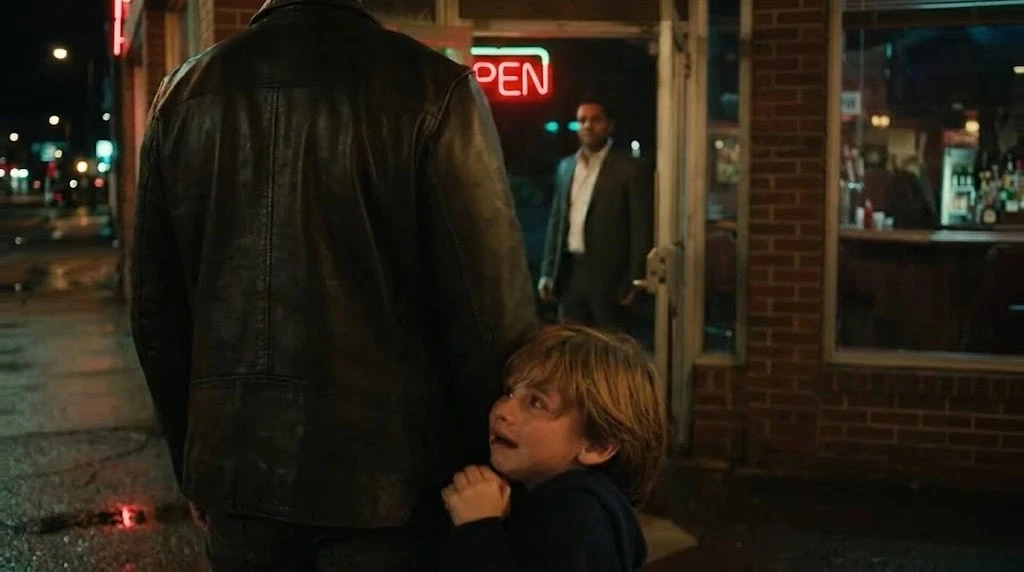
He was maybe seven years old. Small. Dark circles carved under his eyes. His knuckles were scraped raw, one knee of his jeans torn open and bleeding. He ran straight down the middle of the diner with the blind panic of a child who had nothing left but forward.
He hit me like a tackle.
I’d swiveled on my stool by instinct, and he ran straight into my chest, grabbed two fistfuls of my leather jacket, and pressed himself behind me with every ounce of his small body — using me as a wall between himself and the door.
His whole frame was shaking.
“Easy,” I said, low and quiet. “Easy. You’re okay.”
“He’s coming,” the boy gasped into my jacket. “He’s right behind me, please don’t let him —”
The door opened again.
The man who walked in was maybe forty-five. He was wearing what had been, this morning, a very expensive suit — Italian wool, sharp cut, the kind that doesn’t come off a rack. But the right sleeve was torn at the shoulder seam. His shirt collar was ripped open. His tie was gone. He had a smear of dirt across one cheekbone, like he’d stumbled and caught himself on gravel.
He scanned the diner.
His eyes found the boy immediately.
Then they found me.
He stopped two steps inside the door and straightened up, breathing hard, trying to compose himself. Fixing his jacket. Smoothing back his hair. Reaching for the expression of a man used to controlling rooms.
The room was not his to control.
Fifty Iron Hounds had gone very, very still. Fifty pairs of eyes were on him. Nobody moved. Nobody spoke. The only sound was the grease popping on the grill in the back.
The man cleared his throat.
“That child,” he said, his voice aimed at me, careful and calibrated, “is under my legal supervision. He is a ward of —”
“He’s under my hand right now,” I said. “Which is where he’s staying.”
The man’s jaw tightened. “Sir, I don’t think you understand the situation. There are legal documents that establish —”
“What’s your name, son?” I said to the boy behind me.
A pause. Shaking. Then, muffled against my jacket: “Tommy.”
“You know this man, Tommy?”
Another pause. Longer this time.
“He was taking me somewhere,” Tommy whispered. “I don’t know where. He said I had to go. He said my mom said it was okay.” The shaking got worse. “My mom doesn’t know where I am.”
The temperature in the diner dropped about ten degrees.
I looked at the man in the torn suit.
He looked back at me with the eyes of someone recalculating.
“This is a private matter,” he said. “I’m asking you, as a reasonable adult, to step aside and allow me to —”
“Rosie,” I said.
“Already calling,” she said from behind the counter, phone in hand.
“Thank you.” I didn’t look away from the man. “Sit down.”
“I beg your pardon?”
“You heard me.” I picked up my coffee with my free hand. “Sit. Down.”
He didn’t sit. But he didn’t move for the door either. His eyes tracked around the room — counting, calculating. Fifty big men in leather jackets. One exit he’d have to go through to leave.
He sat down on the nearest stool.
Mags materialized beside me like she always does — silent, fast, phone already running. Eight years as our logistics operator. Ex-Army intelligence. She doesn’t startle and she doesn’t waste time.
“You got anything?” I said.
“Pulling now,” she said. She crouched down in front of Tommy, still pressed behind me. “Hey. My name’s Mags. I’m a friend of Scar’s. Can I see your face for a second?”
Slowly, Tommy turned.
Mags looked at him for a moment. Then she stood up and held her phone out to me. A missing persons report. Pittsburgh. A school photo — same kid, same eyes, same dark circles, except in the photo he was smiling.
Fourteen weeks missing.
His mother’s name was Carol.
I turned the phone so the man in the torn suit could see it.
“Fourteen weeks,” I said.
He said nothing.
“His mother has been on every local news station in western Pennsylvania for three months,” I said. “Looking for her son.” I set the phone down on the counter. “So I’m going to ask you one time, and I’d encourage you to think very carefully about your answer. Where were you taking him?”
The man’s composure slipped just a fraction. He reached into his jacket.
Tiny was standing beside him before the hand cleared the lapel. Six-four, two hundred and seventy pounds, and he moved with a quietness that always surprised people. He put one massive hand on the man’s wrist — not squeezing, just present.
“Easy,” Tiny said pleasantly.
The man slowly withdrew his hand. He was holding a phone, not a weapon. His eyes had changed. The calculation was gone. Something rawer was underneath it.
“I need to make a call,” the man said.
“You can make it right here,” I said. “Speakerphone.”
His jaw worked. “That’s not —”
“Speakerphone,” I said. “Or you don’t make it.”
He stared at me for a long moment. The kind of stare that worked on city council members and subordinates and anyone who needed his signature on something.
I drank my coffee.
He put the phone on the counter and hit dial.
It rang four times. Then a man picked up.
The voice was older. Smooth. The particular smoothness of money that had been old for several generations.
“Is it done?” the voice said.
“There’s been a complication,” the man in the suit said, his eyes on me.
A pause. “What kind of complication?”
“The boy is currently —” He hesitated. “In the custody of a third party.”
“That’s not acceptable.” The voice sharpened. “The transport window closes in ninety minutes. The jet is already on the ground. You need to —”
“There’s a room full of people here,” the man in the suit said quietly.
Another pause. Longer this time.
“Who,” the voice said.
The man in the suit looked at me.
I leaned toward the phone. “Iron Hounds MC,” I said. “President speaking.”
Silence on the line.
“Mr. Holloway,” I said, because Mags had just turned her screen toward me with the name already pulled, “we have the boy. We have your associate. And in about four minutes, we’re going to have a great deal more. So I’d suggest you stop the clock on that transport window.”
The line went dead.
I looked at Mags.
“Jet,” she said. “Private airfield. Twelve miles north. Mags is already on it.”
“I’m already on it,” she confirmed, fingers moving. “Rat — pull everything on Holloway’s logistics company. Shell structure, recent transfers, flight records. All of it.”
From the back booth, Rat — twenty-six, looks like a stiff breeze could fold him, fastest hands I’ve ever seen on a keyboard — called out without looking up: “Already pulling, give me six minutes.”
I turned back to the man in the torn suit.
“What’s your name?” I said.
He was quiet for a moment.
“Marcus,” he said. Then, like it cost him something: “Marcus Thiel.”
“Marcus.” I nodded. “How many kids, Marcus?”
He looked at the counter.
“Marcus.” My voice stayed level. “How many kids is Holloway moving tonight?”
Long silence. The kind where a man is doing math on the rest of his life.
“Four,” he said. “In the cargo hold.”
The diner went even quieter, which I hadn’t thought was possible.
“Plus Tommy,” I said.
“Tommy wasn’t supposed to —” He stopped. Started again. “He was supposed to already be on the plane. Tonight was a pickup. He got away from me three blocks from here.”
I looked at Tommy, still pressed behind me, listening to every word.
I looked back at Marcus Thiel.
“You’re going to tell me everything,” I said. “And when the FBI gets here, you’re going to tell them everything too. And if you do that, if you tell them everything — names, locations, financial structure, all of it — you might spend less than the rest of your life in a federal prison.”
Marcus Thiel put his face in his hands.
He started talking.
Rat had the manifest in eleven minutes.
Fourteen names across three active transfers. A Gulfstream on the ground at a private airfield north of town. Four children in the cargo hold, scheduled departure in seventy minutes. Buyer names linked to shell companies in four countries. Financial transfers that bounced through seven intermediaries and landed in accounts tied to an offshore trust controlled by Arthur Holloway.
And a list.
Politicians. A federal judge. Three corporate executives. Names that would be on the front page of every newspaper in the country by morning.
Mags sent the first package to Agent Reyes at the FBI Cleveland field office — a contact who owed us from a case two years ago that I don’t discuss publicly. She sent the second package to two journalists she trusted absolutely.
The third package she held.
“For leverage,” she said.
“For after,” I said.
She nodded.
I stood up and turned to the diner.
Fifty Iron Hounds looked back at me. Nobody had moved in twenty minutes. Nobody had gone back to eating or talking. They were all just there — waiting — the way a storm waits, completely quiet, completely ready.
“Four kids on a plane twelve miles north,” I said. “Jet’s leaving in sixty-five minutes.”
Silence.
“Spider, Dutch, Tiny, Rat — you’re with me. ATVs off the trailer.” I looked at the rest of my brothers. “Everyone else holds this location. Marcus stays put. Nobody leaves until Reyes gets here.” I looked at Rosie. “Tommy stays with you.”
Rosie was already moving around the counter, a hand on Tommy’s shoulder.
“Nobody touches this child,” she said to the room. It wasn’t a question.
Fifty men nodded.
I zipped my jacket and walked toward the door.
“Garret.” Mags caught my arm for just a moment. “There are armed contractors on that plane.”
“I know,” I said.
“This isn’t a bar fight.”
“No.” I looked at her. “It’s not.”
She let go. “Come back in one piece.”
“Always do.”
The airfield was a private strip carved between two hills — no tower, no commercial traffic, just asphalt, a cluster of low metal buildings, and a Gulfstream with its engines already cycling up.
We came over the ridge with the ATVs running dark. No headlights. Moonlight and Rat’s GPS.
The jet was at the far end of the runway, beginning its taxi roll. Slow at first. Then gathering speed.
“They got tipped,” Dutch said into his earpiece.
“Doesn’t matter,” I said. “Cut them off.”
We hit the runway at full throttle and split — Spider and Dutch going left, Tiny and I going right, bracketing the aircraft’s path. The jet’s landing lights swept over us and I heard the engines surge as the pilot registered the obstruction.
“Landing gear,” I called. “Front strut. Rat, you have the shot.”
“On it.” Rat was riding one-handed, tablet in the other. “Killing their avionics comms now. They’re flying deaf.”
“Tiny. Dutch.”
Tiny raised the .44 Magnum. Dutch leveled the sawed-off.
They fired together.
Two heavy reports cracked across the valley like a thunderclap.
The front tires blew. The landing strut dropped. Metal hit asphalt at speed and threw sparks twenty feet high on both sides. The nose of the Gulfstream plowed forward. The aircraft swerved hard right, the wingtip clipping the grass shoulder of the runway with a sound like tearing sheet metal.
The jet left the asphalt and drove itself into the muddy field beside the strip, engines choking on wet earth, shuddering to a stop in a cloud of steam and torn grass.
We killed the ATVs and ran.
Two private contractors stumbled out of the emergency exits onto the wing, disoriented, weapons coming up.
I fired a twelve-gauge slug into the engine cowling six inches from the first man’s head. The concussion took him off his feet, hands over his ears. Spider hit the second one with a tackle off the wing that drove them both eight feet into the mud.
I vaulted the wing. Hit the cabin door. Shoved it open.
The interior was wrecked. Leather torn. Crystal everywhere. Oxygen masks swinging from the ceiling.
At the rear, a man in a tailored suit was fighting the lock on a reinforced cargo door. He turned. His hand went into his jacket.
He never cleared the holster.
The shotgun stock caught him across the jaw. He dropped and didn’t move.
I stepped over him. Aimed at the electronic lock. Pulled the trigger.
The door blew inward.
I dropped the gun. Stepped through.
Four children. Two boys, two girls. Strapped into transport seats. Faces bruised. Eyes locked on me, crying without making sound — the crying of kids who had learned that crying out loud had consequences.
I dropped to my knees.
“It’s over,” I said softly. “My name is Garret. I know Tommy. I came from the diner. You’re going home.”
The older girl — maybe nine — stared at my scar for a long moment.
Then she reached out and grabbed my hand with both of hers.
I started unclipping the restraints.
We had all four kids out of the jet and wrapped in leather jackets on the runway when the sirens started in the valley.
Not private security.
State police. A lot of them. Blue and red strobing up through the mountain dark.
Rat slid up on his ATV, grinning.
“I dumped everything, Prez. Entire database — flight logs, buyer names, transfers, all of it. FBI, Interpol, six news outlets. It’s already viral. They can’t put this back in the box.”
I looked up the hill at the glowing silhouette of Arthur Holloway’s estate.
He had run his operation in darkness because he controlled the lights.
We had just burned the switch.
The first state cruisers hit the airfield and fanned out. SWAT teams came in hard, expecting a firefight. They found fifty bikers in the mud, leather jackets wrapped around small shoulders, while the billionaires and their contractors lay zip-tied on the ground.
We didn’t run. We raised our hands.
The police chief — a man who had taken Holloway’s money for years — walked up to me. He looked at the downed jet. The children. The files he couldn’t contain. The career he’d already lost.
He looked at my scar.
“Garret,” he said. “What the hell happened here?”
“Justice, Chief,” I said. “We did your job for you.”
The sun came up over Ohio the color of old bronze.
Rosie’s Diner was full. Fifty Iron Hounds. Coffee. The smell of eggs and toast and something that came close enough to peace.
The TV above the counter ran nonstop. Arthur Holloway, denied bail. FBI raiding offshore accounts in four countries. Eleven politicians under investigation. The Autumn Gala network, as the press was calling it, dismantled in under twelve hours by fifty bikers and a girl with a laptop.
The men who thought they were untouchable were in orange jumpsuits, completely stripped.
Marcus Thiel had spent four hours in a federal interview room, telling Agent Reyes everything. Every name. Every transfer. Every location.
In exchange for a deal that would keep him alive long enough to see his own children again.
I wasn’t watching the TV.
I was watching the corner booth.
Tommy was there — clean shirt, plate of scrambled eggs, laughing at something Tiny was doing with a napkin. The fear was entirely gone from his eyes. He looked like a normal seven-year-old kid again.
Rosie refilled my coffee and stood beside me.
“You did good, Scar,” she said.
“We all did,” I said.
She smiled and walked back to the kitchen.
I looked around the diner. Fifty men and women wearing the Iron Hound patch. Society had words for us — none of them polite. We were the ones who fell through every crack the system had.
But when a scared little boy sprinted through that door with nothing left but his voice and whatever stranger he could find to hide behind — he found us.
Maybe that was enough.
Tommy finished his eggs, hopped off the booth, and ran across the diner full speed. He hit me around the waist and held on.
“Thanks, Scar,” he said.
Outside in the parking lot, a gray sedan pulled in too fast and stopped crooked. A woman got out before the engine quit. She didn’t look at the bikes or the leather or the men. She only had eyes for one thing.
Tommy turned around.
He went very still for one second.
Then: “Mom.”
Just that one word. And then he was running, and she was running, and they hit each other in the gravel lot and she went to her knees and pulled him in with both arms, face buried in his hair, shaking.
The whole diner watched through the glass and said nothing.
Nobody needed to.
I set my mug down, zipped my jacket, and walked outside into the morning.
The lot was warm with engines and brothers and the first clean air after a long rain.
Society looked at us and saw criminals.
They didn’t see what I saw: fifty people who showed up when it mattered. Fifty people a scared little boy had been lucky enough to run toward.
I threw my leg over my bike. The engine turned over with a low, heavy rumble.
Carol Delvecchio looked up from the gravel. Tommy still pressed against her. She looked at me — at the scar, the jacket, the fifty bikes. Her mouth opened, but nothing came out.
I lifted two fingers off the handlebars. A small wave. The kind that didn’t need an answer.
She nodded. That was enough.
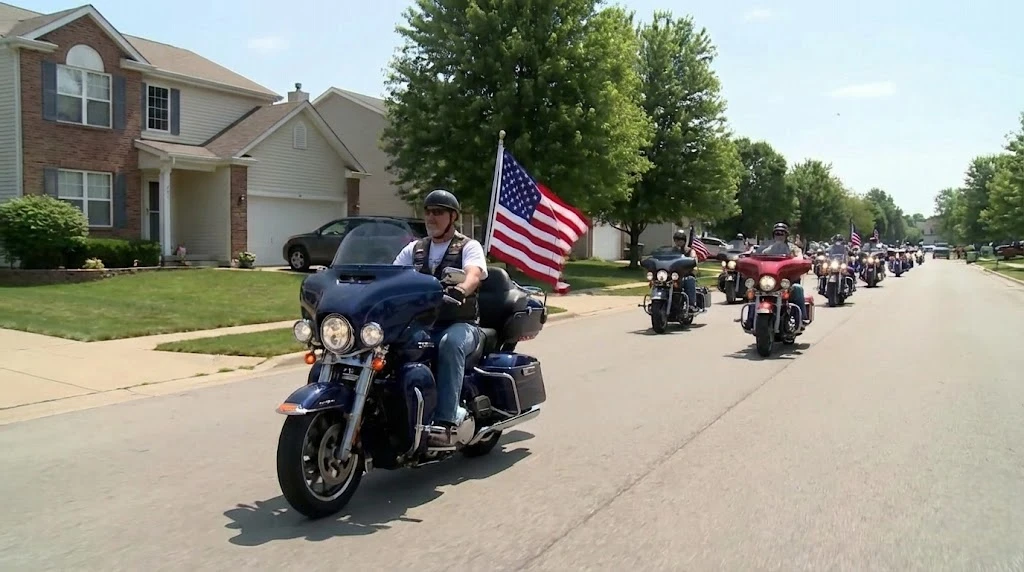
I pulled out of the lot and onto the highway, and one by one my brothers fell in behind me, a rolling thunder that stretched the length of the road.
The Iron Hounds rode.
Original fictional stories. AI-assisted creative content.