Walter Greer arrived at Patsy’s Diner at 5:47 every morning.
Not 5:50. Not 6:00. 5:47, which gave him thirteen minutes to start the coffee, wipe down the counter, and have everything warm before the first regulars walked in at six.
He had been doing this for thirty-eight years.
He knew which burner ran hot. He knew the back booth had a loose leg that needed a matchbook under it or the whole thing wobbled. He knew that Mrs. Kowalski took her eggs over-medium but always said over-easy, and that you just made them over-medium and she’d leave a four-dollar tip and tell you you were the only one who got it right.
He knew everything about this place.
Then Patsy died, and her nephew inherited it.
Dane Holloway was thirty-one years old, drove a leased BMW, and had never worked a service job in his life.
He showed up the first day in a blazer. Looked around the diner the way people look at something they’re trying to decide whether to throw away or sell.
“This place is stuck in 1987,” he said to no one in particular.
Walter was wiping down the counter. “It’s been doing fine.”
Dane looked at him. “And you are?”
“Walter. I’ve been here since—”
“Walter.” Dane said it like he was filing it. “How old are you?”
“Seventy-one.”
Dane nodded slowly. Said nothing. Wrote something on his clipboard.
That was the beginning.
The changes came fast.
New menu. Smaller portions, higher prices. Patsy’s regulars started grumbling after the first week. Old Earl, who came in every Tuesday for the liver and onions, showed up to find it wasn’t on the menu anymore.
“What do you mean it’s gone?” Earl looked at Walter.
“Ask the new owner,” Walter said quietly.
Earl looked around for someone to complain to. Dane was on his phone in the back office.
Earl left. Didn’t come back.
Over the next month, Walter watched the regulars disappear one by one. The booths that used to fill up by 6:15 sat empty until 7:30. The coffee he’d been brewing the same way for nearly four decades got replaced with a machine that took three minutes per cup and made everything taste like hot cardboard.
Walter kept coming in at 5:47. Kept doing his job. Kept his mouth mostly shut.
Mostly.
“You’re running the eggs wrong,” Dane said one morning, leaning against the service window.
Walter didn’t look up. “I’m running them the way they’ve always been run.”
“The new process is—”
“The new process takes six minutes per order. Breakfast rush, that’s a twenty-minute backup.” Walter slid a plate onto the pass-through. “My way takes three.”
“Your way is outdated.”
“My way keeps the customers.”
“We’re getting new customers.”
Walter finally looked up. “Where are they?”
The diner had four people in it. It was 7:45 on a Saturday morning. On a Saturday morning two months ago, every seat had been full.
Dane’s jaw tightened. “Watch your tone.”
“I’m not using a tone. I’m asking a question.”
“You’re being insubordent.”
Walter went back to his eggs. “The word is insubordinate.”
The write-ups started in October.
Failure to follow new menu protocols. Failure to upsell premium beverages. Failure to maintain updated uniform standards — Walter’s uniform being a white shirt and black apron he’d worn for three decades, which apparently did not meet Dane’s new brand standards requiring a polo with a logo on it.
Walter wore the polo. It was stiff and the logo was ugly and he wore it without comment.
He kept coming in at 5:47.
He also started keeping a notebook.
Nothing dramatic. Just dates, times, what was said, what happened. Old habit from his Army days. You write things down because memory gets fuzzy and paper doesn’t.
He wrote down the write-ups. He wrote down the scheduling cuts — his hours going from forty a week to twenty-eight, then to twenty-two, without explanation. He wrote down the time Dane told a new hire, within Walter’s earshot, “Don’t let the old-timers slow you down. Some of them just need to be pushed out.”
He wrote it all down. Date, time, exact words.
Then he went home, ate his dinner, and came back at 5:47 the next morning.
November brought the health inspection.
The inspector — a city employee named Gus who Walter had known for fifteen years — came in on a Tuesday. Standard visit. Walter wasn’t worried. He’d never had a violation in thirty-eight years.
Gus walked through the kitchen. Checked the coolers. Checked the storage. Came out front and sat at the counter with a clipboard.
“You’re fine, Walt.” Gus kept his voice low. “But your walk-in temperature log has a gap. Three weeks in September, no entries.”
Walter frowned. “I logged every day in September.”
“The log on file doesn’t show it.”
“Then someone pulled pages.”
Gus looked at him carefully. “I’m not saying anything.”
“I know.” Walter folded his arms. “What’s the citation?”
“Minor. Fix the log, submit new entries, it goes away.” Gus closed his clipboard. “How are things here?”
“Different,” Walter said.
Gus nodded like that told him everything he needed to know.
The night it broke open was a Friday in December.
Full house — the closest to a full house the diner had seen in months, because Dane had booked a private party for a local company’s holiday dinner. Eighteen people. Three servers. Walter on the grill.
It was going wrong from the start.
The new POS system — another of Dane’s upgrades — was freezing every fourth order. The new server, a twenty-year-old kid named Marcus who had been there three weeks, kept entering things wrong and then panicking. Orders were backing up.
Walter cooked fast. Faster than he’d cooked in years, if he was being honest. His shoulder ached and his feet ached and the kitchen was ten degrees too hot because Dane had turned off the exhaust fan to “reduce noise for guests.”
“Order up!” Walter called. “Table six, I’ve had this sitting for four minutes!”
Marcus ran over. Grabbed the plates. Dropped one.
The crash cut through the dining room. Conversation stopped.
Dane appeared from the back in thirty seconds.
He looked at the broken plate. At the backed-up orders on the screen. At Walter.
“What is going on back here?”
“System’s freezing,” Walter said. “And we’re short a body. You need to call someone in or—”
“I didn’t ask for your analysis.”
“No, but you’re about to have eighteen unhappy people, so—”
“Shut the grill down.” Dane stepped into the kitchen. “We’re comping the table.”
“If I shut the grill down, the orders that are already—”
“I said shut it down.”
Walter turned off the burners. Methodically. The way he did everything.
Dane leaned over the pass-through and started talking to the party table — apologies, complimentary desserts, the system was new, so sorry for the trouble. His voice went smooth and practiced, the voice of someone who knew how to perform.
Walter started wrapping the unfinished plates.
“What are you doing?” Dane was back.
“Wrapping the food. People might want to take it—”
“Leave it.”
“It’s good food. It shouldn’t go to—”
“I said leave it.” Dane stepped close. Very close. “You’ve been undermining me in front of staff all night. In front of customers.”
“I told you the system was freezing. That’s not undermining, that’s—”
“You think I don’t know what you’re doing?” Dane’s voice dropped. “You’ve been working against me since day one. Patsy’s gone. This is my place now. And if you can’t get on board, then I don’t need you.”
The kitchen had gone quiet.
Walter looked at Dane. “You want to fire me, that’s your right.”
“I want you to know your place.”
“My place,” Walter said evenly, “is this kitchen. I’ve been in this kitchen since before you could drive.”
“Past tense,” Dane said. “Was. Your place was this kitchen.”
“Dane—”
“You’re done tonight. Clock out.”
“The dinner isn’t finished—”
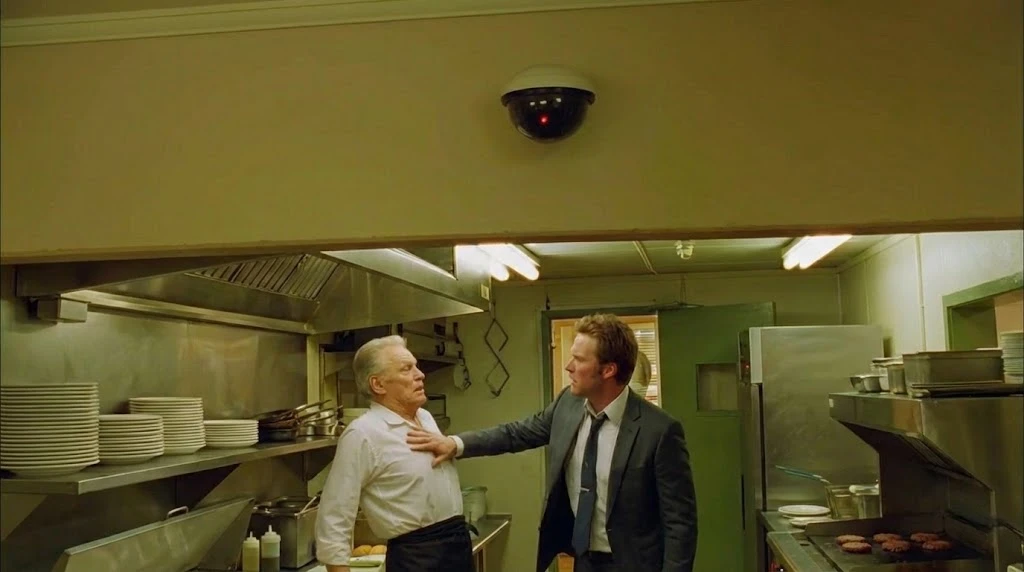
“I said clock out.” Dane stepped closer again. His hand shot out — not a punch, not exactly, more a shove, a hard flat-palmed push at Walter’s chest. “Get out of my kitchen.”
Walter stumbled back. His lower back hit the edge of the counter. Hard.
The pain was immediate and bright.
He grabbed the edge of the prep table to stay upright.
Nobody spoke.
The kitchen was silent except for the hum of the refrigerator units and the distant noise of the holiday party through the pass-through window.
Walter straightened up slowly. His eyes went to the upper corner of the kitchen wall — a habit from years of checking equipment.
The security camera was up there. The small one Patsy had installed in 2011 after a break-in. Walter had been the one to call the installer. He’d been the one to write down the access code in his notebook so it wouldn’t get lost.
The red indicator light was on.
It was always on.
Dane followed his gaze.
He looked at the camera.
Then back at Walter.
His face changed — the performance dropping away, something exposed underneath.
Walter said nothing. Just looked at Dane the way a man looks at something he’s already decided how to handle.
“This changes nothing,” Dane said.
“I think it changes quite a bit,” Walter said.
“You were done here anyway. You’ve been documenting me, don’t think I don’t know that. Going through my office—”
“I’ve never been in your office.”
“The financials—”
Walter looked at him. “What financials?”
Dane stopped.
Something shifted in his eyes. The over-reach of a man who has just said something he didn’t mean to say.
Walter had been in the Army for six years before he started at Patsy’s. He knew what a man looked like when he’d just handed you something.
“I haven’t touched your financials,” Walter said carefully. “But now I’m wondering why you’d bring them up.”
Walter called his daughter that night from the parking lot.
She was a paralegal. Had been telling him for four months to document everything.
He told her about the shove. About the security camera. About Dane’s mention of financials.
She was quiet for a moment.
“The financials comment,” she said. “Do you know anything about how he’s been running the books?”
“I know what the register takes in each day. I’ve seen it for thirty-eight years.”
“And recently?”
Walter looked at the diner through the windshield. The holiday party was still inside. He could see shapes moving.
“Down,” he said. “Way down. But his car’s newer. He redid his apartment — I heard him mention it.”
“I’ll make some calls tomorrow,” his daughter said. “Don’t go back in tonight. And Walter?”
“Yeah.”
“You kept the notebook?”
“Every entry since August.”
“Good.” A pause. “I love you, Dad.”
“Love you too, sweetheart.”
He sat in the parking lot for a while longer. His back throbbed. He was seventy-one years old and he’d been shoved into a counter by a thirty-one-year-old who’d inherited something he never built and never understood.
He thought about the matchbook under the booth leg. The way Mrs. Kowalski liked her eggs. The thirteen minutes every morning.
He thought about thirty-eight years.
Then he started his car and drove home.
The next three months were a different kind of work.
Walter’s daughter filed a police report for the assault — Dane was cited, not arrested, but cited. The security camera footage helped. Walter had kept the access credentials in his notebook since 2011, and the footage — full and uninterrupted — showed everything that happened in that kitchen from the moment Dane walked in.
The labor board opened an investigation into Walter’s hours reduction and the write-ups. His notebook — dates, times, exact words — was, according to the investigator who called him, “unusually thorough documentation.”
“I was in the Army,” Walter said.
“It shows.”
The financial investigation took longer. But it started because Walter’s daughter knew someone who knew someone at the state revenue office, and a quiet tip about cash register discrepancies in a food service business is the kind of thing that gets looked at.
What they found was that Dane Holloway had been skimming from the register since month two. Not a lot at a time. Enough that it added up to just over $40,000 over fourteen months.
Patsy’s estate — which had a small board of trustees, an old family friend and an accountant — filed a civil suit the same week the criminal charges came through.
Walter didn’t go to the arraignment.
He heard about it from his daughter, who heard about it from the news — Dane Holloway, 31, charged with two counts of employee wage theft, one count of tax fraud, and one count of misdemeanor assault.
He was at home when she called. Making breakfast.
“They’re offering him a plea,” she said. “Restitution, suspended sentence, probation.”
“Will he take it?”
“His lawyer says yes.” She paused. “Also, the trustees want to talk to you.”
“About what?”
“About the diner. About what it looked like before he took over and what it might look like if someone who actually knew what they were doing was running it.”
Walter set down his spatula.
“I’m seventy-one,” he said.
“You’re in at 5:47 every morning.”
“That’s not—”
“Walter Greer.” His daughter’s voice was warm and firm at the same time, the voice she’d had since she was twelve and already the most sensible person in any room. “Would you please just go talk to them?”
He went.
The meeting was at a lawyer’s office downtown, which felt wrong — Patsy’s business had always been conducted at the diner, over coffee, with a handshake. But the world was different now.
The trustee was a man named Bernard who had known Patsy since high school. He had the look of someone who’d been losing sleep.
“We made a mistake,” Bernard said. “Letting Dane take it over without more oversight. Patsy wanted family involved, but—” He shook his head. “We should have known.”
“She believed in people,” Walter said. “That was her way.”
“We’ve had the books gone over. Front to back.” Bernard folded his hands. “Before Dane took over, that diner was clearing a consistent profit. Small, but consistent. He managed to undo thirty-eight years of goodwill in fourteen months.”
“I know.”
“We’d like to know if you’d consider a management role. Revenue sharing. Real authority over operations.” Bernard looked at him. “We want it to be Patsy’s again.”
Walter looked out the window at the street below. Ordinary Tuesday morning. People walking, cars moving, a city doing what it did.
He thought about 5:47.
He thought about the matchbook under the booth leg. Mrs. Kowalski’s eggs. The back booth. The coffee. All of it still there, under everything Dane had changed. Waiting.
“I’d need to hire back some people,” Walter said.
“Done.”
“The new menu goes. The machine goes. The old coffee comes back.”
“Agreed.”
“And I want it in writing that no one overrides me on operations without a full board review.”
Bernard smiled for the first time. “I think we can do that.”
Walter nodded.
“5:47 sharp,” he said. “Every morning.”
Dane Holloway took the plea.
Restitution: $40,000, to be paid to the estate over five years. Probation: three years. Community service: two hundred hours.
The assault citation resulted in a separate civil settlement — mediated, not public, but enough that Walter paid off the last of his daughter’s student loans and bought a new kitchen table.
He didn’t feel triumphant about it. Triumph felt like something for younger people, people with somewhere to go next.
What Walter felt was quieter than that.
He felt right. Like a thing that had been leaning the wrong way had been set back where it belonged.
He opened the diner on a Thursday morning in March.
He’d spent the previous two weeks doing it himself — cleaning out the new equipment, hauling back the old coffee urns from storage, replacing the ugly logo polos with white shirts and black aprons. Marcus came back. So did two of the other staff who’d left under Dane.
At 5:47, Walter turned the key.
He walked to the back booth. Checked the leg. Still loose.
He went to the stockroom, found a matchbook — same brand he’d always used — and folded a cardboard strip to the right thickness and wedged it under the leg.
He gave the table a push. Solid.
He started the coffee.
At 6:03, Mrs. Kowalski walked in.
She stopped in the doorway, taking in the room. The aprons. The urns. The smell of the coffee.
Then she walked to her usual seat at the counter, set her purse down, and said: “Over-easy, Walter.”
“Of course,” Walter said.
He cracked two eggs onto the grill.
Made them over-medium.
She left a four-dollar tip and told him he was the only one who ever got it right.
He smiled and cleared her plate and started getting ready for the next customer.
Outside, the morning moved on.
Inside, Patsy’s smelled like it was supposed to smell.
Like it had for thirty-eight years.
Like it would for however many years Walter had left — and he intended to use every single one of them.
Original fictional stories. AI-assisted creative content.