I was fourteen when I realized I might die in that house.
Not dramatically. Not suddenly. Just slowly, quietly, like a plant forgotten on a windowsill. The hunger had become so constant that I barely noticed it anymore. It was just there, gnawing at my insides, making my hands shake when I tried to write.
The kitchen was off-limits. Rick had installed a lock after I’d stolen a bag of chips two months ago. “You eat when we say you eat,” he’d told me, his breath hot against my face. My mother had stood in the doorway, saying nothing. She never said anything anymore.
I survived on scraps from school lunch, whatever I could pocket when no one was looking. Half-eaten sandwiches from the trash. Crackers from the food pantry at school. I wore baggy clothes to hide how thin I’d gotten, how my collarbones jutted out like wings trying to escape.
That night, I found the bread in the back of the pantry. Rick must have forgotten about it. It was covered in green mold, the smell sour and wrong. I stared at it for a long time, my stomach cramping. I cut away the moldiest parts with my fingernails and ate the rest.
It tasted like defeat.
I was still chewing when I heard the noise outside. A low whimper, almost human. I crept to the window and looked out. There, tied to the rusty fence post, was a dog.
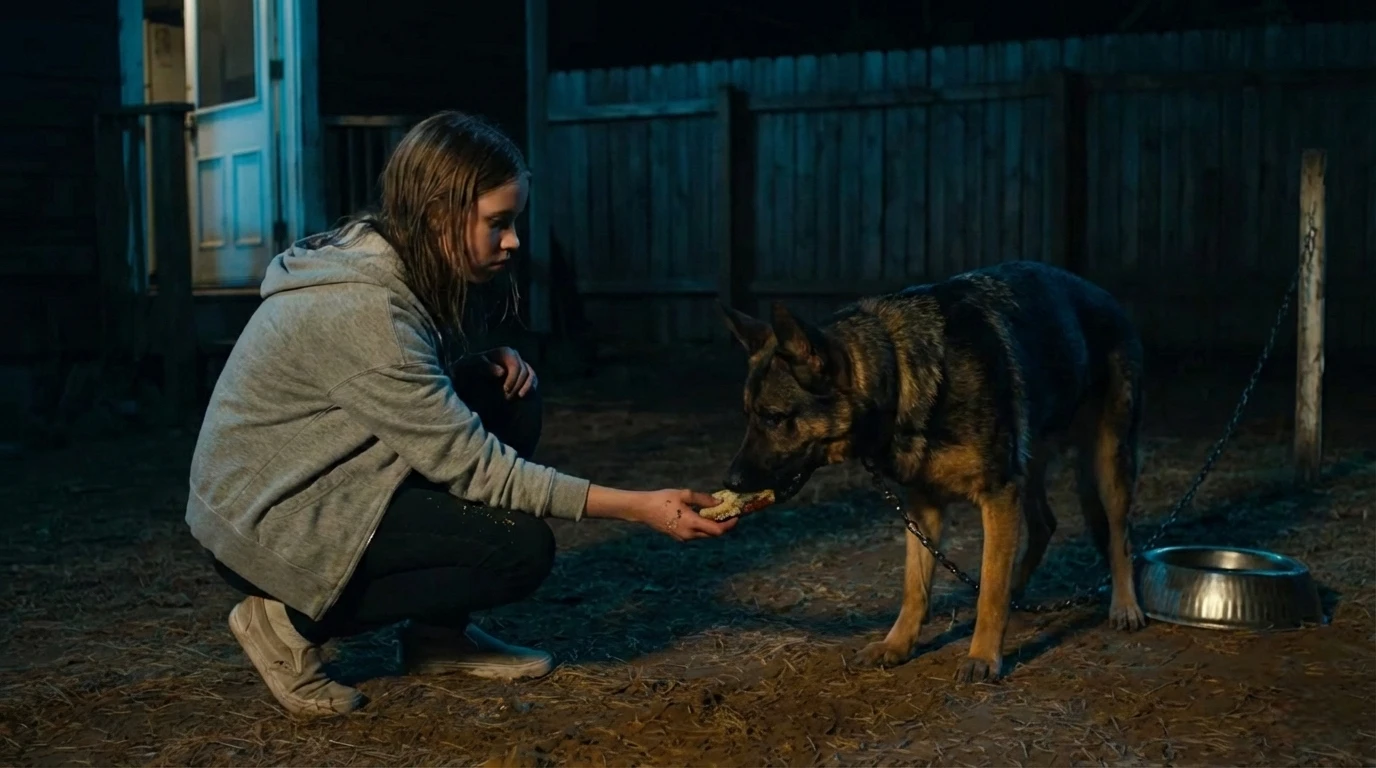
He was huge. Some kind of shepherd mix, with thick brown fur and eyes that glowed in the darkness. He was pulling at his chain, his water bowl overturned in the dirt. Rick had gotten him two weeks ago, said he needed a “guard dog.” But Rick didn’t take care of anything he owned.
I shouldn’t have gone outside. It was past midnight, and Rick’s truck was in the driveway. But something pulled me toward that dog. Maybe it was the look in his eyes. Like he understood what it meant to be trapped.
I filled a bowl with water from the hose and approached slowly. “It’s okay,” I whispered. “I won’t hurt you.”
He watched me carefully as I set the water down. Then his tail gave a single, tentative wag. I sat in the dirt beside him while he drank, his whole body trembling with relief.
“I’ll call you Brave,” I told him. “Because you’re still fighting.”
After that, I visited Brave every night. I snuck him food when I could, even though it meant I had less for myself. We’d sit together in the darkness, and for those few minutes, I wasn’t alone. He’d lick my hand, rest his head on my knee, and I’d tell him things I’d never told anyone.
“Rick hit my mother last night,” I whispered one evening. “She said she tripped.”
Brave’s ears flattened against his head.
“I think about running away,” I continued. “But I’m scared. I don’t know where I’d go.”
He pressed closer, as if he could absorb my fear.
The nights grew colder. Rick still kept Brave chained outside, even when it rained. I brought him blankets, old towels, anything to keep him warm. My mother noticed the missing items, but she didn’t say anything. She barely looked at me anymore.
One morning, I woke to shouting. I crept to the top of the stairs and peered down. Rick was dragging my mother across the living room by her hair.
“You think I’m stupid?” he screamed. “You think I don’t know you’ve been sneaking food?”
“I haven’t! Rick, please—”
“Liar!”
The sound of his fist hitting her face made me flinch. She crumpled to the floor, blood streaming from her nose. I wanted to run down, to help her, but fear kept me frozen. This was the worst I’d ever seen him.
Then I heard it. A deep, guttural growl from outside. Brave had broken his chain.
The window shattered as Brave launched himself through it. Glass exploded across the living room. He landed between Rick and my mother, his lips pulled back to show massive teeth.
“What the—” Rick stumbled backward.
Brave didn’t attack. He just stood there, a wall of fur and muscle and protective fury. His growl filled the room like thunder.
“Call 911,” I shouted to my mother. “Now!”
She scrambled for the phone, her hands shaking. Rick made a move toward Brave, and the dog snapped, his jaws closing inches from Rick’s hand.
“He’ll kill me!” Rick screamed. “Get that thing away from me!”
“Stay back,” I warned, walking slowly down the stairs. “Brave, it’s okay. Good boy.”
The dog’s ears swiveled toward my voice, but he didn’t move. He was still protecting my mother.
The police arrived eight minutes later. They found Rick cornered by a dog, my mother bleeding on the floor, and me standing in the doorway with my ribs showing through my shirt.
The female officer took one look at me and her expression hardened. “How long has this been going on?”
I wanted to lie. Lying had kept me safe for so long. But then I looked at Brave, at his fierce loyalty, his refusal to let harm continue, and something broke open inside me.
“Years,” I whispered. “It’s been years.”
They arrested Rick on the spot. Assault, child endangerment, animal abuse. The list kept growing. My mother was taken to the hospital. I was taken to the police station, wrapped in a blanket that smelled like disinfectant.
A social worker named Carol sat with me while I gave my statement. I told her everything. The hunger, the beatings, the nights I’d wished I could disappear. She listened without interrupting, her eyes bright with unshed tears.
“What about Brave?” I asked when I was finished. “The dog. What happens to him?”
Carol looked surprised. “The dog that attacked your stepfather?”
“He didn’t attack. He protected. There’s a difference.”
She studied me for a long moment. Then she made a phone call. Twenty minutes later, she came back with a smile.
“The shelter is willing to hold him until we figure out his placement,” she said. “But I have an idea. How would you feel about staying with a foster family? One that allows dogs?”
I felt something I hadn’t felt in a long time. Hope.
The foster home was nothing like I’d imagined. It was a small house on a quiet street, with flowers in the front yard and a worn welcome mat. Carol’s sister, Linda, answered the door with a warm smile.
“You must be Jamie,” she said. “Come in. Your room is upstairs.”
The room had yellow walls and a quilt on the bed. A desk by the window. Posters of art supplies on the walls. It was more than I’d ever had.
“Linda is an art teacher,” Carol explained. “She thought you might enjoy having space to paint.”
“I don’t know how to paint,” I said quietly.
Linda smiled. “Then we’ll learn together.”
Two days later, they brought Brave. He bounded into the house and went straight to me, his tail wagging so hard his whole body shook. I buried my face in his fur and cried for the first time since that night.
“Thank you,” I whispered. “You saved me.”
The first weeks were hard. I flinched at sudden movements. I hoarded food in my room, unable to believe it would be there tomorrow. I woke up screaming from nightmares, convinced Rick was coming through the door.
But Linda was patient. She never raised her voice. She never made me feel broken. When I couldn’t eat dinner, she packed it up and left it in the fridge with a note: “Here when you’re ready.”
She introduced me to art slowly. First with coloring books, then with watercolors, finally with acrylics and canvases. She showed me how to mix colors, how to let the brush follow my feelings rather than my thoughts.
“Art isn’t about being perfect,” she told me one afternoon. “It’s about being honest.”
I painted my first real picture that day. It was dark, full of sharp angles and storm clouds. But there, in the corner, was a small light. A window. A way out.
Linda hung it on the wall of my room.
School was harder. The other kids sensed something was different about me. I was too quiet, too watchful. I ate lunch alone in the art room, where the teacher, Ms. Rodriguez, let me work on projects in peace.
“You have talent,” she told me one day, studying a charcoal drawing I’d made of Brave. “Have you thought about entering the youth art competition?”
“I’m not good enough,” I said automatically.
“Says who?”
I didn’t have an answer.
Ms. Rodriguez sat down beside me. “You know what makes great art? Truth. And you, Jamie, know more about truth than most people twice your age.”
That night, I started a new painting. This one was different. It showed a girl, thin and broken, standing in a dark room. But in the doorway stood a massive dog, and beyond him was light. So much light it spilled across the canvas like water.
I called it “Guardian.”
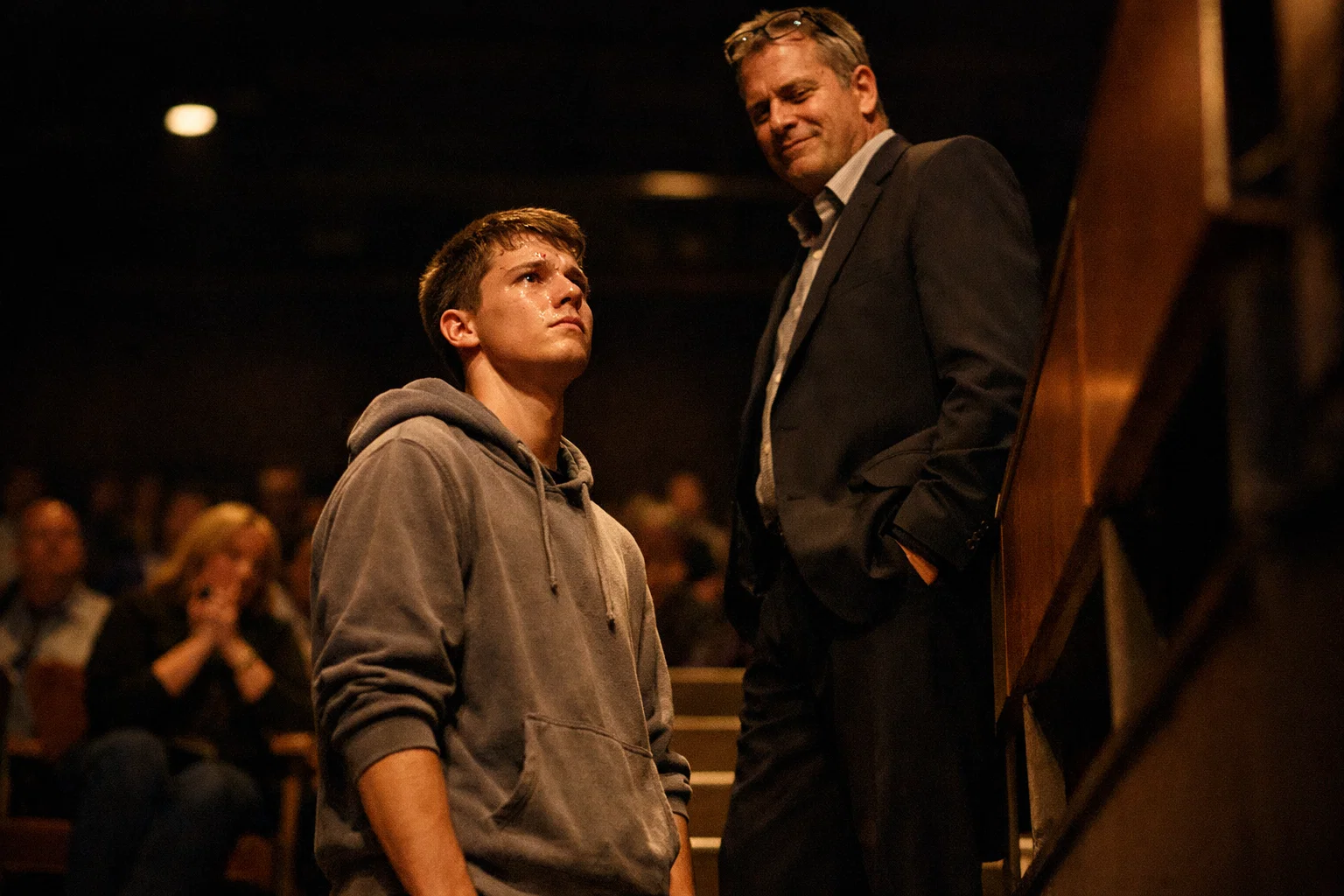
Three months later, “Guardian” won first place in the youth division. I stood on a small stage in the community center, holding a ribbon and a check for five hundred dollars, while people I didn’t know applauded. Linda was crying in the front row. Brave was waiting for me at home.
The local newspaper wanted to interview me. They asked about my inspiration.
“I wanted to show that salvation can come from unexpected places,” I said carefully. “That sometimes the ones who save us aren’t people at all.”
The article ran on the front page. Someone from a national dog rescue organization read it. They called Linda, asked if they could feature Brave’s story in their newsletter. They wanted to use my painting.
“It’s your decision,” Linda said. “Your story, your art.”
I thought about all the kids out there living in darkness. Maybe my story could be a light for them.
“Okay,” I said. “But I want to add something.”
I wrote a note to go with the painting: “To anyone who needs to hear this—you are not alone. You are not invisible. And you are not beyond saving. Hold on. Your Brave is coming.”
The newsletter went out to thousands of people. Donations poured in. The rescue organization used the money to save dozens of dogs, many from situations like Brave’s.
But something else happened too. Letters started arriving for me. From kids, from adults, from people who’d survived their own hells and wanted me to know I wasn’t alone.
One letter stood out. It was from a girl my age named Emma.
“I read your story,” she wrote. “I’ve been living with my dad’s girlfriend for two years. She locks me in the basement when he’s at work. I’m writing this from the school library. I don’t know who else to tell.”
I showed the letter to Linda. She called the police immediately. They investigated. Emma’s situation made the local news.
She was removed from the home within a week.
Emma wrote to me again after she was placed with a kind foster family. “You saved me,” she said. “Because you were brave enough to tell the truth.”
I kept that letter in my desk drawer. On the hard days, when the nightmares came back or the anxiety got too loud, I’d read it and remember: my pain had purpose.
The legal case against Rick took months. My mother was charged too, with child endangerment and failure to protect. She pleaded guilty, got probation and mandatory therapy. She wrote me letters I didn’t read.
Rick went to trial. I had to testify. Linda sat in the courtroom with Brave, who wore a service dog vest so he could be there. Every time I looked at him, I felt stronger.
“Tell us what happened the night of November 12th,” the prosecutor said.
I took a deep breath. “I’d been living on scraps for months. Rick had locked the kitchen. That night, I found moldy bread and ate it. Then I heard Brave outside, and I went to give him water. He was tied up, no shelter, no food. I started visiting him every night.”
I told them everything. The hunger. The fear. The night Rick attacked my mother and Brave broke free to protect us.
“Why didn’t you tell anyone sooner?” the defense attorney asked.
“Because I thought no one would believe me,” I said. “Because I thought I deserved it. Because I was scared.”
“And now?”
“Now I know I was wrong. I didn’t deserve it. And staying silent was slowly killing me.”
The jury deliberated for three hours. Rick was found guilty on all counts. He was sentenced to fifteen years.
When the verdict was read, I felt Brave’s nose push into my hand. I looked down at him, at his steady brown eyes, and I understood something fundamental: courage isn’t the absence of fear. It’s deciding that something matters more than being afraid.
My mother tried to contact me after the trial. Linda said it was my choice whether to respond.
“She let it happen,” I told Linda one night. “She chose him over me.”
“Yes,” Linda said simply. “She did. And that’s something she’ll have to live with.”
“Will I ever stop being angry?”
“Maybe. Maybe not. But anger is just the surface. Underneath is grief. For the mother you needed and didn’t have. For the childhood that was stolen. That grief is worth feeling, Jamie. It’s proof you deserved better.”
I started therapy with a woman named Dr. Martinez. She specialized in trauma. She taught me about PTSD, about triggers and coping mechanisms. She helped me understand that healing isn’t linear, that some days I’d feel strong and others I’d feel broken, and both were okay.
“You’ve been in survival mode for years,” she explained. “Now you’re learning to live. That’s a completely different skill set.”
I learned to live in small moments. Morning coffee with Linda while we planned my day. Art class with Ms. Rodriguez, who became a mentor. Walks with Brave, who never left my side.
I made a friend at school. Her name was Sophie, and she was loud and fearless and everything I wasn’t. She didn’t know my story at first. She just liked that I could draw her portrait during lunch.
“You’re really talented,” she said, studying her picture. “Have you thought about art school?”
“I don’t know if I’m college material,” I said.
“Are you kidding? You’re already better than half the students at the community college where my sister goes. You should apply.”
The idea terrified me. But Sophie kept pushing, and eventually, I filled out the application. I submitted my portfolio—including “Guardian”—with shaking hands.
Three months later, I got my acceptance letter.
I was eighteen now, technically an adult. Linda had agreed to continue being my guardian until I finished school. “You’re stuck with me,” she joked. But I saw the love in her eyes. She’d become more than a foster parent. She’d become family.
College was overwhelming at first. So many people, so much noise. But I found my rhythm. I took classes in painting, sculpture, graphic design. I worked part-time at the campus bookstore. I joined an art collective that created murals for community centers.
And everywhere I went, Brave came too. He was my certified service dog now, trained to help with anxiety and PTSD. He could sense when a panic attack was coming and would lean against me, grounding me, until it passed.
One day, a professor pulled me aside after class. “I’ve been watching your work,” she said. “You have something rare—the ability to put pain on canvas without letting it consume the viewer. Have you considered entering the National Emerging Artists Competition?”
“I don’t think I’m ready for that,” I said.
“I think you’re more ready than you know.”
I created a series for the competition. Five paintings, all connected. They showed a journey from darkness to light, from captivity to freedom. The final painting showed a girl and a dog standing at the edge of a vast, open field, the sun rising behind them.
I called the series “Breaking Free.”
It won.
The prize was a solo exhibition at a gallery in the city and a ten-thousand-dollar scholarship. The exhibition opening was packed with people who wanted to meet the artist, to hear the story behind the work.
I stood in the center of the gallery, Brave at my side, and I realized something profound: I wasn’t defined by what had been done to me. I was defined by what I’d survived, what I’d created, what I’d become.
A woman approached me, her eyes red from crying. “Your work saved my life,” she said. “I was planning to end things. But then I saw your painting, read your story, and I realized—if you could survive, maybe I could too. I checked myself into treatment the next day.”
I didn’t know what to say. I just hugged her.
That night, sitting in my tiny apartment with Brave curled at my feet, I thought about the girl I’d been. Starving, scared, convinced she was worthless. I thought about the moment Brave had burst through that window, refusing to let harm continue. About all the people who’d helped me piece myself back together.
I opened my laptop and started writing. Not a painting this time, but words. My full story. Every horrible, hopeful, heartbreaking moment.
I posted it online with a simple caption: “To anyone who feels invisible—you matter. Your story matters. And the world needs your light. Don’t give up.”
The response was overwhelming. Thousands of comments from survivors, from people still trapped, from those who’d found their way out. My story became a lifeline, a reminder that escape was possible.
A publisher reached out. They wanted to turn my story into a book, with my paintings included. They wanted to donate proceeds to child abuse prevention organizations.
“It’s your choice,” Linda said. “No pressure.”
I thought about Emma, about the woman at the gallery, about all the people who’d told me my story had saved them.
“I’ll do it,” I said. “But I want to add a section about healing. About what comes after you escape. Because survival is just the beginning.”
The book took a year to write. It was painful, dragging up memories I’d worked hard to bury. But Dr. Martinez helped me through it, reminding me that testimony is power, that sharing our stories robs trauma of its hold over us.
On the day the book was published, I stood in a bookstore holding a copy with my name on the cover. Linda was there, Sophie, Ms. Rodriguez, Carol. And Brave, of course.
“You did it,” Linda whispered. “I’m so proud of you.”
I looked at the book’s dedication page: “For Brave, who taught me that loyalty is fierce, love is action, and courage is contagious. And for every child still waiting to be saved—your story isn’t over yet.”
The book became a bestseller. I did interviews, spoke at conferences, visited schools. Everywhere I went, I brought the same message: “You are not your trauma. You are your courage. You are your resilience. You are your ability to keep going, even when it’s hard.”
I started a foundation with the book proceeds. We provided art therapy programs for kids in foster care, funded trauma-informed training for social workers, and helped rescue organizations save animals from abuse situations. We called it “The Brave Project.”
One day, I got a call from Carol. “Remember Emma?” she asked. “The girl who wrote to you after the newsletter?”
“Of course.”
“She’s graduating high school. She wants to thank you in person.”
We met at a coffee shop. Emma was taller now, confident. She had college acceptance letters and a future that sparkled with possibility.
“I wouldn’t be here without you,” she said. “You showed me it was okay to ask for help.”
“You saved yourself,” I corrected. “You were brave enough to reach out. I just… I was there.”
“That’s all I needed,” she said. “Someone to be there.”
Years passed. I graduated from art school. Got my own studio. Exhibited internationally. But my favorite work was always the pieces I made for The Brave Project—murals in shelters, paintings for auction to fund rescue efforts, portraits of survivors who wanted their strength documented.
I met someone. A kind man named David who worked at an animal sanctuary. He understood trauma; he’d survived his own. He loved that Brave still slept between us at night, that I needed time and patience and sometimes just silence. We got married in Linda’s backyard, with Brave as our ring bearer.
My mother wrote to me occasionally. Short letters, stilted apologies. I didn’t respond for a long time. But eventually, with Dr. Martinez’s guidance, I agreed to a supervised meeting.
She’d aged. Gray hair, tired eyes. “I don’t expect forgiveness,” she said. “I just wanted you to know I’m sorry. Every day, I’m sorry.”
“I needed a mother,” I told her. “And you chose not to be one.”
“I know.”
“I’ve built a life without you,” I continued. “A good life. And I did it because people who were strangers showed me more love than you ever did.”
She nodded, tears streaming down her face.
“But,” I said slowly, “I’m tired of carrying this anger. It’s heavy. So I’m putting it down. Not for you. For me.”
It wasn’t forgiveness. Not yet. Maybe never. But it was release. I left that meeting feeling lighter, freer.
Brave’s muzzle went gray. He slowed down, slept more. The vet said we had maybe a year. I spent that year making sure he knew he was loved. We took slow walks. I painted his portrait a dozen times. I told him stories about all the lives he’d touched.
“You’re a hero,” I whispered, scratching behind his ears. “Do you know that?”
His tail gave a weak wag.
When the time came, I held him while he took his last breath. David was there too, and Linda, and Sophie. We all loved this dog who’d refused to let me be invisible.
I buried him in Linda’s backyard, under the oak tree where we used to sit. I planted wildflowers on his grave. And I painted one final portrait—Brave as I liked to remember him. Strong, fierce, loyal. Bursting through that window to save my life.
I donated the painting to a children’s hospital. Below it, I placed a plaque: “In memory of Brave, who taught us that heroes come in all forms, and love is the greatest protection we have.”
Life goes on. That’s what people say, and it’s true. I have my art, my foundation, my family. I have students now—kids I mentor through The Brave Project, teaching them that their pain can become power, their stories can heal others.
But sometimes, on quiet mornings when the light slants through my studio windows just right, I swear I feel him. A warm presence at my side. That steady loyalty that saved my life and taught me everything worth knowing about courage.
I’ll carry him with me forever. Not as a wound, but as a reminder: we are all capable of fierce love. We are all capable of breaking free. We are all capable of being someone else’s Brave.
And that, I think, is the greatest gift of survival—the chance to be for others what we needed most. To stand between harm and the vulnerable. To refuse to look away. To be the window that shatters, the light that guides, the love that saves.
My story didn’t end in that house with moldy bread and locked doors. It began there. And every day, I choose to write the next chapter. Not with pain, but with purpose. Not with fear, but with hope. Not as a victim, but as a survivor who became a warrior.
Because of a dog who taught me what it means to be brave.
Original fictional stories. AI-assisted creative content.