Daniel Carter sat in his wheelchair outside the closed deli on West Madison, cardboard sign propped against the wheel. Six years since the accident. Six years of doctors using words like “permanent” and “irreversible.”
The afternoon sun beat down on cracked pavement. Traffic roared past. Nobody looked at him anymore.
Then she appeared.
A girl, maybe thirteen, barefoot on the scorching concrete. Torn brown dress hanging off her thin shoulders. Dirt smudged across her cheeks. But her eyes—calm, steady, like she knew something the rest of the world had forgotten.
She stopped directly in front of his wheelchair.
“You’re hungry,” she said. Not a question.
Daniel’s throat tightened. “We both are, kid.”
She glanced at the half-wrapped turkey sandwich sitting on his lap. His only meal. The one he’d been rationing since yesterday.
“Give me that,” she said, “and I’ll help you.”
Daniel laughed—bitter, automatic. “Help me how? You got a miracle in your pocket?”
“Something like that.”
Her voice didn’t waver. Didn’t beg. Just stated it like fact.
Daniel studied her face. No con artist smile. No desperation. Just certainty.
His hand shook as he held out the sandwich.
She took it like it was sacred. Like he’d just handed her the most valuable thing in the world.
“Thank you,” she whispered.
Then she looked down at his legs. For a long moment, she just stared.
“They’ll heal,” she said quietly. “Sooner than you think.”
She smiled—soft, genuine—and turned away.
“Wait!” Daniel called out. “What’s your name?”
But she was already gone, disappearing into the lunch crowd like smoke.
Daniel sat there, heart pounding in his chest. His legs felt… different. Not normal. But different. A faint warmth spreading through his calves where there’d been nothing but dead weight for six years.
“I felt something,” he whispered to the empty street.
He gripped his knees. Felt the warmth again. Fleeting. Impossible.
Maybe hunger was finally breaking his mind.
The next evening, Daniel was heating canned soup on his hot plate when someone knocked.
Nobody ever knocked.
He wheeled to the door, heart hammering. Looked through the peephole.
The girl stood there. Same torn dress. Same bare feet. Completely dry despite the rain hammering the street behind her.
Daniel opened the door.
“You came,” he breathed.
“You gave me food when you had nothing,” she said simply. “That matters.”
She walked into his studio apartment without waiting for permission. Took in the bare walls, the mattress on the floor, the single lamp casting shadows across peeling paint.
“You live alone,” she observed.
“Six years now. Since the accident.”
She turned to face him. “What happened?”
“Construction site. Beam fell. Crushed my spine. Doctors said I’d never walk again.”
“They were wrong.”
Daniel’s laugh came out sharp. “Kid, I appreciate the optimism, but—”
“Stand up.”
The room went silent except for rain drumming against the window.
“I can’t,” Daniel said.
“Yes, you can.” She walked closer, crouched in front of his wheelchair. “You’re just afraid of what it means if you try and fail again.”
Her words hit like a punch to the chest.
“I’ve tried,” he whispered. “Physical therapy. Experimental treatments. I’ve tried everything.”
“You haven’t tried believing.” She placed both hands on his knees. “Close your eyes.”
“This is insane.”
“Close them.”
Daniel closed his eyes.
Heat exploded through his legs—sharp, electric, alive. He gasped, gripping the wheelchair arms. Every nerve ending from his hips to his toes suddenly screaming after six years of silence.
“What are you doing?” he choked out.
“Reminding your body what it forgot.” Her voice stayed calm. “Now breathe. Feel it.”
The pain shifted. Changed. Became something else.
Warmth. Strength. Connection.
Daniel’s toes curled inside his worn sneakers.
His eyes flew open. “Oh my God. I just—did you see that? My toes moved!”
“I know.” She stood up, stepped back. “Now stand.”
“I don’t know if I—”
“You can. Push.”
Daniel planted his hands on the armrests. His legs trembled violently. Muscles that hadn’t fired in six years suddenly remembering their purpose.
He pushed.
His body rose.
Inch by inch, his legs straightened, held.
For five seconds, Daniel Carter stood.
Then his knees buckled and he collapsed forward. The girl caught him, impossibly strong for someone so small, lowering him to his knees on the floor.
Daniel sobbed. Laughed. Pressed his palms flat against the ground like he needed to feel something solid.
“I stood,” he gasped. “I actually stood.”
When he looked up, she was backing toward the door.
“Wait!” He scrambled forward on his knees. “Who are you? How did you—what just happened?”
She paused at the threshold, one hand on the doorframe.
“My name doesn’t matter,” she said. “What you do with this matters.”
“Do with what? I stood for five seconds!”
“Tomorrow it’ll be ten. Next week, you’ll walk to the corner. Next month, you’ll run.” Her eyes held his. “The question is: what will you do when you can?”
“I don’t understand.”
“You will.” She stepped into the hallway. “When you figure it out, you’ll know where to find me.”
The door clicked shut.
Daniel knelt on the floor of his empty apartment, rain pounding against the window, legs trembling with exhaustion and possibility.
The next morning, he stood for twenty seconds.
By afternoon, he took three steps before collapsing.
His landlord found him in the hallway, called an ambulance thinking he’d overdosed or had a psychotic break.
EMTs rushed him to County General. Ran every test in the book.
Dr. Chen stood at the foot of his bed, staring at the scans like they’d personally offended her.
“This doesn’t make sense,” she said. “Your MRI from six months ago showed severe spinal damage. Irreversible trauma.”
“And now?” Daniel asked.
“And now you have full nerve function. Complete motor control. Like the injury never happened.”
“So I can walk?”
Dr. Chen set down her clipboard. “Mr. Carter, according to medical science, you shouldn’t be able to feel your legs, let alone move them. But yes. With physical therapy, you should be able to walk.”
Word spread fast.
By the next day, news vans crowded the hospital parking lot. Reporters with cameras. Bloggers with phones. Everyone wanting to know about the homeless man who’d beaten paralysis overnight.
“Miracle recovery,” the headlines said.
“Unexplainable,” the doctors admitted.
Daniel smiled through every interview, but inside, he was screaming one question:
Where was she?
He spent three weeks in physical therapy, relearning how to walk. His muscles remembered faster than anyone expected. By week two, he was walking the length of the hospital hallway.
By week three, he walked out the front doors and into the Chicago sunlight.
The first thing he did was search.
He walked to West Madison. Showed her sketch to every person sitting on the sidewalk, every shop owner, every cop on the beat.
“Have you seen this girl?”
Nobody had.
He expanded his search. Shelters. Soup kitchens. Bus stations. Everywhere a homeless kid might go.
Nothing.
Until one night, frustrated and exhausted, Daniel found himself in the public library. He sat in the back corner, mindlessly flipping through old newspapers.
Then he saw it.
Page seven of a two-year-old edition. Local news section.
“GIRL, 13, DIES SAVING CHILD IN HIT-AND-RUN.”
The photo stopped his heart.
Same face. Same eyes. Same torn brown dress.
His hands went numb. The newspaper trembled.
Maya Rodriguez, age 13. Died pushing a six-year-old out of the path of a speeding car. The driver never stopped.
Daniel’s vision blurred. He read the article three times, hands shaking harder each time.
She’d died two years before his accident.
Two years before she’d stood in his apartment and made him walk.
“No,” he whispered. “No, that’s not possible.”
But the photo didn’t lie.
He kept reading.
“Witnesses say the girl whispered something before she passed away, but her words were inaudible.”
Daniel closed his eyes.
And suddenly, he heard it—the whisper from that night on the sidewalk, the one he’d thought was just traffic noise, now crystal clear in his memory:
“You’re not done yet.”
His breath caught.
Not done yet.
Daniel sat in that library until they announced closing time. Then he walked out into the Chicago night—walked, on legs that worked, on muscles that responded—and everything clicked into place.
She hadn’t just healed him.
She’d given him a purpose.
The next morning, Daniel showed up at the West Madison shelter. Asked to volunteer. Started bringing sandwiches to people sleeping under bridges. Stopped to talk to every homeless person he passed.
He didn’t preach. Didn’t lecture. Just listened.
Remembered their names. Asked about their stories. Treated them like human beings instead of invisible obstacles.
Within two months, he’d organized a clothing drive.
Within four months, he’d started a weekly meal service.
Within six months, local churches and community centers were calling him, asking how they could help.
“The Walking Man,” people started calling him. The guy who’d beaten paralysis and decided to spend his second chance helping others.
Daniel never corrected them about the nickname.
He just kept walking.
Three months later, Daniel organized a 5K fundraiser for spinal injury research. Two hundred people registered. Local news covered it. Someone donated fifteen thousand dollars.
The morning of the race, Daniel stood at the starting line, stretching legs that had been dead weight a year ago.
The gun fired.
He ran.
Not fast. Not graceful. But steady. Strong. Alive.
At mile two, his calves cramped. At mile three, his lungs burned. But he kept going.
As he rounded the final corner, the finish line came into view.
And there, standing at the edge of the crowd, he saw her.
Barefoot girl in a torn brown dress. Smiling.
Daniel’s heart stopped.
He blinked.
She was gone.
But in that split second before she’d disappeared, she’d nodded. Once. Slowly.
Like she was saying: You got it. You finally understand.
Daniel crossed the finish line with tears streaming down his face.
People cheered. Cameras flashed. Someone draped a medal around his neck.
But Daniel wasn’t thinking about the race.
He was thinking about a dead girl who’d given her last meal away before she died. Who’d saved a child she didn’t know. Who’d come back to save him, too.
Not just his legs.
His life.
That night, Daniel stood in his new apartment—the one he’d been able to afford after donations poured in—and looked at the photo he’d framed.
Maya Rodriguez. Age 13.
“Thank you,” he whispered.
The room stayed silent.
But somewhere, he swore he felt her smile.
Daniel kept walking.
Kept running.
Kept reaching out to people the world had taught him to ignore.
Because a girl who’d lost everything had seen something in him worth saving.
And he’d spend every single step of the rest of his life proving her right.
Six months later, the Walking Man Foundation opened its first community center on West Madison.
Free meals. Job resources. Medical care. Everything Daniel wished he’d had when he’d been sitting in that wheelchair, invisible and forgotten.
At the ribbon-cutting ceremony, someone asked him what inspired all this.
Daniel smiled.
“A girl once told me I wasn’t done yet,” he said. “Took me a while to figure out what she meant.”
“And now?”
Daniel looked out at the crowd—dozens of people who’d found hope in this building, in this community, in the simple act of being seen.
“Now I know,” he said. “I’m just getting started.”
That night, as Daniel locked up the center, he found something on the front step.
A small wrapped sandwich.
Still warm.
No note. No explanation.
Just a sandwich.
Daniel picked it up, heart pounding, and looked up and down the empty street.
Nothing but streetlights and shadows.
But he knew.
She was still walking beside him.
And she always would be.
Daniel smiled, unwrapped the sandwich, and took a bite.
Then he kept walking.
Because he wasn’t done yet.
Not even close.
VIDEO PROMPT:
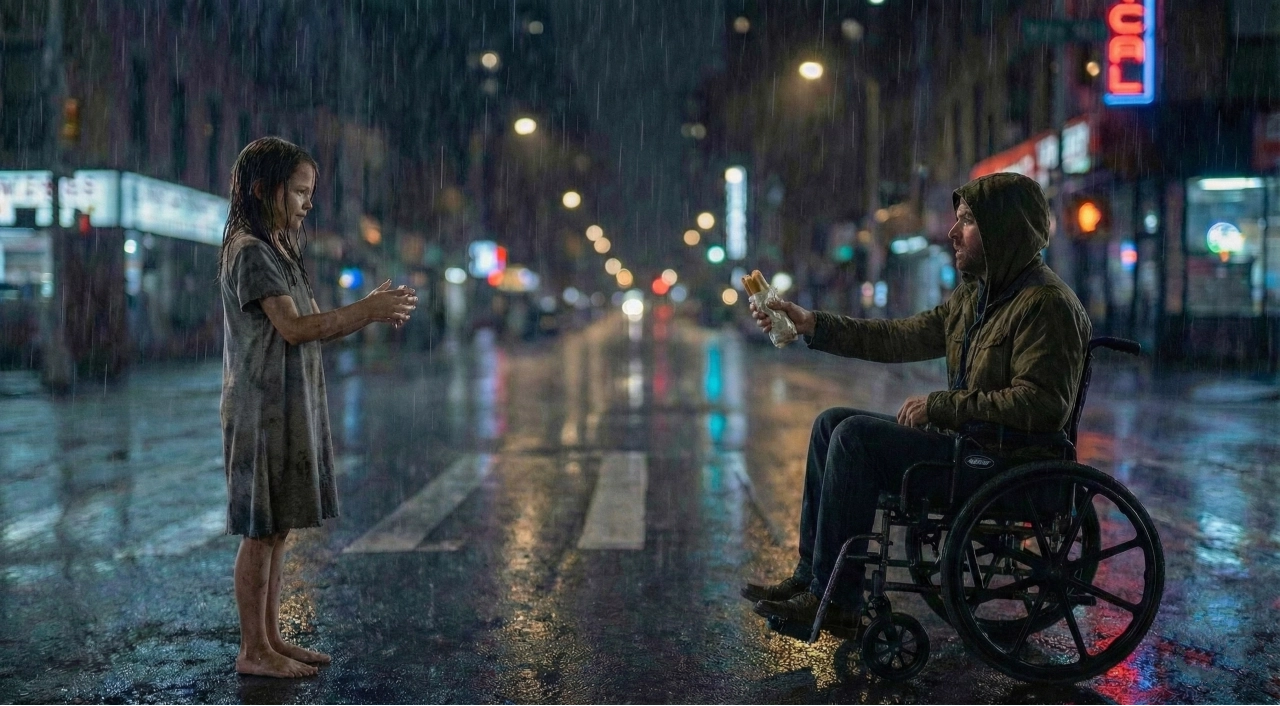
A dimly lit American city street at night, rain-slicked pavement reflecting streetlights. A middle-aged white American man in a wheelchair sits outside a closed storefront, worn jacket pulled tight against the cold. In front of him stands a young white American girl, barefoot, wearing a tattered brown dress, her face smudged with dirt but her eyes strangely calm.
The man extends a wrapped sandwich with a shaking hand. The girl takes it gently with both hands and looks at him. “Thank you,” she says softly, then smiles warmly. Her eyes drop down to his legs for a moment. She looks back up at his face and adds, “Your legs will heal soon.” She gives him another sweet smile.
The girl turns and begins walking away from the wheelchair. She takes several steps backward into the street, moving away from the man. As she steps back, she enters the darker area of the street, shadows falling across her face and body until she disappears into the darkness.
Close-up on the man’s face—his eyes wide with shock and disbelief. His hands move down to grip his legs. “Wait—I feel something, in my leg” he says, voice shaking. He stares down at his knees, hands trembling as he touches them.
Rain continues falling around them, puddles rippling on the pavement.
No logos, no brand names, no signage, no watermarks, no text overlays. Cinematic realism, grounded tone, no subtitles.
Original fictional stories. AI-assisted creative content.