The night Marcus Chen almost didn’t come.
He’d told his assistant three times he was skipping the gala. Black-tie events. Five-hundred-dollar plates. Polished people writing polished checks. He’d done it a hundred times. It never felt like enough.
But she’d looked at him over her glasses and said, “You haven’t left the house for a fundraiser in two years, Mr. Chen. Daniel would’ve wanted you to go.”
He’d put on the suit.
The auction hall was everything these things always were. Silk drapes. Champagne. Modern art that cost more than most people’s houses. The kind of wealth that was so comfortable with itself it didn’t need to announce anything.
Marcus found a seat in the front row and said nothing to anyone.
The auctioneer was mid-sentence about a vintage 1952 Gibson acoustic—authenticated, estate collection, opening bid at forty thousand—when the room shifted.
Not all at once. Just a ripple.
A whisper near the back entrance. Then another.
Then heads turning.
Marcus turned too.
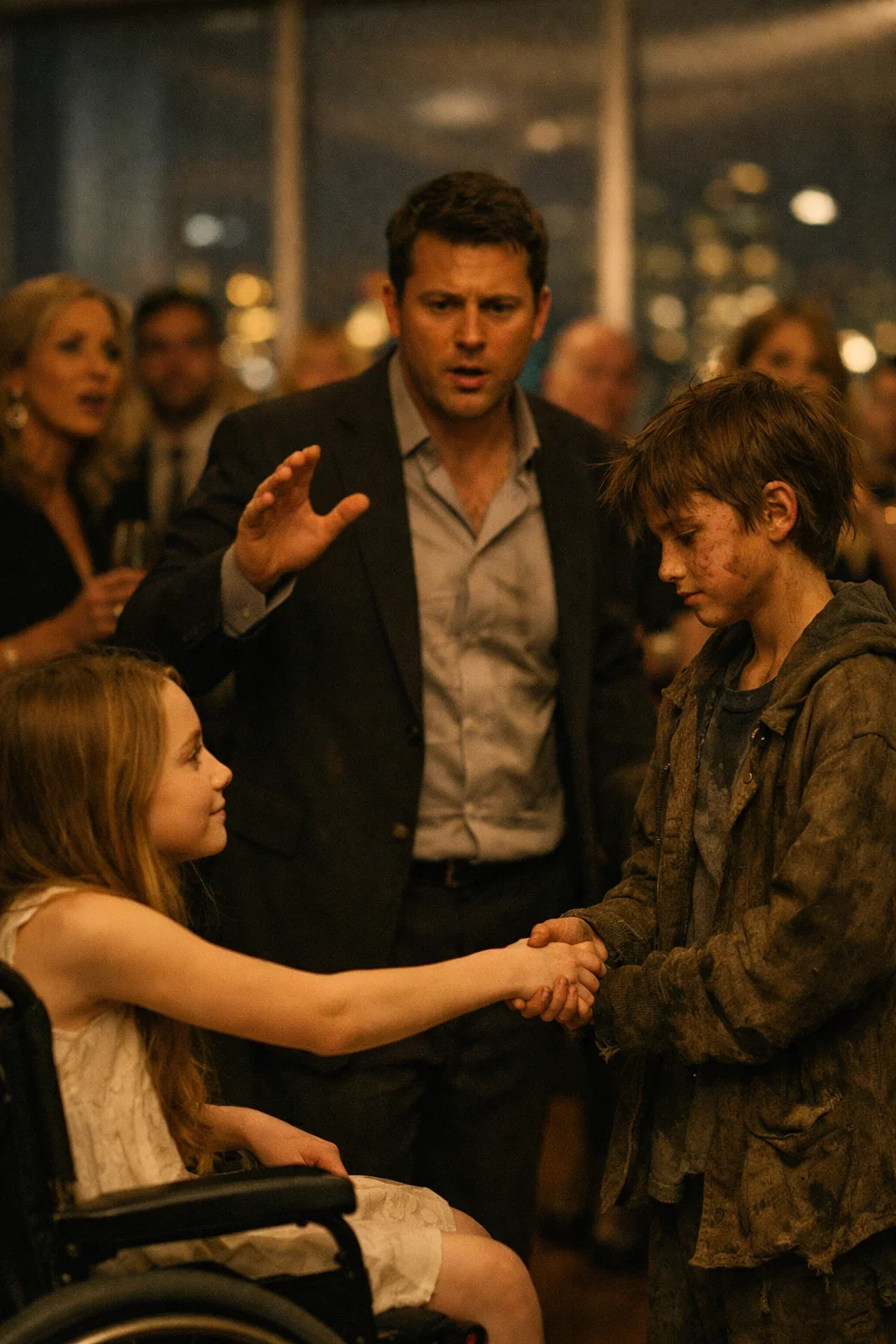
The boy was maybe thirteen. Possibly younger—hard to tell when someone was that thin. His jacket was three sizes too big, navy blue with a broken zipper, the collar stained gray. His jeans were torn at both knees. His sneakers were held together with duct tape wrapped twice around the left toe box. His face was smudged with something—grease, or dirt, or both.
He was standing perfectly still at the back entrance, looking out at the crowd like he hadn’t expected there to be so many of them.
Two security guards were already moving.
“Hold on.” The boy’s voice cracked on the second word. He raised one hand, palm out. “Please. I’m not here to cause trouble. I can sing. For food. That’s all I’m asking.”
The woman beside Marcus whispered to her husband, something sharp and scandalized. A man in the third row laughed quietly—the kind of laugh that meant discomfort, not amusement. Several guests had their phones out already, pointed at the boy like weapons.
The lead security guard—big guy, wide shoulders, radio clipped to his belt—reached the boy in six steps and closed a hand over his shoulder.
“Son, you need to—”
“Let him try.”
Marcus hadn’t planned to say it. He was surprised to find he was already standing.
The room went quiet in that way large rooms do when someone unexpected speaks with complete certainty.
The auctioneer blinked. “Mr. Chen—”
“Give him the microphone.”
There was a beat. Two beats. Then the auctioneer stepped down from the stage and unclipped the handheld mic from its stand. It passed through three sets of hands, each person looking slightly dazed, until it reached the back of the room.
Until it reached the boy.
He held it like he wasn’t sure he was allowed to.
Marcus walked toward him slowly, the crowd parting. He stopped about six feet away and kept his voice low.
“What’s your name?”
“Elijah.”
“How old are you, Elijah?”
A pause. “Twelve. Thirteen in March.”
“Okay.” Marcus nodded once. “Sing whatever you want. Nobody’s going to stop you.”
The security guard looked at Marcus. Marcus looked back. The guard stepped away.
Elijah stared at the microphone.
For a long moment, nothing happened. The gala crowd held their collective breath in that particular way—half pitying, half curious, entirely ready to be either impressed or vindicated.
Then Elijah closed his eyes.
And he sang.
It was an old gospel hymn. Nothing showy. Nothing contemporary. The kind of song that didn’t have a key change or a big finish, just a long, aching melody that felt like it had been walking a very long road.
His voice was raw. Untrained. He breathed in the wrong places. He dropped notes at the end of phrases the way a person does when their throat is too tight to hold them.
None of that mattered.
The sound that came out of Elijah was the sound of someone who had been through things a thirteen-year-old had no business being through and was still, somehow, singing about it. Not performing. Not competing. Just—telling the truth.
A woman near the stage pressed both hands over her mouth.
A man in the corner near the bar turned slowly to face the wall, his shoulders moving.
The auctioneer set his notes down on the podium. He didn’t pick them up again.
Marcus stood absolutely still. His jaw was locked. His eyes were burning.
Because he knew that hymn.
His son Daniel used to hum it in the back seat of the car. Badly, usually. Off-key and distracted, some half-remembered melody from the one Sunday Marcus had taken him to his grandmother’s church when Daniel was nine. Marcus had teased him about it. “You sound like a rusty door,” he’d said. Daniel had grinned. “Yeah but I feel good doing it, so.”
Marcus pressed the back of his hand to his mouth.
Elijah held the final note longer than it seemed like his lungs could manage, and when it fell away, the silence that followed had actual weight.
Nobody moved.
Nobody spoke.
Then the woman near the stage started crying outright—not delicately, not politely, just crying—and somehow that broke the spell.
Marcus walked forward.
The crowd moved back without being asked. He crossed the length of the room and when he reached Elijah, he stopped. The boy opened his eyes. He was bracing himself—Marcus could see it. Shoulders tight. Chin up. Whatever comes next, I can take it.
Marcus put both arms around him and pulled him in.
Elijah went rigid. Every muscle seized.
Then something cracked open.
He made a sound Marcus had heard once before, from Daniel, at seven years old, when he’d fallen off his bike and tried so hard not to cry that the first sob came out like something tearing. The sound of someone who has been holding it together for a very long time and suddenly doesn’t have to.
Marcus held him tighter.
“My son,” he said. His voice had no shape left to it. “My son loved to sing.”
He pulled back enough to look at the boy’s face. His own eyes were wet. He didn’t bother with them.
“He died two years ago. Car accident. He was fourteen.”
Elijah stared at him. His face was doing five things at once.
“He had your voice,” Marcus said. “That same—” He stopped. Started again. “That same thing underneath it. Like you’re singing something that matters. Like it costs you something.”
“I’m sorry,” Elijah whispered. “About your son.”
“Yeah.” Marcus breathed out. “Me too.”
He turned to face the room. Five hundred people who had been waiting to see what happened next.
“This event raises money for youth programs,” he said. His voice was calm now. Steady. Billionaire mode, his assistant called it. The voice that closed things. “I’ve donated five hundred thousand dollars every year for the last decade.”
The auctioneer nodded, visibly relieved to be back on familiar territory.
“Tonight I’m doubling it.” Marcus paused. “One condition.”
The room leaned in.
“This boy gets a full scholarship. Music school—real music school, conservatory level if he wants it. Housing. Healthcare. A stipend. Everything.” He looked at Elijah. “And if he’ll allow me, I’d like to make sure he has somewhere permanent to live before the end of this month.”
Elijah’s mouth opened. No sound came out.
“You don’t have to decide tonight,” Marcus said quietly. “But I’d like to talk. If that’s okay.”
“I don’t—” Elijah’s voice broke. He tried again. “I don’t understand why.”
“Because my son would have wanted me to.” Marcus held his gaze. “And because I’ve spent two years sitting in that front row at every charity event in this city, writing checks and feeling absolutely nothing. And you just made me feel something. That’s worth more than I can put a number on.”
Elijah’s knees buckled.
Marcus caught him by the forearms, steadied him.
“Easy,” he said. “You’re okay. You’re okay now.”
The auction never resumed.
What happened instead was harder to describe. The room reorganized itself around Elijah the way water reorganizes around something dropped into it—not chaotically, but completely, every ripple purposeful.
A woman named Sandra Park, who had founded one of the city’s largest recording studios, walked up to Elijah with a business card and held it out with both hands.
“I heard you,” she said simply. “Call me Monday. We’ll talk about what comes next.”
A restaurant owner named Dom Ferretti pressed a roll of cash into Elijah’s hand and said, “Dinner tonight, wherever you want, whoever you want to bring. And if you don’t have somewhere to sleep, I have a spare room above the restaurant and my wife will be furious with me if I don’t offer it.”
A woman from a city council office pulled Marcus aside and said quietly, “We have a youth housing initiative that just got funded last week. I can make a call tonight. Tonight, Marcus, not tomorrow.”
Marcus said, “Make the call.”
A retired teacher who had come as someone’s plus-one found Elijah standing slightly dazed with the business card still in his hand and sat down next to him on the edge of the stage.
“Do you like school?” she asked.
Elijah blinked. “I used to. Before.”
“Before what?”
A long pause. “My mom got sick. Last year. We lost the apartment.” He looked at his sneakers. “I’ve been staying at the shelter on Dexter, but they close during the day so I just… walk around, mostly. I go to the library sometimes. They have heat.”
The teacher was quiet for a moment.
“What’s your favorite subject?”
Elijah looked at her sideways, like he was waiting for a catch. “History. And English. I like writing.”
“Of course you do,” she said. “You’re a storyteller. It comes out when you sing.” She opened her purse and found a small notebook—the spiral kind, barely used. She pressed it into his hands alongside a pen. “Start writing tonight. Whatever you’re thinking about. Don’t edit it. Just write it.”
Elijah turned the notebook over in his hands. He looked like he might say something. Instead he just nodded.
Marcus sat with Elijah for two hours that night.
They ate from the catering that nobody was touching anymore. Elijah ate like someone who had learned not to be precious about it—steadily, without comment, three plates. Marcus didn’t say anything about it. He just made sure the tray stayed close.
They talked. Elijah’s mother was in a recovery facility upstate, working through treatment. He called her every Sunday from the shelter’s phone when the line wasn’t too long. He hadn’t told her how bad things had gotten because she was already carrying enough.
“When did you last see her?” Marcus asked.
“Four months ago.” Elijah chewed. Swallowed. “She looked better. Less tired.”
“Are you in touch with her caseworker?”
“Sort of. She answers sometimes.”
Marcus took out his phone. “What’s her name?”
“Ms. Tran. Vivienne Tran.”
Marcus wrote it down. “I’ll have my team reach out tomorrow. We can arrange regular visits. Transportation, the whole thing. Supervised if necessary—whatever the facility requires.”
Elijah set down his fork. He looked at Marcus with an expression that was very old for twelve years old.
“Why are you doing all of this? You don’t know me. You didn’t know me three hours ago.”
Marcus considered the question seriously.
“No,” he said. “I didn’t.” He turned his glass slowly on the tablecloth. “My son died and I had more money than I could ever spend and a house I’d been living in for twenty years that suddenly felt like a waiting room. I’ve been going through the motions.” He met Elijah’s eyes. “You sang and I remembered what it sounds like when someone isn’t going through the motions. When something is real.”
Elijah was quiet.
“He was good?” he asked finally. “Your son. Was he a good singer?”
Marcus laughed—a real one, brief and rough.
“No,” he said. “He was terrible. Absolutely terrible. But he never cared. He just—sang anyway. All the time. In the car, in the shower, while he was doing homework. Drove his mother crazy.” His smile faded softly. “It was my favorite thing about him.”
Elijah nodded slowly. “My mom used to hum while she cooked. That’s where I learned that song. She’d hum it and I’d learn the words and then we’d do it together.” He picked up his fork again. “I thought if I could just get through it tonight without stopping, it would feel like she was there.”
Marcus pressed his lips together.
“Did it work?”
Elijah thought about it.
“Yeah,” he said quietly. “Actually, yeah. It did.”
There were things that happened in the weeks after the gala that Marcus’s assistant summarized in a briefing memo she titled simply: “The Elijah Situation (Updates).”
The youth housing initiative placed Elijah in a furnished apartment in a supervised transitional building within eleven days. It had a kitchen, a desk, and a window that faced east. Elijah reported to Marcus, in a text message sent from a phone Marcus had arranged, that he sat at the window every morning because the light was good.
Ms. Tran, Elijah’s mother’s caseworker, responded to Marcus’s team’s outreach within twenty-four hours. Transportation for monthly visits was arranged within the week. The first visit happened on a Tuesday. Elijah called Marcus that evening.
“She cried,” he said.
“Good crying or bad crying?”
A pause. “Both. I think both.”
“That sounds right,” Marcus said.
Elijah enrolled in the city’s premier youth music conservatory the following semester. His intake audition, which was technically a formality given the scholarship conditions, caused the program director to reschedule his afternoon.
He called Marcus afterward.
“Where has this kid been?” the director said. “His technique is raw, but his instinct is—I’ve been doing this for thirty years and I’m telling you, Marcus, his instinct is extraordinary. He’s going to work. He’s going to work like I’ve rarely seen a student work.”
“Good,” Marcus said. “That’s good.”
“He told me he’s writing songs already. He brought a notebook. Twelve songs. He’s been here two weeks.”
Marcus smiled at his desk.
“Yeah,” he said. “That sounds right too.”
Three months after the gala, the conservatory held its winter showcase.
Marcus wore a suit. His assistant had not needed to say anything about it. He went.
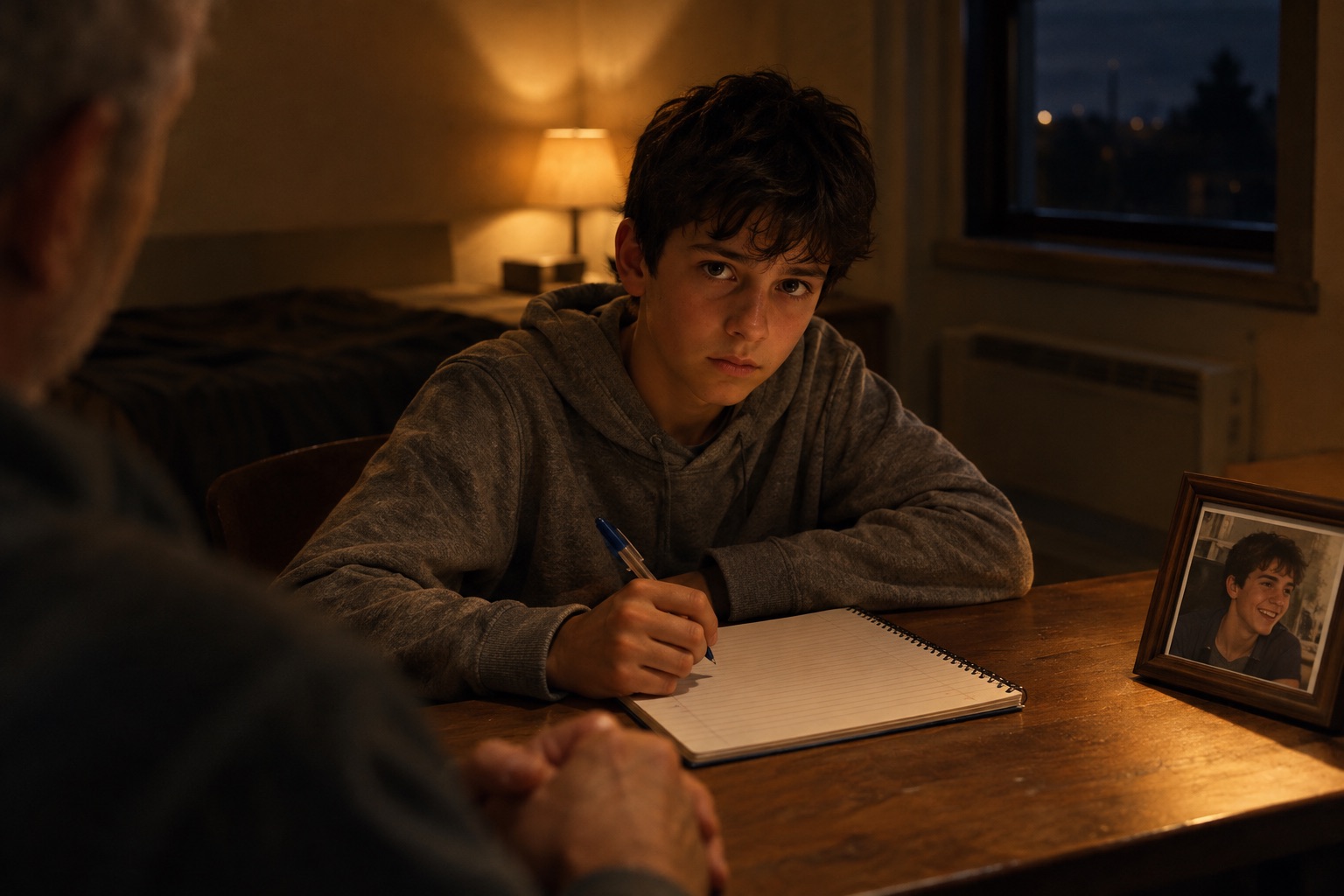
He sat front row center. On the seat beside him he placed a framed photograph—Daniel at twelve, grinning in the back of a car, mid-song, completely off-key, absolutely happy.
Elijah came out last.
He was wearing clothes that fit. His hair was cut. He stood at the microphone for a moment without touching it, looking out at the audience with the same stillness he’d had in that gala doorway—but different now. Not braced. Not waiting for something bad. Just present.
He sang a song he’d written.
It was about a boy who walked into a room where he wasn’t supposed to be and found out that the most broken person there had been waiting for him without knowing it. It was about grief being a door that doesn’t lock from the inside. It was about the way some people carry you forward without meaning to, and you carry them back.
It didn’t have a title yet.
Halfway through, a woman three seats down from Marcus started crying.
Marcus didn’t. He sat very still with his hand on the frame beside him.
When Elijah finished, the room rose.
He stood in the applause and looked out. Found Marcus in the front row immediately—like he’d known exactly where to look. He pointed. Not dramatic. Just direct. Two fingers aimed at the seat beside Marcus, at the photograph.
Then he brought his hand to his chest.
Marcus did the same.
After the showcase, after the reception, after Elijah had shaken fifty hands and accepted a card from a label scout who had come on a tip from Sandra Park—after all of that, Elijah walked over to where Marcus was putting on his coat.
“How was it?” Elijah asked.
“You know how it was.”
“Yeah, but I want to hear you say it.”
Marcus looked at him. This kid, twelve years old four months ago, standing in a doorway with duct-taped shoes, asking for food in exchange for a song.
“It was the best thing I’ve heard since my son,” Marcus said.
Elijah nodded. Took that in.
“I dedicated it to him,” he said. “The song. In the program notes. I hope that was okay.”
Marcus hadn’t read the program notes.
He looked down at the folded paper in his coat pocket. He opened it. Found the last page. Found the line at the bottom.
This song is for Daniel Chen. I never knew him. But I think he’d understand it.
Marcus stood with the program in his hands for a long moment.
“Yeah,” he said finally. His voice was steady. He meant it to be. “That’s exactly right. He would’ve.”
Elijah put out his hand.
Marcus shook it. Then pulled him in by the wrist and put a hand on the back of his head and held him there for exactly one second—brief, firm, real.
“Go talk to that label guy,” he said. “He flew in from New York. Don’t leave him standing by the cheese table.”
Elijah grinned—the first full grin Marcus had ever seen from him, wide and young and completely unguarded.
“Yes sir,” he said.
And he went.
Marcus folded the program carefully and put it back in his pocket, next to the photograph, next to everything he’d been carrying for two years.
He walked out into the cold night air and stood on the steps for a moment.
He breathed.
For the first time in a very long time, it didn’t hurt to.
Original fictional stories. AI-assisted creative content.