Emily Carter was twenty-four and she had already learned the most important lesson about money: it left before you finished needing it.
Six days a week. Double shifts when someone called out. A car that needed an oil change she kept postponing and a mother who lived twenty minutes away in a duplex that cost too much for what it was.
She didn’t complain about any of it.
Complaining didn’t pay rent.
The bakery on Bennett Street closed at nine. Most nights Emily was still wiping tables at nine-fifteen, counting tips she already knew weren’t enough, and reminding herself that next month would be different.
It never was. But she kept reminding herself anyway.
The old man first came in on a Tuesday.
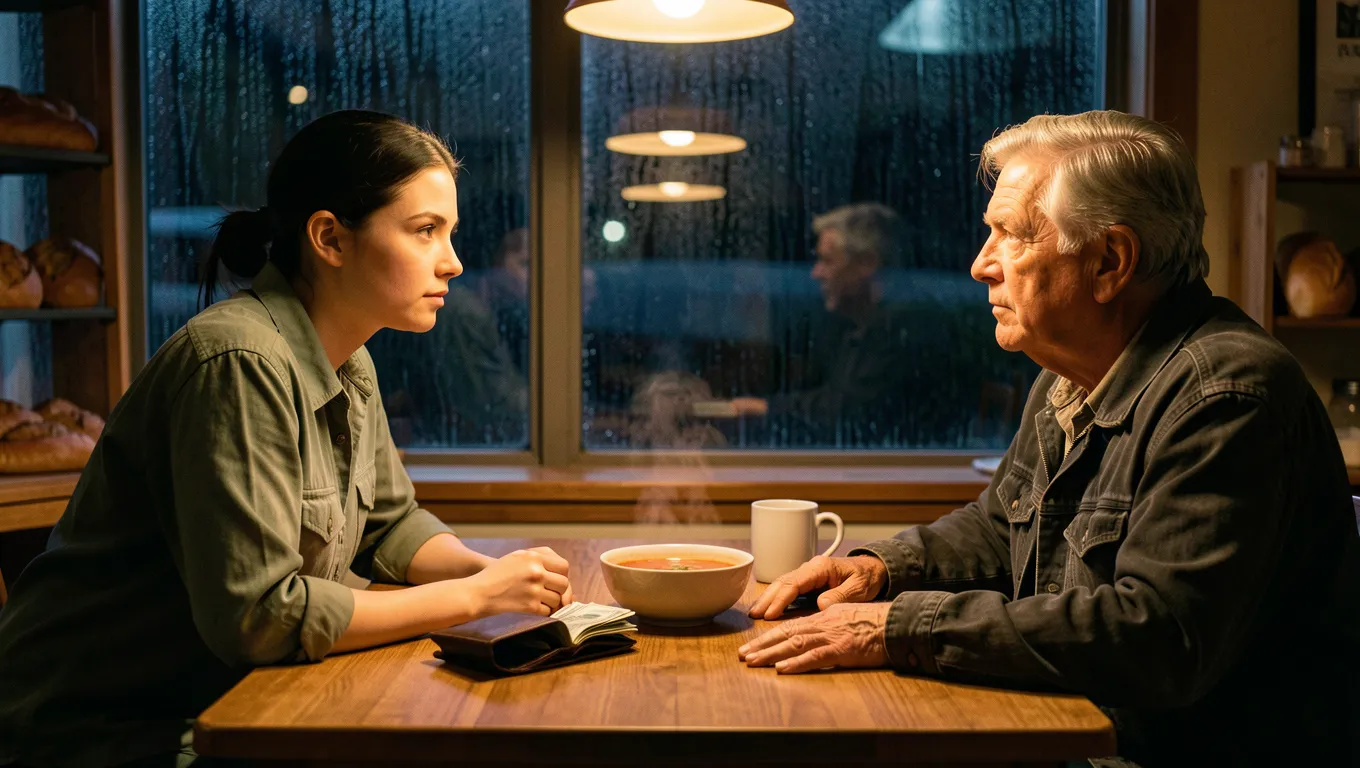
Dark jacket. Slow walk. He sat at the window table like someone who had been sitting at window tables his whole life — not because the view was interesting, but because it gave him something to watch while he ate alone.
Emily brought him coffee without being asked. He looked at her like she’d done something unusual.
“I didn’t order yet.”
“You were going to.”
He almost smiled.
After that, he came in every few days. Always the window seat. Always alone. Coffee. Soup. Sometimes a sandwich. He told her his name was Walter and she told him hers and that was about as personal as it got for the first three months.
But Emily noticed things.
She noticed he never looked at his phone.
She noticed he wore the same jacket regardless of weather.
She noticed the way he sat — straight at first, then gradually more tired as the visit went on — like he was carrying something heavy and had learned to do it quietly.
She also noticed he never had quite enough money.
Not dramatically short. Not asking for help. Just always slightly under, always quietly adjusting — one less item, always the cheapest option — with the particular dignity of someone who had been comfortable once and remembered it.
She started covering the difference herself. A dollar here. Two there. She didn’t make it obvious. She just rang it up differently.
The first time she did it, he noticed anyway.
“Emily.”
“It’s fine.”
“I’m not—”
“Walter. Drink your coffee.”
He drank it.
The night everything changed started the same way all the others had.
Rain. The wet-asphalt smell through the door. The display case going thin toward closing. Emily wiping down the counter and watching Walter make his way through the door, jacket damp, shoulders lower than usual.
He sat.
She walked over.
“Long day?”
“Longer than I planned.”
“You eat yet?”
He gave her the same tiny smile he always gave when she asked questions she already knew the answer to.
“Something small.”
She came back with a turkey sandwich, a bowl of tomato soup, and a piece of bread, none of which she charged him for. Walter stared at the plate and then opened his wallet and counted what was inside and the expression on his face was not panic.
It was embarrassment.
That was worse.
“Emily. I’m a little short today.”
“Keep your money.”
“No—”
“Dinner’s on me.”
“I can pay you back—”
“Walter.”
She pushed his change gently toward him.
He looked at her for a long moment.
“Why are you always so kind to me?”
The question caught her.
Not because it was hard. Because the answer was so obvious to her that she’d never needed to say it out loud.
“Because nobody should go hungry.”
Something moved across his face. Old and heavy, like she’d said something that mattered more than she understood.
Then a voice came from behind her.
“You can’t keep doing this.”
Mrs. Parker was fifty-five, practical, and not intentionally cruel. She was also terrified. The bakery was barely breaking even. The owner wanted cuts. Every comped meal registered in her mind like a problem she hadn’t solved.
She stopped at the table.
“You comped his meal again?”
“I’ll pay for it.”
“That isn’t the point.”
“It’s my money.”
Walter looked between them.
“I can leave.”
Emily turned.
“No.”
Mrs. Parker’s voice dropped low.
“Emily. We have talked about this.”
“He hasn’t eaten.”
“That’s not your responsibility.”
“Then whose is it?”
“You cannot decide which customers become charity cases.”
Walter flinched.
Just slightly. Like a small blow.
Emily saw it.
Her face changed.
“He’s not a charity case.”
Mrs. Parker realized what she’d said half a second too late.
“That isn’t what I meant.”
“But that’s what you said.”
The bakery had gone quiet. Nobody openly staring. Everyone listening.
Mrs. Parker’s jaw tightened.
“This is your last shift.”
Emily stared.
“What?”
“You heard me.”
“You’re firing me for buying somebody dinner.”
“I’m letting you go for repeatedly ignoring policy.”
The word hung there. Policy. Emily thought of her mother’s gas bill. The car payment. The two shifts she’d already picked up this week. Everything moved through her head in less than two seconds.
But she did not apologize.
She looked at Walter.
Then back at Mrs. Parker.
“I’d do it again.”
Mrs. Parker’s face softened for half a second.
Something close to regret.
But she’d already committed.
“Finish the table. Then clock out.”
Emily nodded.
No argument. No tears.
She reached for the empty coffee cup beside Walter’s plate.
And then she heard the soft snap of leather.
Walter had closed his wallet.
He sat up straighter.
He reached inside his jacket — and pulled out a smartphone that was newer than anything Emily owned by several years.
He unlocked it.
Raised it to his ear.
Someone answered immediately.
Walter’s voice changed completely.
The tired man at the window table disappeared.
“It’s me.”
A pause.
“I found the young woman.”
Emily stopped breathing.
“Yes.”
He looked directly at her.
“It’s definitely her.”
A longer pause.
“No. She doesn’t know.”
Emily felt cold move across her shoulders.
“Walter.”
He held up one finger. Not dismissive. Just asking for a moment.
“Send Daniel.”
Pause.
“No security team. Just Daniel.”
He glanced at Mrs. Parker.
“And tell legal to hold everything until I get there.”
Mrs. Parker’s face went completely white.
Walter ended the call and set the phone on the table.
The bakery was still.
Emily asked:
“Who were you talking to?”
“Someone who has been waiting a very long time.”
“That doesn’t answer anything.”
“No.”
He looked at her evenly.
“It doesn’t.”
Mrs. Parker managed:
“Mr. Bennett. Who exactly are you?”
Walter looked toward the rain on the window.
“My name is Walter Bennett.”
“We know that.”
He shook his head.
“No. You know the name I gave you.”
Before Emily could process that, headlights swept across the glass.
A black SUV pulled into the parking lot.
Then a second.
Mrs. Parker whispered:
“Oh my God.”
Walter sighed.
“I said one car.”
The man who came through the door was in his late forties. Dark suit. Rain on his shoulders. He scanned the room once, found Walter, then found Emily — and stopped so completely he might have hit a wall.
His face lost color.
Walter said quietly:
“Daniel.”
The man walked forward without looking away from Emily.
Walter looked between them.
“Emily Carter. Daniel Cole.”
Daniel’s lips parted.
Emily took one step back.
“Why is he looking at me like that?”
Walter’s answer was simple.
“He knew your father.”
The bakery closed early that night.
Mrs. Parker turned the sign herself without anyone asking her to. Customers left quietly. The lights stayed on. The untouched tomato soup went cold.
And Walter Bennett — the Walter Bennett, sixty billion in assets, twelve states of manufacturing, the man whose name was on the building they were sitting inside — told Emily Carter the truth about her father.
Thomas Carter hadn’t been an electrician who wired commercial buildings.
He’d been an engineer who helped build one of the most profitable industrial systems in Bennett history. A man who designed a modular power structure that now underpinned three of Bennett Group’s core divisions. A man who, for six years, had his name beside Walter’s on patents and expansion plans and partnership agreements.
Until Phoenix.
A factory modernization contract. Massive budget. And a subcontractor who falsified safety certifications on a scale that could have killed people.
Thomas found it. Thomas wanted it stopped.
Walter didn’t listen fast enough.
“You knew?” Emily’s voice was flat.
“I knew he was concerned.”
“That’s not what I asked.”
Walter forced himself to meet her eyes.
“No. I didn’t know how serious it was because I chose not to know.”
Thomas escalated. Threatened to go external. There was a board fight. Thomas accused Walter of caring more about the company than the people inside it. Walter accused Thomas of trying to destroy everything they’d built.
Thomas had been right.
The factory never opened. An independent review confirmed his concerns. Nobody died — because Thomas forced the issue before anyone could get hurt.
But the friendship was destroyed.
Thomas resigned. Signed away most of his equity. Walked out with almost nothing.
Emily’s voice came out quiet.
“Why would he do that?”
Daniel spoke for the first time since sitting down.
“Because the board threatened litigation.”
He looked at the table.
“And because he had a newborn daughter.”
Emily didn’t move.
“Me.”
“Yes.”
Walter said:
“He wanted nothing from Bennett. He wanted you to have nothing to do with it.”
Emily looked at the photograph Walter had placed between them. Her father, maybe thirty. Smiling. Standing between Walter and Daniel in front of an enormous brick building she now recognized as the original Bennett manufacturing plant.
Her hands shook.
“What happened five years ago?”
And then Daniel told her the part that changed everything.
Three weeks before the accident, Thomas had found something. A financial arrangement buried in the original Phoenix settlement. Shares he believed had been stolen from him during a quiet corporate restructure — converted on paper, disappeared in practice, with one signature he had never given.
His own name. Forged.
“At today’s valuation,” Daniel said, “the recovered stake would be worth several hundred million dollars.”
Mrs. Parker sat down without realizing she was doing it.
Emily stared.
Then laughed once. The kind of laugh that has nothing to do with anything being funny.
“My dad drove a fourteen-year-old truck.”
“Yes.”
“My mother worked two jobs when he got sick.”
Walter’s face tightened.
“I know.”
“No, you don’t.”
She slammed the photograph down.
“You don’t get to say that.”
Walter accepted it.
“You’re right.”
Emily turned to the rain on the window.
She thought of her father counting cash at the kitchen table. The same washing machine repaired three times. The year she was supposed to start college and didn’t because they couldn’t take on more debt.
Her anger became almost unbearable.
Then Walter said:
“There’s more.”
She closed her eyes.
“Of course there is.”
He reached inside his jacket and removed an old envelope. Creased. Her name on the front. And she recognized the handwriting before he had finished setting it down.
Her father.
Her knees nearly gave out.
“Where did you get that?”
“Daniel kept it.”
She looked at Daniel.
He whispered:
“Your father gave it to me.”
“When?”
“The night before he died.”
Emily did not sleep.
She sat at her kitchen table until sunrise with the letter unopened in front of her.
Her mother arrived at seven-thirty. Linda Carter walked in carrying two coffees, saw the envelope on the table, and stopped.
Her face changed.
“Where did you get that?”
“You recognize it.”
Linda sat down slowly.
“Emily.”
“Mom.”
A long silence.
“You knew.”
“Not everything.”
“How much?”
Linda looked down.
“Enough.”
Emily stood.
“Everybody knew my life except me.”
“That isn’t fair.”
“Then make it fair.”
And Linda began to cry.
Thomas Carter had made her promise to keep Bennett out of their daughter’s life. She had known there might be a claim somewhere. She had not known the number. She had not known about the forged signature. But she had known enough.
“He was stubborn,” Linda said. “Proud. Sometimes impossible.”
“That sounds like him.”
A small sad smile passed between them.
“Yes.”
Emily opened the envelope.
One sheet.
Her father’s handwriting.
Em — If Daniel gives you this, then something happened before I could finish what I started.
She stopped.
Linda put a hand over her mouth.
First: don’t trust anyone just because they say they knew me. That includes Walter Bennett. Especially Walter Bennett.
Emily almost smiled.
That sounded exactly like him.
Walter is not evil. That may be the problem. People do the most damage when they can still convince themselves they are good.
Years ago, I walked away from Bennett because I thought leaving was the only way to stay myself. Maybe I was right. Maybe I was a coward. I still don’t know.
What I do know is that a piece of what we built was never legally theirs to take.
If you ever pursue it, do not do it because you want to be rich. Do it because the truth should belong to the people who paid for the lie.
Emily frowned.
People. Plural.
There were workers at Phoenix who lost pensions when the project collapsed. Contractors who were never paid. Families who carried that damage while executives protected themselves. If my claim is real, it was never supposed to become a private jackpot.
She looked at her mother.
Linda whispered:
“That’s him.”
And Em: if Walter comes looking for you, don’t judge him by the car he arrives in. Make him sit down. Make him tell you the whole story. Then decide for yourself.
She kept reading.
You were the best thing I ever built.
Love, Dad.
Her vision blurred.
For several minutes neither woman spoke.
Then Emily folded the letter and set it down.
“He knew Walter would come.”
“He hoped he would,” Linda said quietly. “Because Thomas never completely stopped caring about him.”
By noon, Walter was back at the bakery.
Emily had called. Not because she trusted him. Because she wanted the rest.
Mrs. Parker let them use the small office in the back. Emily and Linda sat across from Walter and Daniel. The letter was on the desk between them.
Emily said:
“Dad says the money was never supposed to be mine alone.”
Walter nodded.
“I know.”
“How?”
“Because that was Thomas.”
He leaned back.
“Your father could walk away from five million dollars and still lose sleep about a mechanic being underpaid forty dollars.”
Linda smiled through tears.
“That was Thomas.”
Daniel opened a folder. He walked them through it. The original settlement had granted Thomas a minority interest in a specific subsidiary — Bennett Modular Systems. Three years after Thomas left, that subsidiary was reorganized. His remaining shares disappeared during the restructure. On paper, converted. In practice, stolen.
One signature on the conversion documents was Thomas Carter’s.
Thomas had never signed it.
Emily looked at Walter.
“Who ordered it?”
His silence made the room colder.
Daniel answered.
“My father. Richard Cole. Bennett’s CFO at the time.”
“And now?”
“Dead.”
“Convenient.”
Daniel accepted that.
“But he wasn’t alone.”
Walter closed his eyes.
“My brother was involved. Charles Bennett. He was COO during Phoenix.”
He paused.
“Charles died three years ago.”
Emily understood where this was going before he finished.
“But his son still works there.”
Walter’s voice came out quiet.
“Michael Bennett. Current president of the company.”
“You think he knows.”
“I think Michael has spent years making sure nobody looks too closely at what his father did.”
Emily stared at him.
“Did he threaten my dad?”
“We don’t know.”
“Then why was Dad afraid?”
Daniel slid another paper across the desk.
An email sent to Thomas two days before the accident. Anonymous sender. One sentence.
Some doors stay closed because people are safer that way.
Linda’s color drained away.
Emily looked at Daniel.
“You had this for five years.”
He met her eyes.
“Your father gave me a drive that night. Encrypted. He told me not to open it until Walter was willing to expose Bennett publicly.”
Emily turned to Walter.
“And now?”
Walter’s voice was very quiet.
“Now I am.”
Emily did not attend the board meeting.
She wanted no part of Bennett’s corporate theater. But Walter went. Daniel went. And what happened in that conference room three days later became the cleanest part of a very messy story.
Michael Bennett arrived furious. He called it a “senile man’s guilt project” before Walter had finished his first sentence.
Walter placed Thomas’s documents on the table.
Michael stopped smiling.
Then Daniel produced the encrypted drive.
Thomas had left a password clue in the letter.
Emily solved it in under a minute.
Not because she was brilliant. Because it was personal.
The password was the street where her parents had lived when she was born.
Inside the drive were scans, audio recordings, financial ledgers, and a video Thomas had recorded one week before his death. Walter watched it alone first. Then he called Emily.
Her father appeared on screen.
Older. Tired. Alive.
“Walter — if you’re watching this, you finally got over yourself.”
Emily’s tears came before she had time to stop them.
“I don’t think you ordered any of this. I want that clear.”
Walter, watching beside her, closed his eyes.
“But you created the kind of company where men around you thought protecting your name mattered more than telling you the truth.”
Thomas named names. Charles Bennett. Richard Cole. Two outside attorneys. A logistics executive.
And then:
“Michael knew enough by 2018 to stop it. He didn’t.”
Emily paused the video.
Walter sat completely still.
“Michael was my godson.”
She looked at him.
“That can’t matter.”
“No.”
“It can’t.”
Walter nodded.
“You’re right.”
The video ended with something Emily hadn’t expected.
Thomas’s voice, calm now:
“If something happens to me, don’t assume murder because it makes the story cleaner. People make mistakes. Accidents happen. But if anyone interfered, follow the evidence. Not the grief.”
Emily sat in the silence after.
Her father had anticipated even the temptation to turn his death into something bigger than it was.
She loved him for that.
The police reopened their review.
No sabotage. No tampered brakes. No mechanical interference.
But phone records showed Michael Bennett had called Thomas fourteen times in the week before the crash. Thomas answered twice. On the final night, Michael drove to meet him at a roadside gas station.
Michael denied it.
Traffic cameras proved otherwise.
Confronted with the footage, he admitted they had argued. He wanted Thomas to delay the investigation. Thomas refused. Michael followed his truck afterward.
The crash happened twenty-eight minutes later.
Rain. A curve. A deer crossing. Thomas swerved. Hit the guardrail.
Accident reconstruction supported exactly what it looked like.
Michael Bennett was not responsible for his death.
Emily felt two emotions simultaneously.
Relief. And rage.
Because Michael had still lied. Still concealed evidence. Still helped cover what his father had done for years while Phoenix workers lost their pensions and Thomas Carter counted his gas money at the kitchen table.
Walter asked her:
“What do you want me to do?”
Emily stared at him.
“Why are you asking me?”
“Because Thomas was your father.”
“He was also your partner.”
Walter lowered his eyes.
“Yes.”
“Then stop making me carry your decision.”
That sentence changed him.
He nodded once.
“You’re right.”
The next morning, Bennett Group announced an independent investigation. Michael Bennett was suspended as president. Regulators were notified. Old Phoenix claims were reopened. Outside counsel was appointed.
Emily’s name appeared nowhere in the press release.
That was her choice.
Michael Bennett was removed from the board six months later. Two executives named in Thomas’s video faced federal fraud charges. The recovered assets from Thomas’s converted stake were substantial.
Emily did not take a private settlement.
She followed her father’s framework exactly.
The Phoenix Trust was established. Half for workers and contractors harmed by the collapse two decades earlier — families who had absorbed the damage while the board protected itself. A quarter for pension restoration. Scholarship funding for technical education.
And the final portion — smaller than anything the press reported — went to Linda Carter and her daughter.
Enough to be free.
Not enough to stop being herself.
Emily kept her job at the bakery.
Not because she had to.
Because she liked it.
The morning after the announcement, Mrs. Parker handed her the sage-green shirt and a coffee and didn’t say anything about the news or the money or any of it. Just said:
“The muffins are already out.”
And Emily said: “Good.”
And that was that.
The bakery installed a small wooden box near the register.
Emily’s idea. Meal credits for anyone who needed them. No application. No questions. Just a card placed on the table without ceremony.
Mrs. Parker approved it immediately and never mentioned the margins.
Walter came in the following Tuesday.
His usual table. His worn jacket.
He ordered the soup.
He paid for it.
Then he looked at Emily across the counter.
“Thomas would have hated all the attention.”
“He would have hated being right more.”
Walter almost smiled.
“He was right about most of it.”
Emily looked at him.
“He said you weren’t evil.”
“I know.”
“He said that might be the problem.”
Walter sat with that for a moment.
“He wasn’t wrong.”
Emily refilled his coffee.
“He also said to make you sit down and tell the whole story before deciding.”
“Did it help?”
She thought about it.
“Some.”
Walter nodded.
They sat in comfortable silence while rain moved across the window and a young couple at the far table argued softly over something that wasn’t important. The display case was still half full. The coffee machine hissed. Somewhere near the door, someone laughed.
Ordinary.
Emily still liked ordinary.
Walter looked at her suddenly.
“Thank you.”
“For the soup?”
“For finding me.”
Emily’s expression shifted.
“You found me.”
He shook his head.
“No. I knew where you were.”
He looked toward the window.
“That isn’t the same thing.”
She understood what he meant.
She squeezed his hand once.
Walter Bennett died six weeks later. Peacefully, in his sleep, on a Tuesday night. No final dramatic words. No business decisions. No family secrets left to tell.
He simply went to sleep and did not wake up.
Emily cried harder than she expected.
Daniel called her from the airport and couldn’t speak for several minutes. Linda cried at the kitchen table holding the photograph.
The funeral was large despite his instructions. Business leaders and factory workers and Phoenix families and old friends who had known different versions of the same man.
Emily spoke last.
She did not mention billions. She did not mention Bennett Group. She did not mention the fraud or the lawsuit or any of the things that would appear in the news cycle for another eighteen months.
She told the story of an old man who sat beside a rainy window with an empty wallet.
Just the moment.
Then she said:
“The first time Walter asked me why I was kind to him, I told him nobody should go hungry. Years later I understood that hunger can mean more than food. People can be hungry for dignity. For forgiveness. For a second chance. For somebody to sit beside them without asking what they own first.”
She paused.
“Walter spent part of his life building a company. He spent the last part learning that people are harder to build and easier to break.”
Then:
“He got better at fixing what mattered.”
Twenty years later, Emily Carter was forty-four.
The Thomas Carter Practical Kindness Fund had become a national network. Still intentionally boring. Meal credits. Transportation vouchers. Emergency lodging. Employee hardship pools. Small things. Useful things.
The Phoenix Trust had helped thousands of workers and students.
Bennett Group was still successful. But no Bennett family member automatically controlled it anymore.
Emily never joined the company. She never wanted to.
One rainy evening she walked into Bennett Street Bakery.
A new employee stood behind the counter. Maybe nineteen. A teenage boy sat near the window counting coins. Not enough.
The young employee looked toward her manager.
The manager noticed.
Then nodded.
The employee took a meal card from the wooden box and placed a sandwich and soup on the table without a word.
The boy whispered:
“I can pay you back.”
The employee smiled.
“Don’t worry about it.”
Emily stood near the door.
Nobody knew she had helped design the system.
Nobody cared.
That was the point.
She ordered coffee. Sat at Walter’s old table after the boy left.
Outside, rain shimmered beneath streetlights.
She took out two letters. Her father’s, fragile now. Walter’s, found after his death — only three lines.
Emily — Your father taught me that a company is never worth more than the people inside it. You taught me the same thing with a sandwich.
She folded them together.
The young employee approached.
“Need anything else?”
Emily looked at the empty bowl.
Then at the rain.
“No.”
She smiled.
“I think I’m good.”
Original fictional stories. AI-assisted creative content.