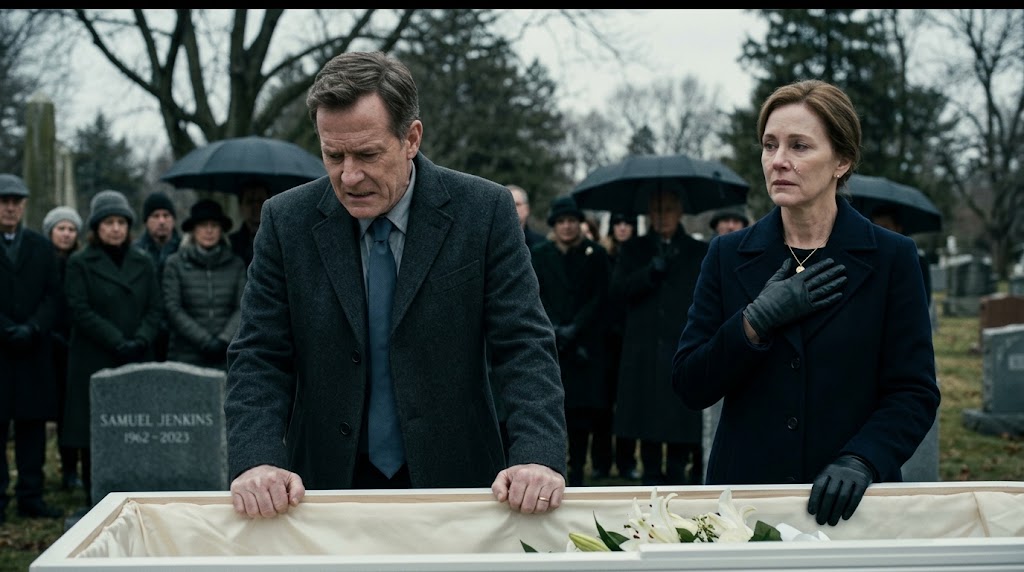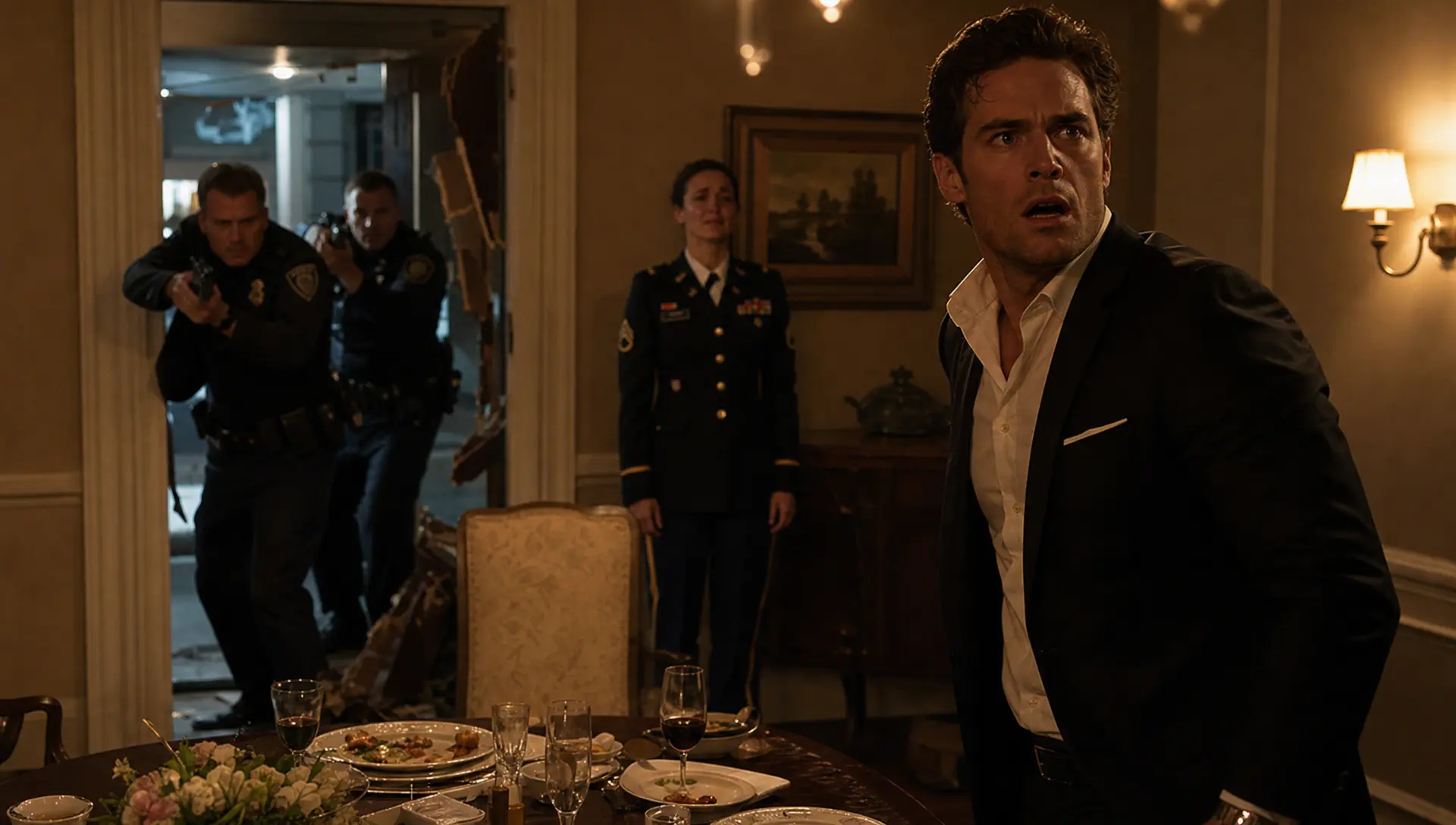
The Veterans Memorial Hall was the quietest place in Washington that morning.
Folded flags. White wreaths. Four honor guards standing so still they looked carved from marble.
Commander Elena Hayes pushed open the heavy wooden doors and walked in.
She was thirty-four. Her Navy dress uniform was pressed to a razor edge, and the decorations on her chest caught the light with the weight of things that couldn’t be faked — because they weren’t.
No one in the room knew that.
She hadn’t seen her brother Michael in seven years.
She hadn’t been seen by anyone in seven years.
As far as the United States Navy was concerned, Commander Elena Hayes had died in the Mediterranean alongside ten other members of Naval Force Eclipse, in an explosion that was never fully explained and never fully investigated.
She walked toward the coffin draped in the American flag.
She didn’t make it ten feet.
Security Officer Robert Kane stepped into her path like a wall that had always been there.
He looked her up and down — slowly, the way men do when they’ve already made their decision and are just looking for language to dress it in.
“Those decorations,” he said. “They aren’t yours.”
Elena kept her eyes level. “I’d like to pass.”
“Show me your ID.”
She pointed to the badge on her hip. He took it. He barely looked at it.
“This is a forgery.”
Murmurs moved through the room like a current. Phones came up.
“Check my name,” Elena said quietly.
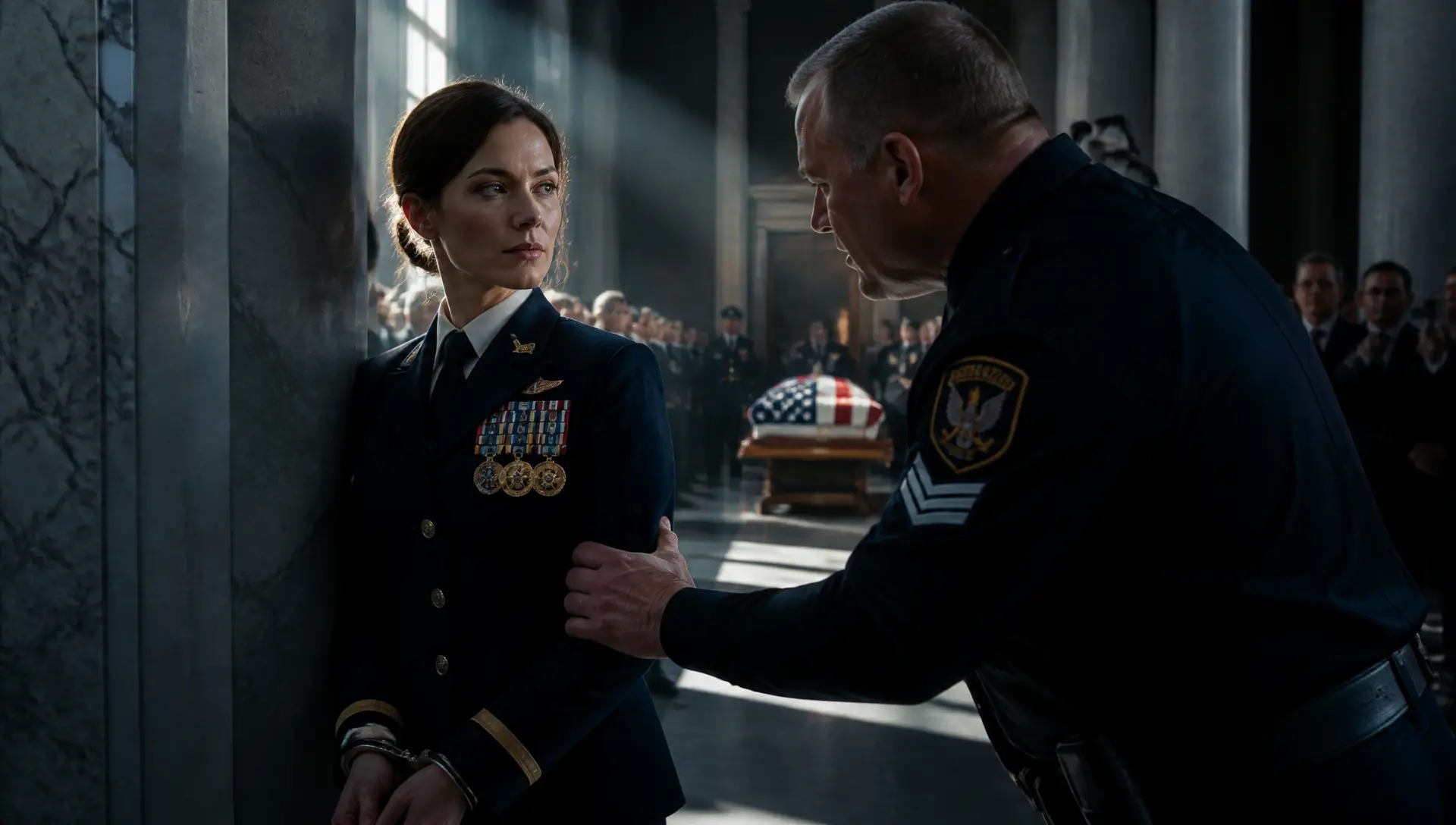
Robert grabbed her arm and shoved her against a stone column. The handcuffs went on fast — the practiced snap of someone who’d done it many times and enjoyed the sound.
“You’re under arrest for military impersonation.”
Elena did not pull away. She did not raise her voice.
“You’re making a mistake,” she said.
He reached up and tore a medal from her uniform.
The fabric pulled. The clasp broke. The medal came away in his hand.
Elena’s jaw tightened — just once. Just for a second.
“Don’t touch what my unit paid for with blood,” she said.
Robert smiled. “An imaginary unit doesn’t bleed.”
Then the ceremonial drums stopped.
Not gradually. All at once.
Every honor guard in the hall turned to face Elena at the same moment — a single synchronized movement, like a clock ticking over. Every hand came up in salute. Precise. Deliberate. A statement.
The room went dead silent.
Admiral Collins came off the stage at a pace that was almost a run.
“Release her. Now.”
Robert didn’t move. “Sir, this woman—”
“She is Commander Elena Hayes.” Collins’s voice filled the hall. “The only known survivor of Naval Force Eclipse.”
The blood left Robert’s face so fast it was visible from across the room.
Collins removed the handcuffs himself. He returned the torn medal to Elena with both hands.
“Welcome home, Commander.”
Elena didn’t answer.
Her eyes had moved to the photograph on the coffin.
Michael. Her brother. In his captain’s uniform. Smiling the way he always smiled — like he knew something you didn’t, and he was waiting for you to catch up.
“How did he die?” she asked.
Collins lowered his voice. “He was looking for you.”
Elena turned to face him. “My brother knew I was alive.”
“Yes.”
“Then why—”
Before Collins could answer, something fell from beneath the flag.
A small medal. Tumbling free from a fold in the fabric, hitting the marble floor with a sound that rang out like a gunshot in the silence.
Elena bent down and picked it up.
She opened the small compartment on its back.
Inside was a photograph.
Recent. Taken in daylight. Michael — alive — walking out of this building.
The timestamp in the corner read that morning’s date.
“This photo was taken today,” she said.
Three knocks came from inside the coffin.
The guards stepped back. Hands went to holsters. The admiral stared at the latch.
“We never saw the body,” Collins said. Almost to himself.
The latch began to move from the inside.
Elena raised one hand. “Don’t shoot.”
She walked to the coffin. She moved the flag aside with the care you’d give to something sacred, and she worked the latch, and she lifted the lid.
It wasn’t Michael.
Inside the coffin was a young sailor — bound, gagged, dressed in a captain’s uniform, breathing in the shallow, desperate way of someone who has been closed in a box too long. His eyes were wide and terrified and alive.
The medics pushed forward immediately.
Elena reached beneath the sailor’s back and found a recorder taped there — small, military-grade, waterproof.
She pressed play.
Michael’s voice came through the speaker.
“Elena. If you’re hearing this, don’t trust the report of my death. And don’t trust every man who’s saluting you right now.”
The hall was sealed.
The sailor’s name was Thomas Blake. He was twenty-six years old and he worked with Michael during the final weeks of an investigation that had nearly gotten both of them killed.
When the medics cleared him and the adrenaline stopped shaking his hands, Thomas told them what he knew.
Michael had uncovered a network. Officers — senior ones — selling operational intelligence. Black market. Weapons dealers. Ghost accounts in countries that didn’t appear on allied maps.
The network knew about Eclipse Force.
More importantly, it knew Elena had survived.
For seven years she’d lived off-grid, moving between identities, chasing the thread of who had set her team up. The ambush in the Mediterranean hadn’t been enemy fire. Someone had given their location away. Eleven names were on that mission. Ten of them came home in caskets.
Michael was the only person on earth who knew she was still breathing.
And someone had used that to build a trap.
“Who authorized this funeral?” Elena asked.
Collins checked with the head of protocol. The documents came back in under two minutes.
Robert Kane’s signature. On the coffin delivery authorization. On the security detail assignment. On the suppression of the body verification order.
Everyone looked at Robert.
He backed up a step. “I followed instructions.”
“Whose?” Elena said.
He didn’t answer.
Elena looked down at her hands.
There was a small streak of metallic grease on her palm — the same compound used to seal the latch on the coffin from the outside. She’d picked it up when she worked the lock.
She looked at Robert’s right hand.
The same grease. Same compound. Same color.
“You knew there was no body in there,” she said.
Robert’s eyes moved to the exit.
The guards were already there.
They moved him against the wall with professional efficiency. When they searched his jacket, they found the medal he’d torn from Elena’s uniform — still in his breast pocket.
Collins opened the medal compartment.
Inside, behind the photograph of Elena as a child, was something that hadn’t been there before.
A transmitter. Small. Military grade. Active.
Sending its location signal to somewhere else.
“He didn’t tear this off to humiliate me,” Elena said. “He tore it off to put a tracker on himself. They needed to know where I was going next.”
Robert said nothing.
Thomas spoke up from the cot where the medics had him. His voice was still rough. “Michael told me — if Commander Hayes showed up, tell her to find the place where Eclipse was officially buried.”
Elena went still.
“What does that mean?” Collins asked.
“I know what it means,” Elena said.
The records listed it as Coastal Station Ember — a decommissioned logistics outpost, forty miles north of the city, on a stretch of coast that appeared on exactly one federal map and had been listed as inactive since the Eclipse unit’s remains were supposedly transported from it, seven years ago.
Thermal imaging from a reconnaissance drone showed heat signatures underground.
Moving ones.
Elena rode in the lead vehicle. She didn’t speak during the drive. Thomas sat across from her, watching the landscape pass. Collins was on comms, coordinating the federal team he’d quietly activated the moment the transmitter was found.
The station looked empty from the outside. Weeds in the chain-link. Rust on the gate. Lights off.
Elena found the hidden elevator behind a false panel in the maintenance bay floor.
They went down.
The lower level was not abandoned.
Cells along the left wall. Surveillance equipment covering every surface. Filing cabinets marked with Eclipse unit designations — names, mission logs, the full operational history of a unit that officially didn’t exist.
And at the far end, a screen.
Michael was on it.
Alive. Handcuffed to a chair. A cut above his left eye, dried blood on his collar. But upright. Breathing. Present.
Beside him stood a man in full naval dress — General Victor Shaw, Director of Naval Intelligence. A man Elena had briefed twice in the years before Eclipse. A man she’d trusted with classified coordinates.
“Welcome, Commander,” Shaw said to the camera. His voice was the same as she remembered it. Measured. Patrician. The kind of voice that made bad decisions sound inevitable. “Your brother did everything he could to bring you here.”
“Let him go,” Elena said.
Shaw smiled. “We didn’t bring you here to negotiate. We brought you here to finish what you started seven years ago.”
“I started?”
“You and your team found a list. Names of assets embedded inside the military. You were supposed to retrieve it quietly and hand it up the chain.” His tone shifted — just slightly. “The chain was us. You were never supposed to see what was on it.”
Seven years earlier, Eclipse Force had been given a retrieval mission. Simple extraction. A list of compromised agents. In and out.
Except the location had been sold before they’d even landed.
Eleven soldiers walked into an ambush.
Michael had intercepted a partial communication — just enough to get a helicopter there before the building came down completely.
Elena had crawled out.
The other ten hadn’t.
And then, Shaw had signed the order declaring all eleven dead. No investigation. No recovery. No names read aloud at any memorial.
Because the list they’d been sent to retrieve had his name on it.
“You ordered the ambush,” Elena said.
“I managed a problem,” Shaw said. “The problem came back.”
“Michael found the files.”
“Michael is very persistent. I’ll give him that.” Shaw glanced at the man in the chair beside him. “He faked his own death to get inside our organization. He was actually quite effective. Until he wasn’t.”
Michael raised his head. His voice was tired but steady. “Elena. The funeral was my idea. I needed to get you out in the open. I knew they were watching your signal. I’m sorry.”
“Don’t apologize to me,” Elena said.
“I got Thomas locked in a box.”
“He’s alive. Focus.”
Michael almost smiled. “I copied the files. Before they caught me. Thomas has them.”
Shaw’s expression changed.
He turned to his men and said something quiet.
The lights went out.
Elena had trained for exactly this.
Not this room. Not this enemy. But this — the specific darkness of a situation that had gone as wrong as it could go, where the only remaining option was to move before the other side could find the light switch.
The transmitter Robert had planted on her medal had been designed to track her. She’d known that from the moment Collins opened the compartment. She’d had twenty-two minutes in the vehicle to modify its output — rerouting the signal to broadcast the GPS coordinates of Coastal Station Ember to the independent federal unit Collins had activated.
She’d done it in fourteen.
Now she moved through the dark with the precision of someone who had spent seven years staying alive in places where being found meant dying.
First guard: disarmed with two movements, down without a sound.
Second guard: elbow to the throat, controlled drop to the floor.
Third guard ran into her in the dark and got the worst of it.
Michael had one hand free — he’d been working the cuff against the chair frame since the lights dropped. He swung with everything he had and connected.
The screen in the corner flickered. Emergency lighting kicked on — dim red, just enough to create shadows and movement.
Shaw moved toward the server bank.
He had a drive in his hand. Physical destruction protocol.
Thomas Blake, sitting on the floor with both wrists taped and one eye swelling shut, said clearly: “I already copied everything. Three months ago. The copies went to a federal judge this morning. Timed delivery.”
Shaw stopped.
“Michael told me,” Thomas said. “He said — if anything goes wrong, make sure someone else has the package. Someone they can’t reach.”
The elevator opened.
Federal agents came through in a stack, fast and professional, filling the space before Shaw’s remaining men could coordinate.
Shaw was the last one cuffed.
He looked at Elena while they put the restraints on him.
“You’ve been dead for seven years,” he said. “Nobody will believe any of this.”
“The files will,” Elena said. “And so will the eleven families who never got a real answer.”
The arrests made no headlines for seventy-two hours.
Then they made every headline.
Shaw. Robert Kane. Fourteen officers across three branches. A network that had been selling operational data for eleven years — longer than Eclipse had even existed. Names, routes, asset identities. Men and women in the field who had died for reasons they never knew, in situations that shouldn’t have been possible.
The list Elena’s team had been sent to retrieve seven years ago was entered into federal evidence.
Every name on it was subpoenaed.
Michael was hospitalized with a fractured wrist, three cracked ribs, and a concussion that the doctors said was “not severe, all things considered.” He stayed two weeks.
Elena was there every morning when the shift changed.
On the fourth night, he was awake when she arrived.
“You look terrible,” she said.
“You look like someone who slept in a car for seven years.”
“I slept in worse things than cars.”
He was quiet for a moment. The monitors beeped. Outside the window, the city was doing what cities do — indifferent and continuous.
“I thought I’d lost you,” he said.
“I knew you’d find a way to pull me out.”
“I put you in handcuffs at your own brother’s fake funeral.”
“You put me in position to catch the man who killed our team.” She pulled the chair closer. “That’s not nothing.”
Michael looked at the ceiling. “You always know how to make a dramatic entrance.”
Elena let out a breath that was almost a laugh. Almost.
“Get some sleep,” she said.
Four months later, the Veterans Memorial Hall was full again.
No coffin this time.
On the stage: eleven portraits. Eleven names. The men and women of Naval Force Eclipse, acknowledged publicly and officially for the first time since their deaths — their real deaths, in a real ambush, ordered by a man who had since been formally charged with eleven counts of felony murder, among other things.
Elena wore her repaired uniform.
The torn medal had been re-clasped by a Navy armorer who’d done it without asking any questions, which Elena appreciated.
Admiral Collins offered her a new decoration before the ceremony began.
She accepted it on behalf of the unit.
When she stepped to the podium, the hall went quiet in the way that rooms go quiet when something is about to be said that can’t be taken back.
“For years,” she said, “they called us ghosts. Because it was easier to let us be ghosts than to explain what happened to us. The men and women whose portraits are behind me were not ghosts. They were soldiers. They had families in this room right now. They had people who waited for answers for seven years and were told there was nothing to find.”
She paused.
“There was something to find. We found it. And the people who buried it are answering for it now.”
In the front row, Michael sat with a cane and Thomas beside him.
Thomas had a bruise that was still fading. He’d declined the offer of a service commendation twice, which Elena thought was exactly the right call, and she’d told him so.
After the ceremony, the families of the Eclipse members were given private time in the hall — with the portraits, with each other, with whatever they needed to do with seven years of unanswered grief.
Elena waited outside.
Michael found her there. He moved slowly with the cane, but he moved.
“What was in your medal?” he asked. “The original compartment. Before Robert opened it.”
Elena reached into her jacket and took out the medal.
She opened the small compartment.
A photograph. Worn soft at the edges. Two kids — maybe eight and ten — sitting on the hood of a car in summer, squinting into the sun, laughing at something outside the frame.
“I carried it on every mission,” she said.
Michael looked at the photograph for a long moment.
“Then I was there,” he said. “Every time.”
Elena closed the medal.
“You never stopped being there.”
The institution had tried to bury eleven soldiers, erase a commander, weaponize a brother’s funeral, and use the dead as cover for a network that had spent a decade bleeding the military from the inside.
It had forgotten one thing.
Coffins can be empty. Records can lie. Names can be struck from the rolls.
But someone who has spent seven years alive in the dark, looking for the people who did this — she does not stop because a security officer puts handcuffs on her at the door.
She stops when it’s done.
It was done.
Original fictional stories. AI-assisted creative content.