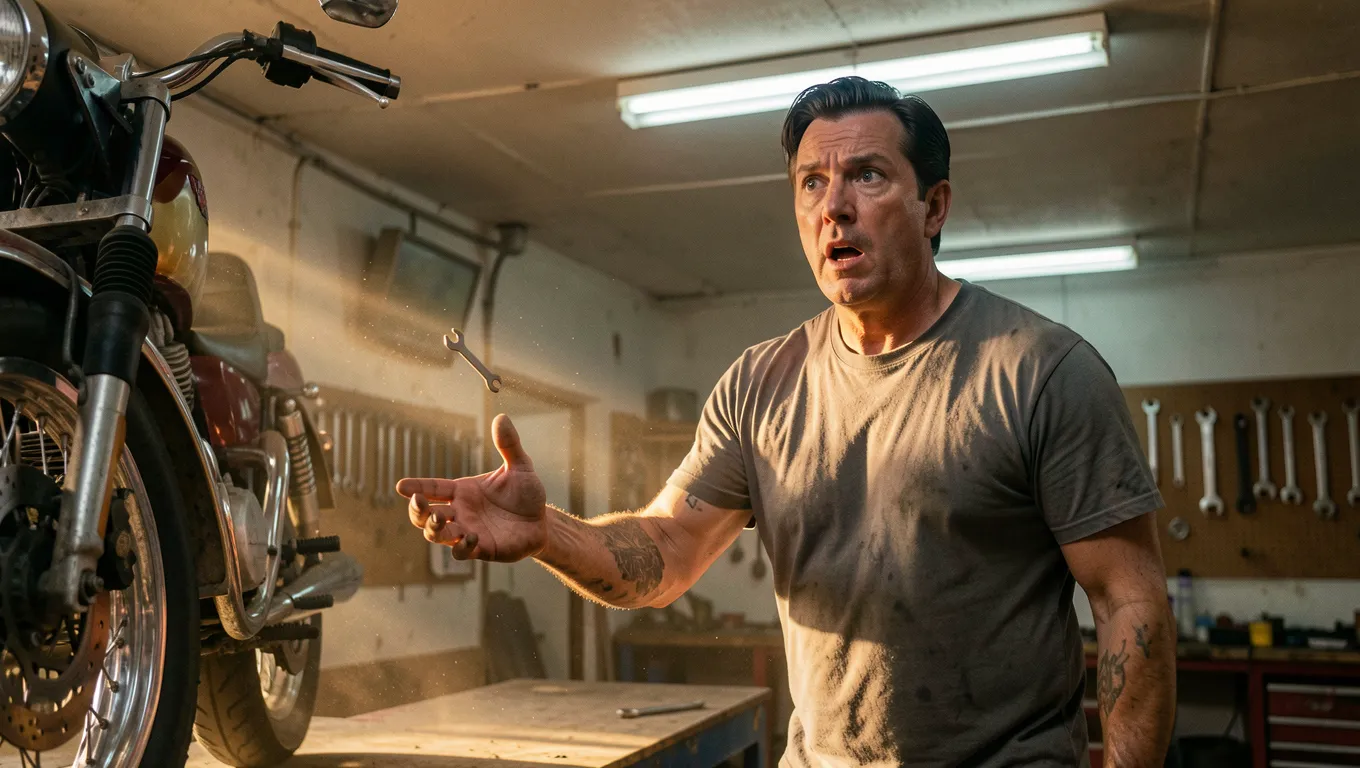
The girl appeared in the doorway of Wrenchhouse Customs at 2:47 in the afternoon.
Malcolm Rourke heard her before he saw her. A slow drag. A pause. Another drag.
He set down his wrench and looked up.
She was maybe seven, maybe smaller. Lavender dress, dirty at the hem. One sock, one bare foot. Her left leg moved wrong—stiff, dragged—and her face wore something that stopped Mack cold. It wasn’t fear. It wasn’t even pain.
It was the look of a child who had learned that crying didn’t work.
“Hey,” he said.
She didn’t answer. She just stood in the light and looked at him.
Behind Mack, his crew went quiet. Tank set down his grinder. Diesel straightened up from under a lifted truck frame. Cruz came around from the far bay. Four grown men who had collectively earned enough charges to fill a filing cabinet—and every one of them went still for a little girl in a dirty dress.
“You need something?” Mack asked.
She reached out her arm. On her wrist was a small silver bracelet with a single charm—a tiny church bell. Her hand was shaking.
“Help,” she whispered.
Mack crouched so he was level with her.
“Okay,” he said. “We can do that. What’s your name?”
“Ellie.”
“Where do you live, Ellie?”
She pointed vaguely toward the center of town. The good part. Heritage Lane, where the lawns were trimmed and the porches had flowers.
“How’d you get here?”
“I walked.”
He looked at her leg again. “That whole way?”
She nodded once.
Mack’s jaw tightened. “Does your mama know where you are?”
Ellie looked at the floor. That was answer enough.
“You hungry?”
She nodded again.
“Tank,” Mack said, not looking away from her, “go get the first aid kit and whatever’s left in the cooler.”
“Already moving,” Tank said.
Cruz pulled a folding chair over and Ellie sat in it like she was grateful to stop moving. She ate half a sandwich and drank an entire bottle of water without speaking. Mack sat across from her and didn’t push. He’d learned long ago that silence after hunger was just the body catching up to itself.
When she was done, she folded the wrapper neatly in half.
“Can I stay here?” she asked.
“You can stay here while we figure out who to call,” Mack said carefully. “Does your mama need help too?”
Ellie looked at him. Her eyes were dark brown and completely steady.
“Daddy hurt her again,” she said. “She can’t walk right now.”
The garage went very quiet.
Mack breathed in slowly. “When did that happen?”
“This morning.”
“Is she alone?”
“Yes.”
“You left to get help?”
Ellie nodded. “I went to the church first. Pastor Dennis said to go home and pray.”
Mack’s eyes went flat. “Then you came here.”
“You have tools,” she said simply. “And you’re big.”
Tank turned away so she wouldn’t see his expression.
“Cruz,” Mack said quietly. “Get Dr. Bennett on the phone.”
Dr. Priya Bennett arrived in eleven minutes. She was county health, not town—which meant she didn’t answer to the same people who ran Maple Ridge, and everyone in that garage knew the difference.
She examined Ellie with practiced calm.
The leg had an old fracture, badly healed. Two ribs showed bruising consistent with impact. Her left shoulder had a range-of-motion problem she had clearly learned to compensate for—the way she’d been compensating for a long time.
None of it was fresh.
All of it was deliberate.
“Ellie,” Dr. Bennett said, “has anyone ever looked at your leg before? A doctor?”
“Daddy said it would get better on its own.”
“Who’s your daddy?”
“Daniel Whitmore.”
The name landed in the room like a dropped engine block.
Councilman Daniel Whitmore. Heritage Committee chair. Three-term elected official. Man whose name was on the plaque outside the library and the cornerstone of the new rec center. Man who shook hands at every ribbon-cutting and quoted scripture at every funeral.
Mack stared at the ceiling for one long second.
“Okay,” he said. “We call county child services. Not town. County.”
Dr. Bennett nodded. “Already dialing.”
They were still on hold with county dispatch when Sheriff Lane’s cruiser rolled into the gravel lot.
Lane was fifty-two, thick across the shoulders, with the kind of face that had learned to look calm even when it wasn’t. He’d been sheriff for fourteen years. He walked in with his hands open, posture easy, and smiled at the room like he’d just stopped by for coffee.
“Heard there was a situation,” he said.
“Who called you?” Mack asked.
“Pastor Dennis mentioned a child—”
“We’ve got county health on-site and county dispatch on the line,” Mack said. “We’re covered.”
Lane’s smile stayed fixed. “Mack, I understand you want to help. But this is a family matter, and the family has—”
“The family has a councilman who broke his seven-year-old’s leg,” Mack said. “So we’re going to wait for county.”
Lane’s eyes moved to Ellie. Something shifted behind them. It wasn’t concern.
“She tell you that?”
“Her bones told us that.”
“Kids fall,” Lane said. “Kids get hurt. You don’t have the full picture here.”
“Then county will get the full picture,” Mack said. “I’m not stopping you from standing there and waiting with us.”
Lane’s jaw moved. He didn’t leave, but he didn’t come closer either. He pulled out his phone and made a call Mack couldn’t hear—turning his back, walking to the edge of the bay.
Diesel drifted quietly to a position between Lane and the child.
Nobody said anything about it.
Daniel Whitmore arrived six minutes later in a silver SUV.
He was dressed for a Sunday, even on a Wednesday—pressed shirt, clean shoes, the kind of watch that said serious money without being flashy. He walked in with his hands in his pockets and an expression that had been engineered over decades to communicate reasonable concern.
“Ellie, sweetheart,” he said. “What are you doing here?”
Ellie’s entire body went rigid.
She didn’t look at him. She looked at Mack.
Mack stepped forward. “She’s under medical evaluation. You need to stand back.”
Whitmore’s eyes moved to him with polite, practiced contempt. “And you are?”
“Malcolm Rourke. This is my shop. Your daughter walked here on a leg that was broken and never treated. So right now, the doctor finishes, and county services decides what happens next.”
“County services,” Whitmore repeated, like the phrase was mildly amusing. “Lane, can you help me out here?”
Lane turned from the wall. His face was still controlled, but something around his eyes had gone tight. “Mack, I think we all need to take a breath and let Mr. Whitmore—”
“No,” Mack said.
One word. Flat and final.
The room held its breath.
“Son,” Whitmore said, his voice dropping into something dangerous and velvet-smooth, “you do not understand what you are getting yourself into.”
“You’re probably right,” Mack said. “But she’s not leaving with you.”
Whitmore turned to Dr. Bennett. “You have no legal authority to hold a minor without parental consent—”
“I have legal authority to document injuries consistent with ongoing abuse and request an emergency custody hold pending county investigation,” Bennett said, not looking up from her clipboard. “Which I’ve done. So you can save the speech.”
Whitmore’s smile thinned to nothing.
“This is slander,” he said.
“It’s x-ray evidence,” Bennett said. “And it’s already been photographed and transmitted.”
Mack watched Whitmore’s face go through several calculations very fast.
“Lane,” he said. “Do something.”
Lane’s jaw set hard. “Let’s all just calm down.”
It was the wrong answer and everyone in the room heard it.
Ellie had been sitting very still. Now she looked at Mack, and in a voice barely above a breath, she said, “Don’t let the sheriff take me. He comes over when Mama cries.”
The world stopped.
Mack heard it. Dr. Bennett heard it. Tank and Diesel and Cruz heard it. Lane heard it most of all—because he went the color of old concrete.
“Excuse me?” Bennett said.
Ellie’s breath came in shallow and fast. “He tells Daddy to make it quiet.”
Whitmore moved.
Not toward Mack.
Toward Ellie.
He covered the distance in two steps—fast for a man his size, the kind of fast that came from practice—and Mack hit him before his hand got close. The punch wasn’t controlled. It was the kind that comes from somewhere below thought. Whitmore went sideways and crashed into the office door frame, slid down it, and hit the floor with the thud of expensive clothing meeting gravel-dusted concrete.
Diesel had him pinned before he tried to get up.
Lane reached for his weapon.
Tank put him into the wall with one arm across the chest. “Don’t.”
The county deputy who’d been waiting outside had his weapon drawn by the time he cleared the garage door. “Hands! Everybody hands where I can see them!”
The next sixty seconds were pure chaos—shouting, boots on gravel, radio bursts, Whitmore cursing, Lane going still in the way that meant calculating rather than complying—
And then Ellie screamed.
Not from pain.
From memory.
“No more basement! No more basement!”
Bennett got to her first, both arms around the girl, talking low and steady into her ear. Mack stood six feet away and felt the words land on him like something physical.
Basement.
Locked door.
Mama bleeding.
Bell on the stairs.
He stared at the silver bracelet on Ellie’s wrist.
The tiny church bell.
Rebecca Whitmore’s car skidded into the lot so fast it threw gravel against the bay door.
She came out barefoot. One side of her face was the yellow-purple of a bruise four days old. Her lip had a healing split. She looked at the ambulance backing toward the garage entrance. She looked at her husband pinned on the floor. She looked at Lane against the wall. She looked at Ellie on the stretcher—
And she broke completely.
“Thank God,” she sobbed. “Thank God she made it here.”
The county deputy moved to her immediately. “Ma’am, we need a statement. Can you—”
“Yes,” Rebecca said. She was already nodding, wiping her face with the back of her hand, pulling herself upright by will alone. “Yes. There’s a room in the basement. Behind the shelves. He said no one would believe me. He said Daniel owns half this town and Lane protects the other half.”
Mack stared at her.
Then at the bracelet on Ellie’s wrist.
Rebecca followed his gaze.
“That bell,” she whispered.
Mack looked up at her.
“It opens it,” she said.
Silence spread through the garage like oil.
“Opens what?” Mack asked.
Rebecca closed her eyes.
“The lock. On the basement door. He always said if Ellie ever got to it first, to just make sure she—” Her voice broke. “He made her wear the bracelet so the key was always with the child and never where I could find it. So I could never—”
She couldn’t finish.
Mack said nothing for a moment.
Then: “How long?”
Rebecca opened her eyes. Wet, exhausted, absolutely certain. “Since before she could walk.”
County investigators went through the Whitmore house that night with a warrant signed by a judge two counties over—the jurisdictional move Bennett had already arranged before Lane ever arrived at the garage.
Behind the basement shelving, behind a wall panel flush enough to be invisible until you knew the angle—they found a room.
Eight by ten feet.
Children’s blankets on a cot. A chemical smell that turned one investigator around in the doorway to breathe clean air. Restraints. Sedatives. And boxes.
Boxes and boxes of records.
Not sloppy. Not impulsive. Meticulous.
Names. Dates. Payments. “Interventions” signed off on by respected community members. Incidents buried. Injuries explained away. Children labeled unstable. Mothers labeled hysterical. Complaints sealed by a judge whose name appeared on three Heritage Day programs. Families who had moved away, transferred out, gone quiet.
It wasn’t just Daniel Whitmore.
It wasn’t just Sheriff Lane.
It was Maple Ridge—the version underneath the version. The machine that kept the lawns trimmed and the church pews full and the truth safely underground.
By 4 a.m., investigators had arrested seven people.
By sunrise, the number was fourteen.
The pastor. The doctor who changed records. The teacher who noticed and filed nothing. The judge who sealed complaints. The city clerk who routed paperwork in circles until problems disappeared. Men and women who had spent years maintaining a town that worked beautifully if you were the right kind of person and ground you into dust if you weren’t.
The last locked cabinet was in Whitmore’s private study, behind a panel his own investigators hadn’t found the first time through.
A county tech opened it with a drill at 6:22 a.m.
Inside: adoption papers. Sealed birth certificates. DNA test results, privately conducted, filed and signed and notarized by a man who collected proof the way other people collected insurance.
Mack was standing in the doorway of the house when the lead investigator walked out with a folder.
She handed it to him without preamble. She’d read the crew intake sheet. She knew who he was.
He opened it.
The name at the top of the birth certificate was Eleanor.
The mother’s name was Ava Rourke.
The date was seven years and three months ago.
Mack sat down on the front steps of the Whitmore house. The sun was coming up over Maple Ridge. News vans were already on Heritage Lane. Someone was taking down the bunting from the streetlights.
He read the page until the letters stopped swimming.
His sister Ava had left Maple Ridge seven years ago with a flash drive and a plan. She’d called him once from a gas station pay phone—the last call—and said she had evidence. That she was scared but she was going.
Authorities had called it a drug relapse three weeks later.
Then an overdose.
Then a closed case.
No body recovered. No real investigation. Lane had filed the paperwork himself.
Mack had spent four years trying to get anyone to listen and eventually stopped—not because he believed it, but because hitting a wall for long enough breaks something in you. He’d come back to Maple Ridge and opened a shop and done his work and told himself he’d made peace with not knowing.
He hadn’t.
He’d just stopped looking.
He read the rest of the file in the back of the county investigator’s car.
Ava had given birth in a county clinic sixty miles outside Maple Ridge, admitted under a different name, bleeding and afraid. She’d survived the delivery. She’d held the baby for three hours.
She hadn’t survived the week.
Not an overdose.
Complications. Untreated. Because she’d been hiding.
Daniel Whitmore had appeared at the clinic the day she died, with paperwork and a private attorney and a deputy beside him—Lane, twenty years younger. He’d told them the baby was an orphaned relative whose mother had signed custody over voluntarily. He had documents. He always had documents.
Eleanor Rourke had become Ellie Whitmore by the end of the month.
A child no one would question. A child tied to a dead woman no one respectable wanted to remember. A child raised inside the machine her mother had died trying to destroy.
Mack sat with that for a long time.
The investigator gave him the time. She leaned against the hood and drank coffee and looked at the news vans and let him be.
Finally she said, “You going to be okay?”
“No,” he said. “Not for a while.”
“Fair answer.”
“What happens to Ellie now?”
“That’s going to be a process. DNA is confirmed, which means she has a living biological relative with no criminal record and a legal claim. Judge in county family court is going to have a full file by tomorrow morning.” She paused. “You should get a lawyer today.”
Mack looked at her.
“Not because you need to fight it,” she said. “Because you need someone in your corner when the process starts. Child welfare, hospital, family court—it’s a lot of systems at once.”
“She’s scared of systems.”
“Yeah,” the investigator said. “She would be.”
Dr. Bennett met him in the hallway outside room 114.
“She’s stable,” she said. “The leg is going to need surgery. The shoulder will need months of physical therapy. But she ate breakfast and she asked for more orange juice, so.”
Mack almost smiled. “How is she otherwise?”
“She asked if the scary man with the soft voice was still here.”
He stopped. “She said scary?”
“The way kids mean it when they actually like you,” Bennett said. “Not scared-of-scary. Respect-scary. Like you’re something bigger than the bad things.”
Mack looked at the door.
“She asked me to give you something.” Bennett held out a folded piece of paper. “She made me find her a pen before she’d let anyone take her temperature.”
He unfolded it.
Inside, in large uneven block letters that had pressed hard enough to nearly tear the paper:
I KNEW YOU WOULD SEE ME.
Mack stood in the hallway for a long time.
Outside, through the window at the end of the corridor, he could see the parking lot filling with news vehicles. He could see the edge of a Heritage Day banner visible on a light pole—and then someone pulled it down, and it was just an ordinary pole on an ordinary morning in a town that was no longer what it had pretended to be.
He thought about Ava.
About a girl who had walked into his garage on a broken leg because the church turned her away and he had tools and he was big.
He thought about the bell on her wrist.
He thought about the moment she looked at him from across the chaos—Whitmore on the floor, Lane against the wall, medics and deputies and county investigators filling every corner of his shop—and the one thing she’d said to him across all of it:
Don’t let the sheriff take me.
She had trusted him before she knew why.
He thought maybe she’d known before he did.
Six months later, the last of the Maple Ridge hearings concluded.
Daniel Whitmore was convicted on fourteen counts, including child abuse, criminal conspiracy, and evidence tampering. He received forty-two years.
Sheriff Lane pled guilty to obstruction, abuse of authority, and two counts as an accessory. Twenty-six years.
The pastor received eight years.
The judge who had sealed complaints received twelve.
Eleven other defendants received sentences ranging from probation to sixteen years, depending on their level of participation in the system they’d built together behind flower baskets and church bells and Heritage Day bunting.
The hidden room was sealed as evidence and later demolished.
The Whitmore house was sold.
Rebecca Whitmore, who had cooperated fully with investigators and provided the evidence that broke the case open, was not charged. She moved to her sister’s home in Tennessee and began a very long process of rebuilding something.
Mack’s lawyer said the family court hearing was one of the faster ones she’d seen.
DNA was confirmed. Background was clear. Home evaluation was completed in three visits. The guardian ad litem—a soft-spoken woman from county who took two full hours getting to know Ellie before she filed her recommendation—wrote four pages about a child who demonstrated remarkable trust in a specific adult and had expressed clearly that she wanted to stay.
The judge asked Ellie one question directly, with all attorneys present and Mack waiting outside.
“Is there anywhere you feel safe?”
Ellie said, “The garage.”
The first morning she woke up in the room above Wrenchhouse Customs—small bed, yellow curtains Tank had picked out, a bookshelf Cruz had built from spare wood in the rear bay—she came downstairs in her socks and stood in the doorway between the kitchen and the shop floor.
Mack was at the workbench with coffee and a carburetor he’d been rebuilding for three weeks.
She watched him for a moment.
“Can I watch?” she asked.
“Pull up the stool,” he said.
She dragged it over and sat beside him. He handed her a clean rag so she had something to do with her hands—he’d noticed she needed that.
They worked in silence for a while. The shop was quiet. Morning light came through the high windows at a low angle and caught the dust and the chrome and the hanging tools.
“Mack,” she said.
“Yeah.”
“Did you know my mom?”
He set down the carburetor.
He’d been thinking about how to answer this question for six months. He had versions ready—careful versions, gentle versions, versions that gave her the truth in manageable pieces.
He looked at her.
She looked back at him with Ava’s eyes.
He went with the truth.
“Yeah,” he said. “She was my little sister. She was funny and stubborn and she never let anything go, and I loved her a lot.”
Ellie was quiet for a long moment.
“Is that why you saw me?”
“What do you mean?”
“When I came in the door. You could’ve called the sheriff. You could’ve sent me back. But you saw me.”
Mack picked up the rag and turned it over in his hands.
“I don’t know,” he said honestly. “I think I just looked at you and knew you needed someone to stay put.”
She thought about that.
“I think she sent me,” Ellie said.
Mack didn’t answer.
He wasn’t sure she was wrong.
Outside, the town of Maple Ridge was somewhere in the painful middle of becoming something it had never actually been—honest. The church was under new leadership. The sheriff’s department was under state oversight. A nonprofit had opened an office in what used to be the Heritage Committee building, and they were quietly doing work that the system had refused to do for decades.
The garage at the far edge of town still had oil stains on the floor and hand-painted letters above the door.
But the sign outside was different now.
Someone—Tank claimed it wasn’t him, Cruz claimed it wasn’t him, Diesel didn’t claim anything—had added four words in smaller letters beneath the shop name:
WE SEE YOU IN HERE.
Ellie had made them keep it.
Nobody argued with her.
End.
Original fictional stories. AI-assisted creative content.