The invitation had arrived six weeks ago — a cream-colored card with gold embossing that Samuel Mercer had read four times before setting it on his kitchen table and walking away.
Veterans Recognition Gala. Black tie. Fort Halstead Officers’ Club.
He hadn’t wanted to go.
It was his neighbor Carol who finally talked him into it.
“Sam,” she said, handing him a cup of coffee on his porch one morning, “Daniel’s name is going on that wall. You were there. You need to be there.”
He stared at the frost on the grass.
“I don’t own a black-tie anything, Carol.”
She smiled. “Goodwill on Route 9. I’ll drive you.”
The suit was navy blue, slightly too wide in the shoulders. He’d found it in fifteen minutes. The clerk had told him he looked distinguished. He’d said thank you and meant it.
He pinned his medals himself, alone in his bathroom that evening.
He hadn’t worn them in eleven years.
He stood in front of the mirror for a long moment.
The man looking back at him was seventy-three years old, with a bad knee, a hearing aid in his left ear, and a collection of bones that complained every morning when he got up.
He picked up the photograph from the edge of the sink.
Three young soldiers. 1973. Somewhere outside Da Nang.
“Alright, Daniel,” he said quietly. “Let’s go.”
The Officers’ Club was everything Sam expected and nothing he wanted.
Crystal chandeliers. Dress uniforms sharp enough to cut paper. A receiving line that stretched to the door. Women in gowns. Men with chests full of decorations.
Sam stood near the entrance and watched.
He hadn’t checked in with anyone. He didn’t know anyone. He had an invitation and he’d come alone and that was the extent of his plan.
“Sir.”
A young aide materialized beside him. Late twenties, blond, pressed to a razor edge.
“Can I help you?”
“I’m a guest,” Sam said.
The aide glanced at Sam’s suit. At the age of the medals. At the hearing aid.
“Do you have an invitation?”
Sam held it out.
The aide studied it like it might be counterfeit.
“And your name?”
“Samuel Mercer.”
The aide checked his clipboard. Checked it again.
“I don’t see you on the confirmed list.”
“Then someone made a clerical error,” Sam said calmly.
“Sir, I can’t let you in without confirmation.”
“The invitation has my name on it.”
“Anyone could have that.”
Sam looked at him.
“The RSVP line was closed three weeks ago. How exactly do you think I obtained a personalized invitation with my name engraved on it?”
The aide flushed.
“I’ll need to verify—”
“Ryan.”
A voice cut through.
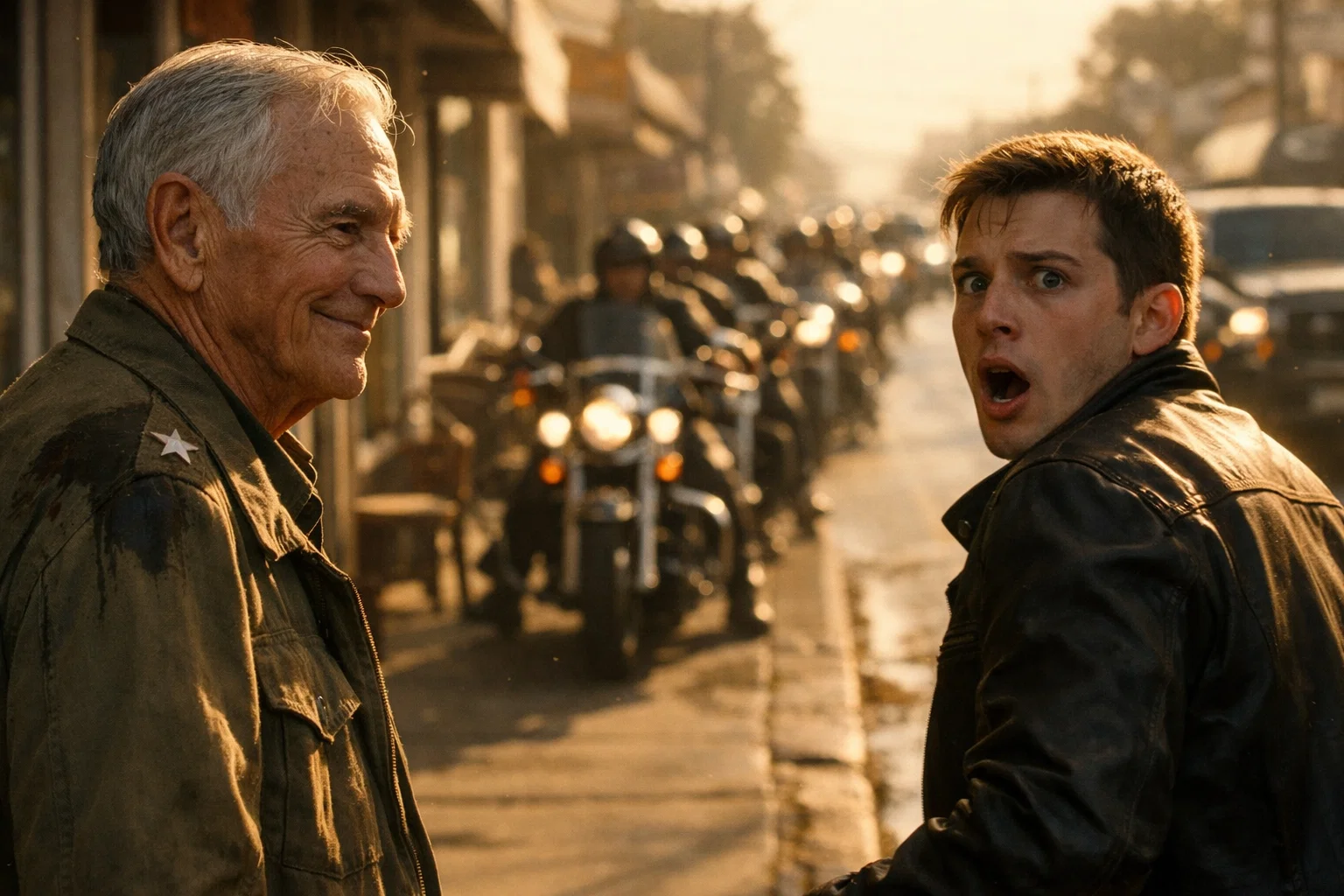
Captain Ryan Cole appeared from the reception line, hand extended, smile practiced.
Forty-two years old. His father’s son in build and posture. The kind of handsome that came from good genetics and a mirror that was consulted often.
“I’ll handle this,” Ryan told the aide.
He looked at Sam.
“Sir, I’m Captain Cole. I manage logistics for this event. Is there a problem?”
“No problem,” Sam said. “I have an invitation. Your aide appears to have misplaced my RSVP.”
Ryan took the invitation, examined it.
“I see.” He handed it back. “Mr. Mercer, this is a black-tie military event. Our attendees are active and retired officers, decorated veterans, and their families.”
He paused just long enough.
“Perhaps there’s been a misunderstanding about the nature of the evening.”
Sam held very still.
“I’m a veteran,” he said.
Ryan’s eyes moved to the medals — old, worn, the ribbons faded.
“Of course.” The tone didn’t change. “But our seating is pre-assigned, and without a confirmed reservation, I’m afraid we can’t—”
“I came for the wall dedication,” Sam said. “Daniel Hayes. His name is being added tonight.”
Something flickered in Ryan’s expression.
“Daniel Hayes was a private who served in Vietnam,” Sam continued. “We were in the same unit.”
Ryan studied him.
“Your name is on the list or it isn’t, sir. I’m going to have to ask you to wait outside while we check.”
Sam didn’t move.
“I’ve been waiting for forty-two years to see his name on a wall. I’ll wait ten more minutes.”
Ryan walked away without answering.
Sam was left near the entrance while the gala swirled around him, untouched and unseeing, the way crowds have always treated old men in bad suits.
He looked at the wall of photographs near the entrance.
Service members. Wars he’d fought in. Wars he’d watched on the news from his couch years later.
He found Daniel’s photograph without looking hard.
Still twenty-one. Still smiling.
Sam pressed two fingers lightly against the edge of the frame.
“I made it,” he said under his breath.
Ryan returned in twelve minutes. He had someone else with him this time. A harder-looking aide with a radio on his belt.
“Mr. Mercer,” Ryan said, “we’ve confirmed that your RSVP was never received. Unfortunately, the event is at capacity. I’m going to have to ask you to—”
“Who invited me?” Sam asked.
Ryan paused.
“The invitation was sent by General Cole’s office. General Marcus Cole.”
Something moved through Ryan’s face.
“My father’s office sends hundreds of—”
“Call him,” Sam said.
“The General is occupied with—”
“Call him.”
Ryan’s jaw tightened.
“Sir, I won’t be spoken to like—”
“Then speak to your father,” Sam said. “Or I’ll find him myself.”
Ryan’s composure didn’t crack. It just iced over.
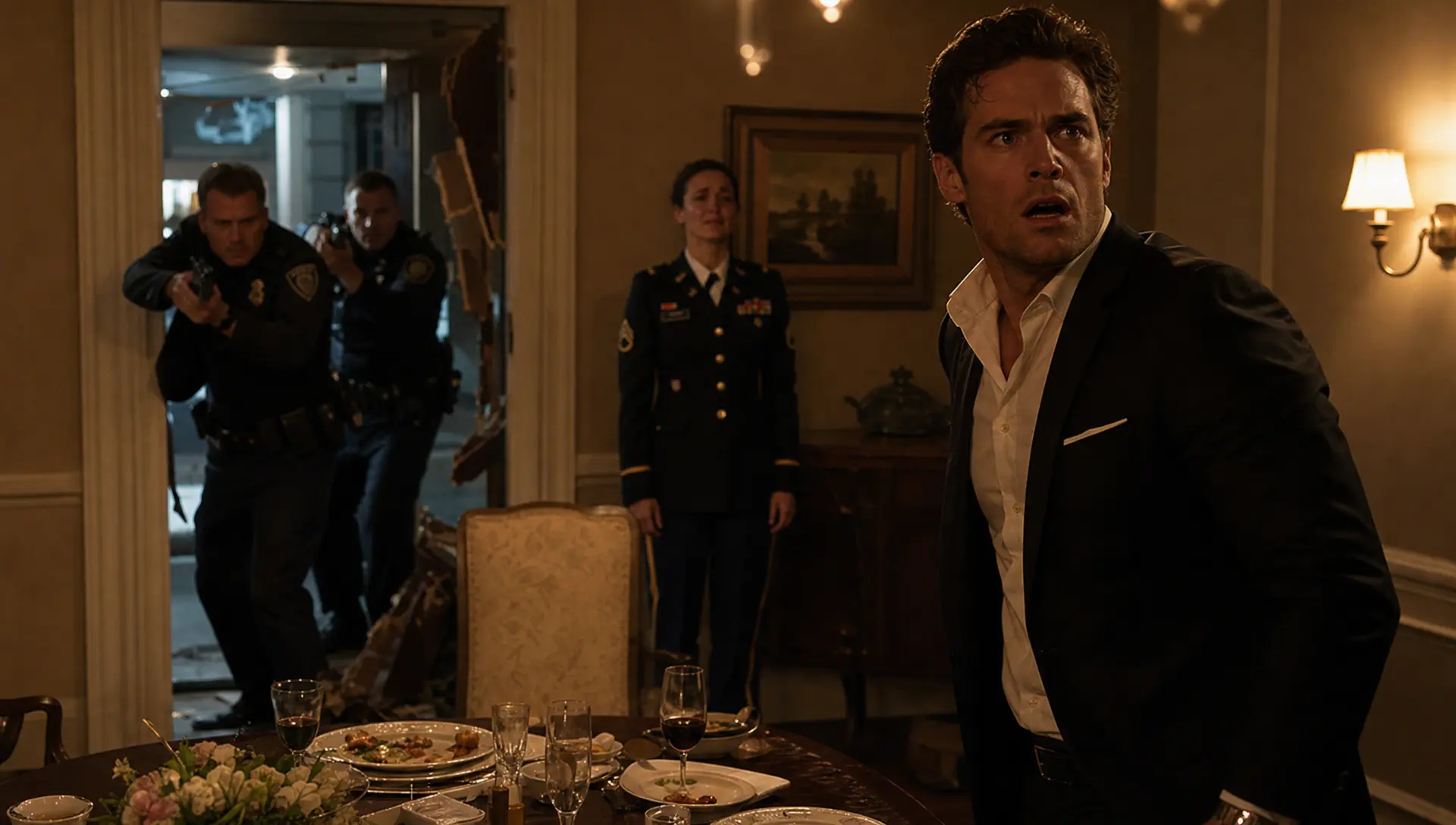
“Escort him out,” he said to the aide.
The aide reached for Sam’s arm.
Sam looked down at the hand on his sleeve. Then up at the aide.
“Son,” he said quietly, “I’ve been escorted out of worse places by better people.”
The aide hesitated.
“Let him go,” said a voice.
The room had been loud a moment ago. Now it wasn’t.
A man stood at the edge of the entrance hall. Seventy years old. Four stars on his collar. A chest of decorations that took ten years to earn and a face that had earned every one of them.
General Marcus Cole.
He was staring at Samuel Mercer.
And his face had gone completely white.
“Sam,” he said.
One word. Barely audible.
The aide stepped back.
Ryan turned.
“Dad—”
Marcus walked past his son as if Ryan weren’t in the room.
He stopped three feet in front of Sam.
The two men looked at each other for a long moment.
Then Marcus Cole, four-star general, offered his hand.
“I thought you were dead,” he said.
“Almost,” Sam said, and took it.
Marcus didn’t explain to the room. He didn’t need to.
He simply put one hand on Sam’s shoulder and steered him inside, and the crowd parted the way crowds part for generals — without thinking about it.
Ryan followed three steps behind.
His expression was unreadable.
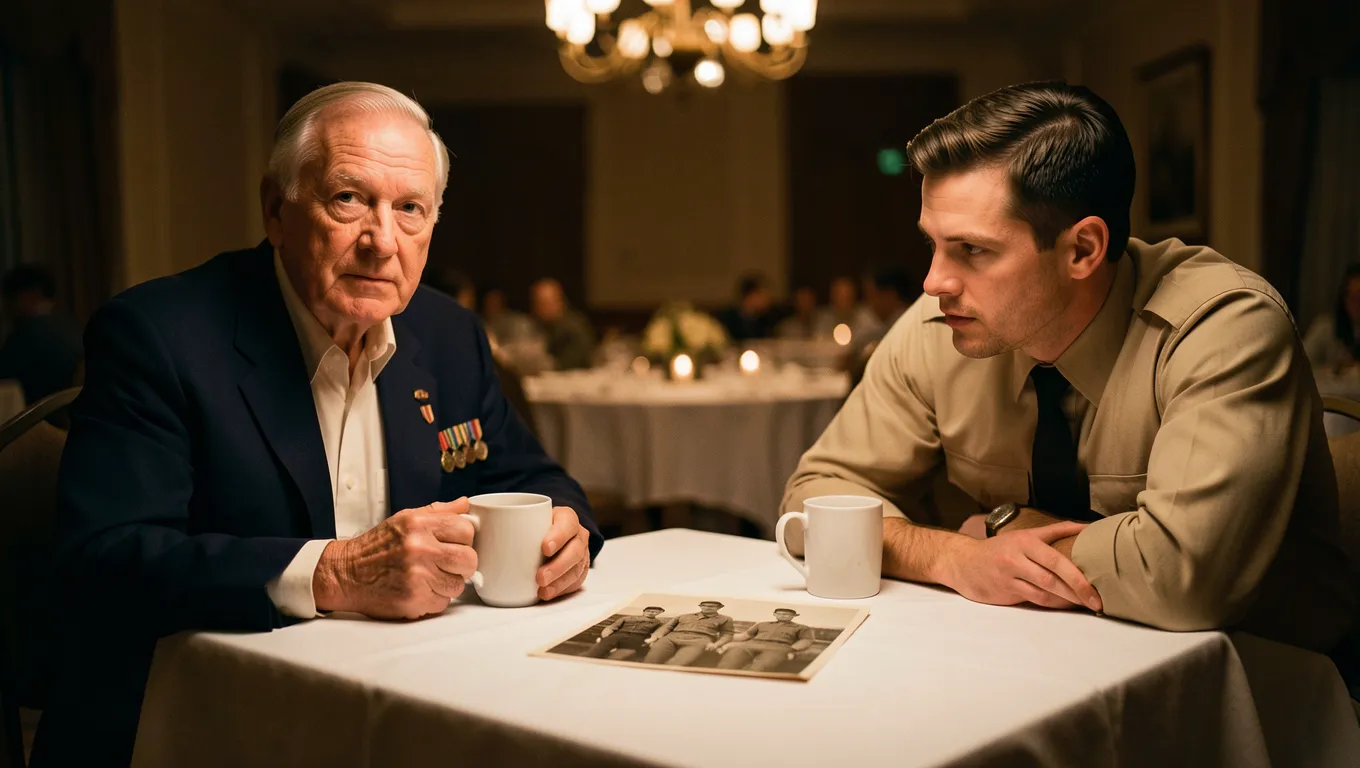
They sat at a round table near the back. Not because Sam was unimportant. Because Marcus had pulled two chairs away from the head table and said, we’ll be here, and no one had questioned him.
“I sent that invitation eight months ago,” Marcus said.
“I know. Carol had to talk me into coming.”
“Carol?”
“My neighbor.” Sam almost smiled. “She thinks I don’t get out enough.”
“She’s right.” Marcus looked at him. “I’ve been trying to find you for fifteen years. The VA had two different addresses.”
“I moved. Twice.”
“Where?”
“Linden, New Jersey. Same house for eleven years now.” Sam looked at him. “You could’ve called information.”
Marcus laughed — a short, surprised sound.
“I could have.”
Ryan appeared beside the table.
He stood at the edge of it like a man deciding whether to knock.
“Dad.”
Marcus looked up.
“This is the veteran you invited? Samuel Mercer?”
“Yes.”
Ryan’s eyes moved to Sam.
“You could have said that at the door.”
Sam looked back at him.
“Would it have mattered?”
Ryan didn’t answer.
“You looked at my suit,” Sam said. “You looked at my medals. You looked at my hearing aid. And you made your decision.”
Ryan’s jaw was tight.
“I was doing my job.”
“Your job was to read a list,” Sam said. “What you were doing was something else.”
The room quieted for the program.
A colonel stood at the podium and began to speak about service, sacrifice, and the debt owed to those who could no longer collect it.
Sam listened with his hands folded on the table.
Marcus sat beside him and said nothing.
When the colonel reached the part about Daniel Hayes — age twenty-one, 1st Battalion, 5th Marines, killed in action October 14, 1973 — Marcus felt Sam’s hands tighten on the table.
“You okay?” Marcus said quietly.
“No,” Sam said. Just as quietly.
“Good. Me neither.”
The dedication took three minutes.
A name was added to a wall.
A spotlight found it.
The room applauded.
Sam didn’t applaud. He looked at the name until the spotlight moved and Daniel Hayes became letters in the dark like all the other letters.
Then he reached inside his jacket and took out a photograph.
He set it on the table between himself and Marcus.
Three soldiers. 1973.
Marcus looked down at it.
Something crossed his face that wasn’t quite grief and wasn’t quite relief. It was the expression of a man who has been carrying something for a very long time and has just set it down for one second.
“God,” Marcus said softly.
“Yeah.”
“That’s—” Marcus pointed. “That’s the night before.”
“Yes.”
“You still have it.”
“Never threw it out,” Sam said.
Ryan had come back to the table. He stood behind his father’s chair, looking at the photograph.
“Who are they?” he said.
Marcus pointed.
“That one is me.” He moved his finger. “That one is Daniel Hayes.”
He stopped.
Ryan looked at the third soldier.
Then at Sam.
Sam looked back at him and said nothing.
Ryan’s face changed.
Marcus spoke to the room because the room had already begun to notice.
He didn’t ask for the microphone. He didn’t stand at the podium.
He simply stood at the table and the colonel, recognizing the uniform, yielded the room.
“Most of you don’t know Samuel Mercer,” Marcus said. “That is the military’s failure, not his.”
The room was quiet.
“In October of 1973, our position was overrun before 0400. Seven men. We were surrounded. I was hit in the first wave. I was down and I was going to stay down.” He paused. “Samuel Mercer didn’t agree.”
He looked at Sam.
“He carried me out under fire. Then he went back.”
Someone at a nearby table said something under his breath.
“Twice,” Marcus said. “He went back twice. We lost Daniel. But he got four others out.”
Sam looked at the table.
“The reason there is a General Marcus Cole standing in this room,” Marcus said, “is because a corporal named Samuel Mercer decided that leaving was something he was not willing to do.”
He stopped.
The room was very still.
“Tonight I found him near the entrance of this building being turned away. And I am ashamed of that. And I want you all to know that.”
He looked at Ryan.
Ryan looked like a man who had just watched the floor open under him.
The aide with the radio badge had quietly disappeared.
Ryan stood at the edge of the table.
His father had stopped speaking. The room was watching.
Ryan looked at Sam.
“I didn’t know,” he said.
“No,” Sam said.
“I want to say—”
“Captain.”
Ryan stopped.
“The question isn’t whether you knew,” Sam said. “The question is whether it would have mattered.”
Ryan’s throat moved.
“I’d like to think it would have.”
“Then think about why you’re not sure,” Sam said. “That’s the part worth keeping.”
Ryan lowered his chin.
“Yes, sir.”
He hadn’t called anyone sir all evening who didn’t outrank him.
After the program, after the photographs, after the handshakes, Marcus found Sam standing near the wall.
Looking at Daniel’s name.
“He talked about going home and opening a diner,” Sam said.
Marcus stood beside him.
“I remember. He had the whole menu planned out.”
“Apple pie on Fridays.”
“He said his grandmother’s recipe.”
“He was twenty-one years old and he had his grandmother’s apple pie recipe memorized.” Sam shook his head slowly. “I’ve thought about that pie for forty years.”
Marcus was quiet for a moment.
“He would’ve made a good diner man.”
“He would’ve made a good everything,” Sam said. “He didn’t get the chance.”
They stood in silence.
“I’m sorry I lost you,” Marcus said finally.
“I wasn’t lost,” Sam said. “I was in Linden, New Jersey.”
“You know what I mean.”
“I do.” Sam turned from the wall. “But it doesn’t need an apology, Marcus. We all went home to different lives. That’s the way it works.”
“You should have been found,” Marcus said.
“Maybe.” Sam looked around the room — the uniforms, the decorations, the polished shoes. “But I wasn’t sure any of this was my world.”
“It’s your world more than anyone’s in here.”
“That’s a kind thing to say.”
“It’s a true thing to say.”
Ryan came back.
He wasn’t in his dress uniform jacket anymore.
He’d taken it off and folded it over his arm, the way men sometimes do when they’re trying to be smaller than their rank.
“Mr. Mercer,” he said. “I’d like to sit with you if you’re willing.”
Sam looked at him.
“Why?”
“Because I want to understand what you actually did.” Ryan paused. “Not the official version. What it actually was.”
Sam regarded him for a long moment.
“It was dark,” Sam said. “And cold. And loud. And after it was over, it wasn’t any of those things anymore. It was just quiet.”
“Will you tell me?”
Sam glanced toward the wall. Toward Daniel’s name.
“That,” he said, “is what I came here to do.”
They sat until the catering staff began folding the cloths off the empty tables.
Ryan listened. He didn’t speak, except to ask questions, and the questions he asked were good ones. He wasn’t performing humility. He was inside the story.
When Sam got to the part about the second trip back — the one where he’d found Daniel already down — Ryan’s jaw tightened and stayed tight.
“I told him to hold on,” Sam said.
He said it like he’d said it ten thousand times in private.
“He held on for about twenty minutes. Then he didn’t.”
Ryan said nothing.
“I couldn’t carry him out and get to cover,” Sam said. “That’s just math. I did the math wrong the first time and I sat with him until it was wrong in a different way.”
Ryan’s eyes were wet.
He didn’t look away from Sam.
“After,” Sam said, “I went back for your father.”
Ryan nodded slowly.
“He was conscious. Scared. He told me he had a son at home.” Sam looked at Marcus, who was standing nearby with two cups of coffee. “He told me that like a bargaining chip. Like I’d work harder if I knew.”
Marcus stepped closer.
“Did it work?” Ryan asked.
Sam took one of the coffees.
“Son,” he said, “I was already working.”
Marcus set a coffee in front of Ryan.
“He didn’t need the motivation,” Marcus said. “Sam is the kind of man who makes a decision once.”
Ryan looked between them.
“And what was the decision?”
“Nobody gets left,” Sam said simply.
The three of them sat with that for a moment.
Ryan picked up his coffee.
“I had you removed from the building,” he said. “I told Daniels to escort you out.”
“You did.”
“You’re a man who went back twice in the dark for soldiers he didn’t have to go back for, and I had you removed from the building because your suit didn’t fit.”
“That’s accurate,” Sam said.
“I don’t know how to account for that.”
“You don’t have to account for it tonight,” Sam said. “Tonight you just have to know it.”
Ryan exhaled.
“I know it.”
“Then that’s something,” Sam said.
He wasn’t letting Ryan off easy. But he wasn’t keeping him down either. He was just telling him where they were.
Near midnight, the hall was mostly empty.
A trio of older veterans were still at a table in the corner, laughing about something.
The staff moved through in pairs, quiet and efficient.
Marcus stood at the wall, looking at Daniel’s name, his hands behind his back.
Sam stood beside him.
“You kept your promise,” Marcus said.
“I said I’d make sure he was remembered.”
“You’re here. That’s keeping it.”
Sam nodded slowly.
“What do you do now?” Marcus asked.
“Go home. Feed the cat. Sleep.”
Marcus smiled slightly.
“You have a cat?”
“I have a difficult cat. There’s a difference.”
Marcus laughed — the real kind this time.
“Can I come see you?”
Sam looked at him.
“In Linden, New Jersey?”
“Yes.”
“Why?”
“Because I missed forty years,” Marcus said. “And because I want to sit on someone’s porch and not be a general for an afternoon.”
Sam considered this.
“You’ll have to deal with the cat.”
“I’ll manage.”
“She scratches.”
“I’ve been scratched before.”
Sam held out his hand.
Marcus shook it.
“Next month,” Sam said.
“Next month,” Marcus agreed.
Ryan was waiting near the door.
His jacket was still over his arm. His tie was loosened exactly one knot.
When Sam reached him, Ryan straightened without quite snapping to attention — the instinct was there but he’d arrested it, like he’d decided this moment didn’t belong to rank.
“Mr. Mercer,” he said.
“Captain.”
Ryan reached into his breast pocket.
He held out a card.
“My direct line. Not the office. My cell.”
Sam took it.
“If there’s anything—” Ryan stopped. Started over. “If you ever need anything. Anything I can actually do. I’d like the chance.”
Sam looked at the card.
Then at Ryan.
“There’s a veteran’s history project out of Rutgers,” Sam said. “They collect first-person accounts. They’ve been trying to get me to sit down with them for three years.”
“I know the program,” Ryan said.
“They need funding.”
Ryan nodded, once, slowly.
“I’ll make a call tomorrow morning,” he said. “First thing.”
Sam put the card in his jacket pocket.
“That’ll do,” he said.
He walked past Ryan toward the exit.
At the door, he paused.
He didn’t turn around.
“Your father’s a good man,” Sam said.
He could feel Ryan’s attention behind him.
“The apple pie,” Sam said. “Daniel’s diner. You should build it.”
A long silence.
“I’m sorry?”
“Find a baker in your town who needs a space. Call it Hayes. Put a picture of him on the wall.” Sam opened the door. “He earned a name somewhere. Give him one.”
He walked out into the cold night without waiting for an answer.
Three months later, a small restaurant opened on Clement Street in San Francisco.
The sign above the door said HAYES.
On the wall inside, between a chalkboard menu and a photo of the Golden Gate, there was a framed photograph of three young soldiers. 1973.
Underneath, a small brass plate:
Private Daniel Hayes, USMC. He had his grandmother’s recipe memorized.
Every Friday, they served apple pie.
Samuel Mercer heard about it from Carol, who read about it in a local newsletter that someone had forwarded to someone who’d forwarded it to her.
He was on his porch when she showed him.
He read it twice.
He folded it and put it in his shirt pocket and finished his coffee.
“Well,” he said.
Carol waited.
“Took long enough,” he said.
Then he got up, went inside, and fed the cat.
Original fictional stories. AI-assisted creative content.