The bank manager said it with a smile that was not a smile.
“You’re in the wrong place, kid.”
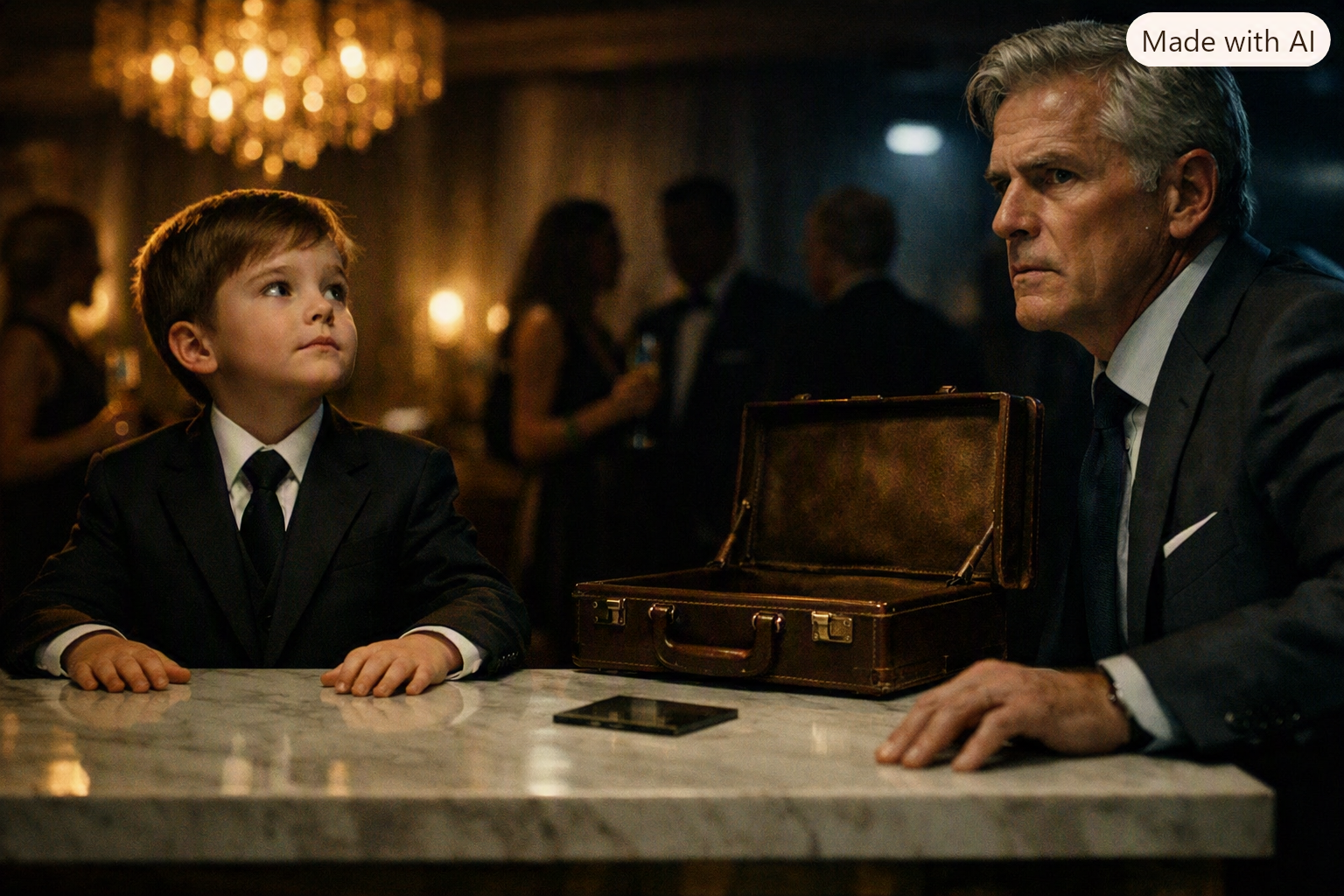
Richard Caldwell was the kind of man who wore contempt like cologne. Tall. Silver-haired. Twenty-five years behind a marble counter, learning how to flatter billionaires and erase anyone who didn’t look profitable.
He looked down at the boy.
The boy looked up at him.
Neither flinched.
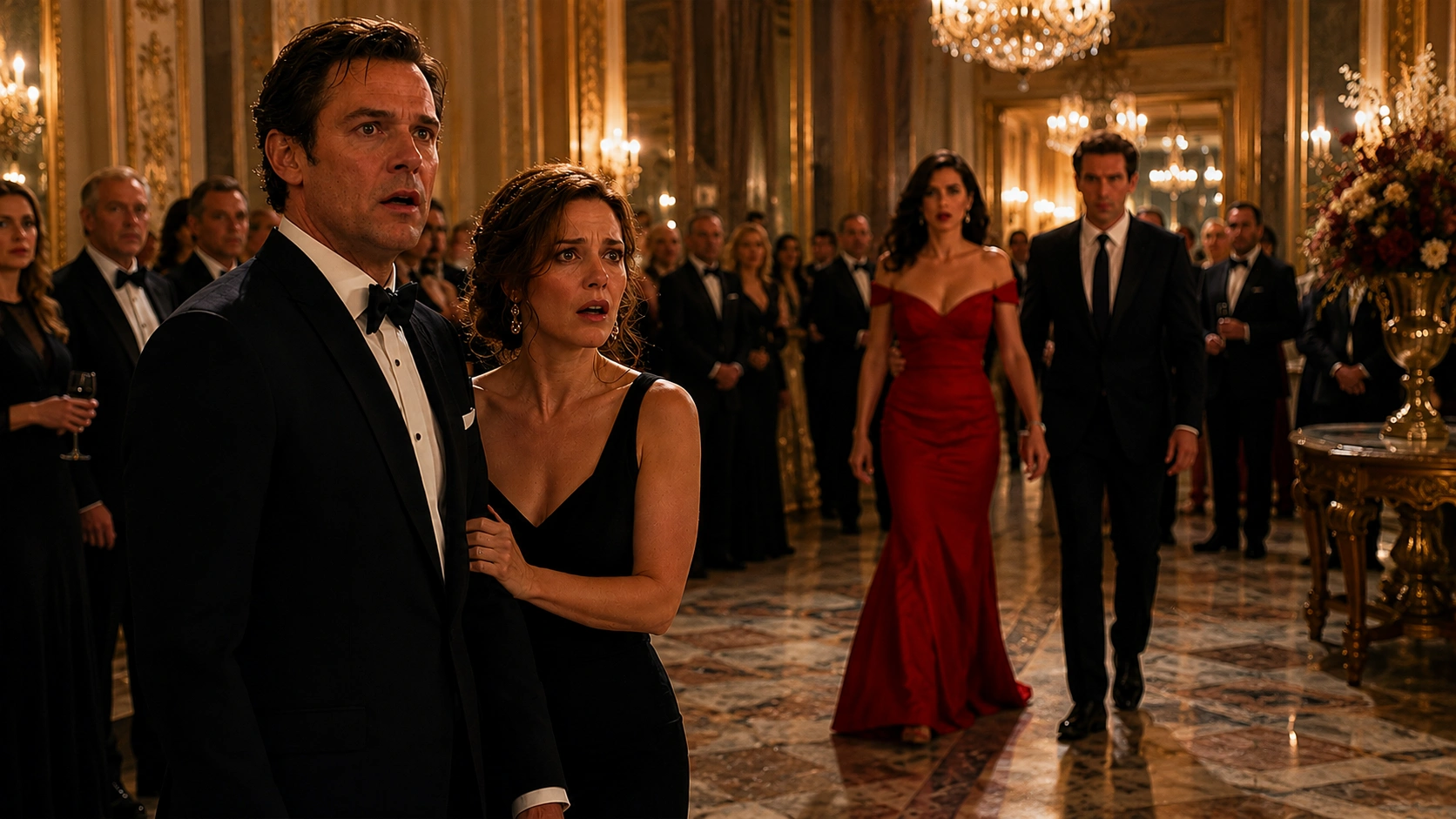
The grand lobby of Harrington Private Bank was dressed for its annual private client reception. Crystal chandeliers. White marble floors reflecting tailored suits and diamond watches. Champagne glasses held by people who knew exactly how important they looked.
No children.
No noise.
No ordinary people.
At least, that was what everyone believed.
But a seven-year-old boy stood at the main counter in a perfectly fitted black suit. Shoes shined. Hair combed. In front of him sat a vintage brown leather briefcase, worn at the edges, much too serious for a child.
Behind him, the room buzzed.
Soft laughter.
Lifted phones.
Whispered commentary.
The boy did not turn around.
“My grandpa opened this account,” he said calmly. “He passed away last week.”
Caldwell’s smile tightened.
“This place is for important clients.”
“I know.”
“Do you?”
“Yes.”
A beat.
“What is your grandfather’s name?”
“Arthur Whitcomb.”
The laughter grew louder.
Someone near the champagne table said, “Arthur Whitcomb didn’t have family.”
A woman in pearls lifted her phone. “This is adorable.”
The boy heard them.
His expression did not change.
Caldwell leaned over the counter with false patience dripping from every syllable. “Mr. Whitcomb was one of this bank’s most private clients. His estate is being managed through proper legal channels. A child cannot simply walk in here with a toy briefcase and ask for money.”
The boy’s eyes sharpened.
“It’s not a toy.”
Caldwell glanced at the briefcase.
“Then what is it?”
The boy opened it.
Inside were three things.
A sealed envelope.
A black metal bank card.
And a small photograph. A boy and an elderly man in flannel, standing beside a lake with fishing poles, both of them laughing.
Caldwell’s face flickered.
Only for a second.
But it was enough.
At the back of the room, near the far end of the champagne table, an elderly woman in a blue evening dress lowered her glass very slowly.
Her name was Margaret Whitcomb.
Arthur’s sister.
She had not spoken to her brother in eight years.
But she recognized the flannel shirt.
“Where did you get that card?” Caldwell asked.
“My grandpa gave it to me.”
“When?”
“Before the hospital.”
The crowd grew quieter now. The manager’s fingers tapped once against the marble.
“What is your name?”
“Oliver Whitcomb Reed.”
Caldwell almost laughed.
“Whitcomb Reed?”
“Yes.”
“You expect me to believe Arthur Whitcomb’s primary account belongs to a seven-year-old boy?”
Oliver did not blink.
“I didn’t ask you to believe me.”
A pause.
“I asked you to check.”
Caldwell gave an exaggerated sigh. The kind meant for an audience.
“Fine,” he said. “Let’s settle this little performance.”
He picked up the card. Inserted it. Typed.
The crowd leaned closer.
“Security phrase?”
Oliver answered without hesitation.
“Never mistake quiet for weakness.”
At the back of the room, Margaret Whitcomb inhaled sharply.
Caldwell’s fingers slowed.
He typed the phrase.
Pressed enter.
The screen changed.
One account opened.
Then another.
Then a trust structure.
Then holding companies.
Then private equity funds.
Then real estate portfolios.
Then voting shares.
Then a liquid balance so large the room seemed to lose oxygen.
Caldwell’s face drained of color.
His mouth opened.
“This can’t be—”
The laughter stopped.
Phones lowered.
Champagne glasses froze halfway to lips.
Caldwell stared at the numbers like they had personally accused him.
He turned slowly toward the child.
“Who are you?”
Oliver looked up at him.
Still calm. Still small. Still holding the briefcase his grandfather had given him.
“I’m the client you were told not to ignore.”
Caldwell’s hand moved toward the screen.
Oliver’s small hand moved first.
“Don’t.”
One word.
Quiet.
But it stopped the manager cold.
“Excuse me?”
Oliver slid the sealed envelope across the marble.
“Grandpa said if you tried to close it before everyone saw, I should give you this.”
Caldwell’s jaw tightened. “This is a private banking matter.”
Oliver looked around the crowded lobby.
“So was laughing at me.”
Silence dropped over the room like a curtain.
Before Caldwell could recover, Margaret Whitcomb walked forward from the back of the room. Her silver hair was pinned elegantly. Her posture was composed. But her eyes were not.
“Arthur wrote that?” she asked.
Oliver turned.
“Are you Aunt Margaret?”
She inhaled.
“He called me that?”
“He said you’d pretend not to cry.”
A laugh broke out of her. Small. Broken. Almost a sob.
“That old fool.”
Caldwell moved quickly around the counter. “Mrs. Whitcomb, this is not the time—”
Margaret did not look at him.
“Open the envelope.”
Caldwell froze.
“I strongly advise—”
“I said open it.”
For the first time that evening, the bank manager obeyed someone without smiling.
He broke the seal.
His hands were steady at first.
Then he began to read.
The color left his face line by line.
Margaret held out her hand. “Read it aloud.”
“No.”
Oliver reached into the briefcase and removed a second envelope. “This one’s for the bank chairman if he refuses.”
The bank chairman, standing near the champagne table, suddenly looked much less comfortable.
Margaret took the letter from Caldwell’s hand.
Her voice trembled as she read it aloud.
Richard — If you are hearing this in a public room, it means you did what I expected. You looked at my grandson and saw inconvenience. You saw a child without an entourage and assumed he had no power. That is the kind of mistake you always made when money was not wearing the correct shoes.
A low murmur moved through the room.
Margaret continued.
For five years, I watched you delay correspondence, misclassify transfers, alter access notices, and prepare the ground for my estate to be challenged the moment I died. You thought age made me careless. You thought illness made me weak. You thought a child would be easy to move aside. You were wrong on all three counts.
“This is slander,” Caldwell said.
Margaret kept reading.
Every irregularity has been documented. Every unauthorized hold has been copied. Every attempt to interfere with Oliver Whitcomb Reed’s trust has been sent to outside counsel, federal regulators, and the independent trustee. If you attempt to close the screen, delay recognition, challenge his identity without legal basis, or remove one dollar, the evidence becomes public before midnight.
She paused.
Then read the final line.
And Richard — if the room is laughing, let them finish. People reveal themselves best when they think no one important is listening.
The lobby went silent.
Caldwell stood behind his counter.
No longer a powerful banker.
Only a man whose smile had betrayed him before the evidence did.
Oliver reached into the briefcase again.
“There’s another letter.”
Margaret looked at him.
“For me?”
He nodded.
Her face crumpled.
She took the envelope carefully. Her fingers moved over Arthur’s handwriting like she was touching her brother’s face.
Near the champagne table, Caldwell whispered to the bank chairman, “This must be contained.”
Oliver heard him.
“My grandpa said you’d say that too.”
The chairman turned.
“He said people who say ‘contain’ usually mean ‘hide.'”
Margaret opened her letter.
The room was quiet enough to hear her breathe.
She read silently at first.
Then she lowered it.
Her eyes were wet.
“When did he write this?”
“Before the hospital,” Oliver said. “He made me promise not to read them.”
Margaret looked at the boy for a long moment.
Then she knelt down in front of him, not caring that broken glass from her dropped champagne flute glittered near her shoes.
“I’m sorry,” she whispered.
“For what?”
“For not finding you sooner.”
He looked down at the briefcase.
“Grandpa said grown-ups waste years waiting to be less wrong.”
Margaret laughed through tears.
“Yes,” she said. “He would say that.”
The bank chairman stepped forward carefully.
“Mrs. Whitcomb. We need to move this discussion upstairs.”
Margaret stood.
“No.”
He blinked.
“No?”
She looked around the lobby. At the frozen guests. The lowered phones. The guests who had laughed.
“At least half this room laughed at him.”
Several people looked away.
Margaret’s voice sharpened.
“They can stand here and learn how expensive arrogance becomes.”
Oliver turned to Caldwell.
“Am I allowed to check my balance now?”
Nobody moved.
The question was childish.
That made it devastating.
He was still seven.
A seven-year-old boy whose grandfather had died last week.
A boy who had walked into a marble lobby alone because the adults around him couldn’t be trusted to do the right thing first.
The chairman stepped behind the counter.
“Yes, Mr. Reed,” he said quietly.
Oliver looked at him.
“My name is Oliver.”
The chairman swallowed.
“Yes. Oliver.”
The screen was turned so the chairman, Margaret, Caldwell, and Oliver could all see it clearly.
The main account alone held more than most people in the room would see in ten lifetimes.
But that was only the surface.
The Whitcomb Family Trust.
The Reed Education Fund.
The Grace Carter Memorial Foundation.
Land holdings.
Voting shares.
Private companies.
Then one final line that made the chairman go very still.
“What is it?” Margaret asked.
He looked at Oliver.
Then at Caldwell.
Then back at the screen.
“Arthur transferred his voting shares in Harrington Private Bank into Oliver’s trust.”
Caldwell’s voice cracked.
“How many?”
The chairman didn’t answer.
Oliver did.
“Grandpa said twelve percent.”
The room inhaled.
Twelve percent didn’t sound like much to ordinary people.
But in a private bank with scattered shareholders and sleepy family holdings, twelve percent was power. Board power. Voting power. The kind of power that came with paperwork adults couldn’t laugh away.
Margaret looked at the chairman.
“And how many shares do I control?”
He hesitated.
“Eight percent.”
Margaret’s expression changed.
Arthur had known.
Of course he had.
Together, she and Oliver held enough to force an emergency board review.
Caldwell stepped back from the counter.
“This is absurd. A child cannot exercise voting control—”
“The trust can,” the chairman said quietly.
Oliver reached into the briefcase.
“There’s an envelope about that too.”
The chairman closed his eyes briefly.
Arthur had not missed a single move.
The guests no longer looked entertained.
They looked like students who had laughed at the wrong person before realizing who was teaching the class.
The same people who had aimed their phones at a small boy now watched as that boy’s hand pulled document after document from the briefcase like cards from a magician’s deck.
Except this was not magic.
It was planning.
Grief.
Evidence.
Love turned into legal structure.
Within twenty minutes, the reception ended without anyone announcing it.
Champagne glasses were abandoned on trays.
Security closed the doors.
And Richard Caldwell was escorted to a private office by the bank’s outside counsel.
He did not smile once on the way out.
In the weeks that followed, the investigation uncovered exactly what Arthur’s letter had promised.
Five years of delayed correspondence.
Misclassified transfer records.
Three unauthorized holds on trust assets.
Documentation altered to create legal ambiguity around Oliver’s inheritance.
Caldwell had never expected to be caught because he had never expected a seven-year-old to walk through the door.
He was charged with financial misconduct, attempted fraud, and obstruction tied to protected trust assets.
The bank paid penalties.
Issued apologies.
The first one used the phrase “unfortunate misunderstanding.”
Margaret sent it back with two words:
Try again.
The second version was better.
Oliver returned to school under privacy protections.
He still wore ordinary clothes.
Still liked pancakes.
Still asked too many questions at the wrong moment.
Margaret moved into the guest room at Arthur’s farmhouse “temporarily.”
Two years later, she was still there.
She learned to make pancakes badly.
Oliver learned to pretend they were improving.
Together, they created the Grace Reed Children’s Trust, named for Oliver’s mother. It provided legal advocacy for children whose inheritances and family assets had been stolen or delayed by adults who assumed children were too powerless to fight back.
Oliver insisted on one rule.
“No grown-up gets to laugh at a kid asking for help.”
The lawyers translated it into formal policy.
Margaret kept his version framed on the wall.
On Oliver’s tenth birthday, she gave him a final box Arthur had left behind.
Inside were not numbers or legal documents.
It was a stack of handwritten birthday letters.
One for every year until Oliver turned eighteen.
The first envelope read:
For Oliver, age 10.
His hands shook as he opened it.
Oliver — If you are reading this, Maggie found the box, which means she is less stubborn than she looks. At ten, you are old enough to know that money makes people louder, but not always wiser. Do not confuse the two. You may own things now that adults will tell you are important. Some are. Most are not. Important things are usually quieter. A good friend. A safe home. A person who tells you the truth even when it costs them. And tomatoes. Never trust a man who dislikes tomatoes. — Grandpa Art.
Oliver laughed and cried at the same time.
Margaret did too.
This time, she didn’t pretend it was allergies.
Years later, people still told the story of the night a little boy walked into Harrington Private Bank with a leather briefcase and asked to check his balance.
They remembered the marble counter.
The cruel manager.
The laughing crowd.
The screen full of impossible numbers.
The moment everyone in that lobby realized the child they had mocked held more power than the adults surrounding him.
But Oliver remembered something different.
He remembered his grandfather’s security phrase.
Never mistake quiet for weakness.
He remembered Margaret kneeling beside broken glass.
He remembered wanting to cry but holding it together until someone finally looked at him like a boy instead of a fortune.
And he remembered Richard Caldwell’s face when the numbers appeared.
Not because it made Oliver feel powerful.
But because it taught him what Arthur had tried to explain long before.
Money does not change what people are.
It reveals what they already believed they could get away with.
That night, Richard Caldwell looked at a seven-year-old child and saw someone small enough to humiliate safely.
He was wrong.
Oliver was small.
He was grieving.
He was frightened.
But he was not powerless.
And by the time the bank manager understood that, every person in that marble room had already gone silent.
Original fictional stories. AI-assisted creative content.