I was standing under a paper archway in the Springfield community hall when the double doors opened and the music stopped.
Every person in the room turned.
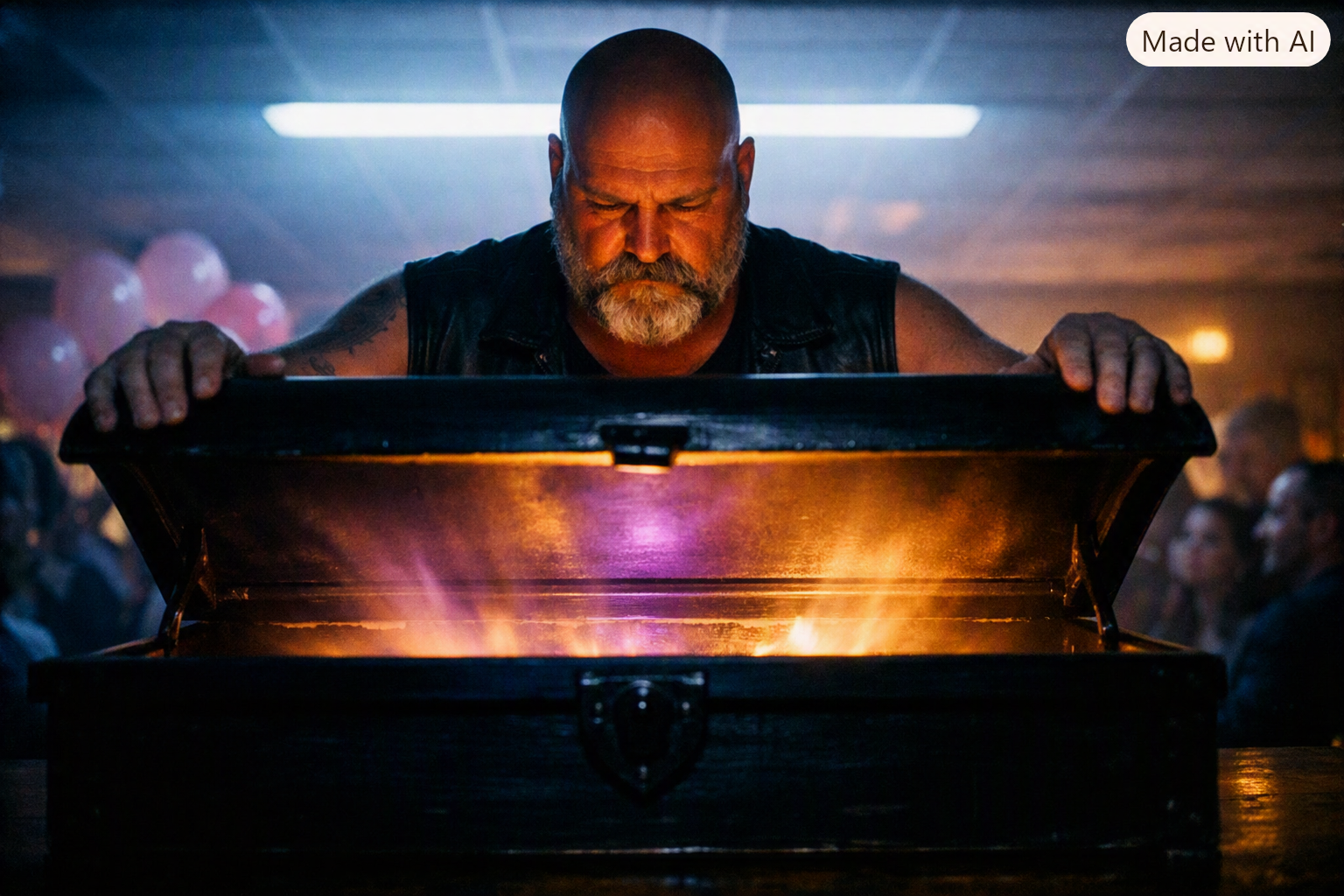
Ray Dawson entered backward, gripping two brass handles on a narrow black box. Six-four, 285 pounds, shaved head, forearms thick with ink. His plain leather vest had pale stitch marks where a back patch used to sit.
Behind him came six more men in leather and heavy boots.
The box was four feet long. It had a curved lid. Silver stars across black paint.
It looked exactly like a coffin sized for a child.
Someone dropped a plate. A little boy started crying before his mother swept him behind her.
My sister grabbed my arm. “Laura. What is that?”
I already knew who Ray was. Six weeks earlier, I had told him never to come near my daughter again.
He had ignored me.
Ray carried the box past pink balloons and a castle cake and set it on two wooden stands in the center of the hall. A father stepped forward. “What is wrong with you? This is a child’s birthday party.”
Ray said nothing.
Another parent had his phone out. “I’m calling the police.”
My brother moved between Ray and Maisie.
Ray didn’t argue. He removed his leather gloves, folded them and placed them on the lid.
“I told you not to come,” I said.
“Yeah.”
“You brought that to an eight-year-old’s party?”
“Had to carry it in something.”
“A coffin?”
“Transport case.”
“It has funeral handles.”
“Only handles Frank had.”
That was how Ray spoke. No extras.
I crossed the room. “What did you tell my daughter?”
“Nothing she didn’t design.”
He reached inside his vest and removed a folded sheet of notebook paper. I recognized Maisie’s handwriting before he opened it—uneven purple letters, small crowns in the margins. A list titled THINGS MY CHAIR NEEDS IF GROWN-UPS WOULD LISTEN.
I had never seen that page.
Ray had.
At the bottom was a drawing of a wheelchair like a princess throne, with glowing wheels and a secret pocket. Beside it, a biker with a square beard holding a wrench. One name written above him.
HAMMER.
“Where did you get that?” I asked.
“Your mailbox.”
Maisie raised her hand from her broken chair. “I gave it to him.”
“You were told not to contact him.”
“I didn’t talk. I mailed it.”
A few nervous laughs escaped the room, but I couldn’t join them. My daughter had been secretly communicating with a man I had banned, and now he stood beside a black box large enough to hold her body.
Ray reached for the first latch.
My brother caught his wrist.
Six bikers shifted. Leather creaked. A silence fell across the hall.
Ray looked at my brother’s hand on his arm.
“Let go,” he said.
My brother let go.
Ray opened the first latch. Then the second. The sound was small, but every person heard it.
He placed both hands under the curved lid and lifted.
The black panels opened outward.
Silver fabric caught the light. Two large wheels appeared, painted deep purple with gold stars in the spokes. Above them stood a high-backed seat shaped like a princess throne—medical supports, safety straps, a silver headrest embroidered with Maisie’s initials. A crown-shaped control panel sat beneath the right armrest. Soft lights lined the wheel rims. Behind the seat, someone had painted a small road disappearing toward a sunrise.
It was not a coffin.
It was a wheelchair.
Not a costume. Not a toy. A full custom mobility system built to fit my daughter’s body—the princess carriage she had drawn after the insurance company denied her replacement chair for the third time.
The parents who had been shouting went quiet.
Maisie stared at it with her mouth open.
Then she saw the small metal plate fixed beneath the footrest. The excitement left her face.
“Mom,” she whispered. “Why does it have Dad’s handwriting?”
I stepped closer.
Five words had been engraved into the steel.
BUILD HER SOMETHING THAT MOVES.
My husband Daniel had written those words eleven days before he died.
Only two people had ever seen them.
I was one.
Ray Dawson was the other.
Ray reached into a hidden compartment beneath the seat and removed a sealed envelope bearing Daniel’s name.
“Chair’s only half the promise,” he said.
I could barely speak. “What is the other half?”
“Read the letter.”
Daniel had written my name on the front. Beneath it: NOT UNTIL SHE CHOOSES THE CHAIR.
Maisie rolled her broken wheelchair forward. “I choose it.”
“You haven’t sat in it.”
“I chose it when I drew it.”
That made me angry again. “You let an eight-year-old decide?”
Ray looked at me. “Her chair.”
“She is a child.”
“Still her chair.”
Dr. Priya Shah stepped in from a side entrance carrying medical forms. She had inspected the brakes, frame locks and pressure settings before the party. She checked them once more, quietly.
“Approved,” she said.
One word changed the object from a garage project to a medically reviewed mobility device.
We transferred Maisie into the seat.
The cushion settled beneath her. Her shoulders leveled for the first time in months. She moved the control stick forward, circled the black transport case and drove toward the cake. The gold stars revolved around her in the light.
The children who had been hiding behind their parents stopped hiding.
They followed her.
One boy asked if the lights could flash. Another wanted to know what was in the secret compartment.
Maisie pressed the brave-sound button.
A Harley’s low, uneven engine note filled the community hall—three full seconds of it.
Then the control panel spoke.
Not a machine voice.
Daniel’s voice.
“Easy on the corners, Bug.”
Maisie froze.
So did I.
Ray stepped back as if he had been struck.
I grabbed the armrest. “What did you put in this chair?”
“Wasn’t me.”
Daniel’s voice came again, quieter under a hiss of hospital-room noise.
“If you’re hearing this, Hammer ignored at least six good reasons to quit. Before your mother blames him, open the envelope.”
Every face in the room turned toward me.
My hands barely broke the seal.
The letter was not a farewell.
It was a confession.
Three weeks before his death, Daniel had gone to Ray’s shop without telling me. I had blamed the visit on the cut across his thumb and a faint smell of motor oil. He told me he had been leaving instructions for something that moves.
I had thought he meant paperwork.
He had meant a wheelchair.
On a cold March afternoon, Ray secured Daniel in a sidecar and drove him to the repair shop at less than thirty miles per hour—four miles from the hospice, no faster, a nurse waiting inside. Wade followed in a pickup with Daniel’s oxygen.
Nothing about the ride was careless.
Everything had been planned.
Daniel had wanted to record instructions sitting beside the unfinished frame. He wanted the sounds around him to be tools and rolling wheels, not hospital machines.
For forty-three minutes he described what Maisie needed. Not measurements—those were already written. He described how she hid snacks under her left thigh. How rain frightened her after a flood in our first apartment. Why every chair needed a pocket within reach of her stronger hand.
He told the bikers never to put his photograph on the backrest.
“She needs people looking at her,” he said on the recording. “Not at the dead man behind her.”
Then Daniel recorded three messages for the control panel.
“Easy on the corners, Bug.”
“Ask where she wants to go.”
And the last one:
“Movement counts.”
Ray had objected to the voice recordings. He believed they would tie Maisie to grief. Daniel agreed to a condition: the recordings would live inside a removable silver module. Maisie alone would decide when to keep, change or erase them. The silver crown Ray had given her outside school was the release key.
The chair belonged to her.
Even its memories.
Before leaving the shop, Daniel scratched BUILD HER SOMETHING THAT MOVES into a thin steel plate. His grip failed twice. Ray offered to finish the letters.
Daniel refused.
That explained why the final word slanted downward.
The last pages of Daniel’s letter were addressed to me.
He knew I would blame Ray for the ride. He had asked Ray to keep the details private because he feared I would stop the project if I learned he had spent his limited strength in the workshop.
He was right.
“I have asked him to carry your anger,” Daniel wrote, “because he is strong enough to stand near it. That does not make it fair.”
I lowered the letter.
Ray stared at the black case.
“You could have told me after the funeral,” I said.
“Promised not to.”
“He knew I would hate you.”
“Yeah.”
“And you agreed?”
“Yeah.”
“Why?”
Ray looked at Maisie testing the turning radius between the tables. “Needed the work finished.”
For five months, he had accepted my accusation because defending himself required breaking Daniel’s final confidence. He had lost his club patch, customers and motorcycle without offering the one explanation that could have protected him.
Then the rear doors of the hall opened.
A thirty-eight-year-old Army veteran entered on forearm crutches. Captain Elena Ruiz—one of Daniel’s former rehabilitation patients, her spine injured by a roadside bomb in Afghanistan. Ray had later built adaptive hand controls for her trike.
She had seen Ray’s Harley listed online.
She had bought it with money collected from nineteen former patients Daniel had treated.
The motorcycle had never gone to Tulsa.
It had been waiting in the parking lot.
Club members rolled the midnight-blue Road King through the rear doors. Afternoon light fell across the tank. Every person who had contributed had signed the underside of the seat where Ray could not erase their names.
Ray stared at it.
“You knew?” he said to Wade.
“Found out yesterday.”
“Money—”
“Paid.”
“Not mine.”
Elena moved forward on her crutches. “Neither was the chair.” She nodded toward Maisie. “Didn’t stop you.”
He had no answer.
Wade stepped forward holding Ray’s old Iron Mile Riders patch folded across both hands. “We should’ve waited for the truth. We judged you while you were keeping a promise. Patch won’t erase that.”
“No.”
“It can tell people where we stand now.”
Ray looked at the worn fabric. One corner had been repaired with black thread. The road-captain bar was gone.
He placed his folded gloves on the coffin-shaped case and picked up the patch.
He did not put it on.
Instead, he walked behind Maisie’s chair, opened the secret compartment and slid the folded emblem inside.
“Safe there,” he said.
Maisie looked over her shoulder. “You’re supposed to wear it.”
“Needs stitches.”
“I have tape.”
Maisie fixed the patch to the back of his vest with the same purple tape that had been holding her old armrest together. It was crooked. One corner curled up.
Nobody corrected her.
Then Maisie took the silver crown key, slid it beneath the control panel and removed Daniel’s voice module.
She held it for several seconds.
I was afraid she would erase it.
Instead she opened the secret compartment and placed the module beside Ray’s patch.
“I don’t need Dad to tell me every turn,” she said. “Just the hard ones.”
Ray lowered his head.
His left hand began to shake.
That was all.
The black transport case never returned to the funeral home. Maisie refused to let anyone dismantle it or take it away. She said it had frightened everyone because nobody knew what was inside, and that meant the box needed a new job.
The Iron Mile Riders carried it to Dawson Cycle Works. Ray cut the curved lid lengthwise and mounted both halves against the wall. One became a folding workbench. The other became a low design table for children in wheelchairs.
The brass handles remained.
So did the silver stars.
Every Thursday evening, families brought damaged mobility equipment to the shop. Ray tightened frames and replaced worn tires. Priya inspected medical components. Marlene kept records and refused to let the bikers call precision machining “hammering until it behaves.”
They named the project Move Night.
Nobody paid.
A ten-year-old boy donated the wheels from his outgrown chair. Maisie sat at the black design table and asked each child the question Daniel had insisted adults remember.
“Where do you want to go?”
Five years later, Maisie returned to the Springfield community hall. Thirteen, no balloons. Her princess chair was gone—replaced by a lighter graphite system for school corridors and the adaptive basketball team she had joined the previous winter. The original purple wheels hung above Ray’s workbench at Move Night.
The silver footplate remained.
So did Daniel’s crooked engraving.
Ray arrived late on the midnight-blue Road King. His beard had turned almost white. He needed several seconds to straighten after lowering the kickstand. His vest still carried the Iron Mile Riders patch—Maisie’s purple tape long since replaced by proper stitching.
Beneath it, Maisie had added a narrow purple strip.
It read DESIGN DEPARTMENT.
Twenty-three repaired chairs and walkers stood in two rows where the black box had once rested.
Near the cake table sat a frightened six-year-old girl in a gray hospital chair. Adults explained the brakes, the supports, the lighter frame. The child shook her head harder each time.
Maisie rolled forward.
She did not tell the girl to be brave. She did not say the chair would change her life.
She pressed a button beneath her armrest.
Three seconds of an old Harley’s uneven engine note filled the hall.
The girl looked up.
Maisie pointed toward Ray. “That sound came from his motorcycle. He sold it because my chair needed a cushion.”
Ray folded his arms. “Got the bike back.”
“Eventually.”
The little girl studied him. “Did you build mine too?”
“Helped.”
“Is it scary?”
Ray looked at the bright green wheels and padded seat. “Only if you don’t pick the color.”
The child reached out and touched one wheel.
Then the other.
A few minutes later she crossed the hall under her own control while her mother walked behind her crying quietly into both hands.
Ray watched from the doorway. He never stepped into the photographs.
Before he left, Maisie opened the compartment beneath her seat and took out Daniel’s silver voice module. She had not played it in almost two years.
She clicked it into the control panel.
Her father’s voice returned, faint and clear.
“Ask where she wants to go.”
Maisie looked toward the little girl circling near the doors.
“Where do you want to go?” she called.
The child pointed through the open doors.
“Outside.”
Ray started the Road King. The low V-twin pulse entered the hall, mixing with the smaller electric sound of two wheelchairs moving toward daylight.
This time, nobody pulled their children away.
Original fictional stories. AI-assisted creative content.