Martha’s cloth hit the marble before her knees did.
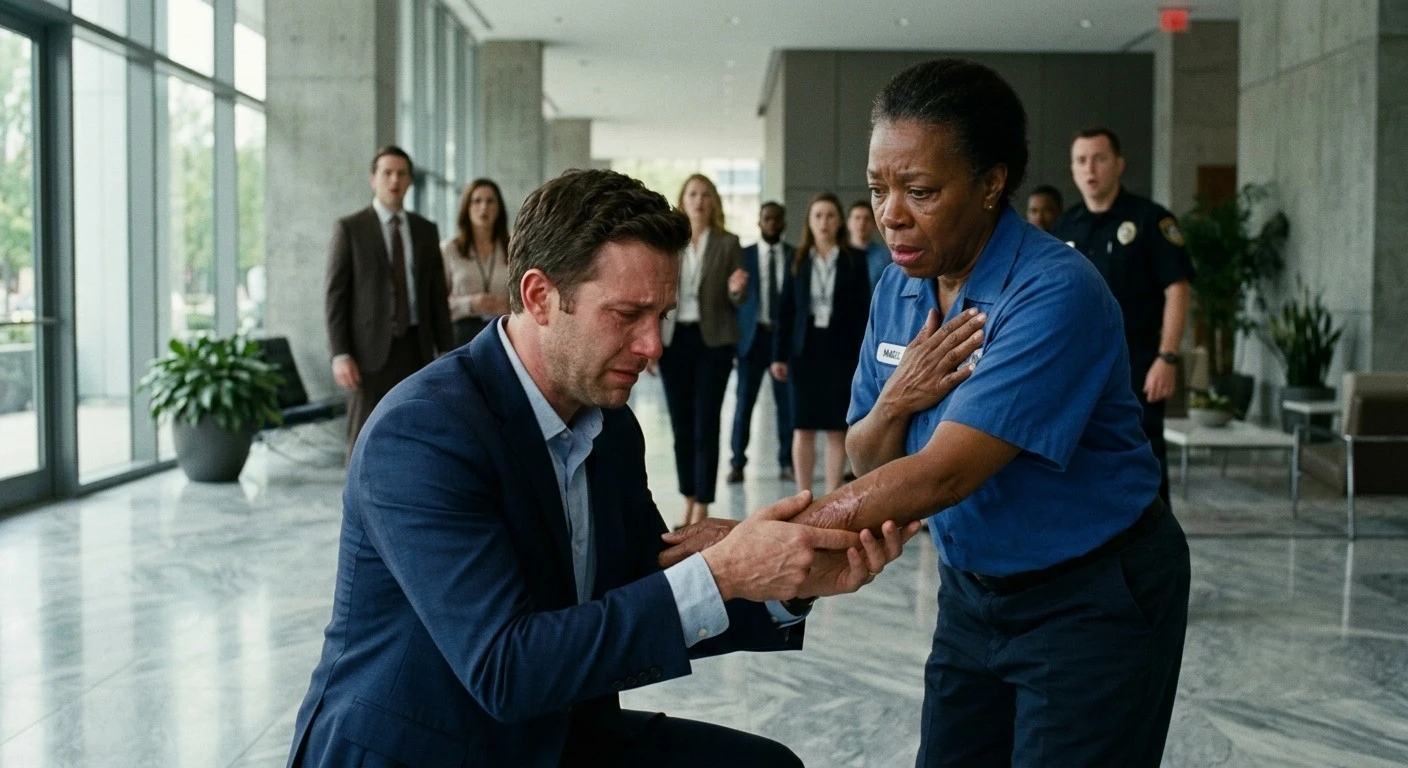
Adrian Cole was on the floor.
Not stumbling. Not fainting. Kneeling — deliberately, in front of a woman in a faded blue uniform, in the middle of his own glass lobby.
The room went silent in stages. First the investors near the window. Then the executives by the elevators. Then the security guards, who took two steps forward and stopped, because nobody had trained them for this.
“Sir,” Vivian Ross said, low and urgent. “Perhaps we should move this—”
“No.” Adrian didn’t look up.
Martha’s hand trembled around the broom handle.
“Mr. Cole, I’ll have the glass cleaned in a minute. I’m sorry for the delay.”
“Take off the glove.”
She stared at him.
“I’m fine,” she said. “It’s just a burn from years ago.”
“Please.”
His voice cracked on the word, and something about that crack silenced the last murmur in the lobby.
Martha looked toward the security desk like she was measuring the distance to the door.
Then, slowly, she peeled back the glove.
The scars ran from her wrist to her palm — pale in some places, raised and rope-thick in others, the kind of scarring that only comes from holding something too long inside a fire.
Adrian made a sound that had no place coming from a man who ran twenty thousand employees.
“No,” he whispered. “It’s you.”
“Sir, I think you’re mistaken—”
“You carried me out of a burning building.”
Trevor Lang, who twenty minutes earlier had told this woman to clean faster because investors were coming, stood frozen by the elevator bank with his mouth open.
Adrian pressed her scarred hand to his face and closed his eyes.
“Sleep, little sparrow,” he sang, barely audible, “the night cannot stay—”
Martha’s legs buckled. A guard caught her elbow before she went down.
“My baby,” she said. “My baby.”
Nobody in that lobby moved for eleven full seconds. Then the applause started — first one person, then all of them, security guards wiping their faces, a woman in a pressed suit sobbing into her sleeve.
Adrian didn’t hear any of it.
He held on like letting go would undo it.
“Why didn’t you find me?” he asked, when he could finally speak again.
Martha’s whole body went rigid.
“I tried,” she said. “For thirty-two years, I tried.”
“What happened?”
She looked past him — toward the row of executives standing near the reception desk — and something in her face changed from relief to fear.
“Someone paid the hospital to erase me,” she said. “Someone made sure you’d never look.”
Adrian pulled back just enough to see her eyes.
“Who?”
Martha reached inside her uniform and pulled out a photograph, protected in a plastic sleeve gone soft with age. It showed her in a hospital bed, bandaged from collarbone to wrist. Standing over her: Graham Whitmore, the man who would later adopt Adrian.
And behind Graham, half in shadow: his younger brother.
Charles.
Seventy years old. Senior director of the Cole Meridian board. The man who had stood at Adrian’s side at Graham’s funeral with a hand on his shoulder, promising that family wasn’t only blood.
He was standing eighteen feet away right now.
On the back of the photograph, in handwriting Adrian didn’t recognize, someone had written: THE BOY MUST NEVER KNOW HIS MOTHER SURVIVED.
Adrian looked up.
Charles had already started backing toward the elevators.
“Charles,” Adrian said.
“This is not the place for—”
“You knew.” Adrian rose to his feet, slow, like something inside him was recalibrating. “You knew she was alive.”
Charles hit the elevator call button twice.
The doors stayed shut.
Vivian had already locked the executive level.
“I am a member of this board,” Charles said, louder now, aimed at the guards. “Open that elevator.”
Nobody moved.
“Answer me,” Adrian said. His voice had dropped to something colder than the marble under their feet.
Charles straightened his tie, buying himself a second.
“This is an emotional situation,” he said. “You shouldn’t be making accusations based on the word of an employee with — an uncertain medical history.”
Martha flinched like she’d been struck.
Adrian caught it.
“What medical history?”
“You were treated for delusions after the fire,” Charles said to her, not to Adrian, like that made it less cruel.
“I was sedated,” Martha said. “For asking where my son went.”
“You spent years in psychiatric facilities.”
“Because your brother told them I was dangerous.”
Charles spread his hands, the picture of reasonable patience. “You see the problem. We need independent verification before anyone says another word.”
Martha reached inside her uniform again.
This time she pulled out a thick envelope.
Inside: a hospital record. A forged death certificate under her birth name, Elena Cole. Bank statements showing a five-million-dollar wire transfer meant to keep a mother and her son permanently apart.
The money had come from a trust established for Adrian by his biological grandfather.
The receiving account belonged to Whitmore Transit Holdings.
The same company Graham and Charles used to buy their very first freight depot.
The depot that eventually became Cole Meridian’s original warehouse.
Adrian stared at the transfer date.
“My inheritance built your company,” he said.
“Your adoptive father took an unmanaged trust and made it into something,” Charles said.
“It belonged to my mother. And to me.”
“You were four years old.”
“And she was alive.” Adrian’s voice rose for the first time. “You let me believe I buried her. You let me grieve a woman you were paying to disappear.”
Investors had their phones up now. Employees too. Nobody was pretending not to record anymore.
“Not everything can be explained in a lobby,” Charles said, quieter.
“Then explain it to federal investigators.”
Charles’s composure finally cracked down the middle.
Martha touched Adrian’s arm.
“There’s more,” she said. “There’s so much more.”
She handed him a second envelope. Inside: thirty-two years of letters, every one addressed to him, none ever delivered. Some in careful, looping handwriting. Others dictated to nurses because her fingers couldn’t grip a pen for years after the surgeries.
Adrian opened the oldest one first.
My sweet boy — they tell me you died after the fire. I do not believe them. A mother knows when her child is still in this world.
He opened another.
Adrian, today you’d be ten. I hope someone lets you have chocolate cake. You always hated vanilla.
Another.
I saw a boy in the paper who had your father’s jaw. His name was printed as Adrian Cole. I wrote to the school. The letter came back unopened.
His hands were shaking too hard to keep reading, so Martha took the last one from him and read it herself, out loud, so everyone in that lobby would hear it.
“My son. Charles knows I found the original trust documents. If anything happens to me, look beneath the foundation of your first warehouse.”
Charles lunged for the envelope.
Two guards had him by the shoulders before he’d taken a full step.
Adrian turned to the lobby’s main display, where Vivian had already pulled up the old architectural plans.
Cole Meridian’s first warehouse sat twelve miles away, in an industrial corridor scheduled for redevelopment next quarter. Its southern foundation had been sealed thirty-one years earlier, after what the county records called a fatal construction accident.
Martha pointed to an unmarked space beneath the old loading bay.
“There was no accident,” she said.
“Then what’s down there?” Adrian asked.
Tears moved silently down her face.
“That’s where they buried your father.”
By noon, two black SUVs were parked outside Cole Meridian Tower and Charles Whitmore was in a conference room with a lawyer he hadn’t chosen fast enough.
He told the agents Martha was an impostor. A con artist targeting a grieving, vulnerable billionaire. He used the word “extortion” four times in six minutes.
A rapid DNA panel would take hours. A full forensic match, days.
Adrian didn’t need either.
He had the scars. The lullaby. The way she’d called him “little sparrow” without anyone prompting her. The small crescent birthmark behind her left ear that he’d traced with a four-year-old’s finger while she carried him down two flights of burning stairs.
Still, the agents needed proof that would hold up in court, not just in a lobby full of witnesses.
Martha agreed without hesitation.
While a nurse swabbed the inside of her cheek in a side room, Adrian sat across the hall in a private conference space, a legal pad in front of him with nothing written on it.
Vivian knocked once and let herself in.
“The demolition crew for Warehouse One is on hold,” she said. “Structural engineers are on-site now. They found a sealed chamber behind the old loading bay wall. Concrete, not original to the building.”
Adrian didn’t answer right away.
“How long has Charles known she was alive?” he finally asked.
“We’re pulling records. Early estimate says decades.”
“He gave a eulogy for my father five years ago,” Adrian said. “The wrong father. Standing over an empty grave, talking about a man who died in a fire that never actually killed him.”
“Adrian—”
“He held my shoulder at that funeral and told me family wasn’t only blood. He said it like it meant something.”
Vivian didn’t have an answer for that, so she didn’t try to give him one.
Martha came in twenty minutes later, her sleeve rolled down again out of decades of habit, and sat across from him like she was still waiting for permission to take up space in the room.
“You can stop doing that,” Adrian said.
“Doing what?”
“Making yourself smaller.”
She almost smiled. Then it faded, because there was too much left to say and not enough time that felt safe yet.
“Why didn’t you go to the police?” he asked. “Thirty-two years is a long time to carry proof and say nothing.”
“I didn’t have proof for most of it,” Martha said. “I had a burned face nobody recognized, a name that wasn’t mine, and a diagnosis on paper that made every word out of my mouth sound like delusion. Do you know what it’s like to tell the truth and watch it turn into evidence against you?”
“Tell me.”
So she did.
After the fire, she’d woken nine days later in a burn unit, registered under the name Martha Ellis because her identification had burned with the building and someone on an intake form had guessed wrong, or lied. She asked for Adrian every single day. A social worker eventually told her the boy had died of smoke inhalation.
When she demanded to see his body, they sedated her.
The burns became infected. She underwent eleven surgeries in fourteen months. During the fourth month, a psychiatrist wrote “fixation on a deceased child” in her chart, and after that, every time she insisted her son was alive, it became one more line of evidence that she wasn’t well.
“They moved me to a private facility after that,” she said. “Funded by Whitmore Transit Holdings. My letters were screened before they left the building. Visitors needed approval I never got. Somewhere in there, a guardianship hearing changed my legal name, and I wasn’t even in the room for it.”
“For how long?”
“Seven years as Martha Ellis before I escaped with a nurse’s help. Then a decade of shelters and rented rooms and jobs that didn’t ask questions, searching public records for a boy named Adrian, and there are thousands of boys named Adrian, Adrian. Thousands.”
“How did you find me?”
“Fourteen years ago. A magazine photo. Young logistics entrepreneur opening a warehouse in Chicago.” Her voice thinned. “I knew your eyes before I finished reading the caption.”
“You wrote to me.”
“Every letter went through Charles’s office. He controlled your personal security correspondence. He answered exactly once — to tell me your biological mother had been confirmed dead, and that any further contact would be reported as harassment.”
“And after that?”
“I tried a public event. Security removed me before I got within thirty feet of you. A man met me outside afterward and showed me medical records describing psychosis and violent behavior. Records I’d never signed off on. He told me if I came near you again, they’d put me back in an institution, and this time nobody would come looking.”
“Charles.”
“Charles.”
Adrian sat with that for a long moment. Charles had managed his security for seventeen years. Reviewed every threat, every strange letter, every person claiming some family connection. Adrian had believed, his whole adult life, that Charles was protecting him from strangers.
He’d actually been protecting a lie from Adrian.
“Why the janitor job?” Adrian asked. “Why walk back into the building of the man who buried you?”
“A year ago, a retired hospital clerk named Ruth Salinger found me. She’d processed my original intake after the fire. She was dying — cancer — and she wanted to undo something before she went. She gave me copies of the photograph. The trust records. The altered hospital file.”
“That’s how you knew about the money.”
“That’s how I knew about more than the money.” Martha’s hands tightened on the table’s edge. “Ruth remembered a man brought in the night after the fire with a head injury, asking for Elena and Adrian by name. Records say he died in the building. Ruth says two men transferred him out of that hospital without authorization.”
“My father.”
“Samuel Cole. Your father.”
“Graham and Charles.”
“Yes.”
“So I contacted the company again,” Martha continued. “Charles intercepted the letter before it reached anyone else. But this time, instead of threatening me, he offered me a job. Nights. Cleaning. Inside your building.”
“He wanted you where he could watch you.”
“He wanted me where he could control the story if I ever tried to tell it.” She looked at her hands. “And I accepted, because for the first time in fourteen years, I’d be in the same building as you.”
“For eleven months you said nothing.”
“I was afraid the first time I saw you. You walked in with Charles beside you, and you smiled at him the way a son smiles at a father, and I thought — if I tell him now, who does he believe? The man who raised him, or the woman with a psychiatric file a foot thick?”
“I might have believed Charles,” Adrian admitted, and it cost him something to say it.
“That’s why I waited,” Martha said. “I worked nights. Copied memos before they hit the shredder. Photographed visitor logs. Listened while executives talked about tearing down Warehouse One. When I heard they’d scheduled the demolition, I knew whatever was under that building was going to disappear with it. I was going to reveal myself this week, before the crew broke ground.”
“And instead your glove slipped.”
“Instead my glove slipped.”
Adrian looked at the scars again, like he was still checking they were real.
“I walked past you for eleven months,” he said.
“You didn’t know.”
“I gave a speech at last year’s holiday event about dignifying every job in this company. My own mother was standing in the back of the room in a uniform, and I didn’t know her.”
“I was never ashamed of the uniform.”
“I know.”
“Then don’t you be ashamed of it either. Don’t use my job to punish yourself.”
It sounded exactly like something a mother would say, which was somehow the thing that broke him completely. He cried again, quieter this time, and Martha reached across the table and covered his hand with hers, scarred palm against scarred palm, in a way that made the years between them feel briefly, mercifully smaller.
The DNA results came back eleven hours later. Ninety-nine point nine nine percent probability of a maternal match.
Charles was arrested that evening on charges of fraud, conspiracy, and obstruction, with more counts expected once the excavation under Warehouse One finished. Federal agents pulled two sets of remains from the sealed chamber the following week: one confirmed through dental records as Samuel Cole, and one belonging to a security contractor who, according to old payroll records, had simply stopped showing up for work thirty-one years ago and had never been reported missing by anyone but his own sister.
The story broke everywhere within forty-eight hours. Not because Adrian’s team leaked it — he refused every interview request for the first ten days — but because half the lobby had recorded it on their phones, and video doesn’t need a press release.
Trevor Lang resigned before HR could finish drafting the termination letter. He sent Martha a written apology that she read once, folded in half, and never mentioned again. Adrian noticed she kept it anyway, tucked in the same plastic sleeve as the photograph, next to the truth instead of buried under it.
The trial took the better part of a year. Charles’s lawyers argued diminished capacity, then argued the trust money was a legitimate business investment, then, when neither worked, argued for a plea. The judge wasn’t interested in leniency for a man who had spent three decades billing a stolen inheritance as a corporate success story while the woman it belonged to slept in shelters.
Twenty-two years. No parole eligibility before fourteen.
Whitmore Transit Holdings was dissolved by court order, its assets — the ones traceable back to Adrian’s original trust — returned to the Cole family. Adrian didn’t take a cent of it for himself. He put all of it, plus a controlling share of Cole Meridian’s foundation, directly into Martha’s name.
“I don’t want the company,” she told him, the day the paperwork arrived. “I never wanted the company.”
“I know,” Adrian said. “That’s exactly why it should be yours to decide what happens to it.”
Martha used the first grant from that foundation to fund a legal advocacy fund for psychiatric patients whose family testimony had been dismissed or falsified — the exact kind of case that had erased her for seven years. She named it after Ruth Salinger, the clerk who’d spent her last months undoing a lie instead of carrying it quietly to her grave.
Six months after the lobby, Martha still worked. Not nights, not with a mop. She sat on the board her son now ran, in a seat with her real name on it, and every employee in that building knew exactly who she was.
Nobody stepped over her coffee cup anymore. Nobody had to.
On the anniversary of the day her glove slipped, Adrian found her in the lobby before sunrise, standing near the spot on the marble where he’d knelt.
“Couldn’t sleep?” he asked.
“Old habit,” she said. “Nights are when I used to feel safest here. Nobody watching me too closely.”
“Somebody’s always going to be watching you now,” Adrian said. “For better reasons.”
Martha reached up and, without thinking about it the way she used to, pulled her sleeve back to let the morning light hit the scars on her wrist.
“Sing it again,” she said. “The lullaby.”
So he did, quietly, in the empty lobby where it had all come apart and then, slowly, come back together — and this time, when the last note faded, nobody had to whisper the truth. It was simply, finally, theirs to say out loud.
Original fictional stories. AI-assisted creative content.