Sara Thompson had learned to dress in layers.
Not for warmth. For hiding. The heavy silver pendant her father had pressed into her palm the night she ran—she’d worn it every single day of the five years since. Tucked under cotton, hidden under flannel, cold against her skin like a secret she couldn’t afford to give up. She didn’t know why she kept it. Habit, maybe. Or the part of her that wasn’t ready to let go of the person she used to be before Mark.
She was eight months pregnant when the pendant finally ran out of patience.
It was a Tuesday. Sal’s Diner. Lunch rush.
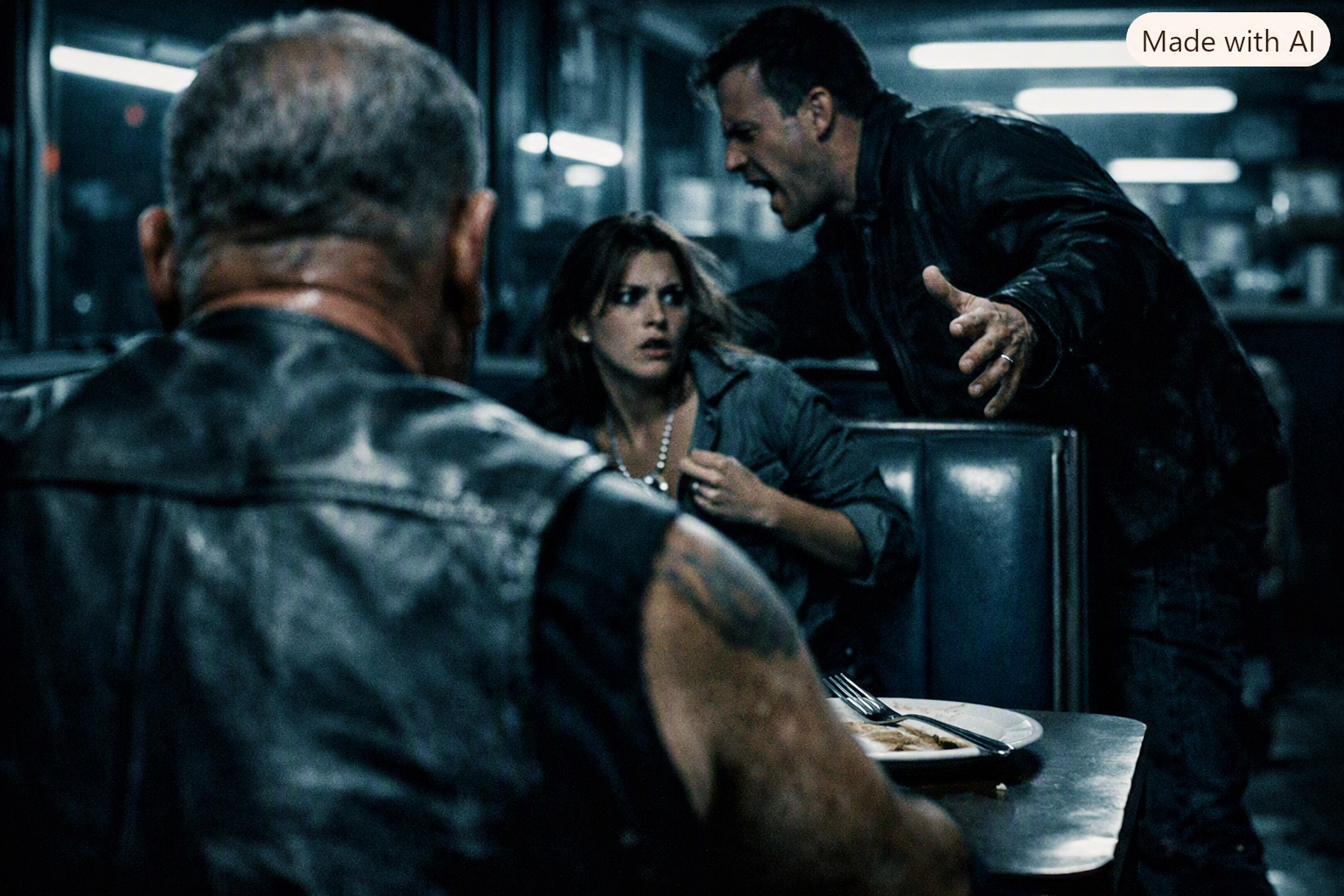
Mark shoved the door open with his shoulder and pulled her through by the wrist the way he always did in public—close enough that it looked like he was helping her, hard enough that she felt every finger bone. The bell above the door gave a broken jingle. The smell hit her first: bacon grease, burnt coffee, old vinyl. Tables full of truckers, a young mom with two kids, an older couple sharing a slice of pie.
Everyone looked up.
“Mark,” she said quietly. “People are watching.”
He didn’t answer. He never did when he had steam to burn.
He found a booth in the center of the room, right under the brightest tube light, and shoved her into the seat. The edge of the table caught her palm. Her purse hit the floor. Her prenatal vitamins rolled out across the linoleum, and Mark kicked the bag under the booth without looking at it.
“You went through my phone,” he said, loud enough that the mother at the next table pulled her daughter closer. “While I was at work.”
“The electric bill was overdue.” Sara kept her voice low, one hand flat on her belly. “I was trying to see if we had money before they cut it off.”
“You don’t get to decide what’s yours to look at.” He grabbed her other wrist across the table, twisting until the skin pinched. “You don’t question where the money goes. I work. I pay. You sit home and do what you’re told.”
“Please.” She didn’t pull back—she’d learned that only made it worse. “Not here. The baby—”
“The baby.” He said it the way he said everything she cared about—soft and mocking, like it was a punchline. “That doesn’t make you special, Sara. You’re not special. Without me you have nothing. No house. No car. No one in this world who gives a damn whether you’re breathing.”
He let go of her wrist and slammed his palm on the table. The salt shaker jumped and spilled white across the Formica.
Across the room, in the corner booth near the pass-through window, a big man in a black leather vest set his fork down.
He was broad-shouldered, gray-bearded, with a scar that ran from his cheekbone into the collar of his cut. He’d been eating quietly, the way men eat after long miles on the road. His plate still had half an order of eggs on it.
He wasn’t eating anymore.
His eyes were on Sara’s chest—on the pendant that had slipped free when she reached for the table edge. The heavy silver skull caught the fluorescent light and threw a sharp glint across the booth. His fork stayed suspended for one second before he set it down on the plate. His expression didn’t change. But something in his posture did—the kind of stillness that comes just before movement.
Mark kept going.
“Five years I’ve carried you,” he announced to the room, voice rising, turning it into a performance. “Five years of your questions and your sad little face. And the second you’ve got a ring on your finger, you think you own me?” He laughed once, short and ugly. “You don’t own anything, Sara. You never did.”
Behind Mark, the big man reached slowly into his vest pocket and pulled out a black phone. He held it low, angled toward Sara’s chest, and pressed the shutter once. Then he typed something with his thumb and slipped the phone away.
He didn’t stand up yet. He just sat back and waited.
Mark pushed to his feet in the narrow space between the booths. His shadow fell across Sara. His hand came up.
That was when the chairs started moving.
Not fast. Not loud. Just the slow, deliberate scrape of wood on linoleum—one, then two, then more—rising from every back corner of the diner at once. Like a sound the room had been holding in and finally let go.
Mark didn’t turn around.
“You gonna cry?” he said, fingers still half-raised. “Go ahead. Nobody here’s going to say a word. They’re all pretending they don’t see, because they know this is none of their business.”
The big man in the corner—the one the others called Bear—stood up. He moved without hurry, stepping into the main aisle and planting himself there, arms at his sides, boots heavy on the floor. He didn’t look at Mark. He looked at Sara. At the pendant. Something moved across his face—recognition, maybe, or grief—and then his jaw set and it was gone.
More men were on their feet now. One by one, not together. A man with a gray ponytail pushed his chair in slowly. Another with a thick beard rolled his shoulders and stepped into the aisle. They didn’t speak. They didn’t look at each other. They just stood.
The diner went quiet in a way that had nothing to do with sound.
The mother with the two kids had pulled both children onto her lap. The older couple stared at their plates. The waitress had backed up until her spine touched the counter. Nobody reached for a phone. Nobody moved toward the door.
Mark finally turned around.
Bear was closest. Six-foot-three, two-fifty at least, patches on his cut that added another kind of weight. He stood in the aisle with the loose patience of a man who’d had worse days than this one and was in no hurry to prove it.
“Problem?” Mark said, voice thinner than he probably wanted.
Bear looked at him the way you look at something you’ve already decided what to do with.
“Sit down,” Bear said.
Not a request.
Mark’s jaw tightened. “This is between me and my wife. You got no business—”
Bear took one step forward.
Mark sat down.
“Good,” Bear said, and then he didn’t say anything else. He didn’t need to. Twelve men now filled the aisles around the booth, shoulders wide, cuts identical. They hadn’t touched anyone. They hadn’t threatened anyone out loud. They had simply arranged themselves so that Mark Thompson was no longer the biggest presence in the room.
Sara sat very still. Her hand rested on the curve of her belly. The pendant had stopped swinging.
The front door opened.
The man who walked in wasn’t the biggest one in the room, but the room changed when he entered. He was in his late fifties, maybe early sixties, silver-haired and lean, moving with the unhurried confidence of someone who’d never once had to announce himself. His cut was different from the others—older leather, more patches, a specific emblem on the chest that matched the skull on Sara’s pendant exactly.
Bear stepped aside without being asked.
The man walked to the center of the diner and stopped. He looked at Bear first, then down at Mark, then—finally—at Sara.
His face broke open for exactly one second.
Then he put it back together and looked at Mark.
“Clear the cameras,” he said.
His voice was calm. Almost gentle.
Two men moved without a word. One climbed a chair and unplugged the dome above the register. Another came out of the back office a minute later carrying a small recording device, which he set on the counter without comment.
Mark watched like a man watching a door lock behind him.
The man—Sara’s father—looked at Mark the way a man looks at something he’s about to remove from his daughter’s life permanently.
“Two choices,” he said. “You sign everything over. House, accounts, car, anything in your name attached to her life. Then you get in your truck, drive until you’re out of this state, and you stay out. No calls. No texts. No showing up. You disappear. That’s option one.”
Mark’s throat clicked when he swallowed. “What’s option two?”
Sara’s father looked at the bruise already forming on Sara’s wrist.
“You don’t want option two,” he said.
Mark’s knees buckled. He caught himself on the counter. A wet sound came out of him—something between a laugh and a sob.
“I didn’t know,” he started. “I didn’t know who she was. I swear to God, it was a misunderstanding, I was just trying to get her to—”
“Stop talking.”
Mark stopped.
One of the younger bikers laid a stack of papers on the table. Simple printed sheets, not fancy—but someone had already filled in the numbers. Mark’s house. His truck. The joint account he’d kept Sara’s name off of. Everything.
Her father nodded at the stack.
“Sign.”
Mark’s hand shook so badly he could barely hold the pen. He signed the first page. Then the second. His signature was a broken, shaking thing. When he reached the last sheet, he hesitated, pen hovering.
Her father didn’t move. Didn’t threaten. He simply waited.
Mark signed.
The papers were gathered and tucked inside another man’s vest. Mark stood there with nothing left in his hands.
“You’re done here,” her father said. “Sunrise tomorrow, you’re out of the state. Every man in this room knows your face and your name. You come back—you call her, you think about her too loud—and option two happens. You understand?”
Mark nodded.
“Say it.”
“I understand,” Mark whispered.
Her father turned away from him like he’d already been forgotten. He walked to Sara’s booth. For the first time since he’d walked through the door, his face changed—the hardness went somewhere else and left just a man who’d been looking for his daughter for five years.
He held out his hand.
Sara stared at it for a long moment. Five years she’d run from this hand. From the world it represented. She’d hidden the only piece of it she’d kept under every shirt she owned, convinced that staying hidden was the only way to stay safe.
She put her hand in his.
He helped her stand. Someone opened the door. Outside, two black SUVs idled at the curb. More men stood on the sidewalk. Mark stayed where he was—surrounded, still, smaller than the room.
The door closed behind them.
Three weeks later, Sara sat in the rocking chair in the nursery of a house with a paid-off deed.
Pale yellow walls. A secondhand crib that had been cleaned and painted white. Cameras at the corners of the yard that didn’t advertise themselves. Two men in leather cuts sat in a truck at the curb. Another pair walked the perimeter every hour without wearing their colors, just walking.
Her son was in her arms. Three weeks old. Dark hair like hers. A grip already that made her feel like he knew exactly where he was.
The silver pendant sat on the windowsill in the late afternoon sun. Chain coiled. Skull face up.
She hadn’t tucked it away once since they’d left the diner.
She wore it out when she ran errands. Left it on the sill where she could see it from the rocker. The men outside knew what it meant. The men who stopped by to check on her knew what it meant. And Sara knew what it meant now too, in a way she hadn’t when she was twenty-three and running.
It meant she would never have to run again.
Mark was gone. The papers had been filed the same week. The house they’d shared was already sold. The accounts were transferred or emptied. He’d left the state before the deadline, and no one had heard from him since. No one expected to.
Her father had set everything up without asking her to come back into the life. No club business. No runs. Just the house, the money, and men who would stand at the gate for as long as she needed them there.
“I can’t go back to all of it,” she’d told him. “Not the way it was before.”
He’d nodded like he already knew.
Then he’d kissed the top of her head, the way he used to when she was small, and said the house was hers. The choice was hers. All of it was hers.
Sara looked down at her son. He made a small sound and turned toward her warmth. Outside, one of the men on perimeter walked past the window, gave her a small nod, and kept moving.
She picked up the pendant with her free hand. The silver was warm from the afternoon sun on the sill. She ran her thumb over the skull—the crest on its forehead, the same one her father still wore on his cut.
For five years she had kept it hidden because she was afraid of what it would bring back.
Now it sat in the open because she was no longer afraid of what it kept away.
She set it back on the windowsill, turned from the glass, and carried her son to the rocking chair.
The house was quiet. The fear that used to live in her chest every time Mark raised his voice had somewhere else to be now.
She sat down, held her baby close, and rocked.
Outside, the light faded slow and gold through the window. The truck at the curb stayed. The men kept walking. The silver skull on the sill caught the last of the sun and held it.
Sara closed her eyes and let the chair move under her.
Her son slept against her heart.
And outside the window, the men who had once been strangers stood guard like they had always known exactly who she was.
Original fictional stories. AI-assisted creative content.