“Step away from my daughter.”
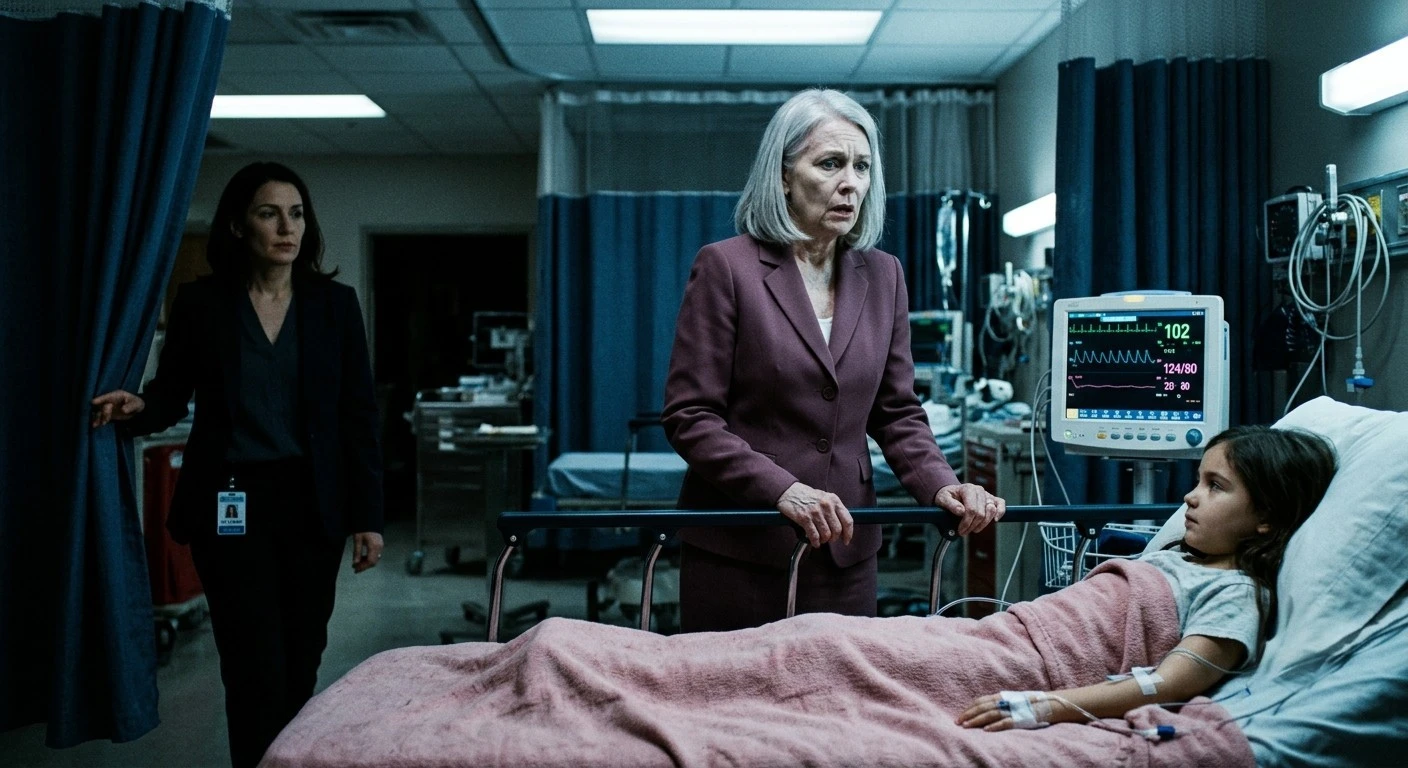
I moved between Evelyn and the hospital bed before she could take another step.
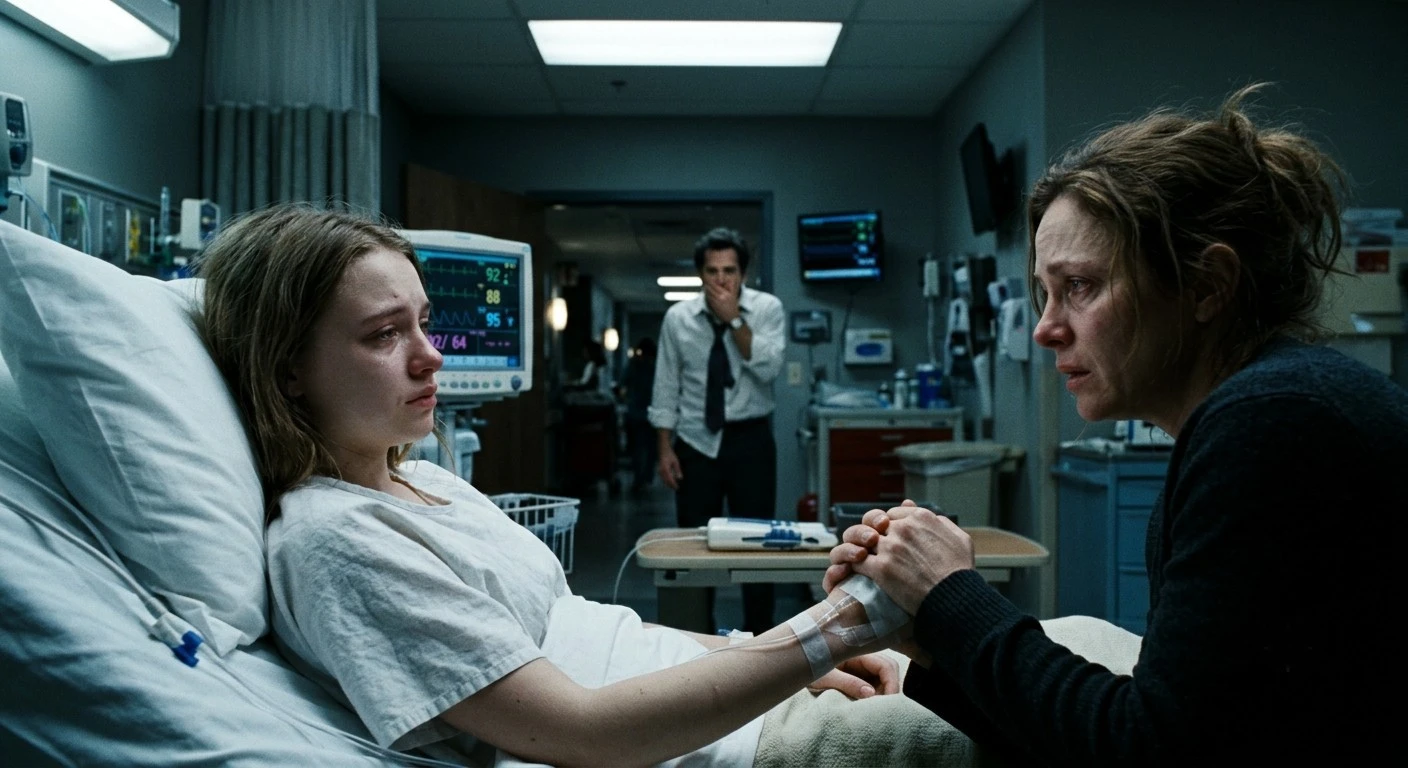
My eight-year-old daughter, Lily, lay beneath a thin pink blanket with an IV in her arm and oxygen running beneath her nose.
Three hours earlier, she had stopped breathing at Evelyn’s charity luncheon.
Lily had lived with a severe peanut allergy since she was two years old.
Everyone in our family knew.
Her medical bracelet was visible.
I had spoken personally with the chef.
And I had carried two emergency injectors inside my jacket pocket.
Yet a dessert covered in crushed peanuts had still been placed directly in front of her.
The moment Lily took a bite, her face began to swell.
She reached for me.
“Dad, I can’t breathe.”
I grabbed for the injector.
It was gone.
While I shouted for someone to call an ambulance, Evelyn stood beside the table and announced that I had forgotten my daughter’s medication.
She said it loudly enough for every donor, doctor, and board member in the room to hear.
By the time the paramedics arrived, several guests were already whispering that I was an unfit father.
Now Evelyn stood inside Lily’s emergency room wearing an expensive plum-colored suit, her silver hair perfectly arranged.
She looked less like a worried grandmother and more like a woman arriving to inspect the results of her own plan.
“You need to leave,” I said.
Evelyn glanced toward the hallway.
“No one stopped me.”
“I am stopping you.”
Her lips tightened.
Since my wife, Anna, died two years earlier, Evelyn had done everything she could to take Lily away from me.
She criticized my parenting.
She reported harmless bruises from the playground.
She told relatives that grief had made me unstable.
But until that afternoon, I had believed she was simply controlling.
I had never imagined she would risk Lily’s life.
Evelyn stepped around me and leaned toward the bed.
“You caused quite a scene today,” she told Lily softly.
My daughter opened her eyes.
Evelyn smiled.
“You were frightened. Children sometimes remember things incorrectly after a medical emergency.”
“Don’t speak to her,” I warned.
Evelyn ignored me.
“If anyone asks what happened, tell them your father forgot your medicine.”
Lily stared at her.
Evelyn’s voice became colder.
“You understand me, don’t you?”
For several seconds, Lily said nothing.
Then she whispered:
“I saw you.”
Evelyn’s smile disappeared.
“What did you say?”
“I saw you switch the dessert plates.”
The hospital room went silent.
Evelyn straightened.
“You were confused.”
“No,” Lily said. “I was recording a message for Dad.”
Before the luncheon, Lily had been using her smartwatch to record a voice message about the speech she was nervous to give.
The recording continued after Evelyn approached our table.
It captured Evelyn telling a server to move a peanut-free dessert away from Lily.
It captured her opening my coat pocket.
And it captured her whispering to someone:
“Once he loses custody, the trust will finally be under our control.”
Evelyn’s face lost its color.
“That recording proves nothing.”
A woman stepped from behind the privacy curtain.
Detective Sarah Collins had been listening the entire time.
“We’ll let a judge decide that,” she said.
Evelyn turned toward the door.
A uniformed officer blocked the hallway.
“This is outrageous,” Evelyn snapped. “I came here because I was worried about my granddaughter.”
Detective Collins held up an evidence bag.
Inside was Lily’s missing injector.
“We recovered this from your car.”
Evelyn looked at me.
For the first time since I had known her, she appeared afraid.
“You planted that.”
The detective did not react.
“Evelyn Hart, you are under arrest on suspicion of child endangerment, theft of emergency medication, and tampering with evidence.”
As the officer placed handcuffs around her wrists, Evelyn began shouting that she knew judges, hospital executives, and half the city council.
Lily watched silently.
When Evelyn was taken into the hallway, my daughter reached for my hand.
“Is it over, Dad?”
I wanted to tell her yes.
Then Detective Collins closed the door.
“No,” she said quietly. “I’m afraid it isn’t.”
She placed a sealed envelope on the table.
It had been found inside Evelyn’s briefcase.
The first document was a petition asking the court to remove me as trustee of Lily’s inheritance.
The second appointed Evelyn to control the money until Lily turned eighteen.
The trust contained almost three million dollars left by my late wife.
I looked at the filing date.
The petition had been prepared two weeks before the luncheon.
Before Lily ate the dessert.
Before Evelyn accused me of forgetting the medication.
Before anyone had a reason to question my parenting.
“This was planned,” I whispered.
Detective Collins turned to the final page.
Evelyn’s signature appeared at the bottom.
Beside it was the signature of the person who had sworn that I was dangerous, unstable, and unable to care for my own child.
My younger brother, Michael.
The same man who had lived in my guest room since Anna died.
The same man who picked Lily up from school.
The same man who had known exactly where I kept her emergency medication.
Then Detective Collins showed me one more line.
Michael had not signed merely as a witness.
He had asked the court to make him Lily’s permanent guardian if I lost custody.
My phone began ringing.
Michael’s name appeared on the screen.
Detective Collins looked at me.
“Answer it,” she said. “But don’t tell him Evelyn has been arrested.”
I put the call on speaker.
My brother’s voice came through calmly.
“Daniel, I heard something happened to Lily.”
I looked at my daughter.
Then Michael asked the question that told me he already knew far more than he should have.
“Did the doctors find the second injector?”
Detective Collins looked at me.
I had never told my brother that both injectors were missing.
“No,” I said carefully. “Why?”
Michael hesitated.
“The blue one probably fell under the table.”
My stomach tightened.
Only someone who had handled the injectors knew one had a blue cap.
“Where are you, Michael?”
He ended the call.
Detective Collins opened the papers found in Evelyn’s briefcase.
Bank records showed that nearly six hundred thousand dollars had been taken from Lily’s trust and sent to a company owned by Michael.
My own brother had been stealing from my daughter while living in our home.
Then Lily whispered:
“Uncle Michael came into my room last night. He wanted Mom’s watch.”
The watch contained Evelyn’s recorded confession.
Moments later, hospital security reported that Michael’s car had entered the parking garage.
“He doesn’t know Evelyn was arrested,” Detective Collins said.
The door opened.
Michael stepped inside carrying a medical bag.
He froze when he saw the police.
The missing injector fell from the bag.
“I came to replace it,” he admitted.
A nurse scanned the label.
“This is not allergy medication,” she said. “It contains a powerful sedative.”
Then she read the name on the prescription.
Anna Hart.
My late wife.
The prescription had been filled two days before she died.
I stared at Michael.
“You said Anna died from a heart condition.”
His face went pale.
“I didn’t know Evelyn would give her that much.”
The room became silent.
Michael had just admitted that my wife’s death was not an accident.
And Evelyn’s plan to steal Lily’s trust had begun two years before the luncheon.
Detective Collins stepped closer to Michael.
“Michael Hart, you’re under arrest for conspiracy, theft, and obstruction. We’re also opening a homicide investigation into the death of Anna Hart.”
Michael’s knees buckled.
“I didn’t kill anyone. Evelyn handled the dosage. I only got the prescription.”
“That’s still a body,” Detective Collins said. “That’s still a crime.”
An officer read him his rights while another photographed the sedative vial for evidence.
Lily gripped my hand tighter.
“Is Uncle Michael bad too?”
I didn’t have an answer that wouldn’t hurt her.
“He made bad choices,” I said. “The police are going to figure out the truth now.”
She nodded slowly, the way children do when they understand more than they say.
Detective Collins pulled me into the hallway while a nurse stayed with Lily.
“We’re going to need to exhume your wife’s body,” she said. “I know that’s not what you want to hear tonight.”
“Do it,” I said. “I need to know what happened to her.”
“There’s something else,” Detective Collins added. “Evelyn’s attorney is already on the phone with the DA’s office trying to negotiate a plea. She wants to blame everything on Michael.”
“Of course she does.”
“We have the recording. We have the injector. We have the bank records. She’s not walking away from this.”
I looked back through the small window in the door at my daughter, small and pale against the pillows, but alive.
“What happens to the trust?”
“That’s a family court matter,” Detective Collins said. “But given what we found tonight, I doubt any judge lets Evelyn near it again.”
Three days later, Lily was discharged from the hospital.
The allergist confirmed what the recording already proved — someone had deliberately routed the dessert past every safety measure we had put in place.
At home, Lily slept in my room for the first week.
She still flinched at the sound of unfamiliar footsteps in the hallway.
I hired a family therapist who specialized in trauma in young children.
Slowly, the nightmares became less frequent.
Meanwhile, the investigation into Anna’s death moved forward.
The exhumation confirmed elevated levels of the sedative in her system, far beyond what any doctor had prescribed.
The medical examiner ruled her death a homicide.
Evelyn’s attorney tried to argue that Anna had been struggling with anxiety and had taken the medication herself.
But the pharmacy records told a different story.
The prescription had been filled under a fake name Evelyn had used before, one investigators traced to two other elderly relatives whose deaths had never been questioned.
Detective Collins called me the week the second body was exhumed.
“Your wife wasn’t the first,” she said. “We believe there may be at least two more victims connected to inheritance disputes going back over a decade.”
I sat on the edge of my bed and said nothing for a long time.
“She was your mother-in-law for six years,” Detective Collins said gently. “You couldn’t have known.”
“I keep thinking about all the times she held Lily,” I said. “All the times I let her into our house.”
“You’re not responsible for what she did,” Detective Collins said. “You’re responsible for stopping it. And you did.”
The district attorney’s office charged Evelyn with two counts of first-degree murder, attempted murder of a minor, elder financial abuse, and fraud.
Michael took a plea deal in exchange for testifying against her, admitting he had filled prescriptions and forged signatures at her direction for over a year.
He received twelve years.
Evelyn’s trial began five months later.
I sat in the courtroom every day.
Lily stayed home with her therapist and a family friend, far away from the cameras that had gathered outside the courthouse once the story broke.
The prosecution played the smartwatch recording for the jury.
Even through the small courtroom speakers, Evelyn’s voice was unmistakable.
“Once he loses custody, the trust will finally be under our control.”
Several jurors looked at her when the recording ended.
She did not look back at them.
On the stand, the forensic accountant walked the jury through years of transfers, shell companies, and falsified guardianship petitions, all pointing to a single motive.
Money.
Not love. Not concern. Not family.
Just the three million dollars my late wife had left for our daughter’s future.
Evelyn’s attorney tried one final argument in closing statements, suggesting that grief and age had clouded her judgment, that she never intended for anyone to die.
The prosecutor’s response was simple.
“She poisoned her own daughter for money. She poisoned another family member before that. And when a peanut allergy nearly finished the job on an eight-year-old girl, she stood over that child’s hospital bed and told her to lie about it. That is not confusion. That is calculation.”
The jury deliberated for six hours.
When the verdict came back, I was sitting three rows behind the prosecution table, my hands pressed flat against my knees.
“On the count of murder in the first degree for the death of Anna Hart, we find the defendant guilty.”
Evelyn’s face did not move.
“On the count of attempted murder of a minor, Lily Hart, we find the defendant guilty.”
Someone behind me exhaled sharply. I realized it was me.
“On the count of elder financial abuse and fraud, we find the defendant guilty.”
The judge set sentencing for six weeks later.
Evelyn was denied bail and remanded into custody immediately.
As the bailiffs led her out of the courtroom, she turned toward me one last time.
“I only ever wanted what was best for this family,” she said.
“You wanted three million dollars,” I said. “There’s a difference.”
She had nothing left to say to that.
At sentencing, the judge handed down two consecutive life sentences without the possibility of parole.
“You didn’t just betray your family,” the judge told her. “You weaponized the people who trusted you most. This court has no leniency for that.”
Evelyn was led out in silence.
Outside the courthouse, Detective Collins found me on the steps.
“It’s over,” she said. “For real this time.”
“Thank you,” I said. “For staying behind that curtain. For believing an eight-year-old before you believed the woman in the expensive suit.”
“Kids don’t lie about things like that,” she said. “Not the way she did.”
That evening, I picked Lily up from her therapist’s office.
She climbed into the car and buckled her seatbelt without being asked, a habit she had picked up in the months since the hospital.
“Is Grandma Evelyn going to be in jail forever?” she asked.
“Yes,” I said. “Forever.”
She was quiet for a moment, watching the streetlights pass.
“Good,” she finally said. “She scared me.”
“I know. I’m sorry I didn’t see it sooner.”
“You saw it in time,” Lily said. “That’s what matters.”
Sometimes an eight-year-old says something that puts every adult in the room to shame.
The court fully restored my role as trustee of Lily’s inheritance, with an independent financial guardian appointed to review the account annually as an added safeguard.
The six hundred thousand dollars Michael had stolen was partially recovered through asset forfeiture and returned to the trust.
A year later, Lily gave the speech she had once been recording a message about, the one interrupted by an allergic reaction that nearly took her life.
It was for her third-grade class, a short presentation on bravery.
She stood at the front of the room in a yellow dress, gripping her notecards, and told her classmates that bravery wasn’t about not being scared.
It was about telling the truth even when the person you were telling it about was someone you were supposed to trust.
I watched from the back of the classroom, and for the first time in over a year, I let myself believe that we were finally safe.
Some nights, I still think about how close it came, how one whispered sentence into a smartwatch was the only thing standing between my daughter and a woman who had already killed once for money.
But mostly now, I think about the yellow dress, the notecards, and the sound of twenty-five second graders clapping for a little girl who told the truth when it mattered most.
That was the ending Evelyn never planned for.
Justice, and a little girl who got to grow up anyway.
Original fictional stories. AI-assisted creative content.