“Please stop…”
The girl’s whisper was almost lost beneath the hiss of the garden hose.
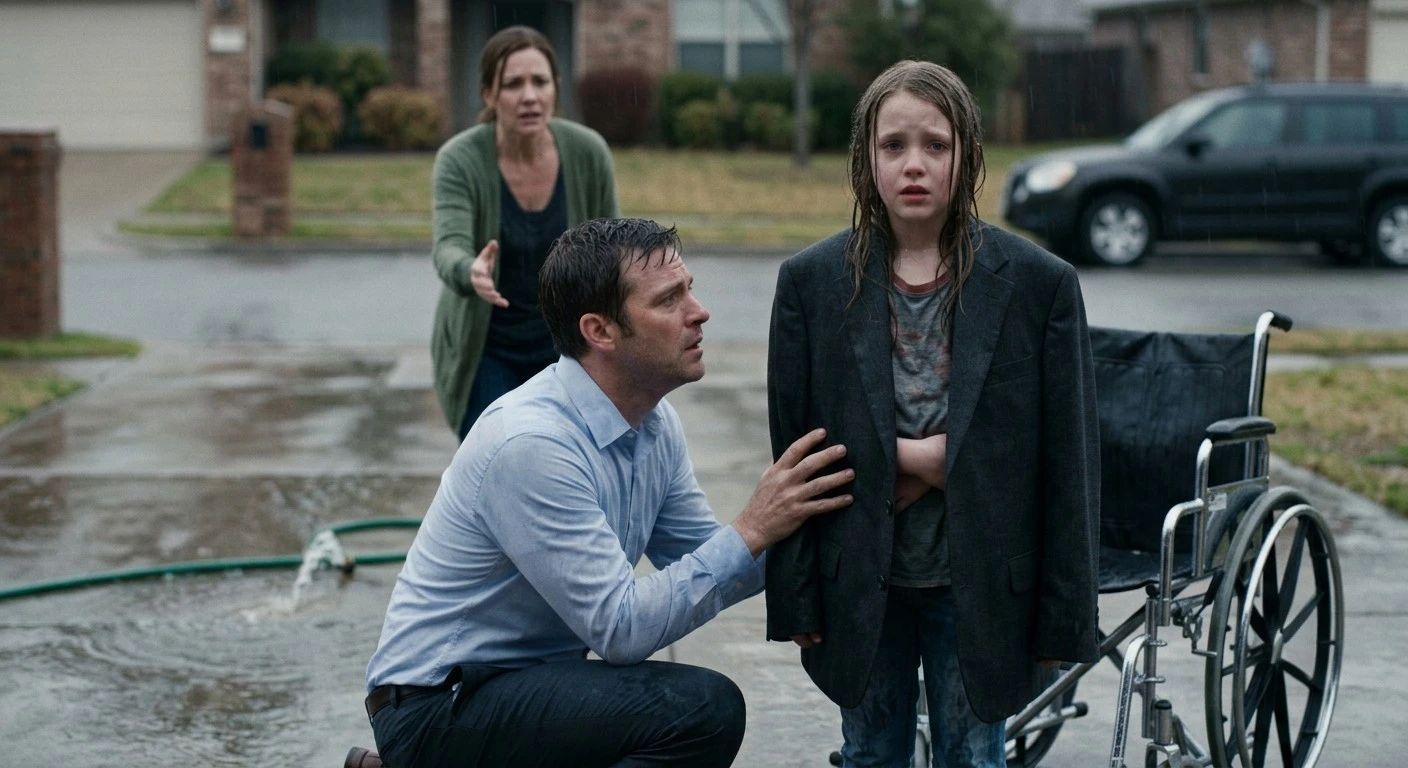
She sat trembling in her wheelchair in the middle of the wet driveway, soaked from her hair to her sneakers. Her light blue T-shirt clung to her shoulders. Water ran down her red, frightened eyes as she gripped the wheelchair arms and tried not to sob too loudly.
A woman stood a few feet away, holding the hose like she had done nothing wrong.
Then a black SUV stopped hard at the curb.
A man in a black suit rushed out.
“Turn it off!”
He grabbed the hose and pointed it away from the girl. Water slapped against the pavement, spreading around his polished shoes.
The woman’s face tightened.
“She needed cleaning.”
The man stared at her, horrified.
For a second, he looked like he couldn’t believe a human being had said it.
“Listen to yourself,” he said, low and shaking.
Then he dropped to his knees in front of the girl.
His voice softened instantly.
“Hey… I’m here now.”
The girl looked at him through wet lashes, breathing in broken little gasps.
Her hands tightened on the wheelchair arms.
Then, slowly, painfully, she pushed herself up.
Her knees trembled.
Her wet sneakers slipped slightly on the pavement.
The man rose with her, stunned.
“You… you can stand?”
The girl looked down at her own feet, confused and terrified.
“I didn’t know…”
Behind them, the hose slipped from the woman’s hand and hit the driveway.
“Then who told you that you couldn’t?” the man whispered.
The girl’s lips trembled.
She looked at the woman first.
That tiny glance told him everything before she even spoke.
“She did,” the girl whispered.
The woman took a step back.
“That’s not fair. The doctors said—”
“The doctors said she needed therapy,” the man cut in, his voice controlled but shaking. “Not fear.”
The girl stood between the wheelchair and the driveway, soaked and unsteady, her whole body trembling from cold, shock, and effort.
“I tried once,” she said, barely audible. “When you were away.”
The man turned back to her slowly.
“What happened?”
The girl swallowed.
“She told me if I fell, you’d send me away because broken girls are too much work.”
The man’s face broke.
The woman looked away.
Water kept spilling from the hose, running in thin streams across the pavement.
He knelt again, not caring that his suit touched the wet ground.
“Look at me,” he whispered.
The girl lifted her eyes.
“You were never too much work. Not for one second.”
Her mouth shook as she tried to breathe.
“I was scared you’d stop loving me.”
He pulled off his suit jacket and wrapped it around her wet shoulders.
“I loved you when you couldn’t stand,” he said. “I love you while you’re standing. And I’ll love you if you need that chair again tomorrow.”
The girl cried then — not loudly, not dramatically, just like a child whose heart had been holding too much.
The woman tried to speak.
“I was trying to make her stronger.”
The man stood, placing himself between them.
“No. You made her afraid of needing help.”
The girl reached for his hand.
Her knees shook, but she stayed upright.
“One step?” he asked softly.
She nodded.
Together, they took one small, uneven step away from the wheelchair.
Then another.
The woman stood frozen beside the fallen hose.
Inside, the house was warm and too quiet.
Daniel Cole carried his daughter, Mia, wrapped in his jacket, straight to the bathroom. He ran the water warm, not hot, testing it twice with his wrist before letting her near it.
“I’m sorry,” he kept saying. “I’m so sorry I wasn’t here.”
Mia’s teeth chattered. “You’re here now.”
He sat outside the bathroom door afterward, phone in hand, staring at a contact he hadn’t called in two years.
RILEY MARSH — ATTORNEY
His thumb hovered.
Then he pressed call.
“Riley. It’s Daniel Cole.”
A pause on the line.
“Daniel? It’s been years. What’s—”
“I need you to tell me what I can legally do,” Daniel said, “if I think someone’s been hurting my daughter. Not hitting her. Something worse.”
Riley’s voice sharpened instantly.
“Worse how?”
Daniel looked at the closed bathroom door.
“She just stood up for the first time in three years. And she didn’t know she could.”
Silence.
“Daniel,” Riley said slowly, “start from the beginning.”
He didn’t sleep that night.
At 2 a.m., he sat at the kitchen table with a laptop and a shoebox of old paperwork — physical therapy schedules, doctor’s notes, insurance forms — and started reading everything Vivian had handled for the last three years while he’d been buried in work trips.
A sticky note in Vivian’s handwriting caught his eye, tucked inside an old folder.
“PT canceled — Mia too tired today.”
Another, dated two weeks later.
“PT canceled — appointment conflict.”
Twelve of them. Twelve canceled appointments in eight months, none of them ever rescheduled, all of them signed with Vivian’s initials.
Daniel’s jaw tightened.
He opened his laptop and ordered three wireless cameras, overnight shipping, no discussion.
By 9 a.m. they were installed — one in the hallway, one in the kitchen, one aimed at the back door.
Vivian noticed within the hour.
“What are those?”
“Cameras,” Daniel said, not looking up from his coffee.
“You don’t trust me now?”
“I don’t trust what I don’t see,” Daniel said. “That’s different.”
Vivian’s smile was thin. “Fine. Nothing to hide.”
For three days, the footage showed nothing unusual.
On the fourth day, Daniel had a work call run long. He came home two hours later than planned.
That night, he opened the app on his phone out of habit before bed.
The kitchen camera had flagged motion at 4:47 p.m.
He pressed play.
Mia was at the kitchen table, working on homework, her walker parked beside her chair. Vivian walked in, glanced at the walker, and without a word, wheeled it into the hallway closet and shut the door.
“Vivian?” Mia’s small voice, off camera. “Can I have my walker back? I need the bathroom.”
“You can hold it,” Vivian said flatly. “Independence starts with discomfort.”
Daniel’s stomach dropped.
He kept watching.
Mia gripped the table edge, easing herself up, wincing, taking one unsteady step, then another, holding furniture the entire way — while Vivian sat at the counter scrolling her phone, watching her struggle without moving to help.
When Mia finally reached the hallway, out of breath, Vivian called after her.
“See? You didn’t need it at all.”
Daniel’s hand shook holding the phone.
He kept scrolling backward through the archive.
Day after day. Different version of the same scene.
The walker, taken away.
The cane, “misplaced.”
A therapy worksheet, thrown in the trash while Mia watched from the doorway, told, “This is babying you. You’re better than this.”
And on one clip, dated three weeks earlier, Vivian crouched to Mia’s eye level and said, in a voice so calm it was worse than yelling:
“If your father sees how much work you are, he’ll leave. Men leave. I’m the only one who stays for girls like you.”
Daniel had to set the phone down and breathe.
The next morning, he didn’t go to work.
He drove Mia to Dr. Patel, her original physical therapist from three years ago — the one whose calendar had somehow always been “full” whenever Vivian tried to book anything.
Dr. Patel examined Mia for forty minutes. Strength tests. Balance tests. Watching her attempt small steps between parallel bars.
Afterward, she sat across from Daniel, her face unreadable.
“Mr. Cole, when was Mia’s spinal injury?”
“Three years ago. Car accident.”
“And her last consistent course of physical therapy?”
Daniel hesitated. “I thought it was ongoing. Weekly.”
Dr. Patel turned her laptop around. “She’s been seen twice in eighteen months. Both times, the appointments were canceled same-day by the guardian on file — Vivian Cole.”
Daniel’s throat went dry.
“What does that mean for her?”
Dr. Patel chose her words carefully.
“It means her injury healed further than anyone gave her credit for — probably a year ago. Kids with incomplete spinal injuries like hers often regain significant function with consistent therapy. She likely could have been walking with support for months. Maybe longer.”
“So she wasn’t—”
“She was capable,” Dr. Patel said gently, “and no one gave her the chance to find out. Someone made a decision, again and again, to keep that chance from her.”
Daniel looked through the glass at Mia, sitting on a therapy mat, watching another child practice steps with a walker, hope and grief fighting on her small face at the same time.
Riley Marsh called that afternoon.
“I talked to a colleague who handles child welfare cases,” she said. “Withholding mobility aids, sabotaging therapy, verbal threats designed to control a disabled minor — that’s not just bad parenting, Daniel. Depending on what the cameras show, that’s neglect. Possibly abuse. CPS needs to see this footage today.”
Daniel’s hand tightened around the phone.
“Do it,” he said. “All of it.”
Two CPS caseworkers and a police officer arrived at the house at 6:40 p.m.
Vivian opened the door with a practiced smile that faltered the second she saw the officer’s uniform.
“Mrs. Cole,” the officer said, “we need to ask you some questions about the care of your stepdaughter.”
“There’s obviously been a misunderstanding,” Vivian said quickly, eyes darting to Daniel. “Daniel, tell them. Tell them I’ve done everything for her.”
Daniel stood in the doorway, Mia’s hand in his.
“Show them the footage,” he said quietly. “All of it. Let them decide.”
Vivian’s face drained of color.
“You wouldn’t.”
“I already did.”
The caseworkers reviewed the footage on-site for over an hour.
When they finished, the senior caseworker’s expression had hardened completely.
“Mrs. Cole, based on what we’ve reviewed, we’re recommending immediate removal of the minor from your care and referring this case for criminal review. Deliberate deprivation of mobility aids and psychological coercion of a disabled minor falls under our state’s child endangerment statute.”
“I was helping her,” Vivian said, her voice cracking for the first time. “You don’t understand what it’s like raising someone else’s broken kid—”
“She’s not broken,” Daniel said, cutting through the room. “She never was.”
The officer stepped forward.
“Mrs. Cole, you’re under arrest for child endangerment and neglect. You have the right to remain silent…”
Vivian’s composure finally shattered.
“Daniel, please — think about what this does to us, to our life, the house, the—”
“There is no us,” Daniel said. “There’s Mia. That’s the only thing that was ever supposed to matter.”
The officer led her out in handcuffs, past the driveway where the hose still lay coiled by the flowerbed.
Neighbors watched from behind curtains. By morning, half the cul-de-sac knew.
The criminal case moved fast once the footage went to the district attorney’s office. Weeks of clips — dozens of small cruelties stacked on top of each other — made the pattern impossible to argue away.
At the hearing, Vivian’s attorney tried to frame it as “tough love” and “unconventional therapy philosophy.”
The judge did not look convinced.
“Counsel,” the judge said, reviewing the exhibit list, “I’ve watched twenty-three separate clips of a ten-year-old child with a documented spinal injury being denied mobility aids, mocked for needing help, and told she would be abandoned if she ‘became a burden.’ There is nothing tough or loving about that. This was control, dressed up as care.”
Vivian was sentenced to probation, mandatory removal from any caregiving role involving minors, and a permanent protective order barring contact with Mia.
She lost her position on the neighborhood HOA board within the month — the same board she’d once chaired with a gavel and a smile. Word travels fast in a cul-de-sac.
Six months later, Mia stood at the edge of a therapy gym, a walker in front of her, Dr. Patel a few feet away with her hands out, ready but not hovering.
“Whenever you’re ready,” Dr. Patel said.
Mia gripped the handles.
She looked back once — at her father, standing by the door, not filming, not pushing, just there.
He nodded.
She took a step. Then another. Her legs shook, but she didn’t stop.
By the door, Daniel didn’t try to hide that he was crying.
“You’re doing it,” he said, voice thick.
“I know,” Mia said, breathless, grinning through the effort. “I finally know.”
That spring, Mia walked into her new school on her own two feet, a cane in one hand, her father a few steps behind — close enough to catch her, far enough to let her try.
A teacher waiting at the entrance smiled and asked if she needed help with the door.
Mia looked at the handle, then at her own hand.
“No,” she said. “I’ve got it.”
She pushed it open herself.
Behind her, the driveway of her old house sat three miles away, hose long since coiled and forgotten, its shadow no longer able to reach her.
She had never been helpless.
She had only been made to believe she was.
Now she knew the difference — and so did everyone who had watched the footage that proved it.
Original fictional stories. AI-assisted creative content.