The shouting started small.
That’s how it always starts. A raised voice. A little more authority than the situation needs. A man behind a desk reminding a man in front of it exactly where the power sits.
Earl didn’t react to the volume.
He’d learned not to.
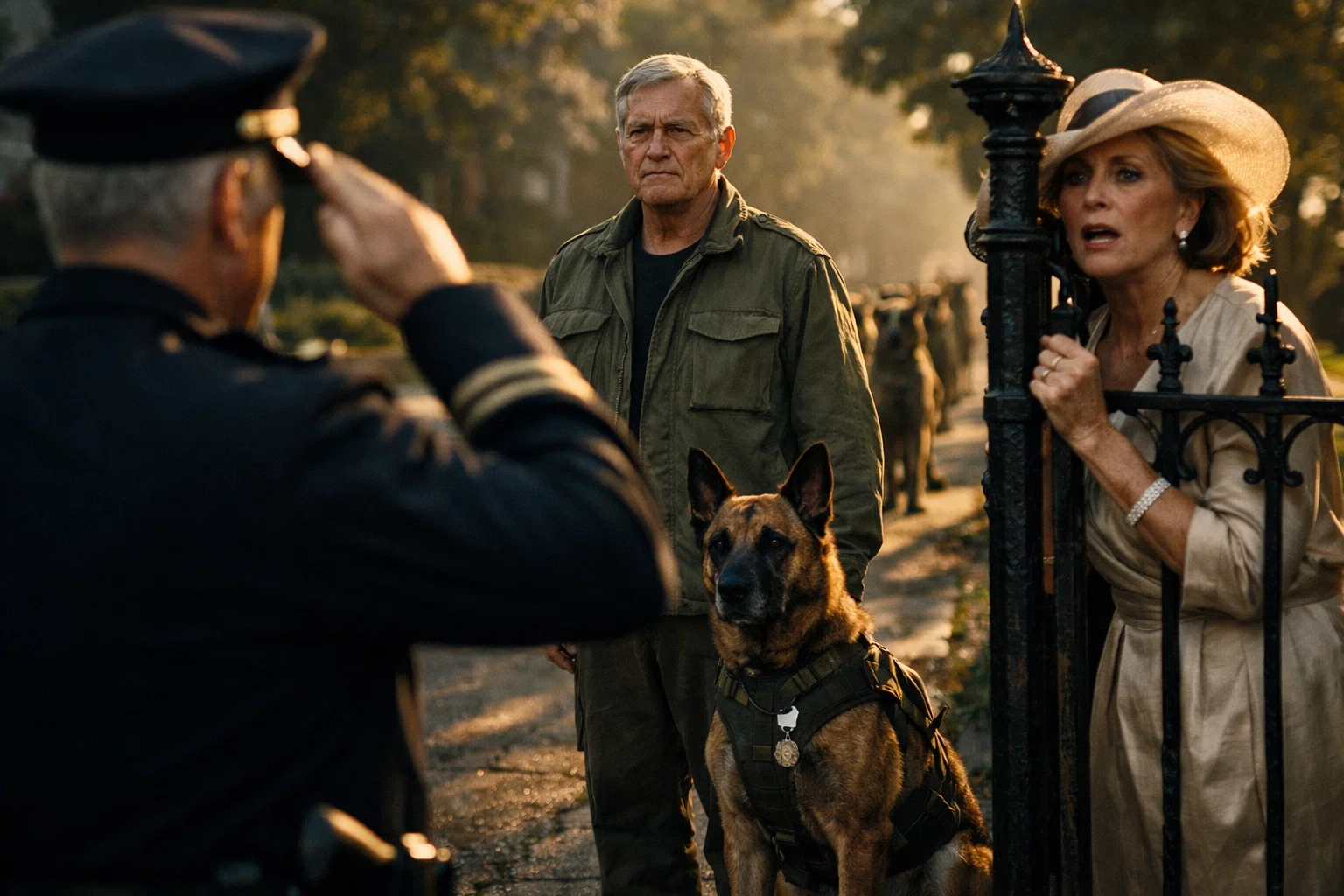
Seventy-three years old. Canvas jacket. Clean boots — he always kept his boots clean, a habit so old he couldn’t remember where it came from anymore. One hand on the strap of his bag. The other holding a slip of paper he’d been carrying for three weeks like it was something holy.
“You’ve been told,” Officer Mason said, loud enough now for the whole lobby to hear. “The form is on the website. Ten business days. That’s the process.”
“I’ve submitted the form twice,” Earl said.
“Then submit it again.”
“Sir.” Earl’s voice stayed low. “Those documents are the only—”
“I don’t care what they are.” Mason leaned over the counter. His face had gone red, the specific red of a man who’s decided that patience is a resource he’s no longer offering. “You don’t come in here four times demanding—”
“I’m not demanding anything.”
“You are harassing my desk—”
“I’m asking.” The word came out steady. “I am asking. That’s all I am doing.”
“And I am done answering.” Mason straightened up. “Step back or I have you removed.”
Earl didn’t step back.
He didn’t step forward either.
He just stood there, the way a man stands when he’s too tired to perform submission but too careful to do anything that could be used against him.
“Please,” he said. One word. No decoration.
Mason opened his mouth.
And across the lobby — from the far bench where a man in a leather jacket had been sitting for the last ten minutes waiting on a form — there was a sound.
Not a voice. Not yet.
Just a stillness that spread outward from one person like a drop of dye in water.
The man in the leather jacket had been looking at his phone.
Then he wasn’t.
He was looking at Earl.
Specifically, at the left lapel of Earl’s canvas jacket.
At the small, worn pin fastened there — a five-pointed star, dulled with age, hanging from a pale blue ribbon so faded it was almost white.
The man’s phone lowered slowly.
His face changed.
He stood up.
Cole Mason was forty-nine years old, and he had a bad knee, and he hadn’t planned on being part of anything today.
He was here because of a parking ticket. A stupid, wrongful, seventy-dollar parking ticket that he’d been disputing for six weeks and that had finally reached the point where showing up in person was the only way forward.
He had his form. He had his evidence. He was going to hand it in, go get coffee, and go home.
That was the plan.
Then he’d seen the pin.
He knew that pin.
He knew it the way you know a face that’s looked at you from a photograph for twenty-two years — from the framed article on his brother’s wall, from the ceremony his whole family had watched on a twelve-inch TV in a military hospital in Germany, from the dreams he still had sometimes where the smoke wouldn’t clear and the sound wouldn’t stop and then a pair of hands came through it and grabbed his brother by the collar and dragged him out of the fire.
A pair of hands he’d never seen the face behind.
Until now.
He crossed the lobby.
Not fast. His knee wouldn’t allow fast. But steady, with the specific weight of a man who has decided something and is not going to undecide it.
He stopped at the desk.
He looked at Mason.
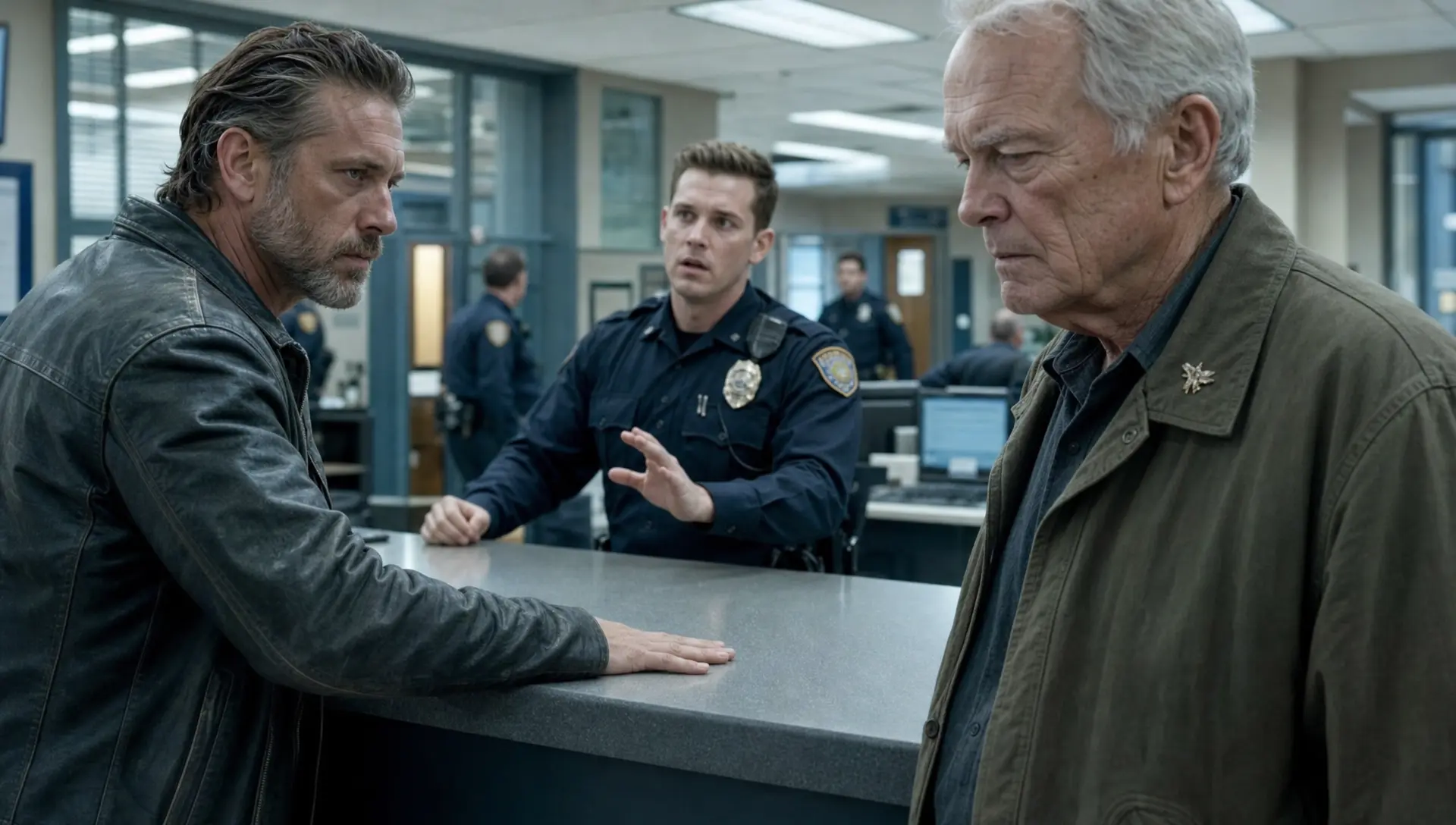
He brought his palm down on the counter — flat, hard, once.
The crack of it stopped the room.
Mason spun.
“Sir—”
“Do you even know,” Cole said, “who this man is?”
His voice was quiet. That was the thing that made it land. Not loud. Quiet in a way that made everyone in the lobby lean slightly forward.
Mason blinked.
“Excuse me?”
Cole wasn’t looking at him anymore.
He was looking at the pin.
Then, slowly, he looked up at Earl’s face.
Earl was watching him with the careful expression of a man who has learned that unexpected attention usually means trouble.
“Khe Sanh,” Cole said. Quietly. Like a key being turned in a lock he hadn’t known was there.
Earl went very still.
“1971,” Cole said. “Third Battalion. The valley.”
Something moved behind Earl’s eyes. Not recognition exactly. Something older. The physical sensation of a door opening in a place you’d walled off so long you’d forgotten the shape of it.
“How do you—” Earl started.
“My brother,” Cole said. “Danny Briggs. Corporal.” A pause that carried weight. “He was in the first wave.”
Earl looked at him.
The lobby didn’t exist anymore. The desk didn’t exist. Mason didn’t exist. It was just these two men, and twenty-two years of something that had been waiting to become a real conversation.
“Dan,” Earl said. Almost to himself.
“He talks about you,” Cole said. “Still. Every Thanksgiving. Every time anyone asks him about the war, he talks about—” He stopped. His jaw worked. “He said a sergeant came back into that valley three times. Three times, while it was still—while everything was—”
“Stop,” Earl said gently.
Cole stopped.
“How is he?” Earl asked.
“Good.” Cole’s voice had gone rough. “He’s good. Retired. Lives in Colorado. Four grandkids.”
Earl nodded slowly.
“Good,” he said. “That’s good.”
A long silence.
Then Cole turned back to Mason.
And the look on his face was different now. Not angry exactly. Something colder and more final than anger.
“That pin,” he said, “is the Medal of Honor.”
Mason looked at the pin.
“This man went back into a burning valley three times. He carried men out on his back while they were still under fire. His hands were so burned they had to cut his gloves off at the field hospital.” Cole’s voice stayed level. Controlled. Every word placed like something heavy being set down carefully. “My brother is alive because of him. Four grandkids exist because of him.”
He looked directly at Mason.
“And you’re screaming at him over a form.”
The lobby was completely, absolutely silent.
An officer near the back wall had stopped mid-step and not resumed.
A clerk’s hands were motionless over her keyboard.
Someone’s radio crackled once, then went quiet, as if even that understood the moment.
Mason’ face had gone from red to something closer to gray.
“I didn’t—” he started.
“You didn’t know,” Cole said. “Fine. You didn’t know who he was. But here’s what you did know.” He took one step forward. “You knew he was old. You knew he was tired. You knew he’d been here before and wasn’t getting help. You knew all of that — and you chose to get louder.”
A pause.
“So don’t tell me you didn’t know.”
Mason’ mouth opened.
Nothing came out.
The sound of a door.
Captain Webb had been in her office at the back of the building, halfway through a budget report, when something in the quality of the silence from the lobby reached her in a way that noise usually didn’t.
She came out.
She read the room in four seconds.
She walked to the desk.
She looked at Earl. At the pin.
She looked at Mason.
She’d had two conversations with Mason in the past year about his approach. Written up the second one. Thought, at the time, it had landed somewhere.
She looked at his face now and understood it hadn’t.
“Mr. Denton,” she said.
Earl looked at her.
“I’m Captain Webb. I apologize for how you’ve been treated in this building.” No hedge. No qualification. “Will you wait here one moment?”
Earl nodded.
She turned to Mason.
“My office.”
“Captain, I—”
“Now.”
The way she said it was not the way she usually said anything.
Mason heard the difference.
He followed her.
The door closed.
Four minutes later it opened.
Mason walked out.
He walked past the desk.
Past Earl.
Past Cole.
He didn’t look at either of them.
He went to the back. Returned with his jacket and a small box of personal items.
His badge was not on his chest.
He left through the side door.
He didn’t speak.
Captain Webb came back to the desk.
“Get someone in the back,” she said to the officer on her right. “Find Mr. Denton’s documents. All of them. Bring them here. Now.”
“Yes, ma’am.”
She turned to Earl.
“It won’t take long. Can I get you something while you wait?”
Earl looked at her for a moment.
“Coffee,” he said. “If that’s all right.”
“Of course.”
She got it herself.
It took nine minutes.
Nine minutes for Officer Collins to go into the storage room, locate the misfiled box, and carry it to the front desk.
Earl went through it quietly while Collins stood back and Cole stood beside him and the lobby gave them space the way people give space to something they understand they’re witnessing.
Service record. Discharge papers. VA documentation. And at the bottom of the box, in a manila envelope — a letter from the VA confirming his benefits eligibility. A letter that had been sitting in a storage room while he slept in a shelter and filled out forms and came back, and came back, and came back.
He held it.
Read it.
Set it down.
“Nine minutes,” he said. Mostly to himself.
Cole said nothing.
“Three weeks. Nine minutes.”
He folded everything carefully back into order. The hands of a man who had learned that the things worth keeping need to be handled like they’re worth keeping.
When the box was closed, he picked it up and held it against his chest.
He turned to Cole.
“Your brother — does he know what you just did?”
“He doesn’t know I’m here.”
“Call him.”
Cole looked at him.
“Yeah,” he said. “I will.”
Earl put out his hand.
Cole shook it.
The handshake lasted a second longer than handshakes usually do.
“Tell him,” Earl said, “that I think about those men more than he probably knows.” A pause. “Tell him they were worth it.”
Cole’s grip tightened slightly.
“He knows,” he said.
“Tell him anyway.”
They walked out together.
The afternoon was gray and flat.
Earl stood at the top of the steps and tilted his face up slightly. Just a few degrees. The way you do when you’ve been under fluorescent lights and forgotten the sky was still there.
Cole stood beside him.
After a while he took out his phone and dialed.
It rang three times.
A voice — older, slow, warmed immediately:
“Cole? You never call in the middle of the—”
“Dan.” Cole’s voice caught slightly on the name. “I’m standing outside the 14th Precinct.”
A pause on the line.
“And you’re not going to believe who’s standing next to me.”
Silence.
Then, quietly — barely above a breath:
“Cole.”
“Yeah.”
“Cole.”
“I know.”
Cole held the phone out to Earl.
Earl looked at it.
He took it.
Pressed it to his ear.
Didn’t speak for a moment. Just breathed.
Then:
“Danny Briggs.”
A sound came through the phone that was not quite a word.
“Still alive,” Earl said softly. “Both of us.”
Dale Mason sat in his car in the parking lot for a long time before he started the engine.
He’d always wanted this job. Since he was a kid. The whole idea of it — showing up, being the person who handled things.
He sat there and tried to locate the exact moment it had become something else.
He couldn’t find it.
That was almost the worst part.
It hadn’t been a moment. It had been a drift. Small accommodations, made once, then twice, then so many times they stopped feeling like accommodations and started feeling like personality.
He started the engine.
He drove home.
He didn’t know yet what came next.
He suspected it would be hard.
He hoped, distantly, that it would be useful.
That was the most he could offer himself right now.
Earl moved out of the shelter six weeks later.
A small apartment on the east side. Two rooms, a working radiator, a window that caught the morning light in a way that made the parking lot below look almost deliberate.
He kept the documents in a folder beside his bed.
Not in a box. Not hidden. A folder, organized, accessible.
For the first time in a long time, he didn’t think they might disappear.
On the third morning, his phone rang.
Unknown number.
“Hello?”
“Is this Earl Denton?”
“Who’s asking.”
“My name is Danny Briggs.” A pause. A voice rough with age and something it had been carrying for two decades. “I’ve been trying to find the right words for twenty-two years. My brother says I should just say them.”
Earl sat down on the edge of the bed.
Outside, the morning light moved across the parking lot the way light moves when nobody’s told it to hurry.
“Say them,” Earl said.
And Danny Briggs said them.
All of them.
Every word he’d been holding since a valley in 1971, since a field hospital in Germany, since every Thanksgiving when someone asked and he tried to explain what it meant to be alive because a man came back for you.
Earl listened.
He didn’t speak.
When Danny finished, Earl said:
“You turned out all right.”
A sound that was mostly laugh and a little something else.
“I tried,” Danny said.
“That’s all it is,” Earl said. “Just trying.”
He hung up.
He sat for a while.
Then he got up, put the phone in his pocket, and went to make coffee.
The morning was ordinary.
He was in it.
That was enough.
Original fictional stories. AI-assisted creative content.