The first sound wasn’t the shouting.
It was the splash.
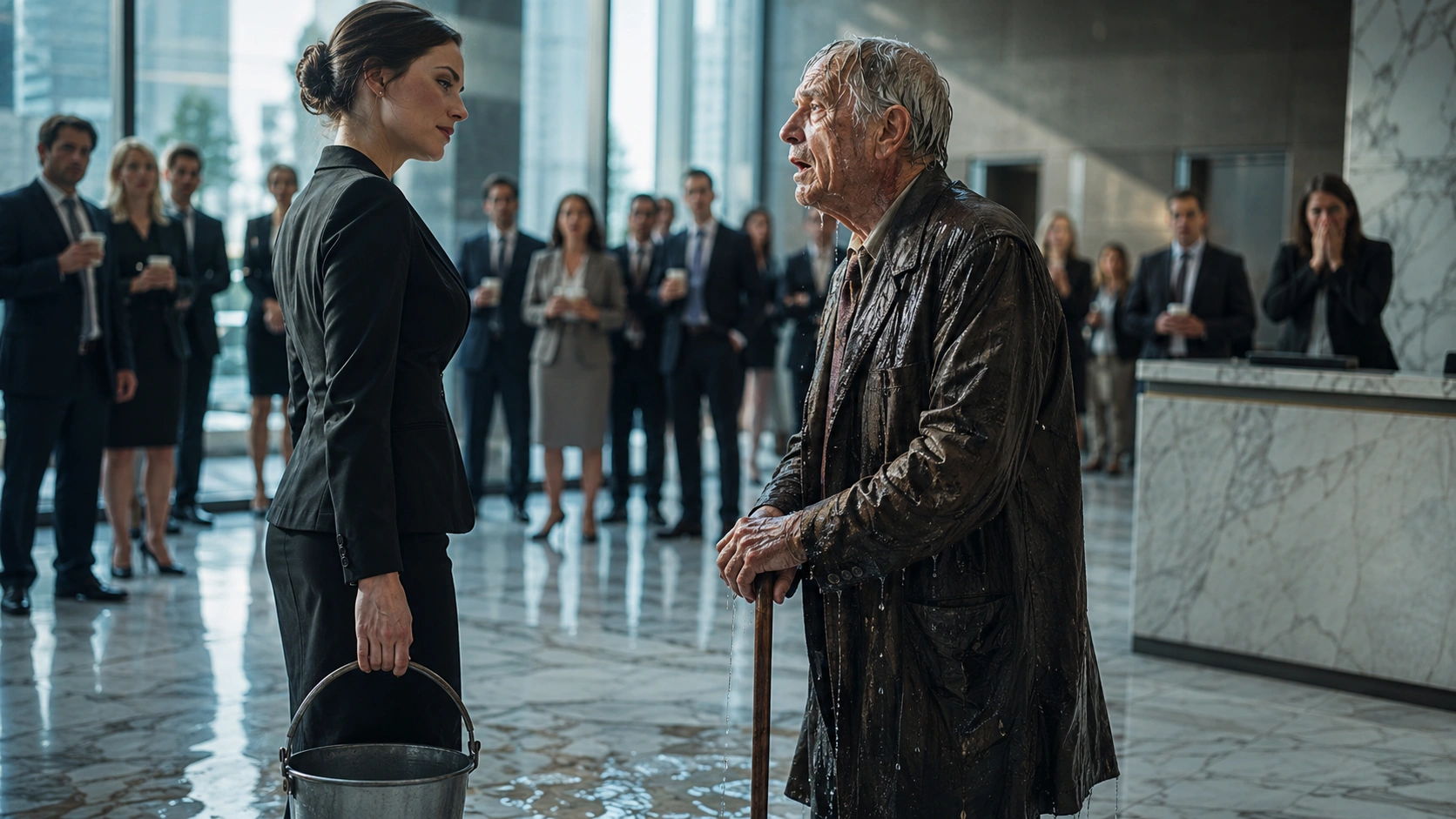
A bucket of icy water crashed over the elderly visitor, soaking him from silver hair to the tip of his wooden cane. Water streamed down his threadbare coat and pooled across the polished marble floor of the downtown headquarters.
No one moved.
No one spoke.
Only Vanessa Clarke smiled.
She lowered the empty bucket with the satisfaction of a woman who believed she had just taught her office a valuable lesson.
She had no idea she had just ended her own career.
Vanessa had run the downtown branch for exactly one week.
Young. Sharp. Ruthless.
From her first morning, she made one rule clear.
“Weakness will not be tolerated in this building.”
Employees straightened when she passed. Conversations dropped to whispers. The receptionist, a soft-spoken young woman named Emily Carter, learned to keep her eyes down whenever Vanessa’s heels struck the marble.
That morning, an old man had walked through the revolving doors. His coat was frayed at the cuffs. His cane was worn smooth from years of use. But his posture was straight, and his voice was gentle.
“Excuse me,” he said to Emily. “I was told someone here could help me.”
Emily smiled. “Of course, sir. What do you—”
Vanessa cut between them.
“We’re not a charity,” she said sharply. “State your business or leave.”
“I’m not asking for money.”
“Then what are you doing in my lobby?”
“I was hoping someone would listen.”
Something about his calm dignity infuriated her.
She turned to the watching employees. “This is what happens when people mistake professionalism for weakness.”
Then she grabbed the janitor’s bucket.
And swung it.
The water hit him full in the face.
Someone gasped. An intern took half a step forward and froze. Emily covered her mouth with both hands.
“Learn the difference,” Vanessa said, “between customers and beggars.”
The old man stood there, dripping.
He didn’t shout. He didn’t threaten. He simply looked at her for one long, quiet second — not humiliated, not angry, only deeply disappointed.
Then he nodded once, turned, and walked out.
Emily grabbed a jacket from behind the desk and ran after him.
She caught up on the sidewalk.
“Sir — please — I’m so sorry. Please take this.”
He looked at the jacket in her trembling hands.
Then at her face.
“What’s your name?”
“Emily.”
“Emily,” he said softly, “thank you.”
He didn’t take the jacket.
But he smiled — a small, tired smile — and walked into the rain.
The next morning, the office was thick with dread.
Whispers ran between the desks. Everyone had heard. No one had reported it.
Then, at nine sharp, the revolving doors turned again.
Every conversation stopped.
The old man was back.
But he did not look like the visitor they remembered.
The frayed coat was gone. In its place, a perfectly tailored navy suit. Polished shoes. A silver watch beneath a crisp cuff. Behind him walked four senior executives from corporate — men and women Vanessa had only ever seen in shareholder photographs.
The lead executive stepped forward.
“Good morning, Mr. Whitaker.”
The name hit the room like a struck bell.
Arthur Whitaker.
The founder.
Vanessa’s coffee cup slipped an inch in her hand.
“No,” she whispered. “No, no, no.”
Arthur’s eyes moved across the lobby. They stopped on the faint water stain still visible near the reception desk.
“So,” he said quietly, “this is what leadership looks like now.”
Vanessa rushed forward. “Mr. Whitaker — I didn’t know who you were —”
“That’s exactly the problem.”
His voice was soft. It didn’t need to be louder.
“You believed kindness should depend on a person’s status.”
He took one measured step forward, leaning on the same worn wooden cane.
“The test was never whether you recognized me. It was whether you could treat someone who appeared powerless with basic human dignity.”
“I can explain.”
“No.” He shook his head. “Yesterday explained everything.”
He turned to the room.
“My late wife cleaned offices at night while raising our children. She wore thrift-store shoes so we could afford diapers. If someone had ever treated her the way this manager treated me —”
He didn’t finish.
He didn’t need to.
He turned to the HR director beside him.
“Effective immediately, Vanessa Clarke’s employment is terminated.”
Vanessa’s knees nearly buckled.
“Mr. Whitaker — please —”
“Ms. Clarke.” His voice hardened. “You are not the first employee I have dismissed. But you are the first I have dismissed in the same lobby where you humiliated a customer.”
Security stepped forward with quiet professionalism.
But Vanessa wasn’t finished.
She spun toward Emily.
“You. You did this. You called somebody.”
Emily flinched.
“I didn’t —”
“Don’t lie to me.”
“Ms. Clarke.” Arthur’s voice cut clean across the lobby. “Do not speak to her.”
The words landed like steel.
But Vanessa was past caution now.
“This company rewards weakness now? Is that it? Cry hard enough and you get promoted?”
“She tried to help him,” said a voice from behind Emily.
Daniel — the young analyst from the third floor — had stepped beside her without seeming to notice he’d moved.
“She followed him outside. She brought him a jacket.”
Vanessa laughed, sharp and desperate.
“She tried to look good.”
Arthur turned slowly.
His cane tapped once against the marble.
“Yesterday,” he said, “when I left this building soaked and cold, Emily followed me onto the sidewalk. She offered me her coat. She apologized on behalf of a company she doesn’t own.”
He looked directly at Vanessa.
“She was the only person in this building who acted like a human being.”
Silence.
Then something shifted in the room.
Small at first.
Emily’s hand slid beneath the reception desk and came back holding her phone.
Her voice trembled.
“I recorded it.”
Vanessa went completely still.
“I was scared no one would believe me,” Emily said. “So I recorded after she started yelling. I got the bucket. I got what she said after.”
Vanessa lunged.
“Give me that phone —”
Security caught her arm before she reached Emily. A chair scraped hard across the floor.
“Let go of me!”
Arthur’s voice remained calm.
“Release her when she stops reaching for evidence.”
Vanessa froze.
The HR director took the phone from Emily’s shaking hand.
The video played from the tinny speaker.
Vanessa’s own voice filled the lobby.
“We’re not a charity organization.”
Then Arthur’s voice, quiet and patient.
“I was simply hoping someone would listen.”
Then the splash.
Some employees flinched as if it were happening again.
“Learn the difference between customers and beggars.”
The HR director stopped the video.
The lobby was completely silent.
Then, one by one, other voices began.
“She canceled my leave when my father was in the hospital,” said a woman from accounting.
“She told me I’d never be promoted because clients don’t trust people with accents,” said another.
“She made me work through a panic attack,” Daniel said quietly. “She said anxiety was an excuse for weak employees.”
“She deleted a complaint from the internal portal before HR could see it.”
Arthur listened to every voice.
He did not interrupt.
When the last one finished, he nodded slowly.
“Ms. Clarke, you will leave this building today. But your exit is not the end of this matter. Every complaint connected to your management will be reopened. Every deleted report will be audited. Every employee affected by your conduct will be heard in a protected review.”
Vanessa’s laugh was breathless.
“You’re going to destroy me over one mistake?”
Arthur looked at her for a long moment.
“One mistake is spilling coffee and apologizing.” His voice lowered. “You chose cruelty. Then you called it leadership.”
He gestured toward the employees.
“They worked as hard as you did. The difference is, they didn’t need to break people to feel powerful.”
Vanessa’s mouth opened.
Nothing came out.
Security led her toward her office. She walked between the desks she had once ruled like a queen. Every lowered gaze was gone. People watched her clearly — not with cruelty, not with triumph, but with the steady quiet of people finally seeing a locked door open.
At her office, she picked up the silver nameplate on her desk.
VANESSA CLARKE — BRANCH MANAGER.
“That remains company property,” the HR director said behind her.
Her fingers tightened.
Her jaw trembled.
She set it down.
The sound of metal on glass was small.
Final.
She walked out of the building with a cardboard box, and this time the revolving doors turned for her the way they had turned for a soaked old man twenty-four hours before.
Only now, no one was afraid to watch.
Six months later, the audit was complete.
Fourteen employees received back pay for canceled leave and unpaid overtime.
Three managers who had helped conceal complaints were dismissed.
The internal reporting system was rebuilt from scratch, with a direct line to Arthur’s office.
Vanessa Clarke’s severance was withheld pending the outcome of a civil suit filed by two former employees. Her professional references were revoked. Her name, which had once opened doors across the industry, quietly closed them.
She took a job at a mid-tier firm in another city.
She lasted four months.
When her new employer discovered the video — now circulating in HR training seminars as a case study in what leadership must never look like — she was let go without severance.
She was not heard from professionally again.
Emily Carter was promoted twice.
The second time, Arthur handed her the offer letter himself.
“Director of Employee Relations,” she read. Her voice caught. “Mr. Whitaker — I don’t have the qualifications for —”
“Emily.” He smiled. “You have the only qualification I care about.”
“What’s that?”
“You chased a stranger into the rain with a coat.”
She laughed through tears.
On her first day in the new office, a cream-colored envelope sat on her desk.
Inside, in Arthur’s careful handwriting:
Emily —
The day I walked into the branch, I said I was looking for someone who could help me.
That was true.
I was not testing Vanessa alone. I was searching for the future of this company.
Years ago, my wife told me that if this place ever grew too large for me to see the people inside it, I should find the person who still noticed the ones everyone else ignored.
Yesterday, that person was you.
Not because you were fearless.
Because you were kind while afraid.
— Arthur
Emily folded the letter carefully and placed it in her top drawer.
Outside her new office window, the city moved on.
But inside the downtown headquarters, something had permanently changed.
The revolving doors kept turning.
And every person who walked through them — in a tailored suit or a threadbare coat — was greeted the same way.
Because Emily Carter had learned the lesson Vanessa Clarke never would.
You never know who someone is.
But you always know what kind of person you choose to be.
Original fictional stories. AI-assisted creative content.