The concert hall was packed.
Every seat sold out three months in advance. Journalists in the front row. Critics in the balcony. A television crew tucked against the left wall.
Vivian Cross adjusted the strap of her black gown and stepped out onto the stage.
Applause thundered through the hall.
She smiled the way she had trained herself to smile — chin high, teeth just visible, eyes fixed on the middle distance.
At thirty-eight, Vivian was one of the most recognized classical pianists in the country. Two Grammys. A residency at Carnegie. A signature perfume that outsold her last three albums.
Tonight was her anniversary gala. Twenty years since her debut.
She sat down at the white grand piano.
The lights dimmed to a single warm spot.
A voice came through the speakers.
“Ladies and gentlemen, our closing performance will feature a surprise duet. A world-class violinist, whose identity has been kept secret… until now.”
Vivian placed her hands over the keys.
She waited.
The curtain shifted.
And an old man stepped out.
—
He walked slowly.
Gray hair. A brown suit two sizes too big. Shoes that had been polished so many times the leather had gone thin at the toes.
In his hands he carried a violin. Not a violin case — the violin itself, exposed, as if he had been holding it since he left home.
The instrument looked ancient. Cracks along the body. Varnish faded to almost nothing. The strings had a dull, tired shine under the stage light.
Whispers spread through the hall.
Vivian’s fingers lifted off the keys.
She turned toward the wings.
“Marcus,” she called out. “Marcus, get out here.”
The stage manager did not appear.
The old man kept walking. Calm. Unhurried.
Vivian stood up.
“There’s been a mistake,” she said to the audience. She laughed, short and tight. “Please, one moment.”
She turned to the old man.
“Sir. Sir, this is a private event.”
“I was invited,” the old man said. His voice was quiet. “To perform with you.”
“Perform,” Vivian repeated. “With me.”
“Yes.”
She looked him over. The suit. The shoes. The violin that looked like it belonged in an attic.
A laugh escaped her before she could stop it.
“With that?”
She pointed at the violin.
Someone in the third row laughed too. Then someone in the fifth. A ripple.
“Sir, I don’t know how you got backstage, but this is embarrassing. For you. Please.”
“One minute,” the old man said.
“What?”
“Give me one minute. Then I will leave if you ask me to.”
Vivian turned back to the audience, palms out, as if asking them to witness her patience.
“Do you know where you are?” she said to him. “This is Carnegie. I was expecting a world-class musician. Not — ” she gestured at him, at the violin, at all of it — “not someone who plays outside a subway station.”
The laughter grew.
Phones came up. Little red dots blinking.
“I can’t even imagine,” Vivian said, warming to her audience, “what kind of sound that museum piece could possibly make.”
The old man did not smile. Did not frown. He simply waited.
“Fine,” Vivian said, sitting back down. “One minute. Impress us.”
She crossed her arms over the piano.
The old man tucked the violin under his chin.
—
The first note stopped the laughter.
It did not fade the laughter, or quiet it, or soften it. It stopped it. The way a hand stops a swinging door.
A single long note, drawn slow and clean, filling every corner of the hall.
Vivian’s arms uncrossed.
The second note bent into the first, and the third slid underneath, and by the fifth there was a melody in the air that she recognized.
She knew it.
She knew it the way you know your own name.
Vaughan Williams. “The Lark Ascending.”
But not the way she had heard it played. Not on any record. Not in any hall.
The old man played it the way someone might tell a secret to a child at bedtime. Slow. Careful. Every note placed exactly where it needed to be.
The hall went silent.
Not polite silent. Held-breath silent.
Vivian’s hand drifted to her mouth.
She had heard thousands of violinists. She had shared stages with the best of them. She had heard Perlman, Mutter, Bell.
She had never heard anything like this.
The old violin, the cracked body, the tired strings — none of it mattered. The sound coming out of it did not belong to the instrument. It belonged to the man.
Somewhere in the middle of the melody, her eyes began to sting.
She did not know why.
Then she did.
—
She was eight years old.
A small apartment in Newark. Rain on the window. Her father sitting on the couch, coughing into a handkerchief. Her mother in the kitchen, counting bills in a low voice.
A knock at the door.
A man in a brown suit. Younger, then. Dark hair. Kind eyes. A violin case in his hand.
“I heard about your daughter,” he had said. “I heard she wants to play.”
“We can’t afford lessons,” her mother had said.
“I’m not asking for money.”
—
The last note held. Trembled. Faded.
Silence.
For a full five seconds, nobody in the hall moved.
Then someone at the back began to clap. Then two more. Then the balcony. Then the entire room, standing, hands over their mouths, some of them crying without knowing why.
Vivian did not stand.
She could not.
The old man lowered the violin. He turned toward her.
He walked to the piano.
The applause was still going.
He set the violin down on top of the piano, gently, as if it were made of glass.
Then he reached into the inside pocket of his suit and pulled out a photograph.
A small square. Yellowed at the edges.
He placed it on the music stand in front of her.
Vivian looked down.
A little girl of about eight. Curly hair. A too-big violin under her chin. Standing next to her, a young man in a brown suit, one hand on her shoulder, both of them smiling at the camera.
Vivian’s breath caught.
She knew the girl.
She knew the man.
“Mr. Halloran,” she whispered.
The applause was fading now. People had started to notice something was happening on stage. Phones lifted higher.
“You remembered,” the old man said.
“I — ” Her mouth had gone dry. “I looked for you. After I signed my first contract. I looked for you for years.”
“I know.”
“I sent letters to the old address.”
“I moved.”
“I hired a — I hired someone to find you.”
“I know.”
She looked up at him. His eyes were wet, but he was smiling.
“Why didn’t you let me find you?” she said.
“Because I promised your father I wouldn’t. Not until it was time.”
—
The word landed like a stone in still water.
“My father?”
The old man reached into his pocket again.
An envelope. Cream-colored. The edges soft with age. Her father’s handwriting on the front.
For Vivian. When she is ready.
She stared at it.
“That’s not possible,” she said.
“It is.”
“He didn’t leave any letters. My mother told me — she said there was nothing. She said he was too sick at the end to — “
“He wrote it three days before he died. He gave it to me. He asked me to hold it until you had become who you were meant to become.”
“Why you?”
“Because he trusted me.”
The hall was completely silent now.
Vivian’s hands were shaking so badly she couldn’t take the envelope. The old man opened it for her. He unfolded the letter and placed it on the music stand next to the photograph.
She read the first line.
My Vivian, my little bird —
Her hand went to her mouth.
I will not see you play in the big halls. I know this now. The doctors are honest men. But I have seen you at seven, at eight, at nine, and I have seen what your hands can do, and I know what is coming for you.
The tears were running now. She did not try to stop them.
I am writing this to the woman you will become. Not the little girl. The woman. And I want that woman to know three things.
One. Every note you play, I hear.
Two. You do not owe your gift to anyone but the people who helped you keep it. There is a man named Thomas Halloran. He gave you music when we could not. Find him. Thank him. Play for him.
Three. When you become great — and you will — do not become cruel. Greatness without kindness is only noise. Do you hear me, my little bird? Only noise.
Your father, always.
—
Vivian sat very still.
She looked at the photograph.
She looked at the man in the brown suit standing in front of her, sixty-something years old now, holding a violin held together by will and glue.
She thought about what she had said to him ten minutes ago.
Someone who plays outside a subway station.
Museum piece.
Do you know where you are.
Her shoulders folded forward. She put her face in her hands. She cried in front of two thousand people and did not care.
The old man waited.
When she looked up, she said, in a voice barely above a whisper:
“I’m sorry.”
“I know.”
“I’m so sorry.”
“I know, Vivian.”
“How did you even get in here tonight? They — they said no one knew who had approved you.”
The old man smiled. A small, tired smile.
“Your father was a good man. Good men have friends. Some of those friends are still alive. Some of them owed him. One of them works at this hall.”
He glanced up toward the balcony. Toward the sound booth.
A man up there — old, white-haired, in a black suit — raised his hand once, then lowered it.
“He waited twenty years for the right night,” the old man said.
—
Vivian stood up from the piano.
She walked around to the front of it.
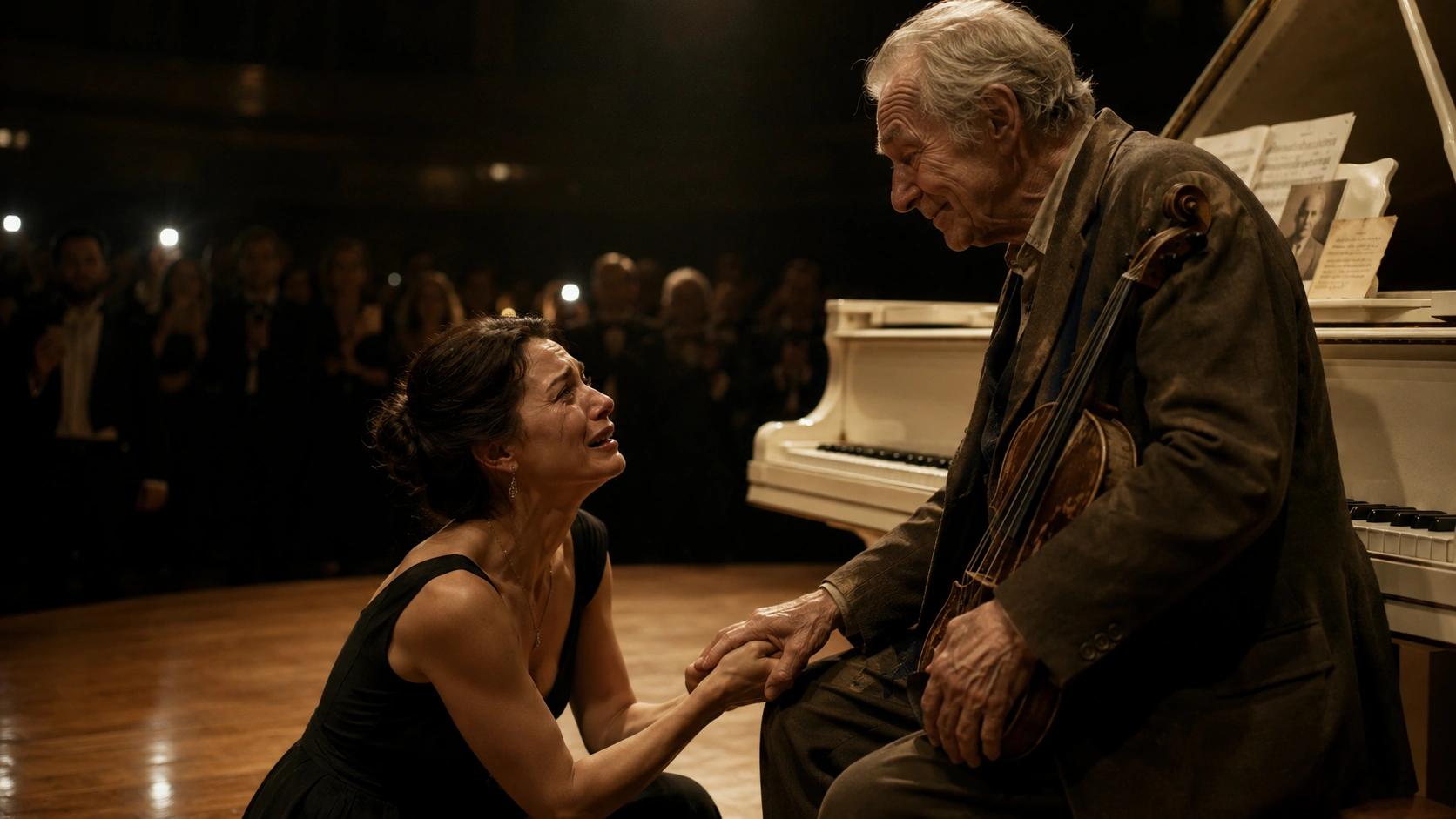
She took the old man’s hand in both of hers.
Then, in front of the cameras, in front of the critics, in front of the journalists who had come expecting a Grammy winner and a surprise celebrity duet, she went down on one knee and pressed the back of his hand to her forehead.
The hall erupted.
Not applause. Something bigger. A sound that had crying in it, and standing in it, and phones held up in it, and people leaning over railings.
She stood.
She walked back to the piano.
She sat down.
She looked at the old man and said, loud enough for the microphone to catch:
“Mr. Halloran. Will you play with me?”
He lifted the old violin.
“Yes,” he said. “I will.”
—
They played for eleven minutes.
Not the program. Not the arrangement the orchestra had rehearsed. Something older. Something he had taught her when she was nine years old on a rainy Tuesday in Newark.
When it was over, she stood, took his hand, and lifted it above their heads.
The audience did not sit down for a long time.
—
Backstage, later, a reporter tried to ask the old man his name.
“Halloran,” he said. “Thomas Halloran. I used to teach.”
“Where do you play now?”
He smiled.
“I don’t. Not really. This was the last one.”
“Why tonight?”
He looked past the reporter, toward the stage, where Vivian was still shaking hands with people who did not deserve to shake them.
“Because a father asked me to,” he said. “A long time ago.”
Then he walked out into the New York night with the old violin under his arm.
—
The next morning, a video of the concert had eighty-two million views.
The morning after that, Vivian Cross announced the founding of the Halloran Foundation, providing free instruments and private lessons to children in three boroughs whose families could not afford them.
She signed the papers with a photograph on the desk beside her.
A little girl. A young man. A too-big violin.
And in the top drawer, folded carefully, a letter that ended:
Greatness without kindness is only noise.
She never forgot it again.
Original fictional stories. AI-assisted creative content.