“Mom… that kid…”
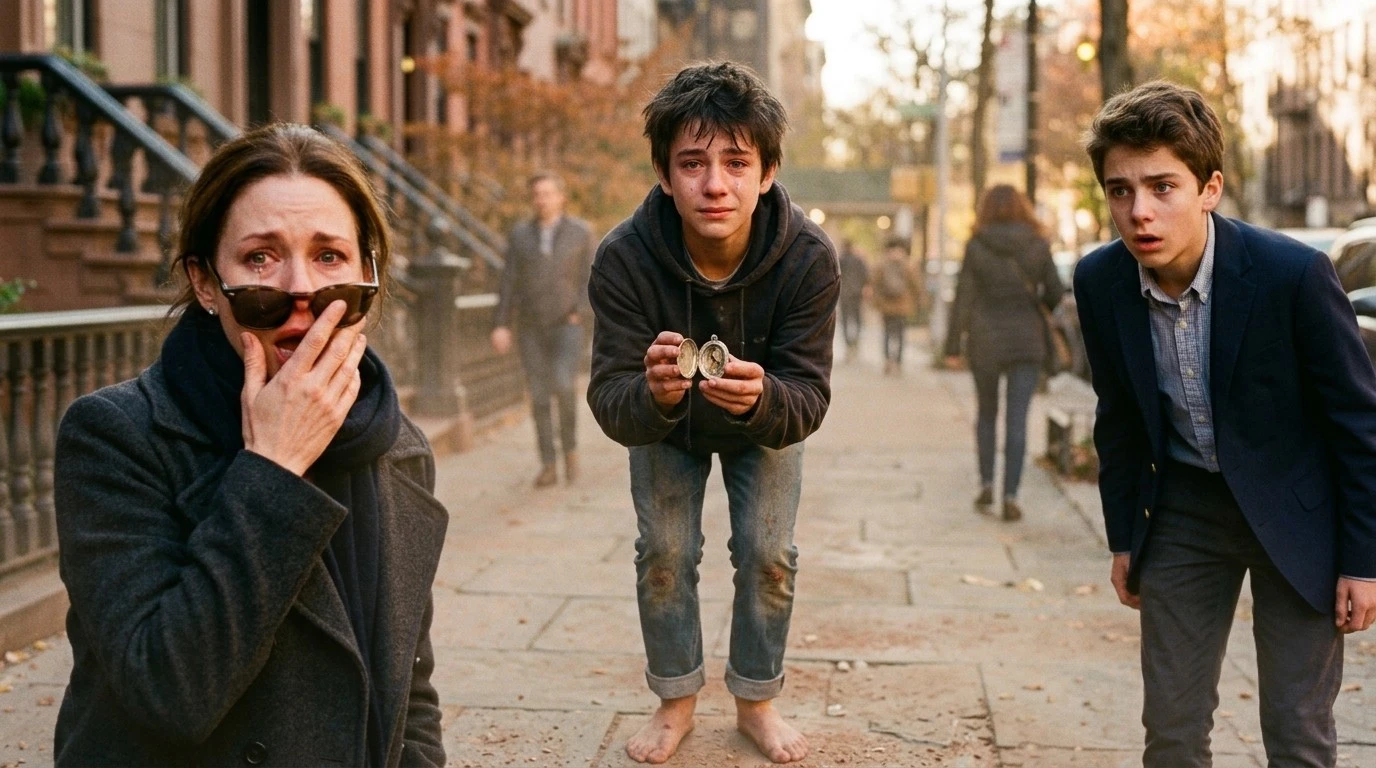
Vivian almost kept walking. Manhattan didn’t stop for anyone, and she’d trained herself not to look at the sidewalk cases — the cardboard signs, the paper cups, the boys nobody claimed.
But Grant had stopped.
He was staring at a boy slumped against a street pole, barefoot on the concrete, knees scraped raw, a thin hoodie hanging off bony shoulders.
The boy looked up.
Vivian forgot how to breathe.
He had Grant’s eyes. Grant’s mouth. Grant’s exact jaw.
“He looks like me,” Grant said, voice small.
The boy stood slowly. He didn’t beg. He reached up to a tarnished locket at his throat and opened it like he’d rehearsed this a hundred times in his head and never once believed he’d get the chance.
Two photographs. Beneath them, worn lettering: To our twin sons.
Grant’s hands started shaking. “Mom. Tell me what this means.”
Vivian’s sunglasses slipped down her nose. Her lips trembled.
“That can’t be—”
The boy looked at her with tired, guarded eyes.
“Mother?”
The city noise seemed to fall away.
“Mom,” Grant said again, “who is he?”
The boy didn’t step closer. He held himself like someone used to being pushed away before he could finish a sentence.
Vivian covered her mouth. Her shoulders shook.
“I was told one of you died,” she whispered.
“What?” Grant stepped back.
“There were complications when you were born. Your father made the decisions. He told me only one baby survived. He put one of you in my arms and said the other was gone.”
The boy’s face tightened — pain and anger fighting for the same space.
“He lied,” he said quietly. “I found the truth in this locket.”
“The woman who raised me was dying,” he went on. “Before she died, she told me I was stolen from a hospital. She said if I ever found the woman in these pictures, I should ask her why I was left.”
“I didn’t leave you,” Vivian said. “I swear to God, I didn’t know.”
Grant looked at the boy again — not like a stranger now. Like a mirror that had suffered.
He stepped forward. The boy flinched, bracing for rejection.
Instead Grant touched his sleeve. “You’re really my brother?”
“I think so.”
Grant turned back to his mother, eyes wet. “You let me grow up alone while he was out here like this?”
“I didn’t know.”
“All this time,” the boy said, “I thought nobody came because nobody wanted me.”
That sentence broke her.
Vivian dropped to her knees on the sidewalk, uncaring of the stares. She reached for him slowly, giving him room to pull away.
He didn’t.
“I wanted you,” she said. “I just never knew where to look.”
Two brothers stood side by side for the first time in their lives. One in polished shoes. One barefoot on cold pavement. Neither of them understood yet how a family could be broken this cruelly — only that they’d found each other before the city could swallow the truth for good.
Vivian got the boy’s name on the walk to the car. Eli. No last name he trusted enough to give a stranger, even one who might be his mother.
The town house on Seventy-Second Street had a doorman who didn’t blink at much, but he blinked at Eli.
Richard was in the study when they came in. He looked up, saw the boy, and something in his face went perfectly, professionally still — the look Vivian recognized from board meetings, the one he wore right before he lied to a room full of people who trusted him.
“Who’s this?” Richard asked, like he didn’t already know.
“Don’t,” Vivian said. “Don’t you dare stand there and ask me who this is.”
Richard’s eyes flicked to the locket around Eli’s neck. Just for a second. Just long enough.
“Vivian, whatever this is, we should discuss it privately.”
“He knows my name,” Eli said. “He hasn’t asked it. He already knows my name.”
Grant looked between his father and the boy who wore his face. “Dad. Do you know him?”
“I don’t know what your mother has told you—”
“She hasn’t told me anything,” Grant said. “You’re the one standing there like you’ve seen a ghost.”
Richard’s jaw worked. “I think we all need to sit down.”
“I think you need to explain why there’s a birth record somewhere that says I died,” Eli said, “and I’m standing right here.”
Richard poured himself a drink he didn’t need, hands not quite steady. “This is not a conversation for tonight.”
“It’s the only conversation,” Vivian said. “Fourteen years late, but it’s the only one.”
Richard set the glass down without drinking. “You’re upset. You’re not thinking clearly.”
“I’ve never thought more clearly in my life,” Vivian said. “Where is Denise Okafor?”
The name hit him like a slap. His face didn’t move, but his hand did — a small tightening around the glass.
“Who’s that?” Grant asked.
“The nurse who was on shift the night you were born,” Vivian said, eyes on Richard. “The one who signed the paperwork. I remember her name. I remember everything about that night, Richard. I just didn’t know I was supposed to be suspicious of it.”
“Vivian—”
“Where is she?”
“I don’t know,” Richard said. “That was fifteen years ago.”
“You’re lying,” Eli said. Quiet. Certain. “You get a specific kind of quiet when you lie. I used to watch men do that quiet on the subway platform, right before they took something that wasn’t theirs.”
Richard looked at the boy — really looked, for the first time — and Vivian saw something crack behind his eyes before he shut it down again.
“Get some rest,” he said. “All of you. We’ll talk in the morning.”
“No,” Vivian said. “We’ll talk now, or I call my lawyer tonight instead of tomorrow.”
Richard’s composure held for exactly three more seconds.
Then he sat down, slowly, like his legs had made the decision without him.
He didn’t confess that night. Not fully. He gave them half a story — a difficult delivery, a decision made in a moment of panic, a nurse paid to keep quiet, a boy sent to a family in Queens who needed the money more than they needed questions.
He did not say why.
Vivian didn’t sleep. By six the next morning she was in her lawyer’s office instead of the kitchen.
“I need everything on a birth at Lenox Hill, nineteen years ago next month,” she told Priya Patel, the family attorney who’d handled three generations of Cross paperwork and asked exactly as many questions as she was paid to. “Two boys. One recorded as deceased. I need to know who signed that death certificate and who paid them to.”
Priya didn’t blink either. “You understand what you’re asking me to open.”
“I understand what’s already been open for fifteen years without me knowing it,” Vivian said. “Open it wider.”
It took nine days.
Denise Okafor was living in Newark, retired from nursing, and answered her door already looking like a woman who’d been waiting a long time for this particular knock.
“I wondered when someone would come,” she told the investigator Priya sent. “I kept the real paperwork. I couldn’t make myself destroy it. I just couldn’t file it either. Man like Richard Cross doesn’t ask a nurse to falsify a death certificate for free.”
She had copies. A real birth record — two boys, both alive, both healthy. A second document: a wire transfer, dated the same week, sixty thousand dollars, no invoice attached.
And a letter. Richard’s own handwriting, addressed to a family friend who ran placements through a private adoption broker in Queens: Handle this quietly. One is enough. The trust doesn’t split for two.
Vivian sat in Priya’s office and read that sentence four times before it made sense.
“The trust,” she said.
“Your father-in-law’s trust,” Priya said. “I pulled the language this morning. The Cross family trust vests to a single named heir per generation — the eldest surviving son. If Richard had reported twins, the trust attorneys would have had to determine which one was legally the heir, or possibly split the estate between them. Richard didn’t want a fight over which twin. He wanted there to only be one.”
“So he threw the other one away,” Vivian said, “for money that was never his to protect.”
“For control of money that was never his to protect,” Priya said. “There’s a difference, and it’s the difference that’s going to matter in front of a judge.”
Vivian went home that afternoon and found Eli in the kitchen with Grant, the two of them sitting exactly the same way, feet hooked around the same chair leg, a habit neither of them had learned from the other.
“I have proof,” she said. “Real proof. Everything he told us was a smaller lie sitting on top of a bigger one.”
Eli didn’t look surprised. “What’s the bigger one?”
“Money,” Vivian said. “It was always money.”
Richard tried the only move he had left. He tried to buy it back.
He came to Priya’s office two days later with his own lawyer, a settlement number that would have made most families quiet forever, and a request: no press, no criminal referral, a private trust established for Eli, case closed, everyone comfortable.
“He’s not a lawsuit,” Vivian said. “He’s my son. You don’t settle a son.”
“Vivian, be reasonable. A criminal referral could end my career, my seat on the board, everything I’ve built for this family—”
“You built it on a lie that cost a nine-year-old boy a childhood on the street,” Vivian said. “Don’t talk to me about what you built.”
Richard turned to Eli, and for the first time his voice lost its boardroom polish. “I can give you more than you’ve ever had. A trust. An education. A name.”
“I already have a name,” Eli said. “You’re the one who erased it.”
Richard’s jaw tightened. “You don’t understand how the world works. There are things that have to be protected—”
“You mean money,” Eli said. “You keep saying ‘things’ like it’s not just money. Say the word. Say you threw me away for money.”
Richard didn’t say it. That was its own answer, and everyone in the room heard it the same way.
“Get out,” Vivian said. “And get your lawyer to start preparing for the referral, because Priya’s filing it Monday whether you cooperate or not.”
The board found out before the district attorney did. That was the part Richard hadn’t planned for.
A trust dispute of this size didn’t stay quiet — not with two attorneys, a retired nurse’s sworn statement, and a written confession in Richard’s own hand circulating between firms that all answered to the same insurers. By the time Cross Holdings’ board called an emergency session, half of them already knew, and the other half found out from the documents sitting in front of their seats.
Richard stood at the head of the table where he’d stood for eleven years and realized, mid-sentence, that no one was going to look at him the way they used to again.
“This is a family matter,” he said. “It has nothing to do with the fiduciary running of this company.”
“You falsified a birth record and paid a hospital employee sixty thousand dollars to help you do it,” said the board chair, not unkindly, which somehow made it worse. “That’s not a family matter, Richard. That’s a felony with your signature on it, and this board can’t be seen anywhere near it.”
“I built this company—”
“You’re welcome to say that to the district attorney,” the chair said. “You’re no longer welcome to say it from that chair.”
He was gone from the company by Friday. Gone from the trust by the following month, once the language forcing a single heir was thrown out by a judge who called the original clause “an antique built to reward exactly this kind of cruelty” and split the estate evenly between both boys the moment paternity and identity were confirmed by DNA.
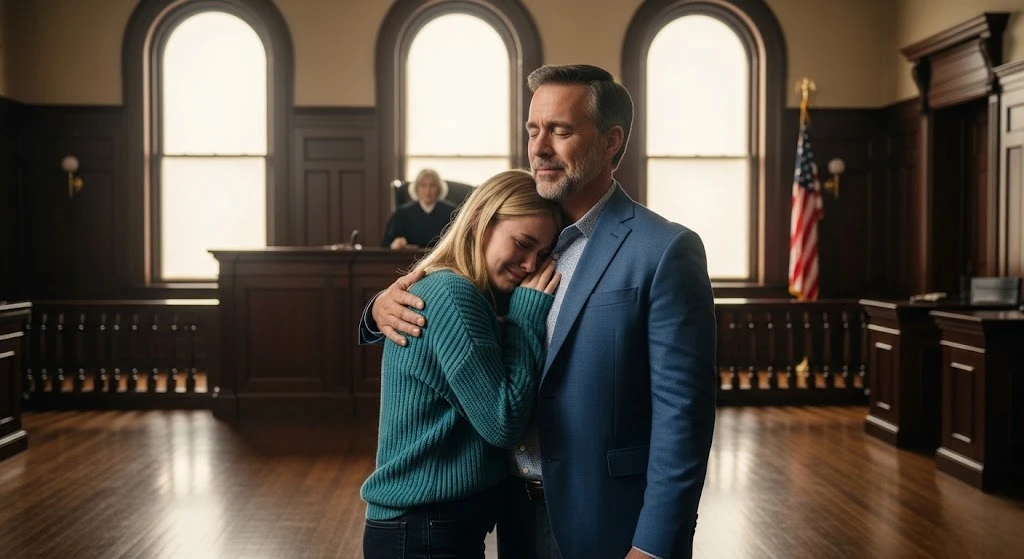
The criminal charges took longer. Fraud. Falsification of records. Conspiracy. Richard’s lawyers negotiated the number of years down, but they couldn’t negotiate them to zero, and the morning he was sentenced, Vivian sat in the courtroom with both her sons on either side of her, and neither boy reached for her hand.
They reached for each other’s.
Eli didn’t move into the town house right away. He said the walls felt like they were still deciding whether to let him stay, and Vivian didn’t argue, because she understood exactly what he meant.
It took four months. A tutor to close the gap the streets had opened in his schooling. A therapist neither boy complained about, because both of them, in their own ways, needed somewhere to put down what they were carrying. A slow, careful rebuilding of a trust that had nothing to do with money and everything to do with two brothers learning what the other one sounded like when he laughed.
The first time Eli called her “Mom” without flinching, Vivian excused herself to the hallway and cried in a way she hadn’t let herself do since the sidewalk.
Grant found her there.
“He’s asleep,” Grant said. “First time I’ve seen him sleep without the light on.”
“I have fifteen years to make up,” Vivian said. “I don’t know if that’s even possible.”
“You don’t have to make it up,” Grant said. “You just have to keep showing up. He counts that. I’ve watched him count it.”
Vivian nodded, wiping her face.
“Dad’s never going to say he was wrong,” Grant said. “Not really. Not the way that matters.”
“No,” Vivian said. “He won’t.”
“Is that going to be enough? Us being right, and him never admitting it?”
Vivian looked through the doorway at Eli, asleep with the locket still around his neck, the one that had cost him a childhood and given him back a family in the same breath.
“It’s enough,” she said, “because we stopped waiting for his permission to be a family. We just became one.”
The city outside kept moving the way it always did — indifferent, relentless, full of people who’d never know how close two brothers had come to living their whole lives four blocks apart and never meeting.
But they had met. And this time, nobody was leaving anybody behind.
Original fictional stories. AI-assisted creative content.