The antiseptic smell hit me before I opened my eyes.
Not a hospital. Too quiet. Too expensive. The sheets beneath me felt like cool water against my skin, and the dull, rhythmic throb in my back told me exactly why I was lying face-down on someone else’s bed.
“Don’t try to sit up, Elena. You’ll pull the stitches.”
I stiffened. The voice was low, unhurried, and entirely too comfortable speaking my name.
Dante Moretti sat in a leather chair in the corner, swirling a glass of scotch like he had nowhere more important to be. His jacket was gone. His shirt was open at the collar. He looked like a man who owned the silence around him.
“Where am I?” I managed.
“My house,” he said. “One of them. You’ve been out for thirty hours.”
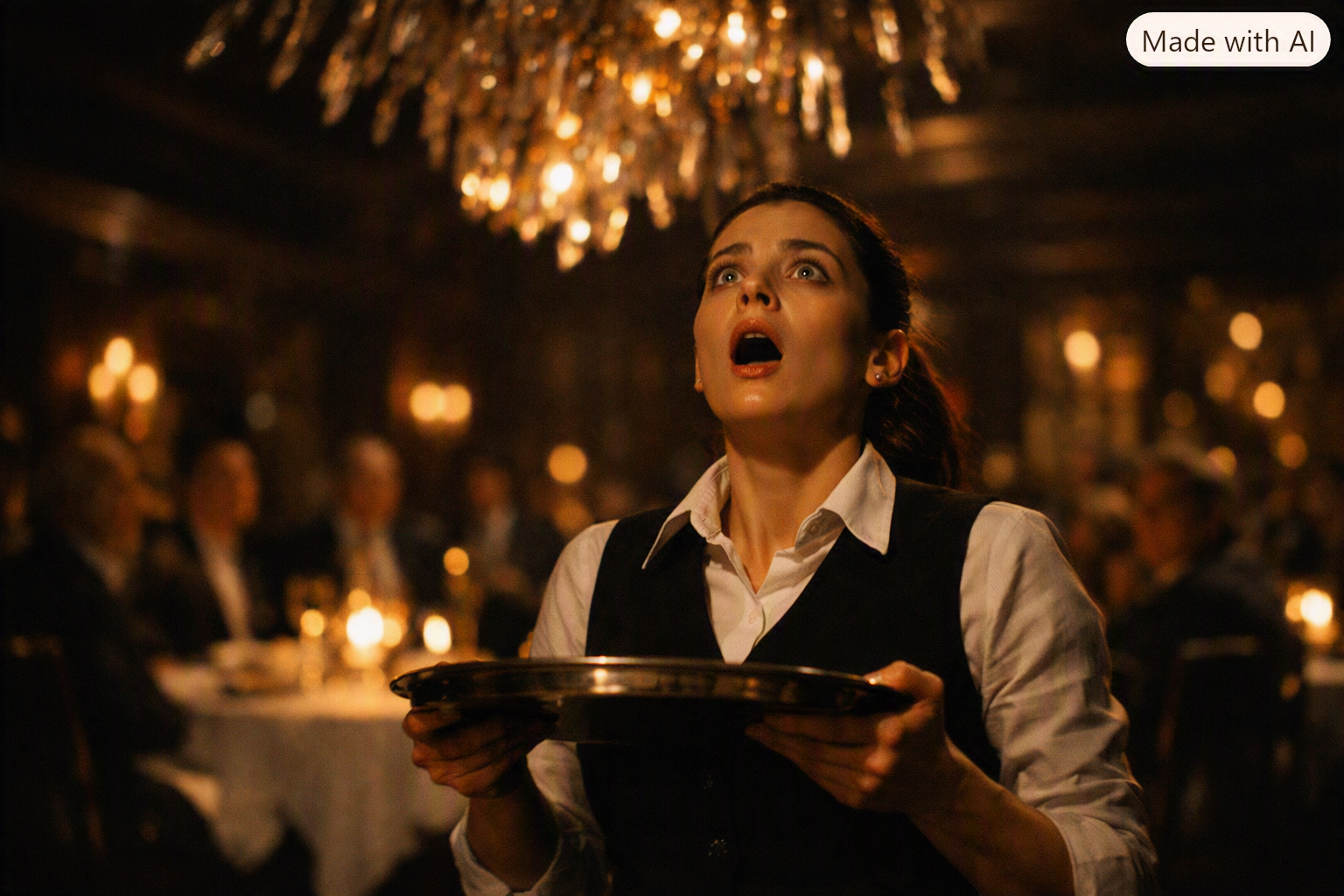
I blinked at the ceiling. Thirty hours. My double shift. The crash of the chandelier. The small boy with dark curls frozen underneath it. My arm shooting out before my brain caught up with the decision.
“Your son,” I said. “Is he—”
“Fine,” Dante said, and something in his voice changed slightly. “Because of you.”
He stood and walked toward the bed, unhurried, each footstep silent on the thick rug. He stopped at the edge of the mattress and looked down at me with eyes that stripped away every defense I owned.
“Dr. Rossi removed forty-two pieces of glass from your back,” he said. “Quite a collection.”
“You know my last name,” I said.
“I know everything about you, Elena.” He said it the way other men said good morning. “South Boston. Father left when you were twelve. Lost your retail job three years ago. Your ex-fiancé Michael cleaned out your savings before he ran to Florida with a cocktail waitress named Tiffany. You work seventy hours a week between Aurelios and a diner on Fourth Street paying off debts that were never yours to begin with.”
The room felt smaller. I couldn’t breathe right.
“You investigated me,” I whispered.
“When a stranger takes forty pieces of glass for my son, I don’t send flowers,” Dante said, his voice dropping into something quieter and more dangerous. “I find out who she is. I find out what she needs. And I find out who might want to hurt her.”
“Nobody wants to hurt me.” I laughed, short and bitter. “I’m a nobody, Mr. Moretti. I’m the waitress who disappears the second your check clears.”
He leaned over the bed until I could smell sandalwood and expensive scotch, his dark eyes locking onto mine with something close to fury.
“Do not call yourself a nobody in my presence again,” he said. “You bled on my floor. You saved my son’s life. You are many things, Elena Rossi. Invisible is not one of them.”
The door clicked open before I could answer.
A small head of dark curls appeared in the gap. Matteo. The same huge dark eyes. The same careful, deliberate way of moving, even at five years old, that his father had.
“Papa,” the boy whispered. “Is she awake?”
Dante straightened instantly. The dangerous energy around him softened so fast it felt like watching a storm pass in three seconds.
“Come in, piccolo mio. She’s awake.”
Matteo crossed the room with surprising speed and climbed up onto the edge of the mattress with immense caution, like he’d been specifically coached not to jostle me. He studied my face in complete seriousness.
“You have a big white patch on your back,” he announced.
“I do,” I agreed.
“Papa said you saved me from the falling stars.”
I felt something loosen behind my sternum. “Something like that, buddy.”
Matteo leaned forward and wrapped both arms around my waist, careful and fierce at the same time. “Thank you,” he said, his voice muffled against my ribs. “Papa said nobody is allowed to hurt you ever again because you’re part of our family now.”
I looked up at Dante over the boy’s head.
Dante’s expression gave nothing away.
“What does that mean?” I asked carefully.
“It means what he said,” Dante replied. “Aurelios is closed, Elena. Permanently. Your apartment lease has been bought out. Your belongings are downstairs in the guest wing. From this point forward, you don’t work for tips. You don’t stress about rent. You don’t look over your shoulder.”
I tried to sit up and instantly regretted it. Pain flared white and sharp across my back.
“You can’t do that,” I said through gritted teeth. “You can’t just rearrange my entire life because you feel guilty.”
“It isn’t guilt,” Dante said, moving to the edge of the bed, close enough that his voice dropped below Matteo’s hearing. “It is a debt. You saved the only thing in this world I cannot replace. That makes your life my responsibility. Whether you agree with that or not is, respectfully, irrelevant.”
The first week at the Chestnut Hill estate felt like being a ghost in someone else’s dream.
The marble hallways were longer than my entire apartment block. Staff appeared silently from doorways, offered things without being asked, and disappeared again. Boutiques sent racks of dresses I was too stubborn to touch. Private chefs left trays of food outside my door that I ate alone, cross-legged on the window seat, watching the grounds in the dark.
I was suffocating inside a gilded box.
“You’re doing it again,” Dante’s voice came from the library doorway.
I jumped, nearly sending a leather-bound volume of Renaissance art off the table. He stood in the frame in a charcoal three-piece suit, tie loosened exactly one degree, like even his casual was calculated.
“Doing what?” I asked.
“Hiding.”
He walked in, unhurried. His eyes moved across my face the way they always did, cataloguing things I hadn’t said.
“I’ve been in here three hours,” I said defensively.
“I know. You’ve been staring at the same page of a book you aren’t reading.” He stopped in front of me, hands in his pockets. “Is the room too quiet? Do you want a car? I’ll take you anywhere you want to go.”
“I want to walk down the street without three armed guards trailing me like I’m the president,” I said, the frustration finally breaking through. “I want to buy my own groceries. I want to earn my own money. I am not your prisoner, Dante. And I’m not your pet.”
He didn’t get angry. I’d half-expected him to. Instead he looked at me with something quieter and more unsettling than anger.
“You think this is a prison because your entire life, peace has always come with a price,” he said. “You don’t know how to accept something that isn’t a trap.”
The words landed like a fist.
Because he was right. Every good thing had eventually turned into a betrayal. My father. Michael. The boutique owner who’d called herself a mentor until the shop failed and she disappeared.
“There is no price here,” Dante continued. He reached out slowly and tucked a strand of hair behind my ear, his fingers just barely grazing my cheek. “You want to walk outside, we walk outside. With me, or with men who would take a bullet before letting anything touch you.”
The library doors slammed open.
A woman stood in the entry. Crimson Chanel suit. Platinum hair pulled back so tight it looked like a weapon. Eyes that went straight past Dante and landed on me with surgical contempt.
“So this is the little stray you brought home,” Isabella Vance said, stepping into the room like she owned it.
Dante’s warmth vanished in an instant. His posture didn’t change. His expression didn’t change. And yet everything about him went arctic.
“Isabella,” he said. “You’re in my home without an invitation.”
“The entire syndicate is laughing at you,” Isabella continued, moving toward us with slow, deliberate steps, her eyes raking over me like I was a piece of furniture she’d decided was cheap. “You’ve put a waitress in the position your allies’ daughters have spent years competing for, while my father’s shipping alliance sits unsigned on your desk.”
My face burned. The old words climbed back up my throat. Nobody. Invisible. Common.
I straightened my spine and stepped out from behind the table.
“The common waitress you keep mentioning,” I said, and my voice came out steadier than I felt, “has had more real conversations with your boss in two weeks than your entire family has managed in years. So before you start throwing around terms like lineage and pedigree, Isabella, maybe figure out why he still hasn’t signed that paper.”
Isabella’s jaw dropped.
She looked at Dante, waiting for him to put me in my place.
Dante slid his arm around my waist and pulled me against his side.
“You heard her,” he said quietly, his eyes fixed on Isabella with the flat calm of a man who has already made a decision. “Now get out of my house before I cancel the merger entirely and make sure every port on the East Coast knows exactly why.”
Isabella shook with fury. She glared at me one last time, then turned and stormed out, the library doors crashing shut behind her.
The echo faded.
I let out a long breath I hadn’t realized I’d been holding.
“She’s dangerous,” I said.
“Let her be,” Dante replied. His arm was still around my waist. He hadn’t moved it. “The moment she decides to come after you is the moment she finds out what a Moretti actually does when something he protects is threatened.”
I looked up at him. His dark eyes were already on mine.
“Something you protect,” I repeated.
“Yes,” he said simply.
Three weeks after the night at Aurelios, it was raining hard against the windshield of Dante’s black Mercedes as we moved through the North End.
I watched the wet cobblestones blur past and thought about how fast a life could change direction.
“You’re quiet,” Dante said, one hand on the wheel.
“I’m thinking,” I said. “About how three months ago I was counting quarters for laundry. And now I’m in an armored car with a mob boss while someone plots to kill us both.”
“Businessman,” Dante said.
“The men with automatic weapons outside your warehouse are security consultants. I know.” I looked at him sideways. “Where are we going?”
“There’s something I want to show you.”
He pulled into a private garage beneath a restored brick building near the harbor. We rode a private elevator to the top floor — a massive penthouse loft with exposed brick and floor-to-ceiling windows overlooking the black water of the bay.
In the center of the room, on a wooden easel, stood a canvas covered by a white sheet.
“What is that?” I asked, walking toward it slowly.
Dante came up behind me, his hands resting lightly on my shoulders.
“Before the debts,” he said. “Before Michael. Before the double shifts. What did you do?”
My throat tightened. “I painted. Art school. Until the money ran out.”
“Take off the sheet.”
My hands were trembling when I pulled the cloth away.
The breath left my body.
It was a painting of my old studio apartment window. The rotting frame, the crooked fire escape, the slice of Boston skyline beyond. But rendered in gold and amber light so warm and alive that it looked like a doorway into something beautiful instead of something broken.
In the corner: E. Rossi, in familiar ink.
My ink.
“I found your old portfolio,” Dante said quietly behind me. “The landlord sold your things when you fell behind on rent. I had it tracked down. I had a studio built into the east wing of the estate.” He paused. “And I wanted you to have the first canvas back.”
Tears came fast and hot. I turned and buried my face in his chest, my arms around his neck, holding on like I might fall.
For the first time I didn’t feel like a charity case. Or a project. Or a rescued stray.
I felt seen.
“Thank you,” I managed, my voice muffled against his shirt. “Dante. Thank you.”
He wrapped both arms around me and held on.
“You gave me back my son, Elena,” he murmured. “This is nothing.”
The steel door of the penthouse exploded inward.
The crash was so violent the windows shook. Smoke poured through the gap, and behind it came three men in tactical gear, automatic weapons raised — and behind them, in a tailored charcoal suit with a silenced pistol, stepped Isabella Vance.
Her face was pure, psychotic triumph.
“Surprise, Dante.” Her voice echoed off the brick. “You thought you could cut my family out of the shipping lanes and parade your little trash-can waitress around Boston like a queen?” She looked at me, and the hatred in her eyes was almost physical. “Say goodbye to your masterpiece, Elena.”
Dante shoved me behind him in less than a second, his firearm already drawn.
“Stay down!” he roared.
He fired twice through the smoke. The first operative dropped. Gunfire shredded through the hardwood floor, kicking up splinters and shattering glass on the kitchen island.
“Elena! Get to the pillar!” Dante shouted, firing again, taking down the second man.
My heart hammered against my ribs. Every old instinct was screaming at me to curl up and disappear. To go invisible. To survive by becoming small.
No.
I wasn’t invisible anymore.
I spotted the heavy iron fireplace poker beside the exposed brick hearth, three feet to my left.
The third gunman had Dante pinned behind the marble pillar, his rifle reloading with a sharp metallic snap. Isabella stood watching, clapping her hands slowly.
“Finish him!” she shrieked. “Kill them both!”
I lunged.
Before the gunman raised his barrel, I swung the iron poker across the back of his helmet with everything I had.
He dropped like a cut tree.
Isabella’s clapping stopped. Her gun hand trembled. She stared at me like I was something that had rewritten the rules of the world she thought she understood.
“You—” she whispered, raising the pistol toward my chest.
One shot rang out.
Isabella gasped. Her gun fell. Her hand went to her shoulder, where a dark stain bloomed fast and red through the charcoal suit. She stumbled backward and hit the window frame, sliding down the glass in a slow, crumpling heap.
Dante came out from behind the pillar, gun still raised, his face stripped down to something cold and absolute. He didn’t look at Isabella. His eyes swept the room until they found me.
He crossed the floor in two strides and grabbed my face in both hands, turning it left and right.
“Are you hit? Elena. Talk to me.”
“I’m fine,” I breathed. My hands were shaking violently. “Dante, I’m okay. I’m okay.”
He pulled me against his chest so hard I couldn’t draw a full breath, his face buried in my hair. Outside, through the shattered door, the first sirens were already wailing up from the street below, growing fast and bright.
Ten minutes later, the loft was swarming with police and paramedics. Isabella and the surviving men were dragged out in handcuffs, her shoulder wound dressed, her face white with shock. The Vance family’s last, desperate gamble had collapsed in a matter of seconds.
Dante sat beside me on the edge of the sofa, refusing to release my hand while a paramedic cleaned a small cut on my forehead. His thumb moved in slow circles across my knuckles.
“You realize,” he said quietly, once the medics stepped away, “that you just saved my life. Again.”
I let out a sound that was half-laugh, half-exhale. “I guess we’re even.”
“We will never be even, Elena.” He turned toward me, his dark eyes holding nothing back. “Because I spend every second of every day falling deeper in love with you.”
The room went still.
I looked up at him. No armor left between us. No careful distance.
“Is that a threat or a promise, Mr. Moretti?” I asked softly.
Dante smiled — slow, real, and nothing like the mob boss — and pulled me back into his arms.
“It’s a life sentence,” he murmured, his lips against the top of my head. “For both of us.”
Three years later.
Rain against the windows of the Chestnut Hill estate sounded different now. Not like a warning. Like a lullaby.
I stood in front of a six-foot canvas in my private studio, paintbrush in hand, studying what I’d spent the last four months building on the surface. A crowded restaurant under glittering chandeliers. A little boy with dark curls laughing as he chased a toy car across marble floors. A woman standing upright, her back straight, unafraid.
“Mama!”
Small arms wrapped around my knees and nearly took my palette down with them.
I looked down at a chubby-cheeked four-year-old with his father’s dark curls and his father’s exact expression of absolute confidence in his own importance.
“Hey, little man.” I scooped him up and buried my face in his neck until he squirmed and giggled. “What are you doing in here? Your dad said this is a restricted zone during painting hours.”
“Papa said lunch is ready,” Matteo announced with great authority, pointing one tiny finger toward the double doors.
Dante was standing in the doorway.
No suit jacket. Sleeves rolled to the elbows. He looked like what he was to us — not the man who ran shipping lanes and made politicians nervous, but the man who showed up to the studio with a four-year-old because lunch was getting cold.
He walked over and wrapped both arms around us from behind, resting his chin on my shoulder, looking at the canvas.
“Months of work,” he said quietly. “Is it finished?”
I turned in his arms and pressed my hand against his chest, right over his heartbeat.
“Yeah,” I said, looking back at the painting that told the whole story — the glass, the dark penthouse, the iron poker, the studio window in gold light. “It’s finished.”
He kissed me slowly, and Matteo covered his eyes with both hands.
“Ew! Grown-up kisses! Gross!”
We laughed and pulled apart.
“Come on, little monster.” Dante swung the boy up onto his shoulders and extended his other hand to me, his dark eyes steady and full. “Your mother has earned a break.”
I took his hand.
My back, where the silver scars had faded to almost nothing, didn’t hurt anymore.
I wasn’t invisible. I never would be again. And as we walked out into the sunlit courtyard together, I understood that my life no longer just belonged to me — and for the first time, that was exactly what I wanted.
Original fictional stories. AI-assisted creative content.