The café on Fourth Street was standing room only. Every table taken, every barstool claimed, the line snaking past the pastry case. I had snagged the last corner table and was nursing a cappuccino, watching steam curl off the rim.
My name is Denise Crawford. I’m fifty-five years old. That Tuesday morning I wore a pressed navy suit, a cream silk blouse, and my mother’s pearl earrings. In twenty minutes I’d cross the street and open Courtroom 12C. But right then I was just a woman warming her hands on a cup.
A shadow fell across the table.
“I need this table. Get up.”
I looked up. A tall, broad-shouldered police officer loomed over me. His nameplate read MERCER. He carried himself the way men do when they’ve never once been told no.
“I’m still finishing my coffee, Officer,” I said calmly.
His face twisted. His eyes traveled from my pearl earrings to my polished nails and back, and I watched his expression curdle into something ugly — the look certain men get when a woman doesn’t jump at their voice.
“I don’t think you heard me, sweetheart,” he said, stepping closer. “This isn’t a nail salon. Move.”
Conversations died around us. Spoons stopped clinking. A barista froze mid-pour.
“I’ll leave when I’m finished,” I replied quietly.
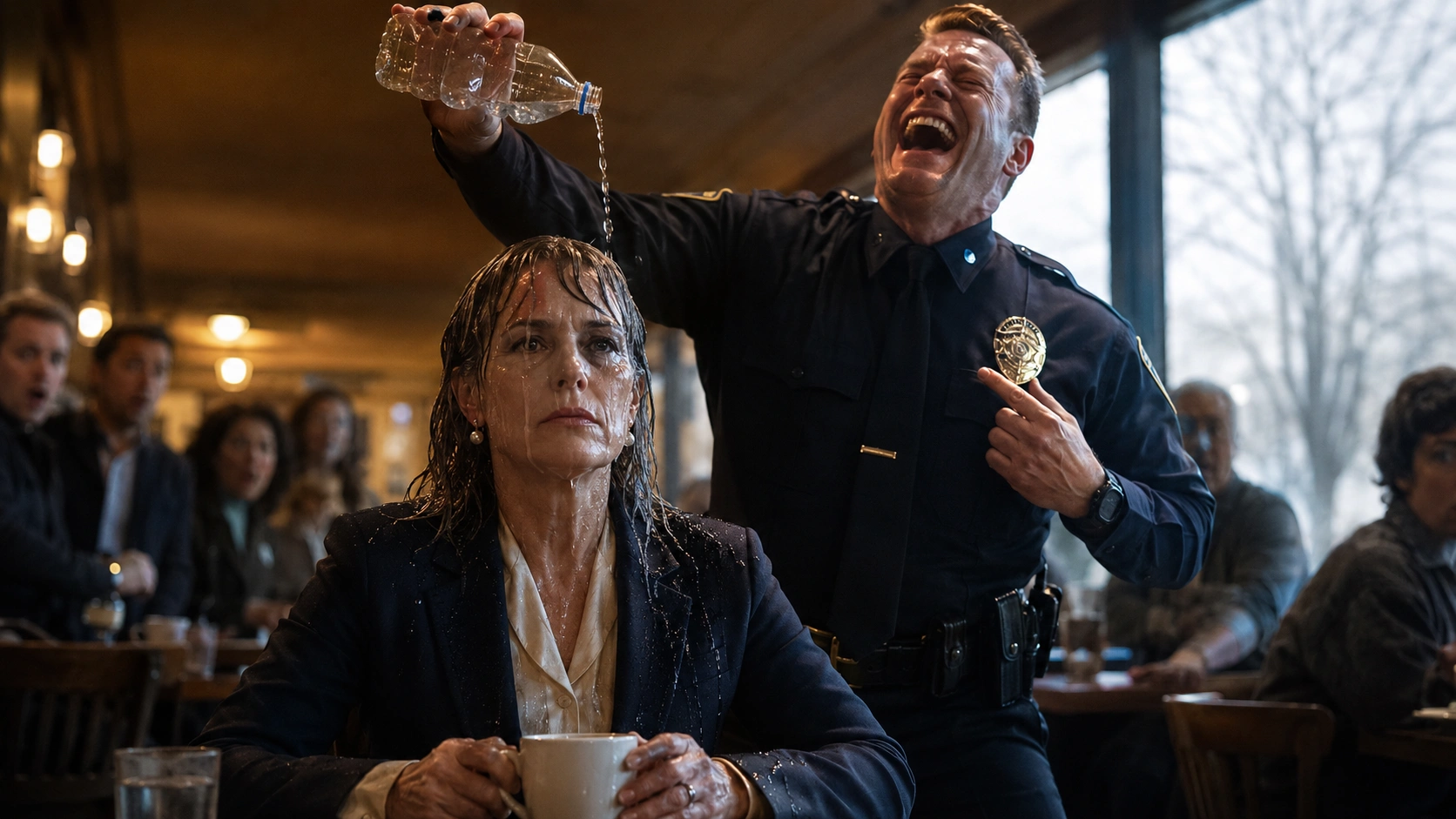
He didn’t say another word. He just grabbed the water bottle off the table, unscrewed the cap, and poured it directly onto my head.
The shock was immediate — cold water running through my hair, streaming down my neck, soaking into my silk blouse. I gasped but did not scream. Someone behind me dropped a mug. Nobody moved.
Mercer leaned down until his face was inches from mine. “Maybe that’ll cool you down, honey. Know your place.” He tapped the silver badge on his chest and grinned. “Go ahead, call the cops. Oh wait — you’re looking at one.”
My hands did not shake. I picked up a napkin and wiped the water from my eyes. I looked at him steadily.
“Are you finished?” I asked.
He laughed — a short, ugly bark — then turned and swaggered to the counter. I stood, picked up my briefcase, and walked out with my chin level. Not because I felt no humiliation, but because I refused to let him see it.
What Officer Ryan Mercer did not know was that the woman he had just humiliated would be sitting behind the bench of Courtroom 12C in forty-five minutes. And he was on my docket.
The wind off the harbor hit me like a slap. Soaked silk in twenty-degree weather turns to ice in seconds. My hair hung in cold, dripping strings. People on the sidewalk stared — a professional woman drenched head to toe, walking like she owned the block.
I did not run. I did not hunch.
Ray, the head of courthouse security, almost fell out of his chair when I walked through the side entrance.
“Judge Crawford! My God — what happened?”
“An unfortunate encounter at the coffee shop, Ray. I’m fine.”
“Give me a description,” he said, hand on his radio. “I’ll have half the precinct out there in three minutes.”
“Stand down. I have this under control.”
He stared at me, jaw tight, but stepped aside.
In the elevator I finally looked at my reflection. My blouse was soaked through. My hair was matted flat. Mascara had traced faint lines along my jaw. For one second — just one — a hot tear pressed against the corner of my eye. I thought of my mother, who had spent thirty years as a public defender and been talked over in every room she ever entered. I thought of every woman who had been belittled by a man with a title and a loud voice.
I forced the tear back down. Ryan Mercer was not worth it.
My clerk, Sophie, screamed when she saw me.
“Judge Crawford! What happened? Who did this?”
“It’s water, Sophie. And it’s quite cold now.” I set my ruined briefcase on the floor. “I need ten minutes. Pull my spare charcoal suit from the garment bag. And have the morning files on my desk.”
She wiped her eyes and moved. I locked the bathroom door, ran warm water, and dried myself off. My mascara was ruined. My hair was a mess. I stared at myself in the mirror and forced compartmentalization: anger out, clarity in. A judge who rules from rage is no better than a bully with a badge.
I dressed in the charcoal suit, pinned my damp hair into a tight bun, and walked back to my desk.
Sophie had the files arranged. I opened them one by one. Traffic dispute. Property damage. Traffic dispute.
Then I opened the fourth file.
State of Massachusetts v. Jerome Patterson. Charge: Resisting arrest. Arresting Officer: Ryan Mercer, Badge #4459.
I read his report twice. It was sloppy — vague timeline, weak justification, aggressive language. It read exactly like the man who had poured water on my head.
“Sophie,” I called.
“Yes, Judge?”
“Bring me my robe.”
She held it open. I slipped my arms into the sleeves and felt its weight settle across my shoulders like armor. This robe was not a costume. It was three centuries of law, and it stripped away everything except the authority of justice.
“You look perfect, Your Honor,” Sophie said softly.
“That is exactly the point.”
At 8:55 I approached the oak door to the courtroom. It was cracked an inch. Through the gap I heard a voice I recognized instantly.
“I’m telling you, Greg, this city’s going down the drain,” Mercer was saying. “Zero respect for the uniform.”
“What happened this time?” his colleague asked.
“Some uppity woman hogging a whole table at the café on Fourth. Sitting there like a princess with her little cappuccino and her pearl earrings. I told her politely to move. She gave me attitude — you know how they get. So I poured water right over her head.” He laughed. “Should’ve seen her face. Mascara running, hair dripping, sitting there like a drowned cat. I told her to know her place.”
“Jesus, Ryan. If she files a complaint—”
“Who’s gonna believe her? Some hysterical woman, or a decorated officer? She ran out with her tail between her legs. All bark, no bite. That’s what happens when women think they can talk back to a man in uniform.”
Behind me, Sophie’s hand flew to her mouth. I raised one finger to my lips. Silence.
My heart beat slow and heavy. I felt no anger. Anger is chaos. What I felt was absolute, frozen clarity.
At 9:00 AM sharp, I nodded to the bailiff.
The oak door swung wide.
“All rise! The Honorable Court of the State of Massachusetts is now in session. The Honorable Judge Denise Crawford presiding.”
I climbed the three steps, swept past my leather chair, and sat down.
“You may be seated.”
I arranged my files, adjusted my glasses, and leaned into the microphone.
“We will begin with the matter of State versus Jerome Patterson. Is the arresting officer present?”
“Present, Your Honor!” That booming, arrogant voice rang out.
I lifted my head and looked directly at him.
Our eyes met.
The transformation was the most dramatic human unraveling I have witnessed in thirty years on the bench. His swagger died mid-stride. The smirk fell off his face like it had been slapped away. He went gray — literally gray — in under two seconds. The clipboard in his hand started rattling against his thigh.
He recognized me. The same pearl earrings. The same eyes. The same woman he had called an “uppity princess” forty-five minutes ago. Only now she was six feet above him, draped in black, holding a gavel.
“Officer Mercer?” Prosecutor Kellner turned around. “Are you alright? You look like you’re going to be sick.”
Mercer opened his mouth. Nothing came out.
“We are waiting, Officer,” I said. “Please approach the stand.”
He staggered forward like a man walking to the gallows. He gripped the witness box railing until his knuckles went white. Sweat poured down his temples.
The bailiff swore him in. His right hand shook so badly he couldn’t keep his fingers straight.
“I… I do,” he croaked.
He collapsed into the witness chair.
Prosecutor Kellner began his questioning. “Officer Mercer, describe your encounter with Mr. Patterson on the night of October fourteenth.”
“He was… loitering. Being loud.”
“In your sworn affidavit you stated the defendant was actively harassing patrons. Which is it?”
“He was… yes. Harassing them.”
“And when you approached, how did he react?”
“Aggressive,” Mercer whispered. His favorite word — the word men like him use to justify everything.
Kellner finished his direct, visibly frustrated. His star witness was falling apart.
Defense attorney Nina Castillo stood slowly. She was a veteran. She could smell a broken witness from across the room.
“Officer Mercer,” Castillo said pleasantly. “You testified my client took a ‘combative stance.’ Describe it.”
“He puffed his chest. Clenched his fists.”
“Did he make any verbal threats?”
“He used profanity.”
“Profanity isn’t a crime in Massachusetts, Officer. Before you approached Mr. Patterson, did you observe him committing any actual crime?”
“He was causing a disturbance.”
“By standing on a public sidewalk?”
“Objection,” Kellner said. “Argumentative.”
“Overruled,” I said instantly. “The witness will answer.”
Mercer’s eyes met mine and snapped away like he’d touched a hot stove.
“He looked like he didn’t belong there,” Mercer mumbled.
Castillo stopped pacing. “Your client is a twenty-three-year-old man standing outside a nightclub at eleven PM on a Friday. Are you testifying under oath that his appearance was the reason you deemed him suspicious?”
“No — I meant his behavior. It was erratic.”
I leaned forward. The squeak of my chair made Mercer flinch.
“Officer Mercer,” I said.
Dead silence. The court reporter’s hands froze above the keys.
“Page two of your sworn report. You wrote that the suspect displayed an ‘entitled and hostile demeanor’ that ‘necessitated physical intervention.'” I looked over my glasses. “Define ‘entitled’ in criminal law, Officer.”
“I… it’s…”
“Is entitlement a misdemeanor or a felony in this jurisdiction?”
“It’s not a crime, Your Honor.”
“So you used a subjective, emotionally charged adjective to describe a citizen who simply did not do what you wanted. Correct?”
He said nothing. Sweat dripped off his chin.
“Let us discuss the phrase ‘necessitated physical intervention,'” I continued. “Security footage — Exhibit B — clearly shows Mr. Patterson turning away from you and walking in the opposite direction. He was de-escalating. You then grabbed him by the collar from behind and threw him to the pavement.”
I set the paper down.
“Officer Mercer. Are you in the habit of falsifying police reports to justify assaults on civilians who refuse to submit to your harassment?”
“Objection!” Kellner shouted.
“The video is in evidence, Counselor. The testimony contradicts it. Overruled. Answer the question, Officer.”
Mercer buried his face in his hands. His shoulders heaved. When he spoke, his voice cracked into a high, desperate wail.
“I made a mistake! The report was rushed — I embellished it! I’m sorry!”
A gasp swept the gallery. The court reporter’s fingers flew. Castillo looked stunned. Kellner dropped his head into his hands.
I had not raised my voice. I had not thrown anything. I had used the law like a scalpel and cut every lie out of him.
“Given the witness’s admission to embellishing an official police report under oath,” I announced, “this court finds Officer Mercer’s testimony entirely unreliable. Mr. Kellner, how does the State wish to proceed?”
Kellner stood slowly. “The State moves to dismiss all charges against Jerome Patterson, with prejudice.”
“Granted.” I brought the gavel down. The crack echoed like a gunshot. Mercer flinched violently. “Mr. Patterson, you are free to go. The arrest record will be expunged.”
Jerome Patterson collapsed forward onto the defense table and wept with relief.
“This court will take a fifteen-minute recess,” I said. “Officer Mercer, you will remain in this building. We are not finished.”
I stood in the shadows of the hallway with the door cracked open. Exactly as before. Listening.
Heavy footsteps. Greg’s voice, a furious hiss.
“Mercer, what the hell was that? You admitted to falsifying a report on the stand! Do you have any idea what Internal Affairs is going to do?”
Silence. Then Mercer, broken: “You don’t understand, Greg. The woman in the café this morning — the one I poured water on—”
A long pause.
“Mercer.” Greg’s voice dropped to a horrified whisper. “Are you telling me the woman you poured water on—”
“It was her. It was Judge Crawford. I poured water on the head of a sitting superior court judge.”
Silence.
“You’re dead, Ryan,” Greg said flatly. “You’re professionally dead. You assaulted a judge because you wanted a chair.” I heard his footsteps retreating — fast, deliberate, a man distancing himself from an explosion.
I listened to Mercer hyperventilate alone in the empty courtroom. His colleagues had abandoned him. His swagger was gone. The badge on his chest couldn’t save him.
I smoothed my robe, walked to my desk, and poured a glass of ice water. I let him sit out there for twenty minutes. Let the terror marinate.
Then I walked back out.
The courtroom was empty except for Mercer, slumped at the prosecution table. He looked nothing like the man from the café. His uniform was soaked with sweat. His face was gray, his eyes bloodshot and swollen.
“Stand up, Mr. Mercer.” I stripped him of his title. In my courtroom he was just a man facing consequences.
He dragged himself upright, swaying.
“I don’t know what to say,” he whispered.
“You can begin by looking me in the eyes. You had no trouble doing so when you poured water on my head.”
He forced himself to meet my gaze.
“I am so deeply sorry, Your Honor,” he said, his voice cracking. “What I did this morning was monstrous.”
“Do not categorize assault as the byproduct of a bad morning,” I said sharply. “Millions of people have bad mornings without pouring water on strangers.”
He looked at the floor.
“When you walked up to my table, you saw a woman sitting quietly. And something about that offended you. A woman who didn’t flinch, didn’t smile, didn’t make room for you. In your world, women exist to accommodate men — especially men with badges. When I refused, your ego couldn’t process it. So you escalated to humiliation and then tapped your badge, weaponizing an institution meant to protect citizens into a tool for intimidation.”
“I was wrong,” he sobbed. “I am a disgrace.”
“You are brave when looming over a seated woman. Face someone with actual authority and you crumble. That is the definition of a coward.”
Mercer dropped to his knees. The thud echoed through the empty room.
“Please don’t destroy my life,” he begged. “I’ll hand in my badge today. Just have mercy.”
I stared down at him. This was the exact posture he had wanted from me — broken, begging. But my power comes from restraint.
“Get up, Mr. Mercer.”
He staggered to his feet.
“A badge is a symbol of public trust, not a license to bully. You poured water on my head because you believed a woman in a silk blouse couldn’t possibly hold power over a man in uniform. You miscalculated.”
I picked up my pen.
“Regarding perjury: the transcript has been forwarded to Internal Affairs and the District Attorney. You will face a tribunal. You will likely lose your badge and face criminal charges for falsifying a report.”
He squeezed his eyes shut.
“Regarding the assault at the café — I could have you arrested right now.”
He stopped breathing.
“But I choose not to press personal charges. Not because I forgive you, but because I refuse to let a man like you consume another second of my life. Filing charges means sitting as a victim while lawyers dissect my humiliation. I refuse. You didn’t break me this morning. I dried my face, put on this robe, and dismantled your career without raising my voice. My dignity is intact. Yours is in pieces.”
He stared at me, and for the first time, I saw genuine understanding cross his face — the vast distance between his cheap, violent power and my deep, quiet authority.
“I have noted your apology,” I said. “Spend the rest of your life reflecting on the man you became when you thought nobody was watching. You are dismissed. Get out of my courtroom.”
He bowed his head, turned, and walked down the aisle. His boots dragged on the carpet. He pushed through the double doors and was gone.
The doors sealed shut with a final, echoing click.
I sat alone on the bench. Silence. Peace.
Ryan Mercer had tried to teach me a lesson about power. Instead, he learned that true power does not roar. It does not pour water over someone’s head. It does not tap a badge.
True power is the quiet, unbreakable strength to rise above cruelty, hold your dignity, and let the truth speak for itself.
Original fictional stories. AI-assisted creative content.