The first sound was not the girl crying.
It was the scissors.
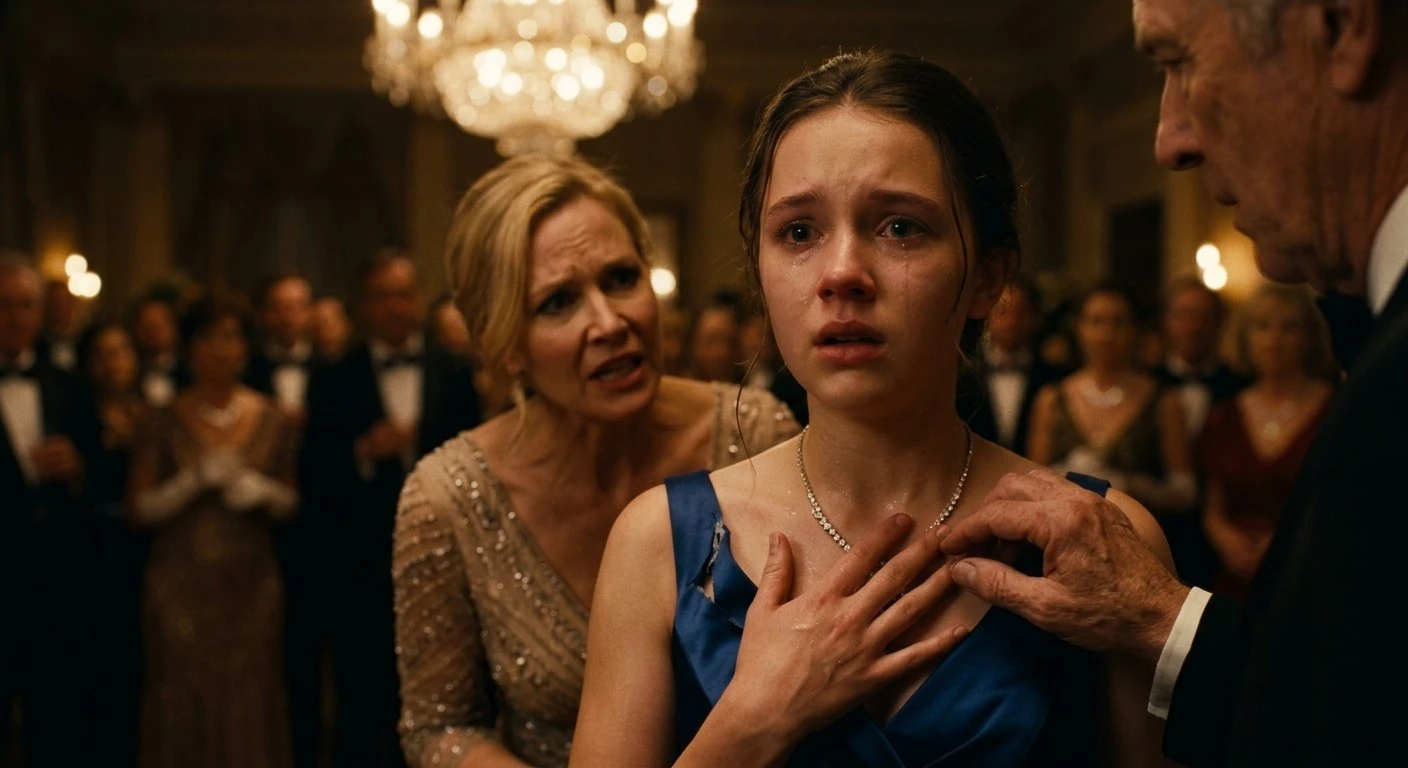
One sharp snip cut through the warm ballroom air, and the blue satin strap snapped loose beneath Vivian Sterling’s gold scissors. Wren gasped, clutching the front of her dress as the elegant guests around them shifted closer, pretending to be shocked while still watching every second.
Vivian leaned in, her beaded beige gown glittering under the chandelier, her voice low enough to wound but loud enough for everyone to hear.
“Girls like you don’t belong in dresses like this.”
Wren’s face turned red with humiliation. Tears filled her eyes as she tried to hold the torn fabric against her chest with both shaking hands.
No one stepped forward. They only whispered, stared, and let the circle around her feel smaller.
“Please,” Wren whispered. “I didn’t do anything.”
“You showed up,” Vivian said. “That was enough.”
Then the ballroom doors slammed open.
Every head turned.
Warrick Sterling walked in fast, carrying a silver tray, his tuxedo crisp, his eyes locked on the crying girl like he had arrived for exactly this moment.
He stopped in front of her, gently lifted a diamond necklace from the tray, and placed it around her neck.
“Please don’t cry, my dear,” he said softly. “It’s yours.”
The crowd froze.
Vivian’s face tightened. “Warrick, what is this?”
The necklace settled against the torn blue dress, and a tiny engraved crest caught the light behind the stones.
Warrick’s hand began to tremble.
“Wait,” he whispered. “This mark.”
Vivian stepped forward too quickly. “Take it off her. Now.”
Warrick did not move.
“This crest was made for one child,” he said. “My daughter Grace’s child.”
Wren looked up through tears. “I don’t understand.”
He turned the necklace and pressed a hidden clasp. Inside was a miniature portrait — a young woman holding a baby wrapped in blue satin.
Wren stopped crying.
“That’s not me,” she said. “I don’t know her.”
“That,” Warrick said quietly, “is your mother.”
Vivian’s face went pale. “Warrick, don’t do this. Not here.”
He turned to her slowly, his voice shaking. “You told me the baby died.”
The ballroom went silent.
“She was supposed to disappear,” Vivian said, and then stopped herself, hearing what she’d just admitted out loud.
Warrick’s eyes filled with rage and grief. He took Wren’s hand and turned to the guests.
“Then everyone here just witnessed the return of my granddaughter.”
Applause did not come. Only silence, and two hundred phones lighting up under the chandelier.
—
By midnight, the ballroom footage was everywhere.
Someone’s phone had caught the whole exchange from three tables back — the scissors, the necklace, the words “she was supposed to disappear” captioned in bold under half a million views before sunrise.
Warrick’s phone did not stop buzzing. Reporters. Old business partners. A cousin he hadn’t spoken to in a decade, texting only “call me.”
“They’re calling it ‘The Ballroom Confession,'” Delia said, holding her phone up so Warrick could see the headline. “It’s on three different morning shows already.”
“Good,” Warrick said. “Let them ask Vivian to explain herself on camera.”
“Dad, this isn’t just family business anymore. It’s public. The board’s going to want answers before we even get the DNA results back.”
“Then the board can wait for the truth like everyone else.”
Preston appeared in the doorway, jaw tight. “Vivian’s lawyer already called. She wants a joint statement tonight. Something about ‘clarifying misunderstandings before this spirals.'”
“There’s no misunderstanding to clarify,” Warrick said. “There’s a sixteen-year-old lie, and it’s already spiraled.”
—
Security walked Vivian to a side room. Warrick followed, pulling the door shut behind him, leaving Wren with his assistant and a glass of water she didn’t touch.
“You have no proof,” Vivian said, arms crossed. “A necklace isn’t a birth certificate.”
“I had that crest made myself,” Warrick said. “There is exactly one in the world.”
“Coincidences happen.”
“Grace disappeared nine months after she told me she was pregnant,” Warrick said. “You told me the baby didn’t survive. You told me Grace couldn’t bear to stay in this family after that. I believed you because I was grieving and you were my daughter and daughters don’t lie to their fathers about dead babies.”
Vivian’s jaw tightened. “I was protecting this family.”
“From what?”
“From a scandal that would have cost us the trust,” she snapped. “Grace got pregnant by a man who wasn’t even engaged to her. The board would have used it to strip your control the second it went public. I fixed it.”
“You fixed it,” Warrick repeated. “By telling me my granddaughter died.”
“I never said that exactly.”
“You let me believe it for sixteen years.”
Vivian’s composure cracked for half a second before she rebuilt it. “That girl out there could be anyone. A con artist. Someone Grace paid to—”
“Grace is dead, Vivian. Or did you forget your own lie?”
Vivian said nothing.
Warrick opened the door. “We’re doing a DNA test. Tomorrow. And I’m calling every attorney this family has.”
—
Wren’s apartment building had a broken light in the stairwell that had been broken for two years. She climbed the four flights in her ruined dress, the necklace still around her neck, and knocked twice before letting herself in.
Marisol was waiting up, the way she always did.
“What happened to your dress?” Marisol’s voice went sharp with worry the second she saw the torn strap.
“A woman cut it. In front of everyone.” Wren’s hands were still shaking. “And then this old man just — walked in and put this on me.”
She held up the necklace.
Marisol’s face changed. Not confusion. Recognition.
“Where did you get that,” Marisol said quietly.
“He said it was mine. He said—” Wren stopped. “Marisol, what’s wrong? You look like you’ve seen a ghost.”
“Nothing.” Marisol reached for the necklace but didn’t touch it, her fingers hovering an inch away like it might burn her. “Who was he?”
“He said his name was Warrick Sterling. He said I’m his granddaughter. He said my mother’s name was Grace and that Vivian told him she died.”
Marisol sat down hard on the couch.
“Marisol.”
“I need you to take that off,” Marisol said. “Tonight. And we’re not going back there.”
“Why not? He wasn’t lying, Marisol, I saw his face, nobody fakes a face like that—”
“Because I said so,” Marisol snapped, harder than Wren had ever heard her. Then, softer, almost breaking: “Please. Just trust me. Not everything that looks like a gift is one.”
Wren stared at her. Sixteen years of small evasions suddenly didn’t feel small anymore.
“You’ve never lied to me,” Wren said slowly. “Have you.”
Marisol didn’t answer.
—
A black car was parked outside the apartment by seven the next morning. Warrick himself stood beside it, hat in hand like a man at a funeral he’d been dreading his whole life.
“I’m not asking you to believe me today,” he told Wren through the cracked door. “I’m asking for one DNA test. If I’m wrong, I will apologize and never contact you again.”
“And if you’re right?”
“Then I’ve spent sixteen years mourning a girl who was alive four miles away, and I would like to know her.”
Marisol stood in the doorway behind Wren, arms folded, face unreadable.
“She’s not going anywhere alone,” Marisol said.
“I wouldn’t dream of it,” Warrick said. “Ms.—?”
“Vega. Marisol Vega.”
Something flickered behind his eyes at the name, gone as fast as it came.
“Then you’re both welcome at the estate, Ms. Vega.”
—
The Sterling estate had a driveway longer than Wren’s entire block. Inside, a man in his thirties and a younger woman were already waiting in the front hall, arms crossed in mirror image.
“This is a mistake, Dad,” the man said before introductions had even happened. “You’re going to let a stranger into a trust worth four hundred million dollars off a necklace and a feeling?”
“Preston,” Warrick said. “This is your niece.”
“We don’t have a niece. Grace’s baby died in oh-nine.”
“So I was told,” Warrick said. “By your sister.”
Preston’s sister — Delia, twenty-four, sharp-eyed — studied Wren like she was doing math in her head. “If this is real,” Delia said slowly, “Mom’s spent sixteen years running the trust on a lie.”
“We’ll know by Thursday,” Warrick said. “DNA doesn’t have an agenda.”
“Neither did I, until an hour ago,” Preston muttered, and walked out.
—
Delia found Wren sitting alone on the estate’s back steps that evening, still in the borrowed sweater someone had handed her after the torn dress.
“Can I sit?” Delia asked.
Wren shrugged. Delia sat anyway.
“I know this is a lot,” Delia said. “Believe me, it’s a lot for us too. I grew up being told my aunt Grace died before I was born. Now apparently she’s been two hours away this whole time.”
“I didn’t ask for any of this,” Wren said quietly. “I just wanted to go to a gala with a nice dress and not embarrass myself.”
“For what it’s worth,” Delia said, “you didn’t embarrass yourself. She did.”
Wren looked over, surprised.
“I watched the whole thing,” Delia said. “My mother cut a child’s dress open in a room full of people because she was scared of what you represented. That’s not your shame to carry. It’s hers.”
“Your mother,” Wren repeated.
“Yeah,” Delia said. “That part doesn’t feel great either, if it makes you feel any better.”
They sat in silence for a moment.
“For what it’s worth,” Delia added, “I hope the test comes back positive. Not because of the trust. I always wanted a sister and got stuck with Preston instead.”
That got the first real laugh out of Wren all day.
“I heard that,” Preston called from an open window, not even trying to sound offended.
—
Monday morning, Wren’s phone had four hundred notifications before she even got out of bed.
Her school group chat had turned into something else overnight — screenshots of the ballroom clip, a girl claiming to have gone to camp with her once, a boy from chemistry asking if it was true she was “secretly rich now.”
She almost didn’t go to school. Grace sat on the edge of her bed instead of telling her to stay home.
“You don’t have to prove anything to any of them,” Grace said. “But if you want to go, I’ll drive you myself.”
In the hallway, the stares felt different than the ballroom’s had. Less cruel, more curious, which somehow wasn’t easier.
“Is it true your grandpa’s, like, actually rich-rich?” a girl named Priya asked at her locker, not unkindly.
“I don’t know what’s true yet,” Wren said honestly. “I’m still finding out too.”
“That’s kind of insane.”
“Yeah,” Wren said. “It kind of is.”
By lunch, a reporter had been asked to leave the parking lot twice. By the final bell, Wren understood that whatever the results said, her old life — quiet, unnoticed, entirely her own — wasn’t coming back the same way it had left.
She wasn’t sure yet if that was a loss or the start of something else.
—
The law office smelled like leather and expensive coffee. Vivian sat across from Warrick’s attorney with her own lawyer beside her, posture perfect, voice even.
“I want the sample collected by an independent lab,” Vivian said. “Not one Warrick’s people chose.”
“Fine,” the attorney said. “Any lab you name.”
“And I want it noted for the record that this girl’s guardian appeared with zero documentation. No birth certificate. No adoption papers. Nothing.”
“I have papers,” Marisol said quietly.
“Do you,” Vivian said. “Where were they filed?”
Marisol hesitated a half-second too long.
“That’s what I thought,” Vivian said, and smiled for the first time all day.
“A missing form doesn’t undo a blood test,” Warrick said.
“No,” Vivian agreed. “But it might explain why a woman who calls herself Wren’s aunt has been hiding for sixteen years with no legal trail at all. What exactly are you afraid of, Ms. Vega?”
Marisol met her eyes. “Ask yourself that question. You already know the answer.”
The room went cold.
—
Warrick found Grace afterward in the estate’s kitchen, alone, staring at a cup of coffee she hadn’t touched either.
“I looked for her,” he said quietly. “After Vivian told me she’d died, I looked for a grave for months. There wasn’t one. I told myself the paperwork just hadn’t caught up yet. I never once thought to look for a living woman instead.”
“I moved four times in five years,” Grace said. “Nursing assistant, then a diner, then a nursing assistant again in a different state. Every time I thought I’d finally stopped flinching at a nice car driving down our street, we moved again anyway. Just in case.”
“Why didn’t you come to me? Not Vivian. Me.”
“Because Vivian told me if I ever tried, she’d make sure a judge saw a homeless, unmarried twenty-two-year-old against the entire Sterling legal team, and I’d lose Wren in a system a lot colder than any ballroom. I believed her. She wasn’t wrong about the odds.”
Warrick’s hands tightened around the mug. “I would have fought for you both.”
“You didn’t know there was anything to fight for,” Grace said. “That was the whole design.”
—
Vivian found Marisol alone in the estate’s east hallway that evening, waiting by the car.
“You should take her and go,” Vivian said, no audience now, no performance in her voice. “Tonight. I’ll wire you two hundred thousand dollars by morning.”
“So you can erase her a second time.”
“I’m offering you a life. Somewhere warm. Somewhere with a fence around it, and no lawyers, and no Sterling name attached to either of you ever again.”
“You offered me that once before,” Marisol said. “Sixteen years ago. I said yes because I was twenty-two and terrified and you told me if I didn’t disappear you’d make sure I lost her in a courtroom instead of quietly.”
Vivian’s expression didn’t move. “And it worked. She grew up safe. Isn’t that what you wanted?”
“She grew up thinking her mother was dead.”
“She grew up,” Vivian repeated. “That’s more than most people in your position got to say.”
“I’m done being quiet, Vivian.”
“You have no proof of anything I just said.”
“No,” Marisol said. “But I have sixteen years of knowing exactly what you’re capable of, and this time I’m not the only one in the room who matters.”
—
That night, Wren found Marisol packing a bag.
“We’re leaving,” Marisol said, not looking up.
“No, we’re not.” Wren shut the door behind her. “I heard you. In the hallway. With her.”
Marisol froze.
“You called her by her first name like you’ve known her for years,” Wren said. “You knew about the estate before we ever drove up here. You recognized his face before I even told you his name. Marisol — who are you?”
The bag slipped out of Marisol’s hands.
“Sit down,” Marisol said. “Please.”
Wren sat.
“Sixteen years ago,” Marisol said, “I gave birth to a baby girl in a hospital two hours from here. Vivian told my father the baby died. She told me if I didn’t disappear and let a nurse raise you under a different name, she’d make sure I never saw you again — through the courts, through money, through anything it took.”
Wren’s breath caught. “You’re not my aunt.”
“No.”
“You’re—”
“I’m your mother,” Marisol said. “I have been every single day since. Just not by that name.”
Wren didn’t cry. She just sat there, the torn blue dress still on the chair behind her, the necklace still around her neck, sixteen years rearranging themselves in real time.
“Why didn’t you tell me.”
“Because the day I told you the truth was the day Vivian found out I’d broken my silence,” Marisol said. “And I didn’t know what she’d do. I still don’t.”
—
The independent lab Vivian had insisted on was a squat gray building on the edge of downtown, chosen specifically because it wasn’t one of Warrick’s usual providers.
A technician named Reyes handled the intake personally, logging both samples under sealed case numbers. Two hours after Wren left, a man in a delivery uniform tried to access the sample storage room, claiming a “misfiled specimen” needed to be pulled for re-labeling.
Reyes didn’t buy it. There was no misfiled specimen on the day’s log, and the man’s badge scanned as inactive the moment security checked it.
“He wanted case four-forty-one,” Reyes told Warrick’s attorney over the phone that night. “That’s Wren’s sample. Whoever sent him knew the exact case number. That’s not information anyone outside this dispute should have had.”
“Only three people had that number,” the attorney said slowly. “Us, the lab, and Vivian’s legal team.”
“You want me to file a report?”
“File two,” the attorney said. “One with the police, one for the board meeting. I want a paper trail on this before anyone tries to say it didn’t happen.”
—
The DNA lab called Warrick’s attorney on Thursday morning, but before the results could even be opened, a different call came in — from the estate’s head of security. A car had followed Wren’s cab two blocks from the lab and clipped the rear bumper hard enough to spin it half around. No one was hurt. The other driver was gone before police arrived.
“That wasn’t an accident,” Marisol said, checking Wren over in the estate’s kitchen, hands shaking as she pushed Wren’s hair back from her face. “That was a message.”
“From who,” Wren said, though she already knew.
—
That night, an unknown number called the estate’s landline three times before Warrick finally answered.
No one spoke at first. Then a voice, muffled, clearly disguised: “Tell the old man to drop the test. Some things are safer left buried.”
“Who is this,” Warrick said.
The line went dead.
He had the number traced by morning — a burner phone, purchased in cash two towns over, already discarded. No prints, no trail back to anyone by name. But the message was clear enough without one.
“Someone’s scared,” Preston said, arms crossed, watching his father set the receiver down. “People don’t threaten strangers over paperwork that doesn’t matter.”
“No,” Warrick agreed. “They don’t.”
Grace kept Wren close for the rest of the night, both of them on a couch in a guest room neither of them had asked for, the necklace locked in the estate’s safe for the first time since the ballroom.
“I’m scared,” Wren admitted, quiet enough that only Grace could hear it.
“Me too,” Grace said. “But we’re not doing this quietly anymore. That’s the difference this time.”
—
Warrick’s private investigator arrived an hour later with a folder Preston hadn’t seen and Vivian didn’t know existed. Inside were hospital discharge records from sixteen years ago — signed not by a doctor, but by Vivian herself, requesting the newborn be released to “a private arrangement” rather than to the birth mother. Beneath it, a single grainy still frame pulled from an old estate security tape: Vivian, twenty-six years old, standing over a crying Grace in this same hallway, one hand raised, her voice caught on the tape’s audio track.
“You disappear, or I make sure you lose her in front of a judge instead. Your choice.”
“There’s more,” the investigator said. “The full tape. Forty minutes of it, timestamped, still on the original estate server. Nobody ever thought to erase server backups from a system that old.”
Warrick’s hands were steady this time, unlike in the ballroom. Steady with something colder than grief.
“Call the board,” he said. “Emergency session. Tonight.”
—
Vivian was already standing at the head of the boardroom table when they arrived, flanked by her own attorney, a stack of papers in front of her.
“I’ve filed a motion,” she said before anyone could sit. “A competency evaluation. Warrick, you cut a stranger’s dress off a girl’s back with a public scene, handed a four-hundred-million-dollar family necklace to someone with zero legal identity, and now you’re accusing your own daughter of falsifying medical records from sixteen years ago based on a photograph. The board deserves to ask whether you’re fit to remain trustee.”
“I didn’t cut anyone’s dress,” Warrick said. “You did.”
“Semantics.”
“Vivian,” Preston said slowly, staring at the folder now open on the table in front of him, “what is this.”
“Nothing that concerns the trust.”
“It has your signature on it.”
“There’s also this,” the investigator added, sliding a second report across the table. “Two days ago, a man impersonating a courier tried to access Wren’s DNA sample at the lab, using a case number only Vivian’s legal team had access to.”
“That proves nothing,” Vivian said.
“It proves someone with access to your files tried to tamper with evidence in an active paternity dispute,” Preston said. “That’s not nothing. That’s a felony.”
Vivian’s lawyer put a hand on her arm. She shook it off.
“Before anyone gets carried away,” Vivian said, sliding a single page across the table, “I have a signed statement from the nurse who handled Grace’s discharge sixteen years ago. She confirms Grace asked, of her own free will, for the child to be placed privately. No pressure. No threats. Just a scared young mother making a choice.”
Warrick picked it up, scanned it, and set it down without ceremony. “This nurse. Does she still work for this family?”
“She’s retired.”
“On what pension?”
Vivian didn’t answer.
“Call her,” Warrick said to the investigator. “Right now, on speaker, in front of this table.”
Two rings. A tired voice answered. The investigator introduced himself and asked, plainly, whether she’d signed a statement that week regarding a discharge from sixteen years ago.
“I signed something,” the voice said carefully. “A woman came to my house with a check and a paper already typed up. She told me it was just confirming old paperwork. I didn’t read it as closely as I should have.”
“Did anyone threaten you, ma’am?”
A pause. “She said my pension review was coming up for renewal soon. I didn’t think there was anything to that until you just asked.”
Vivian’s face had gone the color of the tablecloth.
“Preston, don’t.”
Delia had already turned the laptop around so the whole table could see the paused security frame — Vivian’s face, twenty-six years old, hand raised, mid-sentence.
“Play it,” Warrick said.
“Don’t you dare,” Vivian said, and for the first time her voice cracked all the way through.
Marisol stepped forward and pressed play herself.
The room heard it in her own voice, sixteen years younger, threatening a crying twenty-two-year-old in a hallway that hadn’t changed since.
“You disappear, or I make sure you lose her in front of a judge instead. Your choice.”
Nobody at the table moved.
“That’s not,” Vivian started, “that’s taken out of—”
“Out of what context, Vivian,” Warrick said. “There isn’t a version of that sentence that means something kind.”
The lab’s envelope was still sitting unopened on the table. Warrick picked it up, tore it open with both hands, and read it once, silently, before setting it down for everyone to see.
99.99% probability of a grandparent-grandchild relationship.
“She’s a Sterling,” Warrick said. “She always was. You just made sure I spent sixteen years not knowing it.”
Preston looked at his sister the way you look at someone you no longer recognize.
“You forged medical records,” he said. “You threatened a twenty-two-year-old woman out of her own child. You ran this trust for sixteen years on a lie you built with your own hands.”
“I did it for this family.”
“You did it for yourself,” Delia said quietly. “You’ve been sole trustee successor since the day Grace ‘died.’ That was never about protecting us.”
Security was already at the door by the time Vivian’s attorney stopped whispering in her ear. Two officers, called in advance by Warrick’s counsel the moment the tape’s timestamp had been confirmed that afternoon, stepped forward with a folder of their own — falsified medical documentation, wire fraud tied to trust disbursements she’d quietly rerouted over the years, and obstruction.
“You can’t be serious,” Vivian said, backing toward the window. “Over a family disagreement?”
“Over sixteen years of fraud,” the officer said, “and a threat caught on tape. Ma’am, you need to come with us.”
The cuffs clicked in a room built for signing checks, not making arrests, and somehow that felt exactly right.
Vivian looked at Warrick one last time from the doorway. “You’ll regret choosing them over me.”
“I already regret every year I chose you over them,” Warrick said. “This just stops the regretting.”
—
The following month, Wren stood in the same ballroom, wearing a new dress — not blue this time, but a deep green her mother had picked out with her, both of them, together, in a dress shop for the first time in either of their lives.
The necklace sat where it belonged, crest facing out, nothing hidden behind the stones anymore.
Warrick found her by the window. “How does it feel?”
“Strange,” Wren admitted. “Good-strange.”
“Your mother’s filing to have her name legally restored today,” he said. “Grace Sterling. On paper, not just in this room.”
“I like Marisol too,” Wren said. “She raised me under that name. It’s not nothing.”
“No,” Warrick agreed. “It’s not.”
Preston approached with two glasses of sparkling cider, handing one to Wren.
“I said some things at the estate that first day,” he said. “About four hundred million dollars and a feeling. I want you to know I don’t feel that way anymore.”
“I know,” Wren said. “You’ve said it about six different ways since. It’s fine, Preston.”
“I just wanted it said the normal way too. Not through a lawyer or a board vote.”
“Then thank you,” Wren said. “For the normal way.”
He nodded, awkward and relieved at once, and let Delia pull him toward the dance floor before he could find something else to apologize for. Delia caught Wren’s eye over his shoulder and grinned — the first time since the necklace first caught the light that any of it had felt entirely easy.
Across town, Vivian Sterling sat in a holding cell awaiting arraignment on fraud, forgery, and witness intimidation charges, her attorney warning her the trust’s own auditors had found six years of misdirected disbursements once they knew where to look. She would not run this family again. She would barely run her own life for a long time.
—
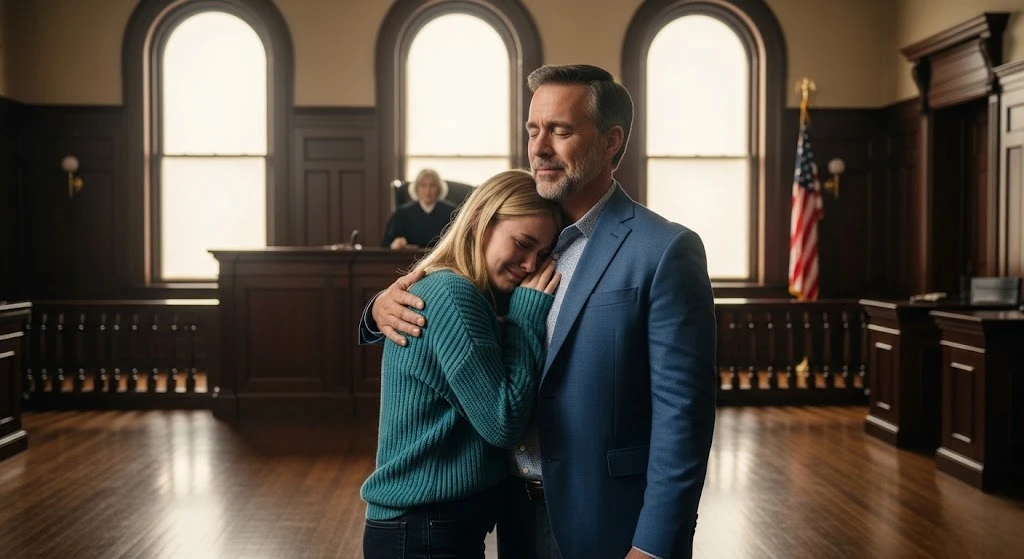
The sentencing hearing came four months later, in a courtroom far less grand than any ballroom she had ever hosted a gala in.
Wren didn’t attend. Grace did, sitting quietly in the second row, hands folded, saying nothing when Vivian glanced back once and then didn’t look again.
The judge read through the charges without much ceremony — falsifying medical records, witness intimidation, obstruction of justice, and six years of quietly rerouted trust disbursements the auditors had traced once they knew where to start looking. Vivian’s attorney argued for leniency, citing decades of “legitimate service to the Sterling family.” The judge was unmoved.
“Ms. Sterling used her position not to protect this family,” the judge said, “but to erase a member of it for personal gain, and then profited from that erasure for sixteen years. The court does not find that mitigating. It finds it aggravating.”
Six years, with full restitution ordered on every dollar the auditors could trace. Removed permanently from any trustee or fiduciary role tied to the Sterling name.
Grace told Wren about it that evening over dinner, plainly, without embellishment.
“How do you feel?” Wren asked.
“Lighter,” Grace said, and meant it.
—
Grace — Marisol, both names true now, neither one a lie — stood at the ballroom’s center with her daughter’s hand in hers, sixteen years of silence finally spent.
“No more disappearing,” Grace said.
“No more,” Wren agreed.
The chandelier caught the necklace’s crest one more time, and this time, nobody in the room looked away out of pity. They looked because it was, finally, simply beautiful.
Original fictional stories. AI-assisted creative content.