I run rooftops the way some people run roads.
Not because it’s impressive. Not for the videos. I do it because up there, the city makes sense. Everything below is noise — traffic, arguments, people lying to each other’s faces — and from six stories up, you can almost pretend none of it’s your problem.
Almost.
It was a Thursday evening in late October, sky the color of a bruise, the last bit of sun dragging itself behind the apartment blocks on Mercer Street. I’d been moving for forty minutes — concrete to concrete, railing to ledge to drainpipe — working out something I couldn’t name, the way you do when your body knows what your brain is still catching up to.
I pulled up onto the edge of the Kellerman Building and stopped.
Below me: the alley between Kellerman and the parking structure on Fifth. A narrow slot of city, poorly lit, the kind of place people cut through when they don’t want to be seen.
Two figures.
I almost kept moving.
Then one of them shoved the other.
The shove was hard. Two hands, full force, the smaller guy’s back hitting the brick wall with an impact I could hear from six floors up.
He was young — maybe nineteen, twenty. Slight build, dark hoodie, backpack still on his shoulders. He’d been walking and suddenly he wasn’t.
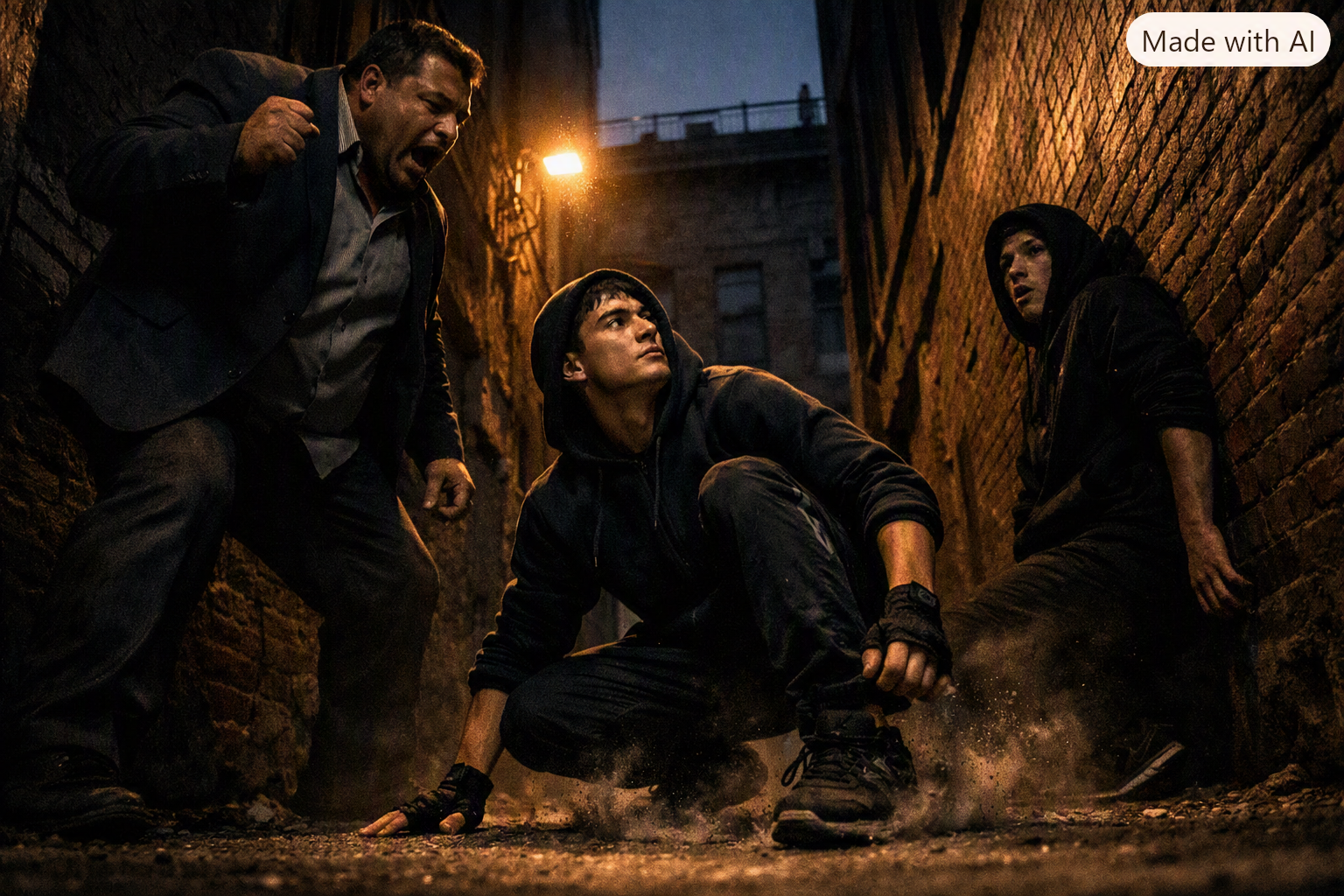
The man facing him was twice his size. Mid-forties, thick neck, sport coat like he’d come from somewhere that had a dress code. He had one forearm braced against the wall beside the kid’s head and was leaning in, voice low and controlled, which somehow made it worse than if he’d been screaming.
I couldn’t hear the words. Not yet.
But I could read the body language from a rooftop with no problem at all.
The kid had his hands up — not fighting, not threatening, palms out, the universal signal for I’m not doing anything — and the man wasn’t buying it. He shoved again. Lighter this time. The kind of shove that’s not about force, it’s about punctuation.
I crouched on the ledge.
My hands found the familiar rough edge of the parapet. Below me, six stories of empty air and then the alley floor.
The man grabbed the front of the kid’s hoodie.
I’ve been doing parkour since I was fifteen. I’ve taken drops that should have broken things and walked away clean. I’ve miscalculated, over-rotated, landed wrong, and learned every single time.
The thing people don’t understand is that a roof jump isn’t about being fearless.
It’s about the math.
You look at the distance. You calculate the arc. You feel the wind, check the surface below, register every variable you can see. And then you make a decision and you commit to it completely, because halfway committed on a rooftop is how people get hurt.
Six stories is approximately eighteen meters.
The alley floor was concrete.
There was a dumpster to my left that I’d need to clear.
I had about four seconds before the man with the sport coat did something that couldn’t be undone.
I did the math.
I jumped.
Freefall is the loudest silence you’ll ever experience.
No wind in your ears yet — that comes after — just this enormous, expanding quiet where the city disappears and there’s nothing except the feeling of commitment. You’ve made your choice. Physics is handling the rest.
The dumpster lid caught my feet first — I used it as a redirect, killed half the velocity, tucked, rolled the momentum into a back handspring off the alley wall, hit the concrete in a crouch that absorbed the rest.
Clean landing.
Two point three seconds, maybe.
I stood up.
The man and the kid were staring at me.
The man’s hand was still twisted in the front of the kid’s hoodie.
I said:
“Nobody move.”
I’ll give the man credit for recovery time. He unfroze faster than most people do after watching a human being fall six stories and stick the landing.
“What the—” he started.
“Nobody,” I said again, “move.”
He took a step toward me. “Who are you? Where did you—”
“I was on the roof,” I said. I nodded upward.
He looked up. Looked back at me. Looked at the dumpster. Ran the math himself and came up wrong, because his face did something complicated that ended somewhere between fury and bewilderment.
“Walk away,” he said. “This is none of your business.”
“You’ve got your hand on someone who’s half your size,” I said. “That made it my business.”
“This kid—” He stepped closer, releasing the hoodie to point instead — the classic tell of a man who wants to argue more than he wants to fight. “This kid has been texting my wife. For six months. I have the messages. I have the screenshots. He knows exactly what he’s—”
“I don’t,” the kid said. His voice was shaking, but he said it. “I swear to God I don’t know who your wife is.”
“Liar.”
“Sir, I live in this building.” He pointed at the door ten feet behind him. “I cut through this alley every day. I don’t — I’ve never even talked to your wife.”
A silence.
I looked at the man.
He was breathing hard. The certainty was still there, but underneath it, a crack. A sliver of something else.
“She said it was someone named Jake,” he said. Quieter now. “Tall. Dark hoodie. Lives near here.”
The kid blinked.
“My name is Marcus,” he said.
Another silence.
Longer.
The man’s hand dropped to his side.
I’ve been wrong before too.
Not in the same way — I’ve never pinned an innocent person against a wall in an alley — but I’ve been wrong with the same conviction. The kind where you’re so certain that the certainty itself becomes the blindfold. Where you stop looking for contradictions because you’ve already built the verdict.
The man’s name, I found out later, was Paul.
He stood in that alley for a long time without speaking. Not because he’d run out of things to say. Because the thing he’d been about to do — the thing he’d already partly done — was reorganizing itself in his mind into something he had to look at directly.
“I have his number,” Paul said, finally. Not to me. To Marcus.
Marcus, to his considerable credit, didn’t say the obvious thing.
“Okay,” Marcus said.
“Jake. Twenty-something. Dark hoodie.” Paul’s voice had gone flat. Not the flat of a man calming down but the flat of a man whose floor had just shifted. “She said his name was Jake.”
“I’m not Jake,” Marcus said.
Paul looked at him for a long time.
“No,” he said. “You’re not.”
He left without another word.
No apology. Maybe he’d get there. Maybe he wouldn’t. Some people process on a delay; the shame arrives three days later while they’re in the shower and hits harder than it would have in the moment. I’ve seen it happen. I’ve felt it happen.
Marcus watched him go, then turned to look at me.
“You fell off a roof,” he said.
“Jumped,” I said.
“That’s insane.”
“A little.”
He looked up at the Kellerman Building, then back at me, processing. “Why?”
I thought about it.
“You had your hands up,” I said. “Palms out. Wasn’t going to touch him.”
Marcus looked at his hands. He was still shaking slightly, the adrenaline working its way out.
“He could have really hurt me,” he said.
“He might have,” I said. “He was convinced.”
“Of the wrong thing.”
“Yeah.”
We stood in the alley for a moment. The sky was full dark now, the last of the bruise-colored light gone from between the buildings. Somewhere on Fifth Street, traffic moved.
“You land like that on purpose?” Marcus asked.
“Every time,” I said.
“How?”
“Practice,” I said. “And then you stop thinking about it and you jump.”
He nodded slowly. Like that meant something to him beyond the literal.
“Thanks,” he said.
“Go home,” I said.
He went.
I found the building access door on the east side of Kellerman and took the stairs back to the roof.
Six flights. Not as fast as the way down.
From the edge, the alley looked exactly like what it was — a narrow slot of city, poorly lit, the kind of place things happen that nobody above street level ever sees. Paul was gone. Marcus was gone. The dumpster lid sat at a slight angle where I’d hit it, which I felt marginally guilty about.
The city was just the city.
I rolled my shoulders. Found the next rooftop. Measured the gap.
Did the math.
Jumped.
Original fictional stories. AI-assisted creative content.