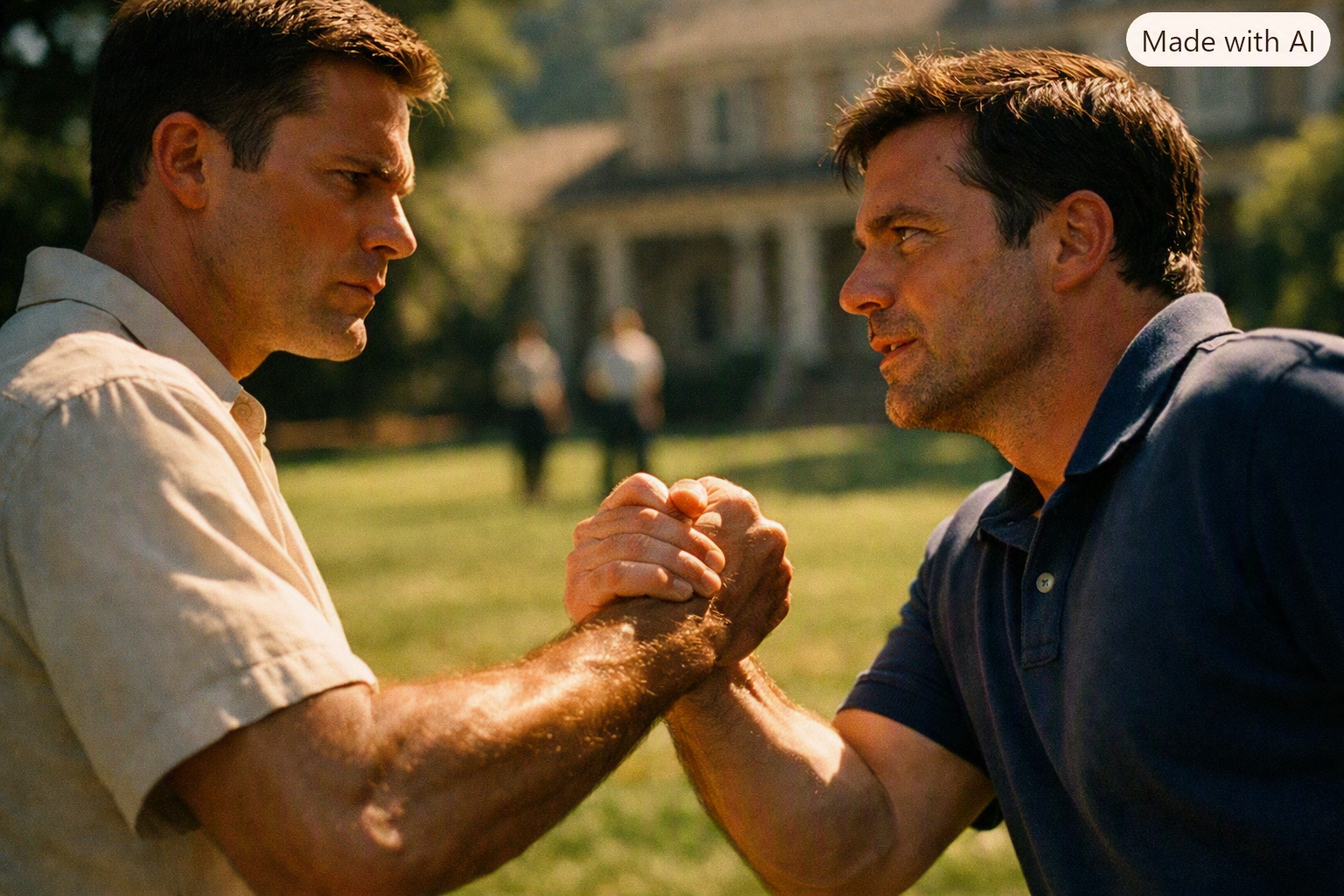
Javier Romano’s knee pressed into Leo’s back.
The eight-year-old boy’s cheek was against the grass. His fingers dug into the lawn.
“Say it.”
Leo twisted his head. “I didn’t—”
“Say it.”
Mia ran at them. “Get off him!” She grabbed Javier’s arm. He shoved her away. The seven-year-old hit the grass.
That was when Leo screamed.
“Dad! I can’t breathe!”
Twenty yards away, Dante Romano stopped mid-sentence. Three senior family men had been standing around him at the barbecue tables. None of them finished speaking.
Dante turned. He saw Mia on the ground. Leo beneath Javier.
The world narrowed.
He crossed the lawn in seconds. Javier looked up only when Dante’s hand closed around his shoulder. Dante tore him backward. Javier stumbled. Leo rolled onto his side, coughing.
Dante’s voice dropped to something colder than shouting. “Take your hands off my children.”
Mia ran behind her father. He crouched beside Leo. “Look at me. Can you breathe?”
Leo nodded weakly. Dante looked at the red mark along his son’s cheek. Something old stirred inside him. He stood.
Javier straightened his polo shirt like the interruption had been a minor inconvenience. Guests had stopped eating. Music had cut out. Even the bodyguards looked uncertain.
Dante took Leo’s hand. Mia pressed herself against his other side.
Javier walked toward him. “You’re making a scene.”
“You had my son under your knee.”
“He stole from me.”
Leo shook his head hard. “I didn’t!”
Javier ignored him. Dante stared at his cousin. “What did he steal?”
Javier didn’t answer.
Interesting.
Dante said his name once, like a door closing. “Javier.”
“Something that belongs to my side of the family.”
“What?”
Javier stepped closer and shoved Dante in the chest.
The entire garden went silent.
“What are you going to do about it, Boss?” The word came out like a slur.
Dante looked down at the hand that had pushed him. Then Javier swung.
Dante moved aside. Caught the wrist. Turned the arm. Javier hit the lawn face-down. Dante controlled him there without striking again.
Not rage. Control.
That frightened the witnesses more than violence would have.
Leo and Mia were moved behind two bodyguards. Javier struggled and Dante leaned close to his ear.
“You put your knee on my son.”
“He needed to learn—”
Dante tightened his grip just enough to stop the sentence. “You wanted to teach my son strength.” He released Javier. Shoved him across the grass.
Javier rolled and crawled back. Dante stood between him and the children.
“Remember who taught you fear.”
For a moment Javier’s face showed pure, undisguised hatred.
Then Leo spoke.
“Dad?”
Dante turned. The boy was holding something — a small black chess knight. Old wood, one side burned darker than the other.
Dante stopped breathing. “Where did you get that?”
Leo pointed toward the small brick building at the edge of the garden. It had been locked since Salvatore Romano died. Nobody used it. Nobody had a reason to.
“I found it under the floor.”
Javier stood too quickly. “Give me that.”
Dante turned toward him slowly.
Javier froze. That reaction said more than any confession.
Dante took the piece from Leo. Underneath the base was a tiny carved letter. R. His father’s mark. R for Romano.
But Dante knew what the knight meant. His father, Salvatore, had used black chess pieces to mark people inside the family accused of betrayal. A pawn meant suspicion. A bishop meant warning. A rook meant removal.
The knight meant something worse. Blood had betrayed blood.
Twenty-seven years ago, the last black knight Dante ever saw was placed in front of one man. Javier’s father. Mateo Romano.
Mateo vanished the next night. No body was ever found.
Javier looked at the piece. Then at Dante. His voice changed. “Where exactly did Leo find it?”
“You knew it was there.”
Javier said nothing.
Dante looked toward the locked garden house. The barbecue was over. Whatever had begun twenty-seven years earlier had just returned to the table.
Dante took the children inside first. Nothing else mattered until he knew both were physically all right. Leo’s breathing returned to normal. Mia’s elbow was scraped. A trusted doctor checked them quietly. No dramatic language. No unnecessary fear.
Leo kept asking whether Javier was angry because of the chess piece.
“He made a bad choice,” Dante told him.
“Because I took it?”
“No.” He made sure the answer was immediate. “You didn’t make him hurt you.”
Leo studied his father. “Am I in trouble?”
“No.”
“Can I keep the knight?”
Dante looked at the piece. “No.”
“Why?”
“Because it belonged to Grandpa.”
That was enough. Mia, sitting beside her brother, spoke. “Uncle Javier said Leo stole his father.”
Dante’s expression shifted. “He said what?”
“Before he pushed him. He said Leo stole his dad.”
Silence. Leo looked confused. “I didn’t steal a dad.”
Dante felt something cold move through him. He kissed both children on the forehead and left them with Maria, his housekeeper of decades — one of the few people in the house he trusted without needing to explain why.
Javier was waiting in the old dining room. His wife Clara stood near the windows. She looked furious. Not at Dante. At her husband.
Dante entered alone and placed the black knight on the table. Javier stared at it.
“Start.”
Javier laughed bitterly. “You always did like giving orders.”
“And you always mistook resentment for courage.”
Clara stepped between them. “Enough.” She turned to her husband. “You put your knee on an eight-year-old child.”
“He found something.”
“That is not an answer.”
“It matters.”
“No.” Her voice sharpened. “What matters is that you chose a child because you were afraid of what he found.”
Javier’s jaw tightened. Dante almost smiled. Clara continued. “You owe Leo more than whatever explanation you’re constructing.”
Javier looked away.
Dante returned to the chess piece. “You knew it was in the garden house.”
“Yes.”
Clara stared at her husband. “You knew?”
Javier nodded. “Someone told me.”
“Who?”
“I don’t know. Three months ago I received a call. A man told me my father didn’t betray the family.” He looked at Dante. “He said Mateo was framed.”
Dante had heard versions of that theory before. Mostly from Javier when he was younger. Mateo Romano had been Salvatore’s younger brother. Dante’s uncle. Javier’s father. He ran shipping routes. Controlled dockworkers. Had enough support to challenge Salvatore, if he wanted.
Then one shipment disappeared. A rival family received information only Mateo should have known. Money vanished from a family reserve. Salvatore convened the old council. Placed a black knight in front of Mateo. Two days later Mateo vanished.
“Your father accused mine,” Javier said.
“Yes.”
“And you stood beside him.”
“I was twenty-eight.”
“You were already his enforcer.”
“Yes.”
“Did you help take Mateo?”
“No. I searched for him.”
“After he disappeared.”
“Yes.”
“Too late.”
Dante accepted that. Javier continued. “The caller said the knight used against my father was hidden in the garden house.”
“Why would the accusation piece prove innocence?”
“He said there was another piece. A black king.”
Silence. Clara looked between them. “What does that mean?”
Dante knew. Salvatore never used the king publicly. Only once had Dante seen it referenced. A black king marked betrayal at the highest level — the person who controlled the accusation. The man behind the family’s own corruption.
“If there’s a king in that house, my father believed someone above Mateo was involved.”
Javier’s face twisted. “He knew. He framed my father.”
“Maybe.”
“You still defend him.”
“No.” Dante’s voice dropped. “I am refusing to replace one old lie with another because you need someone to hate.”
Javier stepped forward. “You think this is about hate?”
“You pinned my son to the ground over a chess piece.”
Javier’s eyes flickered with shame. Then anger covered it. “That boy sits where my father’s blood should sit.”
Dante went still. Clara whispered her husband’s name like a warning.
Too late.
Dante stared. “Say that again.”
Javier’s voice lowered. “You heard me.”
Dante crossed the room. Clara stepped between them — not because she thought Dante was wrong, but because two men fighting would bury the question.
“What does Leo have to do with your father?” she asked Javier.
He looked at her. Then Dante. “The caller said Mateo never wanted Salvatore’s chair. He wanted Dante removed from succession.”
“Why?”
Javier looked toward the black knight. “Because he believed Dante wasn’t Salvatore’s son.”
Dante did not react immediately. That frightened Javier more than anger would have.
Clara looked at her husband as though she wanted to strike him. “You attacked Leo over that?”
“No. I said the call connected Mateo to succession.”
“And you translated that into hurting an eight-year-old?”
Javier looked away. Clara’s voice broke with disgust. “You are forty-one years old.”
Dante leaned against the table. “Who supposedly is my father?”
“The caller never said.”
“Did you believe him?”
“At first, no. Then he knew things. The old cellar beneath the garden house.”
“There is no cellar.”
Javier looked at him. “That’s what I thought.”
They opened the garden house. Javier had an old key from his father. Under the workbench, a trapdoor. First lock: the key. Second lock: a carved depression shaped like a chess piece.
Dante placed the knight into it. A click. The door released.
The cellar below was narrow. Stone walls. One old table. Three chairs. A shelf of wooden chess pieces — most black, some white. Objects: a silver lighter, a wedding ring, a broken watch, a child’s wooden whistle. Each beside a chess piece.
Javier whispered, “What is this?”
“Memories,” Dante said. Salvatore used objects to remember debts. People. Betrayals.
On the far shelf sat a black king. And beneath it, a photograph. Four men around a table: Salvatore Romano, Mateo Romano, their cousin Dominic, and a fourth man.
Dante knew the face. So did Javier.
Clara whispered, “That’s Sebastian Cole.”
Dante’s former head adviser. A man who had served Salvatore for thirty-five years and then quietly disappeared into retirement after Salvatore died. Nobody had questioned it.
Sebastian held a black king in the photograph. On the back, Salvatore had written: IF MATEO FALLS, ASK SEBASTIAN WHY.
Javier stopped breathing.
Dante’s phone rang. Unknown number. He answered.
A male voice. Calm. Unaltered. “Dante.”
He knew it. Not immediately. Then his chest tightened. “Sebastian.”
A soft laugh. “You finally opened the cellar.”
Javier went rigid. Dante put the call on speaker.
“Where are you?”
“Still leading with the wrong question.”
“What happened to Mateo?”
Silence. Then: “He survived Salvatore.”
Javier’s voice cracked. “What does that mean?”
Sebastian heard him. “Javier.” He sounded almost warm. “You have his anger.”
“Where is my father?”
“Ask Dante why Salvatore named him heir before Mateo disappeared.”
Javier turned toward Dante. Dante stared at the phone. “I was not named heir before.”
“You were,” Sebastian said quietly.
The call ended.
Javier’s voice was no longer angry. Worse: suspicious. “What did your father know about you before he decided mine had to disappear?”
The adults gathered that evening: Teresa Romano — Mateo’s younger sister, seventy-four years old — entered the library and saw the ring on the table. Mateo’s signet ring, found in Javier’s car alongside a black rook. Fresh engraving inside: SON.
Someone wanted Javier to think his father was alive. Or Mateo actually was.
Teresa sat slowly. Her eyes filled. Then she said: “Sebastian loved Mateo.”
Not like family.
The room changed. Not because the love shocked anyone — because secrecy had motive. Sebastian had spent decades beside Salvatore while loving the man Salvatore later accused.
“Mateo wanted to leave the family,” Teresa said.
Javier shook his head. “No. My father wanted the chair.”
“He told you what he thought would keep you proud. You were thirteen.” Her voice softened. “He wanted to leave because Sebastian wanted out.”
Clara whispered it first: “They planned to leave together.”
Teresa nodded. “And Salvatore found out.”
Dante understood. A black knight for blood betraying blood. Perhaps the betrayal wasn’t selling routes. It was leaving. To men like Salvatore, exit could be worse than treason.
“Who took Mateo if Salvatore wouldn’t?”
Teresa looked at Dante. “Ask the man who wanted Sebastian for himself.”
“Who?”
“Dominic Romano.”
Dominic had been dead fifteen years. Or, as everyone was beginning to understand, there had been a funeral.
Dominic had been Salvatore’s closest adviser after Mateo disappeared. He rose higher as Mateo fell. He had wanted Sebastian’s loyalty attached to himself. Sebastian refused. When Mateo and Sebastian planned their escape, Dominic found out and told Salvatore.
“What happened the night Mateo vanished?” Javier asked.
Teresa looked toward the fireplace. “I heard shouting. Salvatore, Dominic, Sebastian. One sentence I kept.” She paused. “Dominic said, ‘If Mateo leaves, tell the boy the truth.'”
Dante went still. “Which boy?”
“I always thought they meant you.”
Before anyone could respond, Dante’s phone rang again — this time Teresa’s. Sebastian, calling them.
“Dante opened the cellar,” Sebastian said when they put it on speaker.
“Yes,” Teresa whispered.
“Then it’s too late to preserve Salvatore’s version.”
“Good,” Dante said.
Sebastian laughed softly. “You sound less like him than I feared.”
“Where is Mateo?”
Silence. Then: “With me.”
Javier’s knees nearly gave. Clara caught his arm. Dante stared at the phone. “Alive?”
“Yes.”
Javier couldn’t speak. Sebastian heard the silence. “Your father does not want to come home.”
“Why?”
“Because he has seen what the Romano family does when the dead return.” A pause. “But someone else is coming. Dominic’s son. And if he reaches the family before Mateo does, Leo and Mia will not be the last children used to settle an old man’s war.”
The lakeside chapel stood under gray clouds.
Dante arrived at six with Javier, Clara, Teresa, and two guards. No army. A black car pulled up. Sebastian stepped out first. Thin. Eighty-one. Cane. His eyes found Teresa before he said anything.
Then the rear door opened. Mateo Romano stepped out.
Sixty-eight. Gray hair. Broader than Javier. A scar across his left cheek. He looked at his son — the boy he’d last seen at thirteen, now forty-one years old and furious.
“Javi.”
Nobody called him that anymore. Javier walked forward. Stopped three feet away.
“You’re alive.”
“Yes.”
“You let me think you were dead.”
“Yes.”
Mateo’s eyes filled. “I’m sorry.”
Javier hit him. One punch. Mateo staggered. Sebastian moved forward. Dante raised one hand. No.
Mateo straightened. Javier hit him again. Then stopped. His fists shook.
“You left me.” His voice broke. “You left Mom. She died thinking you were dead.”
Mateo’s face cracked. “I know.”
“You knew?”
“Yes.”
Javier stepped backward. Clara came beside him. No touch. Just presence.
Then a voice from the chapel door.
“Welcome home, Uncle.”
Michael Crane stood in the doorway. Dante’s head of household security — twelve years of access, trust, and presence. He smiled at Mateo like blood had suddenly become useful.
Inside the chapel, Dante learned the shape of the trap Michael had been building.
Forty-four years old. Dominic’s secret son by a woman named Laura Hale. Raised under the name Crane to keep him outside Romano recognition. He had grown up watching Dante inherit, watching Javier resent, watching Leo become the family’s symbolic future. Three generations of men sitting around a structure that never recognized him.
He had fed Javier resentment for three months. Created conditions. Javier chose the act.
“I didn’t tell you to hurt the boy,” Michael said to Javier.
“No.” Javier’s jaw tightened. “You just made sure I was angry enough.”
“You did that because you needed someone smaller than Dante to punish.”
The truth landed hard. Javier said only: “Yes.”
Michael’s smile faded slightly. Shame admitted was harder to weaponize.
Then Mateo stepped forward. “He doesn’t want your chair, Dante.”
Michael’s eyes narrowed. Mateo looked at him directly. “You want Salvatore’s room.”
Silence.
Mateo continued. “Dominic told me before I left. There is one final room beneath the old banquet hall. Not chess pieces. Not memories.” He looked around. “Names of every Romano marked for removal who was never killed. Exiles. Hidden people. Everyone Salvatore moved without the family knowing.”
Michael wanted that room because opening it could destroy half the alliances in the city. He could control who learned what, when, and at what price.
Dante looked at him. “So this was never about leadership.”
Michael’s voice went cold. “It was about ending lies.”
Mateo answered before Dante could. “It was about owning them.”
The council gathered at the old Romano banquet hall. Thirty-two men. Nine women. Captains. Senior cousins. Family allies. No children. Dante had insisted. Leo and Mia would not become props in an adult succession fight.
Michael arrived last. Dark suit. No bodyguards. Confidence built from knowing every room.
Dante spoke first. “Michael called this council in my name. I allowed it.” The murmurs stopped. Michael’s eyes narrowed. “Before he explains why I should no longer lead, I’ll save him time.”
And Dante told them everything.
Mateo was not a proven traitor. Salvatore had manipulated his own brother. Dominic helped. Sebastian and Mateo planned to leave. Mateo was exiled. Dante searched seven months. Stopped. A choice he had never stopped regretting.
“Mateo is alive.”
The room erupted. Mateo stepped from the back. Men stood from their chairs. One crossed himself. Several didn’t move at all.
Then Javier stepped forward. His voice shook.
“I let resentment make me useful to someone who wanted this family divided.” A breath. “I spoke against Leo. And at the barbecue, I put my hands on him.” Some men looked disgusted. Good. No shielding. “I told myself I was challenging Dante. I hurt a child because I was angry at his father.” He looked toward the floor. “That is mine.”
Michael had expected to be the one to reveal all of it. The weapon was gone.
He smiled slowly. “You think confession is power.”
“No,” Dante said. “It’s harder to blackmail people with what they’ve already admitted.”
Michael walked to the center. He had his argument still — that blood succession was corrupt, that the Romano name itself was the disease. He made it well. Parts of it were even true.
Then Dante said: “He’s right about one thing.”
Michael paused.
“Our family has treated birth like proof. It isn’t.” Dante looked toward his captains. “Neither is a secret council. Neither is a man who uses children as pressure.”
“I never touched Leo,” Michael said.
“No.” Dante looked at Javier. “You found someone who would.”
Silence.
Dante continued. “If I die tomorrow, the council chooses my successor. This is still our world. Strength matters. Judgment matters. Loyalty matters. But blood alone stops deciding.”
Michael’s entire argument had depended on the Romanos defending blood. Dante removed it.
Michael’s hand moved toward his coat. Javier saw it first. He tackled the arm aside. A gun hit the floor.
In the silence after, Javier looked at Michael. “I chose not to make another child pay for my father.”
Michael stared. That answer hurt more than allegiance.
The next morning Javier asked permission to see Leo.
Not Dante’s. Leo’s.
Dante sat with his son in the garden. Mia close by. “Uncle Javier wants to talk to you.”
Leo’s expression shifted. “Why?”
“To say something.”
“Do I have to?”
“No.”
Leo thought. “Will you stay?”
“Yes.”
Mia immediately said: “I stay too.”
Leo nodded.
Javier came alone. No family ring. He stopped several feet from the boy and crouched.
“I hurt you.”
Leo said nothing.
“I was angry about things that happened before you were born. I acted like that made it okay.” He held the boy’s gaze. “It didn’t.”
Leo looked toward his father. Then back. “Why squish me?”
Javier’s face broke slightly. “Because I wanted your dad angry.”
Leo stared. “That’s dumb.”
“Yes. It was.”
Leo thought for a moment. “Are you gonna do it again?”
“No.”
“Promise?”
Javier paused. Good. Not easy promises. “I promise I will never put my hands on you like that again.”
Leo looked at Dante. Dante didn’t nod. His son’s choice.
“Okay.” Not forgiveness. Not invitation. Just okay.
Javier stood. “Can I go?”
Leo shrugged. Javier left. Clara waited at the far end of the path.
“Did he forgive you?”
“No.”
“Good.” She looked toward the house. “If he had, you might confuse relief with repair.”
Javier absorbed it. “What about us?”
Clara’s voice was quiet. “I don’t know.”
He nodded. Not the answer he wanted. The honest one.
Inside, the unraveling continued.
A small box appeared on the front step. Maria brought it to Dante. Inside: a black chess queen. Salvatore had never used queens. Never.
Underneath, scratched into the wood: THE WOMAN WAS ALWAYS THE HEIR.
Teresa saw it and went pale.
“Eleanor,” she said. Dante’s mother. Dead twenty-three years. The woman history remembered mostly for dinners and raising sons.
Teresa sat. “Eleanor’s father ran the Romano family before Salvatore’s. Henry was the public head. Eleanor designed the markers.”
Not as punishment. As protection.
The chess pieces had been her system first: pawn meant shelter, bishop meant escort, knight meant remove from danger, rook meant relocate, king meant head of family protected last. And the queen — the person authorized to override the king.
Salvatore had corrupted the system. The knight placed on Mateo, which the family read as condemnation, had originally been Eleanor’s mark to move him to safety. Someone had turned her protection into an accusation.
“Eleanor kept one person outside Salvatore’s control,” Teresa said. “Before she died, she told me: ‘If Salvatore destroys the knight, the queen will come back.'”
A woman had appeared at the east gate earlier that morning. Security said she was around sixty. No name given. She had left only one message: “If Eleanor’s son has finally learned to leave the dead alone, tell him the Queen says it’s time.”
Dante looked at the black queen in his hand.
“Ruth Mercer,” Teresa said. The name settled into the room. Eleanor’s closest friend. Gone from the estate the week after Eleanor’s funeral. An invisible woman who had spent twenty-three years waiting for the right generation.
The dining room service bell rang once from deep inside the house.
Everyone stopped moving.
Dante remembered that bell from childhood. One ring meant family to the table. Two meant staff. Three meant danger.
The bell rang again.
Then a third time.
Dante looked toward Mateo. Mateo looked toward Javier. And from the front entrance came Maria’s voice.
“There’s someone at the door. An old man.”
“Name?”
“He says Romano.”
Dante stepped forward. “First name?”
Maria swallowed. “Elias.”
Teresa dropped her glass.
Dante turned. “Who is Elias?”
Teresa’s face had gone white. “The boy in the photograph.”
Silence.
“He should be dead.”
Dante looked toward the entrance. Then at the photograph. Then at the children, still in the garden with their hands clasped.
He handed the box to Maria. “Stay with them.”
Leo looked up. “Are you coming back?”
Dante looked at his son. “Yes.” Not a promise he made casually. A choice.
At the entrance stood a seventy-year-old man with a cane. Tall. Silver hair. Romano eyes. He looked at Dante first. Then Mateo. A strange sadness crossed his face.
“You two look like Salvatore.”
Dante stopped. “Elias Romano?”
The man nodded.
“Who are you?”
Elias smiled without warmth. “The brother your father spent his entire life pretending he never had.”
Mateo stared. “Our father?”
“No.” Elias looked at Dante. “Salvatore.”
Another hidden son. Older. Born before Salvatore’s legitimate line. The family had been built on erased blood before any of them were born.
Dante asked: “Why are you here?”
Elias reached into his coat slowly. He removed no weapon. Only a black chess king — older than Salvatore’s, cracked through the center. He placed it in Dante’s hand.
“Because your mother wasn’t trying to save Mateo from Salvatore.”
Dante stared.
“She was trying to save all of you from me.”
The air changed.
“I was the rightful son,” Elias said. “But I stopped caring about the chair forty years ago.”
“Then what?”
“I came because Ruth is missing. Three hours ago.”
Dante went cold. “She called me less than an hour ago.”
Elias’s face changed. “That wasn’t Ruth.”
Silence. Dante looked at the phone in his hand. Someone had used Ruth’s voice. A living identity turned into a weapon.
“Who?” he said.
Elias looked toward the garden. “I don’t know.” He reached into his pocket and placed a silver bracelet on the table beside the cracked king. Teresa gasped. Eleanor’s bracelet. Dante had seen it on his mother’s wrist every day of his childhood.
“Whoever took Ruth left that in her house,” Elias said. “Because Ruth was not Eleanor’s true successor.”
“Then who was?”
Elias looked past him. Toward the mansion. Toward someone apparently already inside.
“I don’t know her current name. But forty years ago, Eleanor called her the Queen.”
Dante looked at the black chess queen still in his pocket. Then Elias said:
“And if she has finally come back, Michael was never your real enemy.”
From somewhere deep inside the mansion, the old service bell rang once.
Then again.
Then a third time.
Danger.
Dante looked toward Mateo. Mateo looked toward Javier. In the garden, Leo clutched Mia’s hand as the doors of the old Romano dining room swung slowly open by themselves.
Inside, someone had placed a black queen at the head of the table.
Beside it were two empty chairs. One marked DANTE. The other marked MATEO.
And carved freshly into the wood beneath them, six words:
YOUR MOTHER NEVER FINISHED HER WAR.
Dante did not freeze.
He crossed the dining room. Checked the adjoining corridor. Checked the kitchen entrance. No one. Every window shut. The chairs had been placed by someone who knew the house — who knew which dining room Salvatore had always used for family matters, who knew which chairs Dante and Mateo preferred when they sat together as boys.
He turned and looked at the black queen.
“Maria.”
She appeared in the hallway.
“Who has been in this room today?”
“No one since the morning clean.”
“The staff who cleaned it — anyone unfamiliar?”
Maria hesitated. “One woman. New. She was assigned by the catering company.”
Robert Vale’s company. Robert, Dominic’s older son. The man who had said he wanted to stop Michael but had still used an eight-year-old to trigger a chain reaction.
“Find her,” Dante said.
“She left.”
Of course.
Mateo entered behind him and read the carved words. He said nothing for a long moment. Then: “Eleanor carved messages into wood?”
“She made the whole system,” Teresa said from the doorway. “This is hers.”
“The Queen left us a warning,” Javier said.
“Or an invitation,” Clara answered.
They stood around the table — all of them. Dante, Mateo, Javier, Clara, Teresa, Sebastian on his cane, Elias with his cracked king still in hand. Everyone who had been hidden from or lied to or moved around like pieces on a board.
Dante looked at the two marked chairs.
He sat in his.
After a moment, Mateo sat in the other.
Sebastian smiled faintly.
Elias placed his cracked king at the center of the table.
Dante looked at it. Then at the black queen beside the chairs. His mother had built a system meant to protect her family from a man she loved who could not stop consuming the people around him. She had hidden pieces of herself in rooms, in friends, in symbols that outlasted her by twenty-three years.
He picked up the queen.
“Wherever Ruth is,” he said, “she’s alive. The Queen — whoever she is — wants us to know that.”
Elias nodded. “Eleanor chose her because she was someone Salvatore would never consider important.”
“Invisible power,” Clara said. She had been saying it in different ways all day.
“We’ve been surrounded by it,” Mateo said.
Dante looked at the carved words again. YOUR MOTHER NEVER FINISHED HER WAR.
Then he looked at Leo and Mia through the window — still in the garden, Mia now drawing something in the dirt while Leo watched.
“She doesn’t have to,” Dante said. “She already raised the people who would.”
He placed the black queen face-down on the table. Not surrendered. Rested. The war, if it came, would not be played in her name by dead men’s rules.
Elias watched him. “You’re not going to chase the Queen?”
“No.”
“She took Ruth.”
“We don’t know that yet. And chasing blindly is exactly what the message is designed to provoke.” He looked at the old man. “You know that.”
Elias smiled without humor. “Eleanor’s son.”
“Her son,” Dante agreed. “Not Salvatore’s echo.”
The table was quiet. Outside, Leo’s voice rose from the garden — something cheerful and small, a child’s argument with his sister about whose drawing was better.
Javier was the one who laughed first. Quietly. Almost despite himself.
Then Mateo. Then Clara. Then even Teresa, pressing her hand to her mouth.
The board was still set. The Queen was still out there. Ruth was missing. Elias was a question with seventy years of history attached to it. Michael was in custody. Robert Vale had walked free with names Dante chose not to demand.
None of that was resolved.
But Dante looked around the table — at the people who had been used against each other for decades, now sitting in the same room — and understood something his father never had.
Control was not the same as safety.
Safety looked like Leo choosing whether to accept an apology. It looked like Mateo being allowed to say I don’t know yet. It looked like Clara standing beside herself rather than beside the man who hurt her husband’s child. It looked like two brothers sitting at a table their mother had carved.
Dante put his hand flat on the wood.
“We find Ruth,” he said. “Not because someone carved it into a chair. Because she’s family.” He looked at Elias. “And you — you’ll stay until we know why Eleanor was afraid of you. Not as prisoner. As someone who owes us the honest version.”
Elias studied him. “And if I refuse?”
“Then you leave the cracked king and we decide without you.”
Elias looked at the chess piece in the center of the table.
Then he sat.
Not performance. Not surrender.
A man who had spent forty years living outside the family he was erased from, finally sitting down at the table without needing the chair.
Dante nodded once.
“Then we begin.”
From the garden, Leo’s voice again, brighter now:
“Dad! Mia cheated at drawing!”
Dante stood. Walked to the window. Looked out at his children arguing pleasantly about nothing in the late afternoon light.
“I’ll be right there,” he called.
And for the first time in three days, he meant it without condition.
Original fictional stories. AI-assisted creative content.