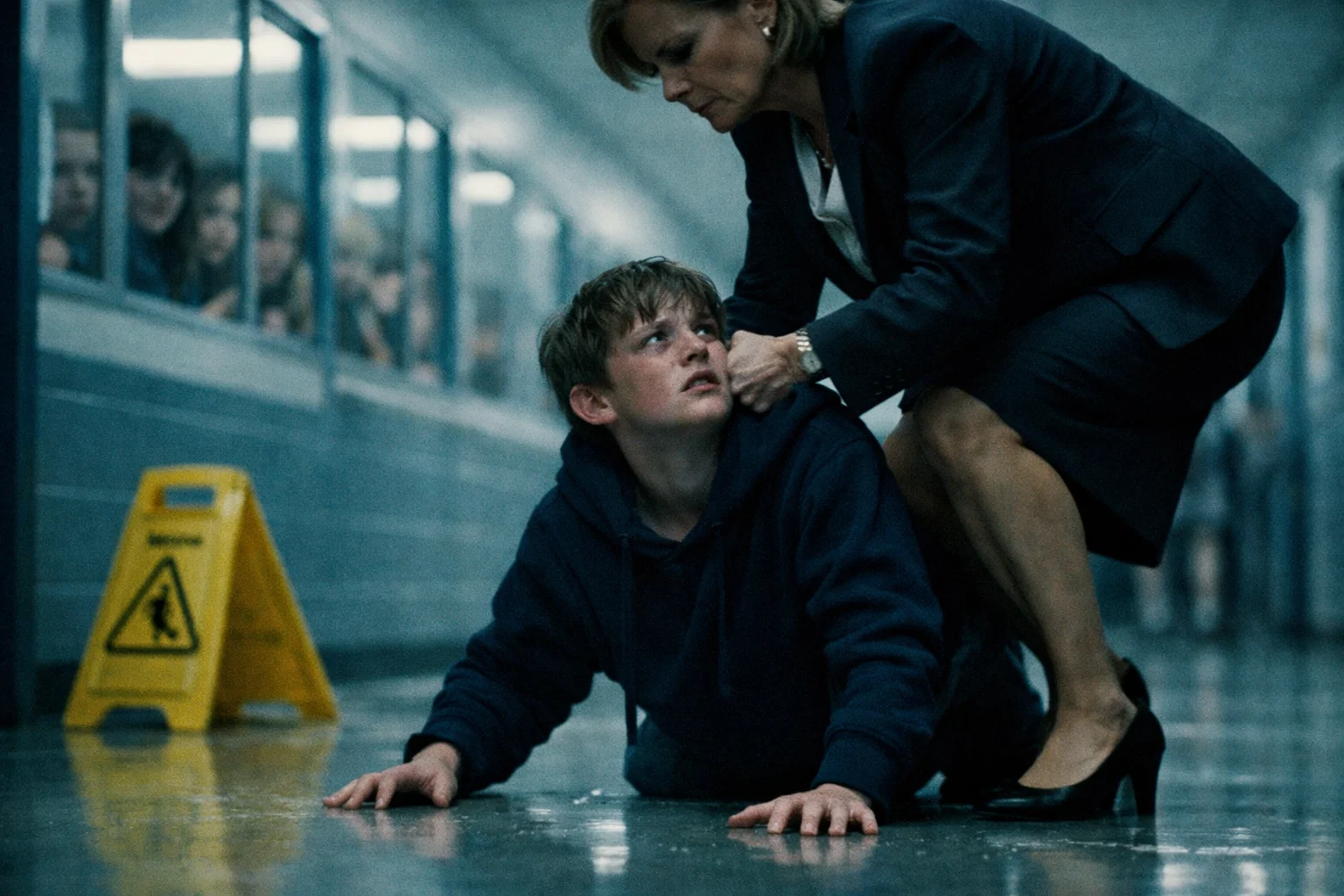
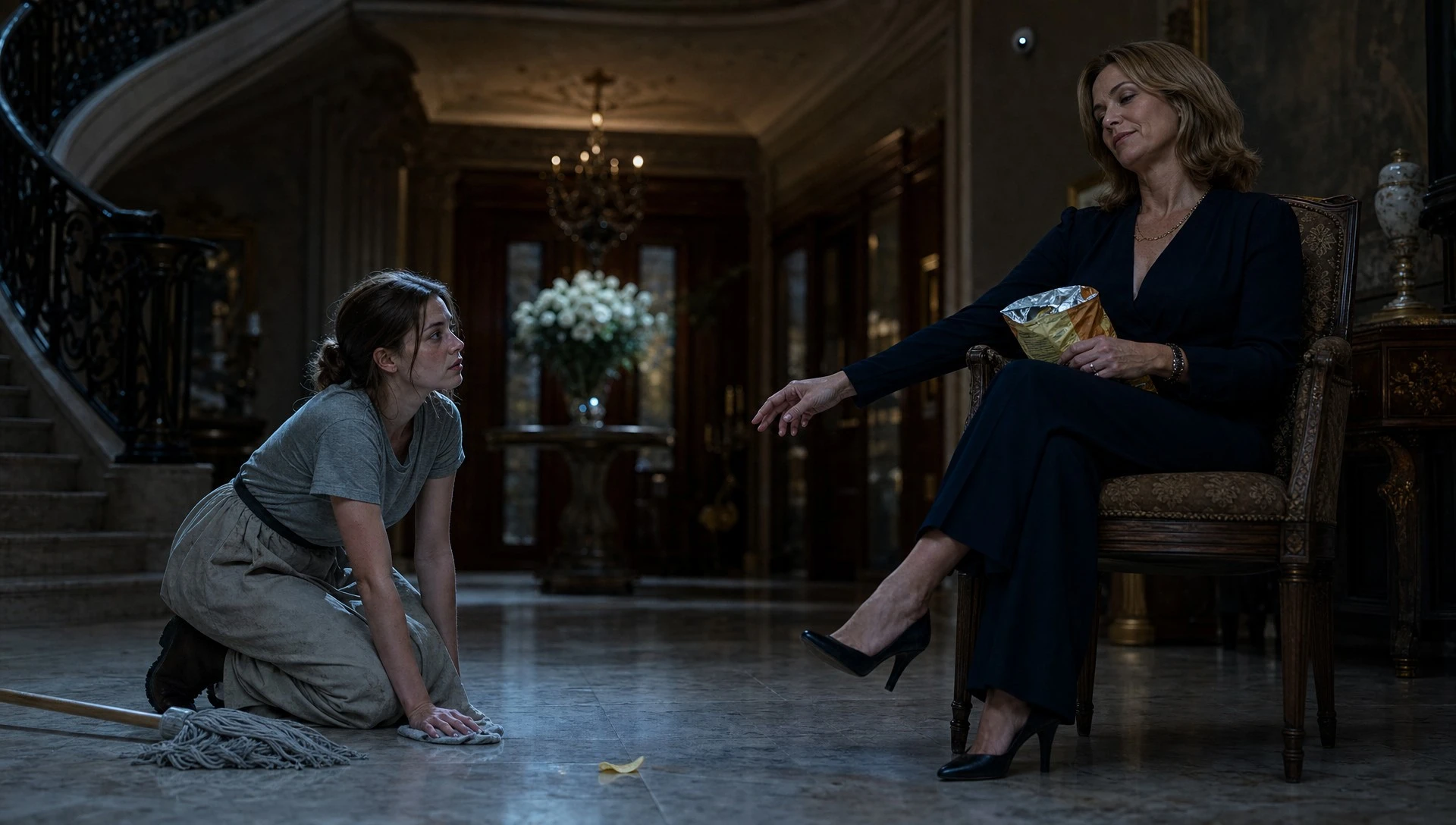
The mop hit the floor before Sofia did.
She was small for her age — too small for the handle she’d been given — and when her wet shoes slipped on the marble, she dropped everything and went down hard on both knees. The snack bag the maid had been holding clattered beside her. Neither of them moved for a second.
Then the silence broke.
“Stand up, Sofia.”
The voice came from the top of the staircase.
Sofia looked up, water still dripping from the mop strings across her fingers. An old woman stood at the railing — white hair, straight spine, one hand gripping a gold-topped cane — looking down at the foyer like a judge who had finally arrived at the right courtroom.
Sofia looked left, then right.
“Me?”
“Yes, child.” The grandmother’s voice dropped. “You.”
Sofia tried to push herself up, but her shoes slipped again on the wet marble. Before the maid could reach her, the old woman was already moving — faster than her cane suggested she should — descending the curved staircase with a grip that said she had done it ten thousand times before.
She reached Sofia in seconds.
She took the mop handle out of the girl’s hands and let it fall. The sound echoed off every wall in the foyer.
The maid stepped forward. “Madam, I thought—”
“No,” the grandmother said without looking at her. “You didn’t think. You obeyed greed.”
The maid went white.
Sofia stood still, water soaking through her socks, watching the old woman the way children watch something they can’t yet name but already fear. Not because the woman frightened her. Because something about the woman’s face looked like it was about to break.
“Am I in trouble?” Sofia asked.
The grandmother looked at her — really looked, the way no one in this house had ever looked at her — and something shifted in her expression. Pain, yes. But underneath it, recognition.
She knelt slowly, one hand on her knee, the hem of her silk dress spreading across the wet marble like she didn’t notice and wouldn’t have cared if she did.
“You were never trouble,” she said.
Sofia’s chin trembled. She looked at her own hands — small, reddened from scrubbing, still pruned from the mop water — and then back up.
“They said my mom left me,” she said quietly. “Because I was bad.”
The grandmother closed her eyes.
A long breath moved through her chest.
“Your mother did not leave you.”
The foyer went still. Even the maid stopped breathing.
“She died,” the grandmother said. “Trying to bring you home.”
Sofia didn’t make a sound. She just stood there, and the tears started without her permission, the way tears do when the truth is too large to process and the body decides to process it anyway.
“Then why—” Sofia’s voice broke. She started again. “Then why was I sleeping by the laundry room?”
The grandmother’s hand shook. She steadied it against her cane.
“Because someone hid you from me.”
From the hallway to the right — the hallway that led to the east wing, the good wing, the wing with the fireplaces and the oil portraits — two people appeared.
A man and a woman. Both in their forties. Both dressed the way people dress when they want to be seen as serious, as trustworthy, as the kind of people who would never do anything wrong.
Their faces were ruined.
The man’s jaw was tight. The woman’s eyes darted to the maid, then to the staircase, then to the old woman still kneeling on the wet floor. She was doing the math. Whatever she calculated, it wasn’t good.
The grandmother didn’t turn around to look at them.
She reached up and took Sofia’s small wrist in her hand. She turned it gently, and the gold bracelet caught the light from the chandelier above — a small crest etched into the face, barely visible to anyone who didn’t know what they were looking for.
“This belonged to your mother,” she said. “She put it on your wrist the night she ran from this house. She wanted someone to be able to identify you.”
“Identify me?” Sofia said.
“To find you.” The grandmother’s voice fractured at the edges. “She knew something might happen to her. She was trying to get you out first.”
Sofia stared at the bracelet.
She had worn it every day since she could remember. The maid had tried to take it twice and both times Sofia had screamed until they gave it back. She hadn’t known why it mattered so much. She had just known it did.
“They told me it was from a charity bag,” she said.
The woman in the hallway made a small sound and pressed her lips together.
The grandmother finally rose to her feet. She turned slowly — the way people turn when they’ve been waiting a long time for a particular moment and they want to feel every second of it — and faced the two people standing at the edge of the room.
“I want to show you something,” she said.
She pointed upward.
Above the staircase, tucked into the corner where the crown molding met the wall, a small camera lens caught the light.
“I had it installed six months ago,” the grandmother said. “After the lawyer found the discrepancy in the estate documents. After I started asking questions no one wanted to answer.”
The man’s face didn’t move. But his hands did. He curled them at his sides, slowly, like something closing.
“That camera has been recording this house for one hundred and seventy-two days,” the grandmother said. “It recorded the night you moved the child to the servants’ quarters. It recorded the morning you told her she had no family. It recorded every time you used her name on a document you had no right to sign.”
The maid took one step backward toward the kitchen.
“Don’t,” the grandmother said, without even looking at her. “The lawyer is already outside.”
The woman in the hallway spoke for the first time. Her voice was controlled and tight and clearly practiced.
“Mother, you don’t understand the full picture. We were protecting—”
“Her from what?” the grandmother said. “Her own inheritance? Her own name?”
“She was a disruption. The estate was already—”
“The estate,” the grandmother said, “belongs to her.”
Silence.
“Every deed. Every account. Every share.” She looked down at Sofia, who was watching all of it with enormous, still eyes. “Her mother was my daughter. My only daughter. And you buried that so you could divide what wasn’t yours.”
The man finally spoke.
“You can’t prove intent.”
The grandmother almost smiled.
“I have one hundred and seventy-two days of footage,” she said. “I have the original birth certificate your lawyer buried in the wrong filing cabinet. I have three bank transfers made from the trust fund to an account neither of you can explain.” She paused. “Would you like to keep going?”
The woman turned to the man. The man looked at the floor.
Sofia tugged the grandmother’s sleeve.
“What does that mean?” she asked. “What’s a trust fund?”
The grandmother looked down at her.
“It means you are safe,” she said. “It means you are home.”
“I live here?”
“You have always lived here.” Her voice broke cleanly, the way old things break — suddenly, after holding for too long. “I just didn’t know where they put you.”
Sofia looked around the foyer — the marble floor she had scrubbed, the staircase she had never been allowed to use, the chandelier she had never stood beneath — and something shifted in her expression. Not anger. Not triumph. Just a slow, quiet accounting. A child realizing that the world she had been handed was not the world that belonged to her.
“They made me clean the floors,” she said.
“I know.”
“Every day.”
“I know, sweetheart.”
Sofia looked at the two people in the hallway. They did not look back at her. They were looking at the grandmother, at the camera, at the door — anywhere that wasn’t Sofia’s face.
“Are they going to jail?” Sofia asked.
The grandmother folded her hands over her cane.
“The lawyer outside has a court order for asset freeze and a warrant for financial fraud. Criminal charges follow that. Yes.” She let the word settle. “They are going to jail.”
The woman in the hallway made one last attempt.
“You’re doing this over sentiment,” she said. “Over a child you don’t even—”
“Over my granddaughter,” the grandmother said. “Whom you enslaved.”
The front door opened.
Two men in suits entered, followed by a uniformed officer. They moved past Sofia without disturbing her, and she watched, very still, as the man and woman she had feared her entire short life were escorted out of the house without their coats, without their dignity, without a single word from anyone that wasn’t procedural and cold.
The maid was taken separately.
The foyer emptied in under four minutes.
When it was quiet, Sofia looked up at the grandmother.
“I don’t know your name,” she said.
The old woman laughed — a real laugh, surprised out of her, the kind that sounds like it hasn’t been used in years.
“Eleanor,” she said. “But you can call me Nana, if you’d like.”
Sofia thought about it.
“Nana,” she said, testing it.
“Yes?”
“My knees hurt.”
Eleanor looked down. Both of Sofia’s knees were scraped from the fall, faintly bloodied under her thin leggings.
She didn’t call for anyone. She didn’t look toward the kitchen for the staff. She simply reached down, lifted Sofia into her arms — grunting with the effort, not caring — and carried her up the staircase she had descended twenty minutes ago to change the course of a child’s life.
At the top, she pushed open the door to the room that had sat locked for nine years. White furniture. A window that faced the garden. A shelf of books left exactly where a young woman had left them before she ran into the night with a baby in one arm and a bracelet in the other hand.
She set Sofia down on the bed.
Sofia looked around the room.
“Whose was this?”
“Your mother’s,” Eleanor said. “And now it’s yours.”
Sofia ran her fingers over the quilt. Over the books. Over a small framed photograph on the shelf — a young woman, laughing, holding a newborn wrapped in white.
She picked it up.
She looked at it for a long time.
“She looks like me,” Sofia said.
“She does,” Eleanor said, and did not trust herself to say anything more.
Sofia set the photograph down carefully and lay back on the bed with her scraped knees and her wet socks and her gold bracelet catching the afternoon light, and she looked at the ceiling the way children look at ceilings when they are trying to make sense of a world that has just been handed back to them.
Outside, through the window, the lawyer’s car was still in the drive.
The man and the woman were in the back of a police vehicle, faces turned away.
The marble floor in the foyer was still wet.
No one would ask Sofia to clean it.
Original fictional stories. AI-assisted creative content.