Elena Vasquez was running on four hours of sleep and her third black coffee of the morning when she walked past the flagship store on Meridian Avenue and saw the diamond collection for the first time under real light.
She stopped.
Eight months of development. Three redesigns on the rose-gold central setting. Forty-seven emails with the Geneva atelier about the pear-cut proportions. And now, behind the glass, lit from below like something worth looking at — which it was — the finished thing existed in the world.
She pushed open the door.
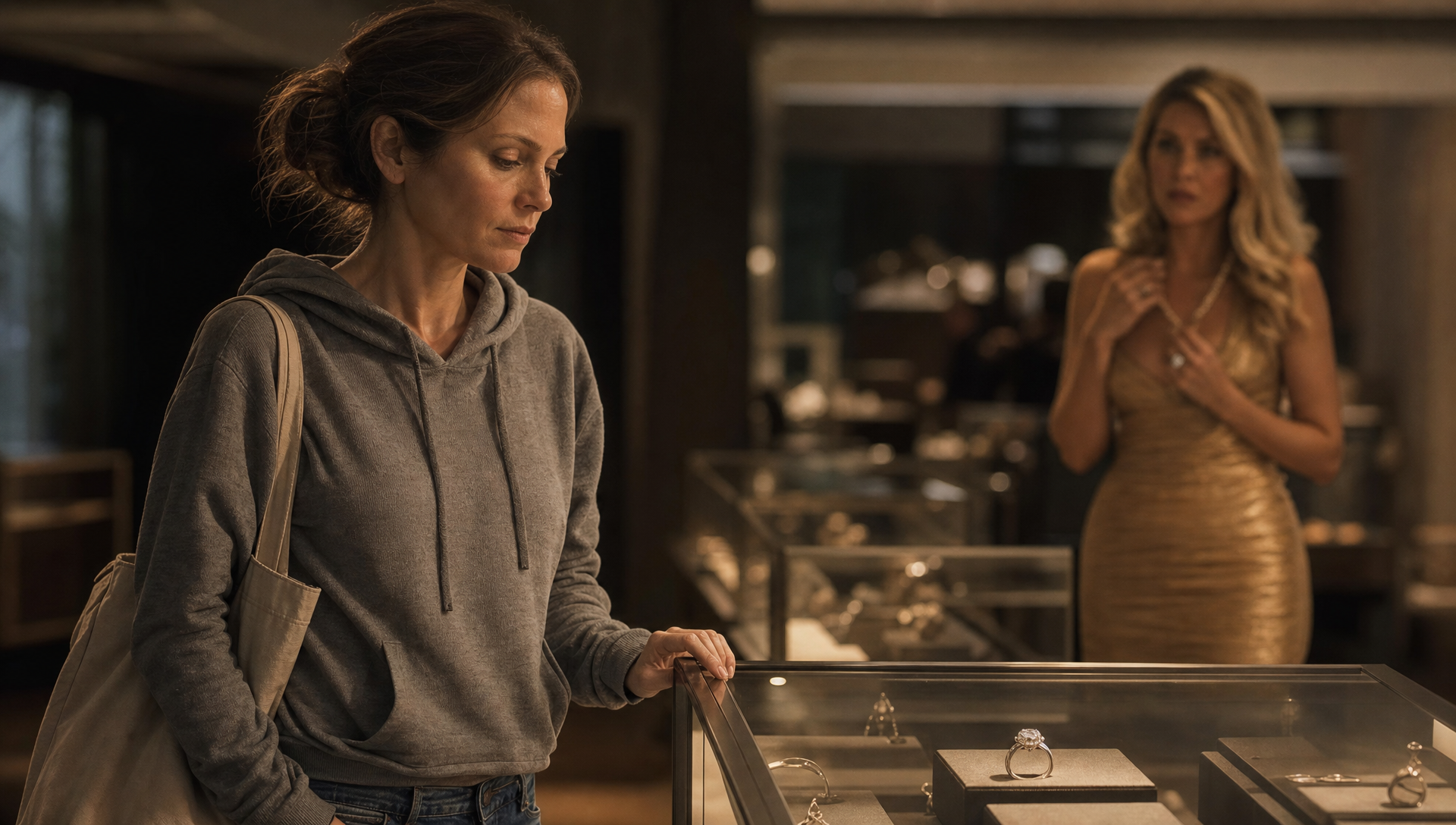
She was wearing jeans, a faded grey hoodie, and sneakers she’d had for two years. A canvas tote on one shoulder — the kind you get free at industry events and keep because it holds a laptop. No jewelry. She never wore the house pieces in public; it felt like advertising, and advertising had always made her vaguely uncomfortable, as though the work should be loud enough on its own.
The cases were even better up close.
She was standing in front of the central piece, noting the way the light caught the rose-gold at precisely the angle she’d hoped, when she heard the voice.
“Elena?”
She knew it before she turned. There was only one person alive who said her name with that exact calibration of warmth and condescension, the two things braided so tightly you almost couldn’t separate them.
Vivienne Laurent stood six feet away in a gold dress that left very little to interpretation — fitted from shoulder to mid-thigh, the kind of dress that announces itself before the person wearing it has said a word. Her hair was blown out in that particular way that takes ninety minutes and is supposed to look effortless. Her left hand rested at her side at a deliberate angle, the ring catching the store lighting exactly as intended.
The man beside her was tall, conventionally handsome, wearing a suit that was brand new and trying very hard. He looked at Elena — at the jeans, the hoodie, the canvas tote — with the polite blankness of someone who has decided, in under two seconds, that she was staff.
“Vivienne,” Elena said. “It’s been a while.”
“Years.” The brightness was a performance. Elena had known her long enough to read what was underneath it. “What are you doing here? Did they let you in through the service entrance?”
The man beside her made a sound that was almost a laugh. Not quite — he had enough sense for that — but almost.
Elena said nothing.
Vivienne glanced at the cases, then back, and did the thing she had always done — the small, practiced survey, eyes moving from hoodie to sneakers to bare neck, two seconds that communicated a full paragraph. “I’m kidding,” she said, which was how she had always followed things she was not kidding about. “You look —” A pause, chosen carefully. “Comfortable.” She turned to the man. “This is Elena. We grew up in the same neighborhood.” Another pause, one beat too long. “She’s an old friend. But poor.”
The four words landed in the air and stayed there.
The man blinked. His smile tightened into the expression people produce when they want to seem kind without committing to anything.
Elena looked at Vivienne. She thought of several things she could say, catalogued them quickly, and chose none of them. She was forty-one years old and had not been in the habit of defending herself to Vivienne Laurent since approximately age nineteen, when she had understood that the defense was what Vivienne was actually after — the reaction, the flush, the flinch. Remove the reaction; remove the reward.
“Good to see you,” Elena said. And turned back to the cases.
Behind her, she heard Vivienne laugh — small, satisfied, the laugh of someone who believes they’ve just landed something clean — and then the sound of two sets of footsteps moving away, already certain they had won.
Elena studied the rose-gold setting and said nothing.
She was still looking at it thirty seconds later when she heard Marcus.
She recognized his footsteps before she saw him — nine years, and she had learned the rhythm of his walk, the particular quality of silence that preceded him when he was moving with urgency. Marcus Chen, store manager of the Meridian flagship, who had been with the company since the second expansion and who was one of the three best managers in the entire network, approached at a pace that was professional speed without technically being a run.
“Director Vasquez.” He was slightly out of breath. He made a small bow — she had asked him, on multiple occasions, not to do this; he did it anyway, apparently stitched into his professional constitution. “I’m so sorry — we didn’t know your arrival time, we’d have had the back suite prepared —”
“It’s fine, Marcus. I just stopped to see the cases.”
“Of course. Of course.” He was visibly recalibrating, trying to balance deference and professionalism, which produced in him a particular anxious efficiency she had come to find almost endearing. “The Geneva pieces arrived yesterday. The central rose setting — the proportions came out exactly as you specified. We’ve already had three serious inquiries in the first twenty-four hours.”
“I saw it from the street,” she said. “The lighting is right.”
“Chen adjusted the angle twice before he was satisfied. He sends his regards.”
The store had gone quiet.
Not silent — there was still music playing softly, still the ambient hum of climate control, still the distant murmur of other transactions in other corners. But a different kind of quiet had descended over the central floor. The kind that happens when enough people in a room simultaneously realize that something worth watching is occurring.
Elena became aware of it the way she became aware of most things — precisely, and without drama.
She turned.
Vivienne was standing perhaps twenty feet away, holding a necklace that a young associate had been showing her. The necklace was no longer receiving any of her attention. The man beside her had gone very still. Both of them were looking at Marcus — at his posture, at the word he had just used, at the way he stood relative to Elena.
Director.
Elena watched the calculation happen in Vivienne’s face. It was not a fast calculation. That was perhaps unkind to observe, but it was accurate.
“Elena.” Vivienne’s voice had changed entirely. The practiced warmth was gone. Something thinner and less certain had replaced it. She set the necklace down on the case — the associate made a small involuntary movement toward it — and took two steps forward. “I didn’t — we were just —” She stopped. Collected herself. Deployed the smile that had worked since school, the one that assumed forgiveness as its premise. “It’s so wonderful, honestly, what you’ve built. We should catch up properly sometime.”
Elena looked at her for a moment.
Then she looked at the man beside her, who had the expression of someone performing very rapid mental arithmetic about professional consequences.
“You were looking at rings?” Elena asked him. Her voice was completely even.
He nodded. A single, reflexive motion.
“The Meridian cut in the third case,” Marcus offered, quietly. “We’d been preparing a presentation for the Greystone client —”
“Yes.” Elena turned to Marcus. “Cancel the transaction.”
The silence that followed had a different quality than the one before it. This one had edges.
“You can’t do that.” Vivienne’s voice sharpened. The social performance was gone now, replaced by the real thing underneath. “I’m a customer. I have money. I’ve spent thousands in your stores —”
“You have,” Elena agreed. She said it without heat, without satisfaction, without any of the things Vivienne was visibly waiting for. Just acknowledgment, the way you acknowledge a gemstone’s carat weight — noted, factual, and not particularly interesting. “That’s noted.”
“Then you can’t just —”
“This store bears my family’s name,” Elena said. “My father and I built it when I was twenty-three, on the back of a restaurant receipt, arguing about sightlines and ceiling height and what light does to color. Every branch we’ve opened — here, the Chicago location, the Hong Kong store — operates by one first principle.” She paused. “We don’t sell to cruelty. Not because cruelty can’t afford us. Because we don’t want to.”
Vivienne stared at her. “Because of what I said? That was a joke —”
“It wasn’t,” Elena said. Simply. Not angrily. Not with the relish of someone finally winning an old argument. Just as a statement of observable fact, the way you state that the setting is rose gold or the stone is pear cut. “It wasn’t a joke, and we both know it. I’m not interested in a conversation about whether it was.”
She turned to Marcus. “Extend the cancellation to a network hold. Both names, all locations.”
The man in the new suit had been backing away incrementally — the movement of someone hoping not to be noticed while retreating. He had released Vivienne’s arm at some point in the last two minutes. His face had gone through several colors and arrived at a drained, blank white.
“Elena,” he said. “I didn’t say anything. I wasn’t part of —”
“You laughed,” she said, without turning to look at him. “Small, but I heard it. People always think the small laugh doesn’t count.”
She turned back to Marcus. “The rose-gold setting — put it in the catalogue under the Geneva collection name, not my approval note. I don’t want my name on the tags. Just the atelier.”
“Understood, Director.”
“And the lighting in the east case needs to go up three degrees. The color temperature is reading too cool for the yellow-gold pieces.”
“I’ll have Chen look at it this afternoon.”
“Thank you.” She looked around the room — at the cases, the pieces, the space she and her father had designed when she was twenty-three and the company was one location and a set of hand-drawn diagrams. The two of them arguing happily about sightlines on a Tuesday evening in a Vietnamese restaurant, drawing on the back of the receipt because he didn’t have paper and she’d said use the receipt, it’s flat enough. She took the room in. “It looks good, Marcus. The team did well with the installation.”
“We’re proud of it,” he said. He meant it.
She did not watch Vivienne leave.
She heard, from Marcus at four o’clock, that it had been quiet — no further scene, no dramatic exit. Just the muted, deflated departure of someone from whom all the air has gone out. No statement, no parting words. Just the door.
The man in the new suit left separately. A side entrance. He didn’t look back.
Marcus sent her the formal summary of the network hold at four, as she had requested — both names, registration details, a confirmation note that all branch managers had been informed through standard protocol. Clean, efficient, thorough. She signed off and moved on.
At five-thirty she had a call with the Geneva atelier. The designer — a meticulous, passionate woman in her sixties who had been working in jewelry since before Elena was born — wanted to discuss a return to simpler settings for the next seasonal collection. Less architectural, more intimate. Elena listened carefully, asked three questions, said she trusted the instinct, and told her to send the first sketches when they were ready.
She stayed in the suite until seven. The building settled around her the way buildings settle when the working day is done — small adjustments of a structure that has been holding people all day and can finally relax. She had always liked this hour.
When she left, she took the side exit through the courtyard, so she could walk past the pear tree. It had been there before the renovation, before the expansion, before the building had become what it was. She had kept it through three rounds of redesign because she liked it, which was the only reason she had needed to give, and had given.
It was bare-branched now, minimal against the last of the evening light, doing nothing demonstrative, simply present in the cold air.
She put her hands in her hoodie pocket and walked home.
Across the city, in a restaurant he had booked for an occasion that had not materialized as planned, the man in the new suit sat alone at a table for two and looked at the menu and understood — in the specific, clarifying way of a consequence fully arrived — that certain decisions leave marks that no amount of rapid arithmetic can undo.
He had laughed. Small, but she had heard it.
And somewhere, Vivienne Laurent was turning the same four words over in her mind — an old friend, but poor — and understanding, for the first time, that the cruelty had never pointed outward.
It had been inside herself. It had always been inside herself. She had simply walked into the right room for it to finally show.
Elena walked home in her faded grey hoodie. She was thinking about the rose-gold setting, and the proportions, and whether the next collection should go simpler, and the pear tree bare in the courtyard, and her father’s handwriting on the back of a restaurant receipt, and everything still ahead.
Original fictional stories. AI-assisted creative content.