Margaret hadn’t slept.
She’d spent the night replaying it — the crash of the tray, Mr. Blake’s voice cutting through the kitchen, his finger pointed straight at her. Twenty-two years. Twenty-two years of early mornings, of remembering how every regular took their coffee, of covering shifts nobody else wanted. Gone in sixty seconds.
Charlie knew something was wrong before she even put on her coat.
He’d pressed his body against her legs all morning, following her from room to room, his ears low, his dark eyes tracking her every move. When she finally sat on the edge of the bed and stared at the wall, he climbed up beside her and laid his head across her lap.
“It’s okay, boy,” she said, though her voice cracked on the last word.
He didn’t believe her. She could tell.
Arthur Reeves had heard about it through Jimmy, who’d heard it from the delivery guy who serviced Blake’s restaurant. That’s how it worked in their world — word moved fast, loyalty moved faster.
He’d called a meeting at the garage that same night.
“Margaret Chen?” he’d said, holding up his phone, a photo of her on the screen — a news clipping from four years ago, some community fundraiser. “Small woman, gray braid, works the lunch counter at Blake’s on Fifth?”
Six faces nodded around him. He didn’t need to say anything else.
They left at nine the next morning, twelve bikes, two cars, Charlie riding shotgun in Arthur’s cab, his nose pressed to the gap in the window the whole drive.
The restaurant door opened at 9:47 a.m.
Charlie went in first.
He moved slowly, deliberately, his body low and alert. He scanned the room once, sniffed the air, then turned back to check on Margaret. Only when she stepped inside did he move forward again, positioning himself slightly ahead of her, his tail low but steady.
The room went quiet the way rooms do when something shifts in the air.
Forks stopped moving. Conversations dropped to nothing. Three servers clustered near the kitchen doorway. A busboy in the back froze with a rack of glasses halfway to the shelf.
Arthur and the others filed in behind them. The sound of their boots on the tile was slow and deliberate, twelve sets of footsteps in no particular hurry.
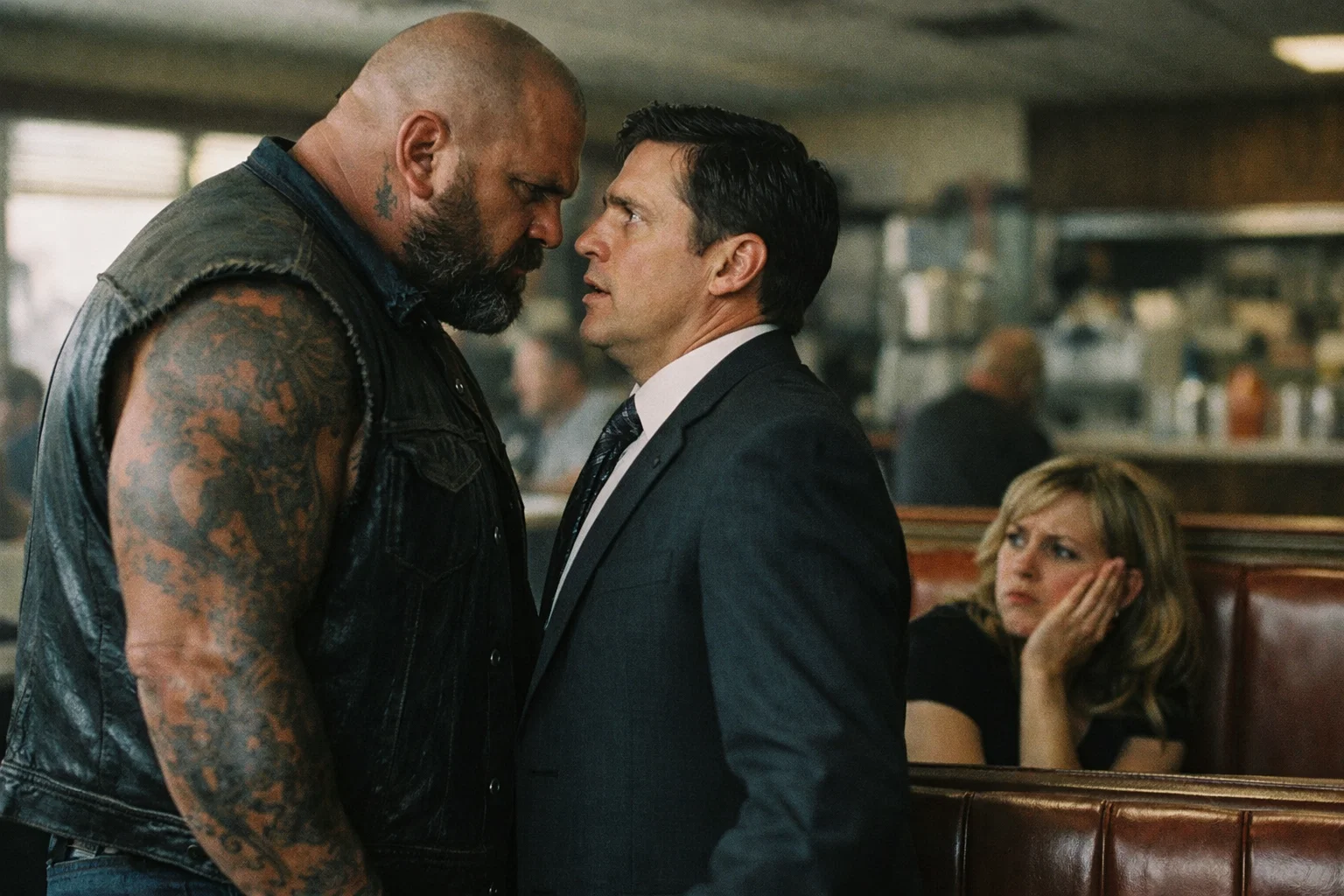
Edward Blake appeared from his office within seconds. His face was composed, but his jaw was tight.
“What is this?” he asked, voice even.
“A conversation,” Arthur said. “That’s all.”
Blake’s eyes moved to Margaret, then to the dog, then back to Arthur. “I run a business. Whatever grievance you think you have—”
“Twenty-two years,” Arthur said.
Blake blinked.
“Twenty-two years, no write-ups, no complaints, three employee-of-the-month plaques still hanging on your wall.” Arthur nodded toward the far wall where the framed photos lined up. “She broke a tray she never touched, and you fired her in front of the whole lunch crowd without pulling a single second of footage.”
“The cameras,” Blake started, “were—”
“Working,” said a voice from the back.
Everyone turned.
Emily Carr was standing near the kitchen pass-through, her order pad in her hand. Her face had gone the color of copy paper. Her eyes were red, swollen at the edges like she’d been crying since yesterday.
She took one step forward.
Then another.
Charlie watched her. He didn’t move — just watched, his head tilting slightly to one side.
“Mr. Blake.” Emily’s voice was barely above a whisper. “It was me. I dropped the tray.”
The room held its breath.
“I was carrying two at once — I knew I shouldn’t have, but we were slammed and I didn’t want to make another trip. The edge caught the corner of the counter and it went down and—” Her voice broke. “And you were already in the dining room and you looked so angry and I just… I panicked. I went back to my station and I let you think it was Margaret.”
The silence that followed was the heaviest kind.
Blake’s face had shifted from controlled to something much harder to read — a man watching the floor he’d built start to crack beneath him.
“Why,” he said slowly, “are you telling me this now?”
Emily looked at Margaret. Her chin trembled.
“Because I’ve been throwing up every morning since I did it.”
Charlie left Margaret’s side then. He crossed the room quietly, stopping a foot in front of Emily. He sniffed her hands once, twice. She didn’t move. Then, slowly, he wagged his tail — just once, just enough.
Margaret exhaled.
“Emily,” she said gently. “Come here.”
The young woman crossed the room in three steps and started crying the moment Margaret put a hand on her shoulder. “I’m so sorry. I’m so sorry. I should have said something right away, I don’t know why I—”
“You were scared,” Margaret said. “I know.”
Arthur looked at Blake. “This is what fear does in a workplace. It makes people quiet. The honest ones get destroyed. The frightened ones get buried. You built that.”
Blake didn’t argue. He stood very still for a long moment, and when he finally spoke, his voice had lost its boardroom edge.
“Ms. Chen.” He cleared his throat. “I was wrong. I moved too fast and I didn’t give you a fair hearing, and I’m sorry.” A pause. “Your position is open. Full back pay for the time missed. Whatever you need.”
A low murmur of approval moved through the room.
Margaret didn’t answer right away. She looked down at Charlie, who had returned to her side and was leaning his full weight against her leg.
“I’ll consider it,” she said finally. “But if I come back, things run differently here. Emily keeps her job. And the next time something breaks, we look at the cameras first.”
Blake nodded. “Agreed.”
“All of it.”
“All of it,” he repeated.
Arthur waited until Blake had returned to his office before he spoke again. He turned to Margaret and lowered his voice.
“There’s something else. Something I should have said a long time ago.”
She looked at him.
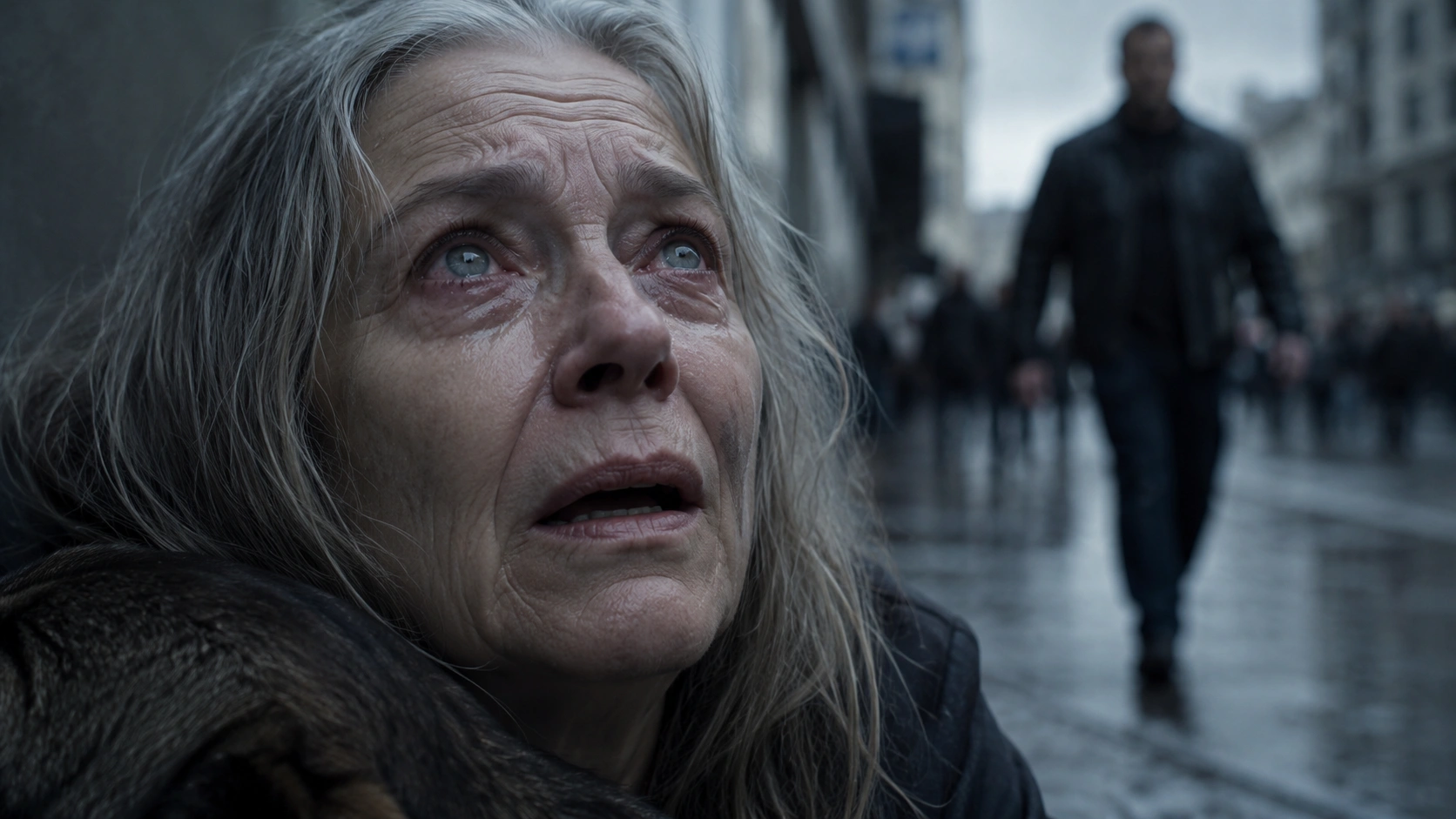
“About eleven years ago,” he said, “there was a guy who used to come around the back of this building on Thursday nights. Late. After close. He was in rough shape — dirty jacket, hadn’t eaten in a while. He had a little white dog with him. Puppy, really. Maybe four months old.”
Margaret’s eyes changed.
“The woman who worked the late counter used to leave soup out. Never asked questions. Just — soup, and sometimes bread, and one time a whole piece of pie wrapped in foil.” He paused. “She told him once that being at the bottom wasn’t a permanent address. That you could leave whenever you decided to.”
Margaret’s hand was over her mouth.
“That was you,” she said.
“That was me.” Arthur glanced down at Charlie. “And that was him.”
Charlie looked up at Arthur. Then he walked over and pressed his nose gently against the man’s hand.
Arthur’s throat moved. He crouched down, eye-level with the dog, and for a moment didn’t say anything at all.
“I’d been on the street fourteen months,” he finally said, standing back up. “That night was the first time in over a year that I ate sitting down at an actual table. I didn’t even realize how much that meant until the next morning.” He looked at Margaret directly. “You didn’t save my life. But you reminded me it was worth saving.”
Margaret was quiet for a long time.
Behind Arthur, several of the other bikers were nodding. One of them — a heavyset man named Victor with silver at his temples — spoke up.
“Soup kitchen on Morrow Street. She used to volunteer there on weekends. I ate there three winters in a row when I had nothing.”
Another: “She testified at my brother’s hearing. Told the judge he’d been a decent kid. Judge gave him probation instead of time.”
Another: “She found my mom a shelter bed when the one she was in got shut down.”
Margaret stood in the middle of these men and their stories, her hand on Charlie’s back, and said nothing for a while.
“I didn’t know any of you remembered,” she said finally, her voice thick.
“We didn’t forget,” Arthur said simply.
William Brek — quiet, methodical, the group’s unofficial accountant — pulled a folded paper from his jacket pocket.
“We have a proposal,” he said. “There’s a vacant space on Calloway, two blocks from the shelter district. Rent’s low, the building’s solid. We’ve pooled enough to cover the first year — lease, equipment, renovation.” He held the paper out to her. “It would be yours. A kitchen. Small, but real. Run it the way you want.”
Margaret stared at the paper.
“You can call it whatever you want,” Arthur added. “But we thought maybe Charlie’s Kitchen had a ring to it.”
Charlie barked once, sharp and bright, as if punctuating the point.
The room laughed for the first time all morning.
Margaret laughed too — the kind of laugh that’s also crying, the kind that happens when something that’s been held tight for too long finally loosens. She took the paper. She read it through. She read it again.
“I’ll need help with the permits,” she said.
“Done,” said William.
“And a commercial hood vent. The code requirements are brutal.”
“Victor used to do HVAC,” Arthur said. “He’s already offered.”
She looked around at all of them — these men with their leather jackets and their road histories and their quiet debt — and she shook her head slowly, not in refusal, but in the way a person does when they’ve been handed something they don’t quite know how to hold.
“Okay,” she said.
Charlie sat down at her feet and thumped his tail against the floor three times.
The renovation took six weeks.
Arthur’s crew showed up every Saturday. Victor ran the ventilation. Two of the younger bikers turned out to have done construction work and handled the drywall and tile. Emily came every weekend without being asked, painting, hauling, making coffee runs at midnight.
Charlie was on site every single day.
He appointed himself doorman — sitting just inside the entrance, tail moving in slow, steady arcs as workers arrived. He supervised. He greeted. He occasionally stole sandwiches when left unattended. When Margaret was exhausted and frustrated and ready to give up on a Tuesday when the plumbing backed up and the inspector came back with new requirements, Charlie put his paw on her knee and refused to move until she’d taken a full ten minutes to just sit.
“You’re bossy,” she told him.
He wagged his tail.
Opening day was a Saturday in October.
There was no grand sign, no ribbon-cutting ceremony — just the door propped open at eleven a.m. and the smell of soup moving out onto the sidewalk. A hand-lettered chalkboard on the stoop read: CHARLIE’S KITCHEN — Everyone Eats.
By noon, the line extended half a block.
Margaret moved behind the counter without stopping, ladling, handing plates across, remembering names after the second or third visit, asking after people’s days with an attention that made them feel, at least for that hour, that someone was keeping track of them.
Charlie lay at the end of the counter on a folded blanket, eyes half-closed, watching the room with calm authority.
Arthur arrived at two. He stood in the doorway for a moment, watching her work.
“You’re going to need a second ladle,” he said.
“I already have three,” she said without looking up.
He sat down with a bowl of soup and a piece of bread and didn’t say much. He didn’t need to.
A few minutes later, a teenager came in alone — backpack, eyes down, the particular careful posture of someone who’s learned not to make eye contact. He stopped inside the door like he wasn’t sure he was allowed.
Charlie stood up from his blanket.
He walked directly to the kid and sat down in front of him and looked up.
The teenager blinked. Then slowly, his hand came down. Charlie leaned into it.
“That’s Charlie,” Margaret called from the counter. “He’ll want you to stay.”
The kid sat down.
Margaret put a bowl in front of him before he even looked at the menu.
Edward Blake came in on a Thursday in November, alone, no announcement. He ordered the soup special and paid in cash and left a twenty in the tip jar. He didn’t linger.
But he came back the following Thursday. And the one after that.
One evening he caught Margaret wiping down the counter as the last customers left.
“You didn’t have to forgive me,” he said.
“I know,” she said.
“Most people wouldn’t.”
She set down the cloth and looked at him. “Most people are exhausted from carrying things that were never theirs to carry.” She paused. “You admitted you were wrong. In front of your whole staff. That’s not nothing.”
He nodded slowly. After a moment: “If you ever need anything — equipment, a character reference, whatever — you call me.”
“I know where to find you,” she said.
He left. Charlie watched him go, then looked at Margaret.
“I know,” she said. “I know.”
The kitchen settled into its rhythm.
Emily became the lunch manager. Victor kept the equipment running. Arthur came by every week or two, sometimes with the others, sometimes alone, always staying long enough to eat something and check on the building.
The people who came to Charlie’s Kitchen came for the food, but they stayed for the room — the way it held its noise, the way Margaret remembered your name, the way the dog in the corner looked at you like you’d been expected.
Some of them started helping. A retired teacher ran a GED prep session in the corner on Wednesday mornings. A nurse practitioner came in twice a month with a blood pressure cuff and a quiet manner. A man who’d been laid off the previous spring started running the weekend breakfast shift and turned out to be the best cook in the building.
The city noticed. A reporter came and wrote a short piece. The piece circulated. Donations arrived. Margaret used them to extend the hours.
On the one-year anniversary, Arthur showed up early with a cake — chocolate, not very pretty, clearly homemade.
“Victor made it,” Arthur said. “Don’t ask questions.”
Margaret laughed.
Charlie stood up, sniffed the box, and sneezed.
“He’s a critic,” Emily said.
They ate the cake at the counter before the morning rush, the core group of them — Margaret, Arthur, Emily, Victor, William, two of the other bikers, the retired teacher, the nurse practitioner. Charlie moved between them all, accepting small pieces of cake with absolute dignity.
At some point the conversation paused, the way conversations do when everyone realizes they’ve arrived somewhere.
“You know what I keep thinking about?” Emily said. She was looking at the room, at the morning light coming through the front window, at the empty chairs that would be full in an hour. “That day in the restaurant. When I finally said it.” She paused. “I was so terrified. But then Margaret just said, ‘I know, come here.’ And I thought — she had every reason to be furious, and she just… wasn’t.”
“I was a little furious,” Margaret said.
“You hid it very well.”
“I had twenty-two years of practice hiding things from Edward Blake.”
More laughter. Charlie barked once, agreeing.
Arthur looked at Margaret. “You doing okay? Really?”
She thought about it — not the polite, reflexive answer, but the real one.
“I’m good,” she said. “I’m actually good.”
Charlie put his head in her lap.
She rested her hand on top of it and looked out at the room that had been an empty building fourteen months ago.
Outside, the first customers were starting to gather on the stoop. A man with a cardboard sign and a woman with two kids and a city worker in a reflective vest and an old woman in a green coat and a teenage boy who looked like the same teenage boy who’d come in three months ago and now came every Thursday without fail.
“Okay,” Margaret said, standing. “Let’s open.”
Charlie jumped down from his blanket, shook himself, and walked to the door.
He sat down in front of it, tail sweeping back and forth, and waited.
Margaret unlocked it.
The morning came in.
Original fictional stories. AI-assisted creative content.