The Tuesday night crowd at Sullivan’s was thin. A couple in the back corner split a pitcher. Two regulars argued over the game on the muted TV. Danny wiped down the bar for the fifth time, mostly out of habit.
Then the door pushed open.
A golden-brown dog walked in like he owned the place.
Danny blinked. “Hey — you can’t be in here, buddy.”
The dog didn’t look at him. He moved past the barstools, past the coat rack, past the dartboard, heading straight for one spot like he had GPS.
The stool at the center of the bar.
The worn one. The one Danny had thought about replacing a dozen times and never did.
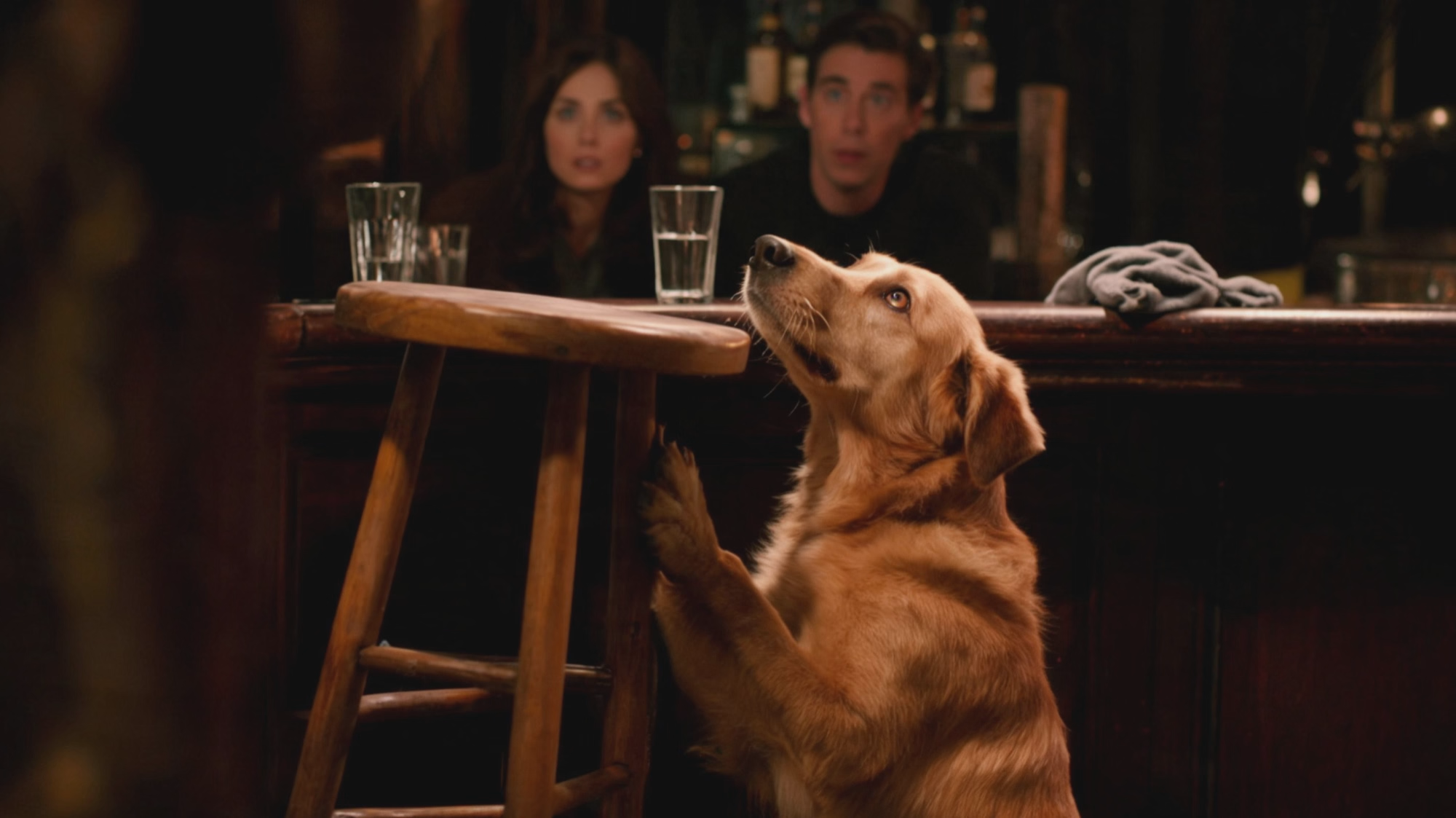
The dog rose up on his hind legs and started clawing at it — fast, desperate, not like a dog begging for food. Like a dog looking for something that should have been there.
“Whoa — hey —” Danny came around the bar. “Easy.”
But the dog looked up at him then. Right at him.
Danny stopped walking.
He knew those eyes. Brown, deep, patient. He had seen them a hundred times resting on a man’s knee while the man talked and the whole bar leaned in without meaning to.
“Oh my God,” Danny said. His hand came up to his mouth.
The couple in the back corner had gone quiet. One of the regulars muted the TV argument mid-sentence.
The dog kept scratching the stool. Short, urgent sounds — not barks. Something closer to crying.
Danny’s eyes were burning. He pressed his knuckles against his lips hard.
Two years. It had been two years since that stool had a regular.
He turned toward the glass door without knowing why.
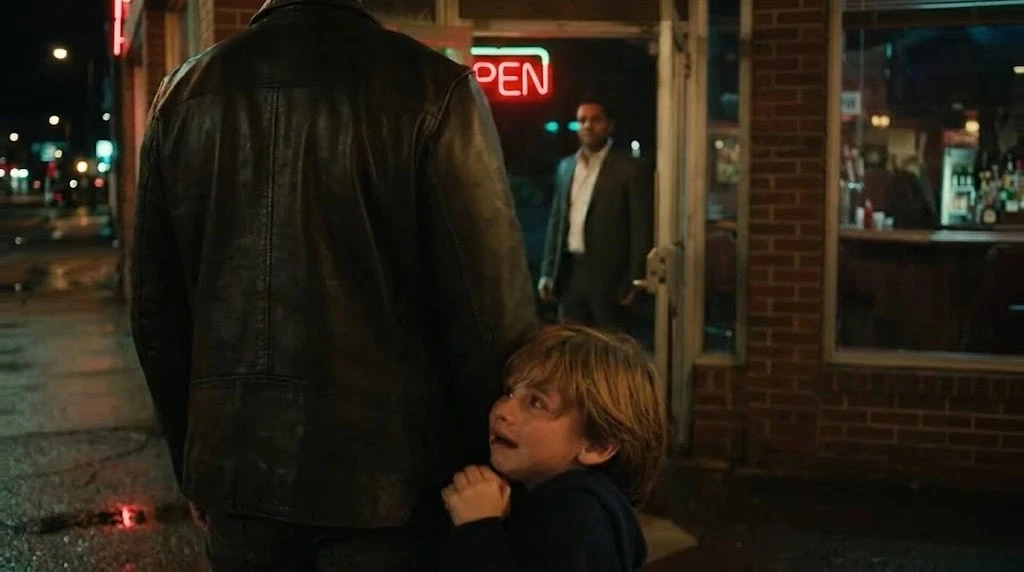
A young man stood on the sidewalk. Maybe twenty-five. Dark coat. He was watching the dog through the glass, one hand pressed flat against it, jaw tight.
Danny crossed the room and opened the door.
“That your dog?” he managed.
The young man exhaled. “He was my father’s.” His voice cracked on the last word. “I took him when Dad passed. I live in Portland now. I’m just in town for the week.”
“What’s his name?”
“Fenwick.” A short, wet laugh. “My dad had a thing for old-fashioned names.”
Danny stepped back. “Come in.”
The second Fenwick heard the young man’s footsteps behind him, he spun around. His tail went nuclear. He launched himself across the floor, nearly took the guy’s legs out, then circled him three times like he was counting to make sure he was real.
The young man dropped to one knee and buried his face in the dog’s neck.
Nobody in Sullivan’s said a word.
When he finally stood up, his eyes were red. He looked at the stool. “He sat there?”
“Every night for six years,” Danny said. “Always ordered the same thing. Always had something worth saying.”
“That sounds like him.”
Danny nodded toward the stool. “Sit down.”
“I don’t want to —”
“Sit down.”
The young man sat. Fenwick pressed himself against his leg, chin on the man’s knee, exactly the way Danny remembered.
Danny pulled out the bottle without asking. Poured a glass.
“What was his drink?” the young man asked.
“Jameson. Neat.” Danny slid it over. “Yours?”
The young man looked at it for a second. “Same.” A half-smile. “Didn’t know that until just now.”
He took a sip. Set the glass down carefully.
“What did he talk about?” he asked.
Danny thought about it. “People, mostly. He had this way of watching someone for thirty seconds and just — knowing something about them. Not in a creepy way. In a way that made you feel like you’d been seen.”
“He did that.” The young man nodded. “He did that with everyone.”
“He told me once —” Danny stopped, surprised the memory was so clear. “He said the best thing a person can do is make someone feel like their story matters. He said that’s the whole job.”
The young man was quiet for a long moment. Fenwick’s tail moved slow and steady against the bar rail.
“He said that to me too,” he said finally. “I thought he meant writing. He was always scribbling in notebooks. I thought it was about writing.”
“Maybe it was about both.”
The young man turned the glass in his hands. Around them the bar had quietly come back to life — low voices, the clink of ice, but softer now, like people were trying not to break something.
“I’m Marcus,” he said.
“Danny.”
They shook hands across the bar.
“I didn’t come in here on purpose,” Marcus said. “Fenwick just — stopped. Wouldn’t move. Then he went straight for the door.” He shook his head. “Two years, and he remembered.”
“Dogs remember what matters.”
Marcus looked at the stool beside him. The empty one. He put his hand on it for a second, then pulled it back.
“I’ve been trying to figure out what to do with all his stuff,” he said. “The notebooks mostly. There are forty of them. I don’t know if I should try to do something with them or just —” He exhaled. “I don’t know.”
“What’s in them?”
“Stories. Observations. People he met. Things he overheard.” Marcus almost smiled. “This place is in at least three of them.”
Danny looked down at the bar. He cleared his throat. “Then they matter.”
“Yeah.” Marcus picked up his glass again. “Yeah, I think you’re right.”
They stayed another hour. Marcus talked. Danny listened. Fenwick stayed pressed against Marcus’s leg the entire time, eyes half-closed, tail moving in slow, peaceful sweeps.
At some point one of the regulars drifted over and started listening. Then the couple from the back corner.
Nobody introduced themselves. Nobody had to.
When Marcus finally stood to leave, Danny came around the bar.
“You said you’re here for the week?”
“Through Sunday.”
“Come back.”
Marcus looked at the stool. At Danny. At the room that had quietly gathered itself around him without making a fuss about it.
“Yeah,” he said. “I will.”
He walked to the door. Fenwick followed, then paused at the threshold and looked back at the bar — at the stool, at the warm amber light above it.
One long look. Like a period at the end of a sentence.
Then he walked out with Marcus.
Danny watched them go down the sidewalk. He stood there until they turned the corner.
Then he went back behind the bar, picked up the glass Marcus had left, rinsed it slow, and set it upside down in exactly the right place.
Ready for tomorrow.
Original fictional stories. AI-assisted creative content.