The ballroom was the kind of place that made people feel small unless they were born to it.
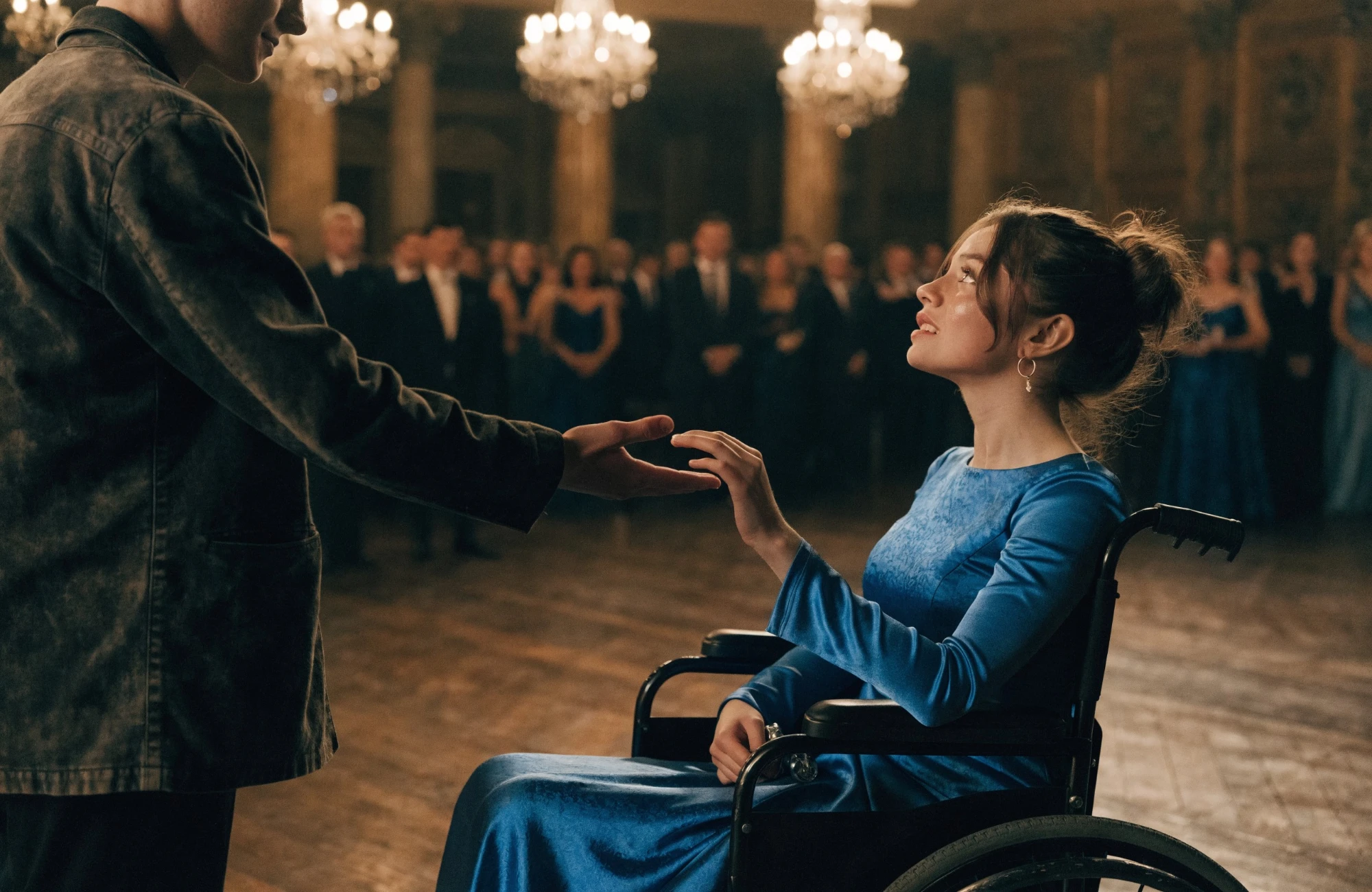
Chandeliers cast amber warmth across four hundred guests. Silk gowns, tailored jackets, champagne flutes catching the light. The kind of gathering where silence itself had a dress code.
Eleanor sat near the center of it all, in her wheelchair, in her blue dress, watching.
She’d learned to watch instead of want. It was easier.
Her father, Richard Hargrove—the kind of man whose handshake opened doors and closed arguments—stood two steps to her right, talking to Senator Aldridge about something that would matter to them both and no one else.
Eleanor traced the rim of her glass.
She was twenty-three years old, and she could not remember the last time someone looked at her like she was going somewhere.
Then the doors opened.
Not with fanfare. Not with announcement.
Just—open.
And the boy walked in.
He wasn’t a boy, exactly. He was her age, maybe a year older. But something about him looked young in the way that hardship makes people look—like he’d been weathered from the outside and kept something clean on the inside.
His clothes were wrong for the room. Dark jacket, worn at the cuffs. Shoes that had walked real distances. No tie. No invitation, she guessed.
He didn’t look lost.
That was the first thing she noticed.
He looked like he’d been here before.
“Richard.” Senator Aldridge’s voice dropped slightly as the boy crossed the floor.
Her father turned. His eyes found the intruder, sharpened.
The boy walked straight to Eleanor.
Not the bar. Not the host. Not anyone else in the room.
Her.
He stopped three feet away and looked at her—not at the wheelchair, not past it—just at her face.
“I’d like to dance with you,” he said.
The words landed so plainly it took a second for anyone to process them.
Eleanor’s lips parted.
Her father stepped forward.
“Excuse me.” Richard’s voice was blade-flat. “Do you know where you are?”
“Yes,” the boy said.
“Do you have an invitation?”
“No.”
Richard Hargrove was not a man who laughed at audacity. But something about the boy’s stillness—the complete, undefended calm of him—made the usual toolkit feel useless.
“Do you even know who she is?” Richard asked.
“I know she wants to dance,” the boy said.
A few guests drifted closer, sensing something unscripted in a room built on scripts.
“That’s not your determination to make,” Richard said. “She hasn’t—”
“Dad.” Eleanor’s voice was quiet.
Both men looked at her.
She was looking at the boy.
Something was pulling at the edge of her memory. Not an image. Not a name. Just a feeling—like the ghost of a sound she’d heard as a child, something she couldn’t place but couldn’t dismiss.
“What’s your name?” she asked.
“Caleb,” he said.
The word landed somewhere old inside her.
She shook her head slightly. “I don’t know you.”
“You do,” he said. Not pushback. Not performance. Just fact delivered gently. “You’ve just spent years learning how to forget.”
Her father’s hand found her shoulder. “Eleanor, you don’t have to engage with—”
“He’s right,” she said.
Her father went still.
She looked down at her hands. At the small silver pendant she’d been turning between her fingers for the last hour—a habit she hadn’t even noticed until this moment. A crescent moon. Tiny. Worn smooth on the back from years of touch.
She looked up at Caleb.
“You had the other one,” she said.
He reached into his jacket pocket.
He held it out.
The same pendant. A sun. Worn smooth on the back.
The two halves of a set.
She’d had the moon since she was eleven years old. She’d never once been able to remember where it came from.
“We were kids,” she said softly.
“Summer camp,” he said. “Lake Arrowood. You were twelve. I was thirteen. We danced at the last-night bonfire and you laughed so hard you stepped on my feet twice and didn’t apologize once.”
A sound came out of her—not quite a laugh, not quite a sob.
“I don’t—I was in an accident. When I was sixteen. I lost—there were gaps—”
“I know.” His voice didn’t soften into pity. It stayed level. Warm. “I looked for you after. For a long time.”
Her father’s face had gone through several iterations of emotion that he’d suppressed out of decades of practice. Now he was simply watching.
“This isn’t possible,” he said—but the authority had drained from it. “You couldn’t have just—walked in here—after all this—”
“I saw her name on the event announcement,” Caleb said, still not looking away from Eleanor. “I was outside for forty-five minutes trying to figure out if it was a terrible idea.” A pause. “Still not sure it wasn’t.”
That got her.
She laughed.
Real. Bright. Unexpected.
Several guests blinked.
Richard Hargrove blinked.
He hadn’t heard that laugh in a long time.
Caleb held out his hand.
Not grand. Not dramatic. Palm up, offered, unhurried.
“You don’t have to,” he said. “I just wanted you to know that someone remembered.”
Eleanor looked at his hand for a long moment.
“The music stopped,” she said.
“I know.”
“There’s four hundred people watching.”
“I know.”
She put her hand in his.
What happened next would get described differently by everyone in the room, depending on who they were and what they needed to believe.
What Richard saw was his daughter—who hadn’t taken an unassisted step in seven years—shift her weight forward in her chair. He saw her legs make contact with the floor. He saw her rise—not fully, not perfectly, not without trembling—but rise.
What the guests saw was something that violated the predictable choreography of the evening completely.
What Eleanor felt was something she had no adequate language for.
It was like hearing a song you didn’t know you’d memorized. Your body knows the next note before your mind does. Your feet find the rhythm before your thoughts arrive.
She wasn’t standing. Not really. She was leaning—into him, into the memory, into some stubborn signal her body had been sending for seven years that no one had known how to receive.
But she was moving.
Three steps. Maybe four.
The room had gone funeral-quiet.
Her father’s hand was pressed to his mouth.
And then—slowly, as gently as it had begun—her body reached its limit.
Caleb felt it before she said anything. He guided her back, lowered her into the chair without a word, without a fuss, without making it into something tragic.
“Thank you,” she whispered.
“You did that,” he said.
The room exhaled.
Several people were crying—the kind who would have been embarrassed to admit it thirty seconds earlier and now weren’t bothering to hide it.
Richard Hargrove stepped forward.
He was a man of resources and leverage and carefully maintained control.
Right now, he didn’t know what he was.
“How long?” he asked. “How long have you been looking?”
Caleb turned to him.
“Seven years,” he said. “Took me a while to save enough to make it across the country.”
Richard stared at him.
“You have nowhere to stay.”
It wasn’t a question.
“I have a car,” Caleb said.
Something passed over Richard’s face—something complicated and hard-earned, the expression of a man revising a conclusion he’d held for a long time.
He put out his hand.
“You’ll stay with us,” Richard said. “Tonight. And we’ll talk.”
Caleb looked at Eleanor.
She nodded once.
He shook her father’s hand.
Later—much later, after the ballroom emptied and the staff began their quiet work of disassembly—Eleanor sat by the tall windows with both pendants in her palm. The moon and the sun. Halves of a set that hadn’t been whole for eleven years.
Her father sat beside her in uncharacteristic silence.
“I kept the moon all that time,” she said. “I didn’t even know why.”
“You always wore it when you were a child,” he said quietly. “After the accident—when you couldn’t remember—you still reached for it. Every single morning.”
She closed her fingers around both pendants.
“He didn’t give up,” she said.
“No.”
“You would have turned him away.”
Richard was quiet for a moment.
“Yes,” he said. “I would have.”
She looked at him.
“But you didn’t.”
He met her eyes.
“No,” he said. “I didn’t.”
It was as close to an apology as Richard Hargrove had come in thirty years. Maybe the closest he was capable of. But Eleanor had learned—slowly, in the years of stillness the accident had forced on her—to hear the things her father couldn’t say out loud.
This was enough.
She looked out the window.
In the glass, she caught a faint reflection—her own face, finally resting. Behind her, the last of the ballroom lights dimming.
And she could have sworn—just for a moment—she saw two children in that reflection.
Dancing barefoot around a bonfire, laughing.
Then the light shifted.
And she was herself again.
Older. Seated. Holding both halves of something she thought she’d lost forever.
Whole.
Original fictional stories. AI-assisted creative content.