They called me Maid Number Seven.
Not Clara. Not even “the new girl.” Just a number on a staff rotation sheet pinned to the kitchen bulletin board.
I had been assigned to the Ashford estate for two years, three months, and eleven days. I knew every crack in the marble, every cigarette burn hidden beneath the Persian rugs, every secret whispered behind closed doors.
They thought I was invisible.
They were wrong.
The morning it all collapsed started the same way every morning started — with Madam Madeline at her vanity, and me standing two feet behind her left shoulder like a human coat rack.
“Closer,” she said, without looking up.
I stepped forward.
She was fastening the clasp on her pearl earrings, adjusting the angle of each one with the focused precision of a woman who had never tolerated anything less than perfection. The golden light in the room made her look almost divine.
Almost.
“Hand me the brush.”
I reached across. And that was when the collar of my uniform shifted.
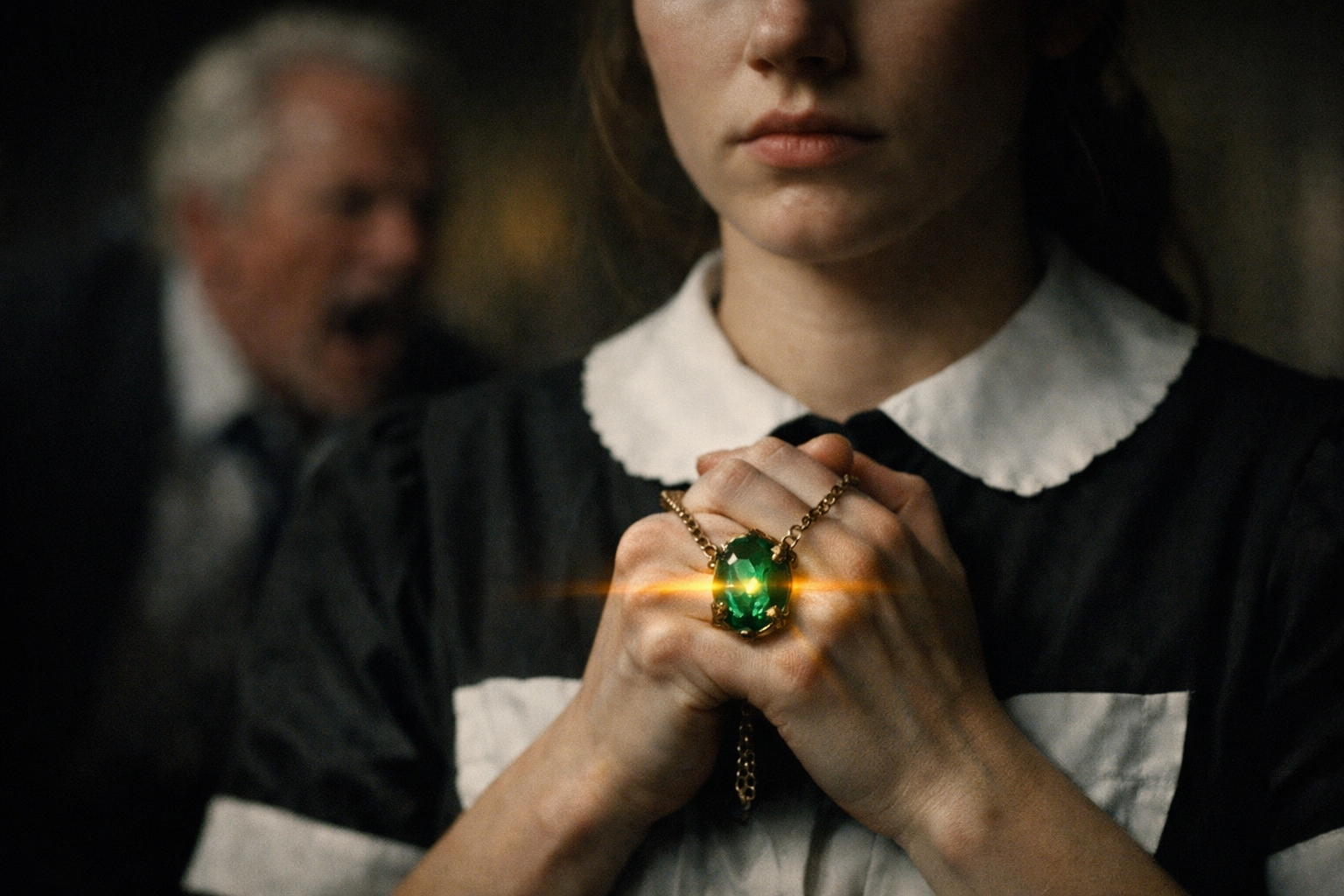
The chain slipped out.
One inch. Maybe two. Just enough for the emerald to catch the light.
Madeline’s hands went still.
In the mirror, I watched her eyes lock onto it — that deep, cold green — and something ancient and terrible moved across her face.
“What,” she said quietly, “is that.”
It wasn’t a question.
She was out of the chair before I could answer.
Her grip closed on my shoulder with a strength I didn’t know she had, yanking the necklace into the light. The chain bit into my neck. I gasped.
She didn’t flinch.
She was staring at the emerald the way you stare at something you buried and never expected to see again.
“There were only two in existence,” she whispered.
“I didn’t steal it.” My voice came out smaller than I wanted. “I swear to you, I didn’t—”
“WHERE DID YOU GET THIS?”
“A nun gave it to me.”
Silence.
“At Saint Brigid’s Orphanage,” I said. “When I aged out of the system. She said — she said my birth parents left it. That it was the only thing they left behind.”
The room went completely quiet.
Madeline let go of the chain. Not gently. Her hands were shaking too hard to hold on.
She stood there for a long moment, her back to me, her shoulders rising and falling with slow, controlled breaths.
Then she walked to her wardrobe.
Pulled out a crimson velvet box.
Opened it.
Inside, lying on a bed of dark silk — was a necklace identical to mine. Same chain. Same cut. Same weight. The same thin, winding engraving etched into the back of the setting, worn smooth by years of quiet touching.
She lifted it with both hands and held it next to mine.
Two halves of a story neither of us had been allowed to finish.
I couldn’t breathe.
“Twenty-two years ago,” I said slowly, “the sisters told me I was left at the orphanage as an infant. No name. No records. Just this necklace, and a note that said to keep it safe.”
Madeline’s chin dropped to her chest.
“They told me,” she said, her voice cracking down the middle, “that one of my daughters didn’t survive the night.” A sob broke through. “They said it was a fever. They said they’d already arranged the burial. They wouldn’t let me see—”
She couldn’t finish.
“Then you are my—”
The bedroom door flew open.
“Madeline.” Arthur Ashford filled the doorframe, his voice carrying the comfortable authority of a man who had never once been told no. “What is all this shouting about?”
He stepped inside.
His eyes swept from his wife’s tear-ruined face, to the velvet box, to me — and landed on the emerald at my throat.
Every drop of color left his face.
For one moment, he looked like a man standing at the edge of a cliff he’d spent twenty-two years telling himself didn’t exist.
Then the smile came.
Slow. Manic. Calculating.
And my blood went cold.
“Arthur.” Madeline raised the second necklace with a trembling hand. “Look at this. The maid — she has—”
“She’s a thief.”
His voice was calm now. Completely controlled.
He crossed the room in four long strides, his fingers reaching for my chain. “You snuck into my private study. You stole a family heirloom. I am going to have you arrested, and you will spend the next several years learning what poverty actually—”
“Don’t touch me.”
I stepped back.
I don’t know where the steadiness in my voice came from. But it was there.
“I have worn this necklace my entire life,” I said. “The Mother Superior at Saint Brigid’s watched over it for me from the day I was brought in until the day I left. You can call the police. Please. Call them.”
“Madeline.” Arthur turned to his wife with a practiced look of pained patience. “Are you seriously entertaining this? Look at her. She’s a household employee. She saw an opportunity and she took it. You know how these situations—”
“How these situations what?” Madeline’s voice had dropped to something dangerous.
“I’m trying to protect you, darling—”
“Stop calling me that.”
She turned back to me. And in her eyes I saw it — the flicker of a woman who had been told what to believe for so many decades that she’d almost forgotten she had her own mind.
“Maybe,” she said slowly, “maybe he’s right. Maybe there’s an explanation we’re not—”
“Exactly.” Arthur pulled out his phone. “I’ll call the precinct. This will be resolved in an hour.”
“Call them,” I said.
He looked up.
I reached into the deep pocket of my apron and pulled out a folded piece of paper sealed in a clear plastic sleeve — yellowed at the edges, the ink faded but perfectly legible.
“This is an original birth certificate,” I said. “It documents the transfer of ‘Infant Female, Number 2, Ashford’ to Saint Brigid’s Orphanage. It includes a twenty-thousand-dollar donation to the facility, listed as — ” I turned it slightly so he could see — “a ‘charitable gift to ensure discretion.'”
I paused.
“Your signature is on line eleven.”
The phone hit the marble floor.
Arthur didn’t move to pick it up.
Madeline crossed the room in three steps and took the document from my hands. Her eyes moved across the faded ink — slowly at first, then faster, until they found the signature at the bottom.
His handwriting. Unmistakable.
“You told me she died.” Madeline’s voice had gone somewhere far away. “You held my hand in the hospital and you told me she caught a fever and she was gone before morning.”
“Madeline, listen—”
“You told me there was a grave.”
“The inheritance structure would have — Madeline, your father’s will specified—”
“You sold her.” The word came out like something physical. “You sold our daughter to an orphanage so you wouldn’t have to split the estate.”
“It wasn’t like—”
“You made me grieve a child who was ALIVE.”
SMACK.
The slap hit him so hard his head turned. A thin line of blood appeared at the corner of his mouth.
He stumbled back against the mirrored vanity, knocking perfume bottles to the floor, hands raised — the practiced authority suddenly, completely gone.
“I will call my lawyers tonight,” Madeline said, and her voice was the quietest it had been since the door opened. “By tomorrow morning, every account you have access to will be frozen. Every asset you acquired through this marriage will be contested. I will take this document, and this birth certificate, and every piece of evidence that exists — and I will make sure that everyone who matters in this city knows exactly what kind of man you are.”
“Madeline, we have been married for—”
“Get out of my house.”
He opened his mouth.
“This estate belongs to my family,” she said. “It has always belonged to my family. You were a guest who outstayed his welcome by twenty-two years. Get. Out.”
Arthur Ashford — the man whose name was on the donor plaques in three hospital wings, whose photograph hung in the lobby of the city’s most prestigious club, who had looked at me every day for two years without once seeing me — walked out of the bedroom with blood on his lip and nothing in his hands.
The door closed behind him.
The room was silent.
Madeline stood in the middle of it, holding the birth certificate, holding the necklace, holding twenty-two years of grief that had just been handed back to her with a new shape.
She turned to me.
I don’t know what she saw. Maybe the same dark eyes she saw every morning in the mirror. Maybe the same jaw. Maybe something she had been looking at for two years without knowing what she was looking at.
She crossed the room and pulled me into her arms.
She didn’t say anything. She just held on.
And for the first time in my entire life, I let someone.
The legal process took four months.
The DNA test — which Madeline had insisted on within forty-eight hours — took nine days to confirm what two emerald necklaces had already told us.
Arthur contested everything, of course. He hired four different attorneys. He called in favors. He gave an interview to a financial magazine about “the systematic weaponization of family courts against men of standing.”
The judge was not impressed.
The frozen accounts stayed frozen. The prenuptial agreement — which Arthur had drafted himself to protect his own assets in the event of divorce — turned out to contain a fraud clause that voided his protections entirely once the orphanage documents surfaced.
He walked away with a car, a suitcase, and a lease on an apartment in a building that did not have a doorman.
I moved into the east wing.
Not as staff.
The Ashford name took some adjustment. I had been Clara for twenty-two years — Clara with no last name, Clara from Saint Brigid’s, Clara who mopped the third-floor corridor on Tuesday mornings and was never once asked how she was doing.
Clara Ashford felt like wearing a coat that had been made for someone else.
But I was growing into it.
Three months after everything came out, Madeline knocked on my bedroom door — my bedroom now, with a window seat and bookshelves and a view of the garden — and sat down across from me.
“I owe you an apology,” she said.
“You didn’t know.”
“I let him make me doubt you. In that room, when he told me you were a thief — I almost believed him. I had looked at you every day for two years and I still almost believed him over you.” She looked at her hands. “That’s not a small thing.”
“No,” I said. “It’s not.”
We sat with that for a moment.
“I would like,” she said carefully, “to try. If you’re willing. I don’t expect anything. I know I’m not — I know this isn’t a simple situation. But I would like to try.”
I looked at her.
I thought about every morning I had stood behind her left shoulder, invisible, learning the shape of a woman I didn’t yet know was my mother. I thought about the weight of a necklace I’d carried my whole life without understanding what it meant. I thought about twenty-two years of cold dormitory floors and secondhand coats and learning very early that the world would not hand me anything.
“I’m willing,” I said.
It wasn’t forgiveness. Not yet. It was something smaller — the first step of a very long walk.
But for the first time in twenty-two years, I wasn’t walking it alone.
Original fictional stories. AI-assisted creative content.