Hannah Whitaker had worked eighteen years at Millbrook Community Health Center without once bringing her son to work.
Today she had no choice.
Her sister’s car broke down. Her shift started in forty minutes. And Owen—nine years old, sandy-haired, quiet in ways that ran deep—sat in the back seat holding his plastic dinosaur like it could anchor him to the earth.
“Just for a few hours,” Hannah told him. “I’ll set you up in the back. Trains on the tablet. Okay?”
He didn’t answer.
But he brought the dinosaur.
She’d made him a nest in the supply room—beanbag chair, noise-canceling headphones, weighted vest, tablet propped against a box of latex gloves. The waiting room was already filling up. Flu season had arrived early and hit Millbrook hard.
Between patients, Hannah slipped back to check on him.
Old steam trains rolled across the tablet screen.
Owen tapped the dinosaur against his knee. Twice.
Tap. Tap.
Okay.
“You’re doing great, buddy,” she whispered, brushing hair from his eyes.
He glanced at her—just for a second—then looked back at the screen.
That glance was everything.
The wiring in the building was thirty years old and had never fully trusted strong wind.
At 2:17 p.m., a gust rolled down from the ridge and rattled the clinic windows.
The fluorescent lights blinked.
Once.
Twice.
And then came a sound—the sudden, disorienting pop of every light cutting out for half a second before slamming back on.
In the waiting room, a few people glanced upward. Someone chuckled. A toddler startled in her mother’s lap.
Hannah was already moving.
She heard Owen before she saw him.
He burst from the supply room door with both hands clamped over his ears, his mouth wide open in a sound that didn’t sound like crying—it sounded like everything at once.
“Owen!”
He couldn’t hear her.
Or maybe he was hearing everything, all of it, all at the same time, the buzzing lights and the chiming phones and the overlapping voices and the toddler who had started crying again and the front desk phone that never stopped ringing.
He ran straight into the waiting room.
Twenty people turned.
He hit the tile floor before she reached him—knees first, then curling inward, arms wrapped around his own head like he was bracing for impact.
“Hey.” Hannah dropped beside him. “Sweetheart. It’s Mom. You’re safe.”
He shook his head so hard his whole body rocked with it.
She reached for the headphones in her pocket.
He knocked them away.
They skidded under a chair.
The whispers came fast.
“Maybe she should take him outside.”
“That looks like a tantrum to me.”
“Why bring a child to work if he’s going to disrupt people who are actually sick?”
Hannah kept her voice low. “Breathe, honey. Just breathe. I’m right here.”
But her voice shook.
She could feel the whole room watching. The weight of twenty pairs of eyes pressing down on her.
Then something made her chest tighten worse than any of it.
A teenager near the wall had lifted his phone.
Camera pointed directly at them.
“Please,” she said quietly, looking at him. “Don’t record this.”
He shrugged. “I’m just filming what’s happening.”
As if my son’s worst moment is content.
The clinic door opened.
Heavy footsteps. Slow. Measured.
The whole room went oddly still.
Hannah looked up.
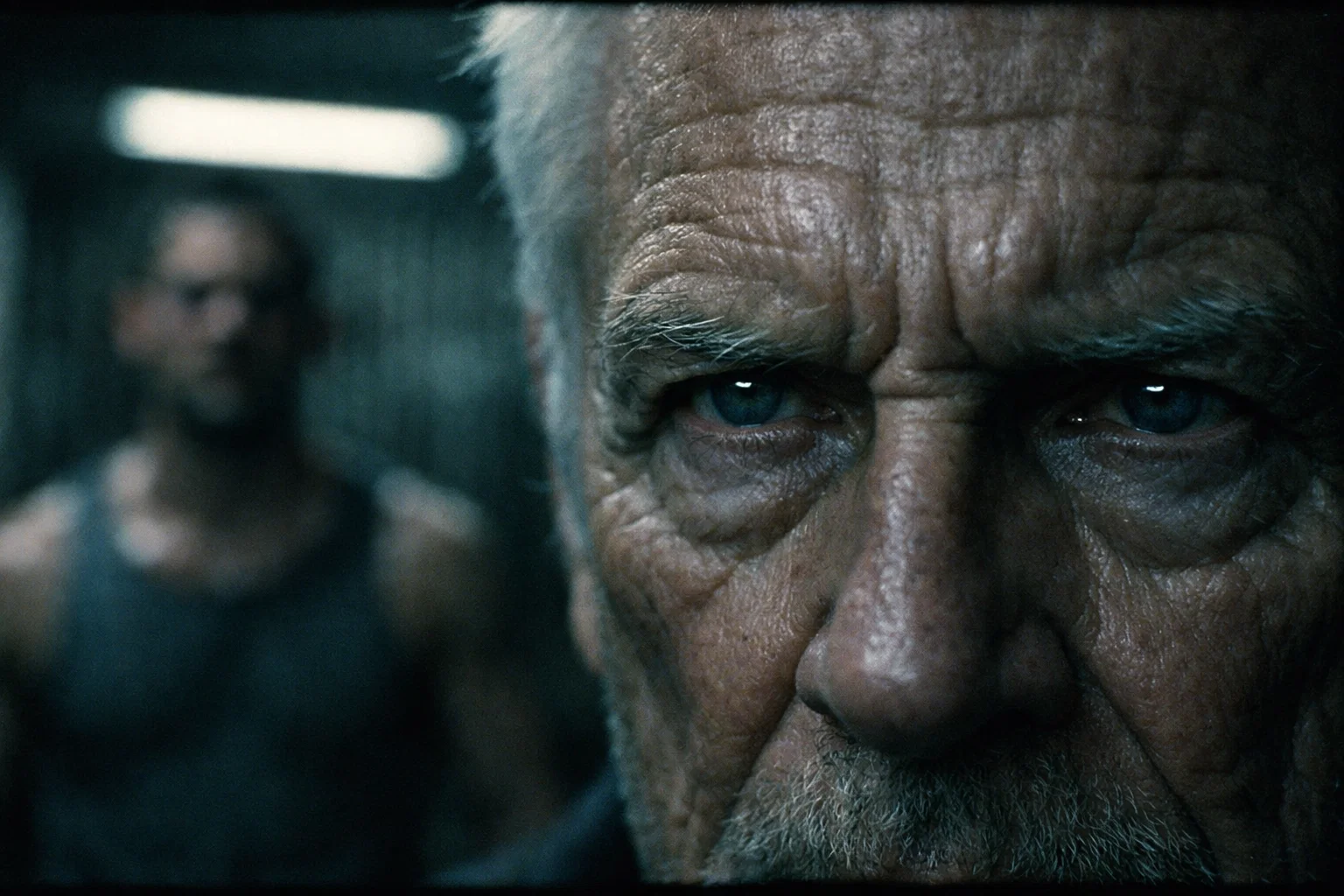
A tall older man stood just inside the entrance. Silver hair tied back loosely. Worn leather motorcycle jacket with faded patches—American flag on the shoulder, a winged military emblem on the chest. A wooden cane in his right hand.
He looked at Owen.
The receptionist moved toward him. “Sir, I’m sorry about the—”
He raised one hand. Gently. She stopped.
He looked at Hannah.
“That boy is autistic,” he said quietly. Not a question.
“Yes.” She swallowed. “I’m sorry for the disruption.”
His eyes were steady.
“You never need to apologize for your child.”
A man near the window muttered something under his breath.
The old biker didn’t look at him. Didn’t acknowledge him at all. He was already looking at Owen.
Then he looked at Hannah—a silent question in his eyes.
She hesitated.
Something in his expression made her nod.
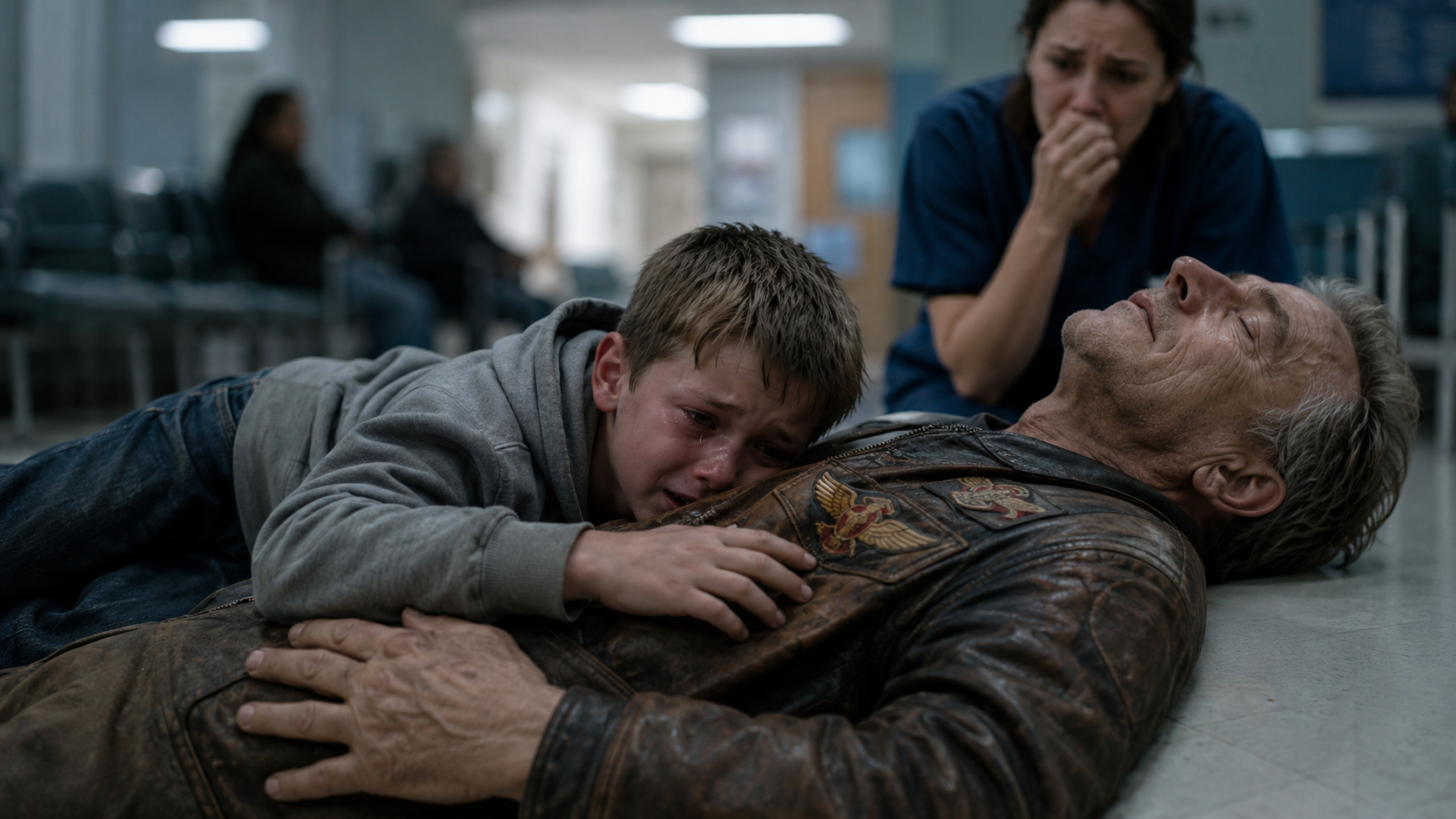
Without another word, he lowered himself to the floor.
Slowly.
Carefully.
He lay down flat on his back, right beside Owen, the leather jacket spreading out beneath him like wings.
Someone gasped. A woman whispered, What is he doing?
“Sir, you really don’t have to—” Hannah started.
“Just watch,” he said gently.
He folded his hands on his chest.
Closed his eyes.
And began to breathe.
Long.
Slow.
Exaggerated.
Deliberate.
Then he started humming. Low and soft. A single note, steady as a distant engine idling in a warm garage.
For a moment, nothing happened.
Owen rocked.
The room held its breath.
The teenager with the phone still had it raised. But his thumb hovered. Not pressing.
Then—barely noticeable at first—Owen’s rocking slowed.
The man kept humming.
Didn’t open his eyes.
Didn’t speak.
Just breathed.
Someone in the back muttered that it looked strange.
Without moving, without opening his eyes, the man said quietly: “Sometimes the best way to help someone is to meet them where they are.”
The room went silent again.
Owen’s rocking slowed further.
His breathing, which had been coming in desperate bursts, began—slowly—to lengthen.
His eyes drifted sideways.
He stared at the patch on the leather jacket.
The winged emblem.
He reached out and touched it.
The man opened one eye. Smiled—just barely.
“That patch?” he said softly. “Got it a long time ago.”
Owen’s fingers traced the stitching.
Hannah’s throat tightened. “You’ve done this before.”
“My granddaughter, Emma.” He hummed one more time before continuing. “Loud alarms send her into the same storm.”
He took a slow breath.
“Her therapist taught me this. Kids can borrow calm from us when they can’t find their own.”
Time stretched.
The toddler had stopped crying. The front desk phone had gone quiet. Even the buzzing overhead lights seemed softer somehow.
The teenager lowered his phone.
Owen’s fists unclenched—one finger at a time.
His breathing kept softening.
Hannah watched her son’s chest rise and fall, matching the rhythm of the man beside him.
One more shaky sob escaped Owen. Then his whole body went still.
He lay with his cheek against the cool tile floor, staring at the winged patch, the dinosaur clutched loosely in one hand.
Hannah brushed his hair back. “You did great, sweetheart.”
The older man pushed himself upright with a slow wince—his knees announcing themselves.
The room exhaled.
People shifted. A few looked away, finding suddenly interesting things on their phones—not filming anymore. Just avoiding.
He picked up his cane.
“You did good, kid,” he told Owen.
Then he looked at Hannah.
“Don’t be too hard on yourself. These moments happen.”
She swallowed hard. “Thank you. I don’t know how to—”
“No repayment needed.” He shook his head. “Just passing along something someone once taught me.”
He was almost to the door when the teenager spoke up—quietly, directed at the floor more than at anyone.
“I deleted it. The video.” A pause. “Sorry.”
The man looked at him for a long moment.
“Good call,” he said simply.
Then he pushed through the door.
Before the door fully closed, he leaned back in.
“Veterans Hall on Maple Street,” he said. “We host quiet afternoons there—for kids who need a calmer place. No one complains about noise or movement.”
Hannah blinked. “That sounds—”
“Bring your boy sometime.”
The door swung shut.
The waiting room slowly returned to itself—coughs, shuffling magazines, a phone ringing.
Hannah sat on the tile floor for another minute, Owen curled against her side.
She didn’t move him.
She didn’t rush.
She just let them both breathe.
They went the following Saturday.
The Veterans Hall on Maple Street smelled like coffee and old wood. Veterans played cards near the window. Kids rolled toy cars across the floor. No fluorescent flicker. No sudden sounds.
Owen walked in holding his dinosaur.
He stopped when he saw a girl about his age sitting cross-legged on the floor, lining up small colored tiles in a pattern only she understood.
Her name was Emma.
He sat down across from her.
They didn’t speak.
They lined tiles up in parallel rows—different patterns, same floor, same quiet.
Walt watched from a folding chair near the window, coffee cup in hand.
“They’re going to be fine,” he told Hannah.
She nodded. She believed him.
Months later, a thunderstorm came through Millbrook Crossing.
Owen froze when the first crack of thunder split the sky. His hands went to his ears. His eyes went wide.
Hannah felt her pulse spike—and then remembered.
She lay down on the living room rug.
Flat on her back.
Folded her hands on her chest.
Owen stared at her like she’d done something impossible.
She took one slow breath.
Then another.
And hummed.
Low. Soft. Steady as an engine.
Owen watched her.
Then he rolled over until his forehead pressed against hers.
His breathing found hers.
The thunder cracked again.
He didn’t flinch.
After a long moment he said something so quiet she almost missed it.
“Mom.”
He hadn’t said that word in weeks.
She lay there in the dark with her son and let the storm pass over them.
Outside, lightning lit up the Tennessee sky.
Inside, everything was calm.
She thought about a leather jacket on a clinic floor.
About a man who didn’t explain himself. Didn’t ask for credit.
Who simply lay down beside a struggling child and breathed.
Kids can borrow calm from us when they can’t find their own.
And she thought: that’s what parents are for.
That’s what neighbors are for.
That’s what we are all for.
Original fictional stories. AI-assisted creative content.