Jonathan Parker had been wearing the same suit for three months. It was his father’s, and it was two sizes too big now.
He hadn’t noticed until that morning, standing in front of the bathroom mirror, when it suddenly hit him — he had become someone else. Smaller. Hollowed out.
He skipped breakfast. His throat wouldn’t allow it.
The courtroom smelled like paper and old wood. Jonathan took his seat next to his attorney, Amelia Brown, and tried not to look at the jury.
Amelia was thirty-two. This was her first major case, and some mornings Jonathan could see the doubt in her eyes before she managed to hide it behind a tight smile.
He didn’t blame her. The evidence against him looked solid. Even he had moments — three in the morning, lying in the dark — when he wondered if anyone would ever believe him.
Thomas Weston, the prosecuting attorney, opened his binder and smiled at the jury like a man who had already won.
“Ladies and gentlemen,” Weston said, his voice easy and practiced, “the facts in this case are not complicated. They are simply inconvenient — for the defense.”
A few jurors nodded. Jonathan watched and felt the floor tilt beneath him.
Amelia leaned over. “Don’t look at them.”
“I can’t help it,” Jonathan whispered.
“Then look at me.”
He did. She gave him a short nod that was either reassurance or a warning. He couldn’t tell which.
Weston spoke for forty minutes. He was good. He moved between the exhibits like a man giving a guided tour of Jonathan’s guilt — a text message here, a bank record there, a witness who described Jonathan’s behavior on the night in question as “suspicious and erratic.”
When Amelia stood to cross-examine, her voice was steady, but Jonathan could see her hands.
She got two concessions from the witness. Not enough.
She sat back down. “We’re still fighting,” she said quietly.
“I know,” Jonathan said.
He didn’t believe it. Not anymore.
Judge Harrison called a short recess. The courtroom doors opened. People filed out into the corridor. A few journalists looked at their phones. One of the jurors stretched his neck.
Jonathan remained in his chair.
That’s when the dog came in.
No one announced it. No one explained it. The courtroom door, still half-open from the recess, simply widened, and a medium-sized dog walked through — unhurried, calm, tail low but not tucked.
The bailiff turned. “Hey—”
The dog ignored him.
It moved past the prosecution table. Past the judge’s bench. Past the gallery of spectators who were slowly going quiet, one by one, the way silence spreads when something unexpected is happening and no one wants to be the first to speak.
The dog walked straight to Jonathan.
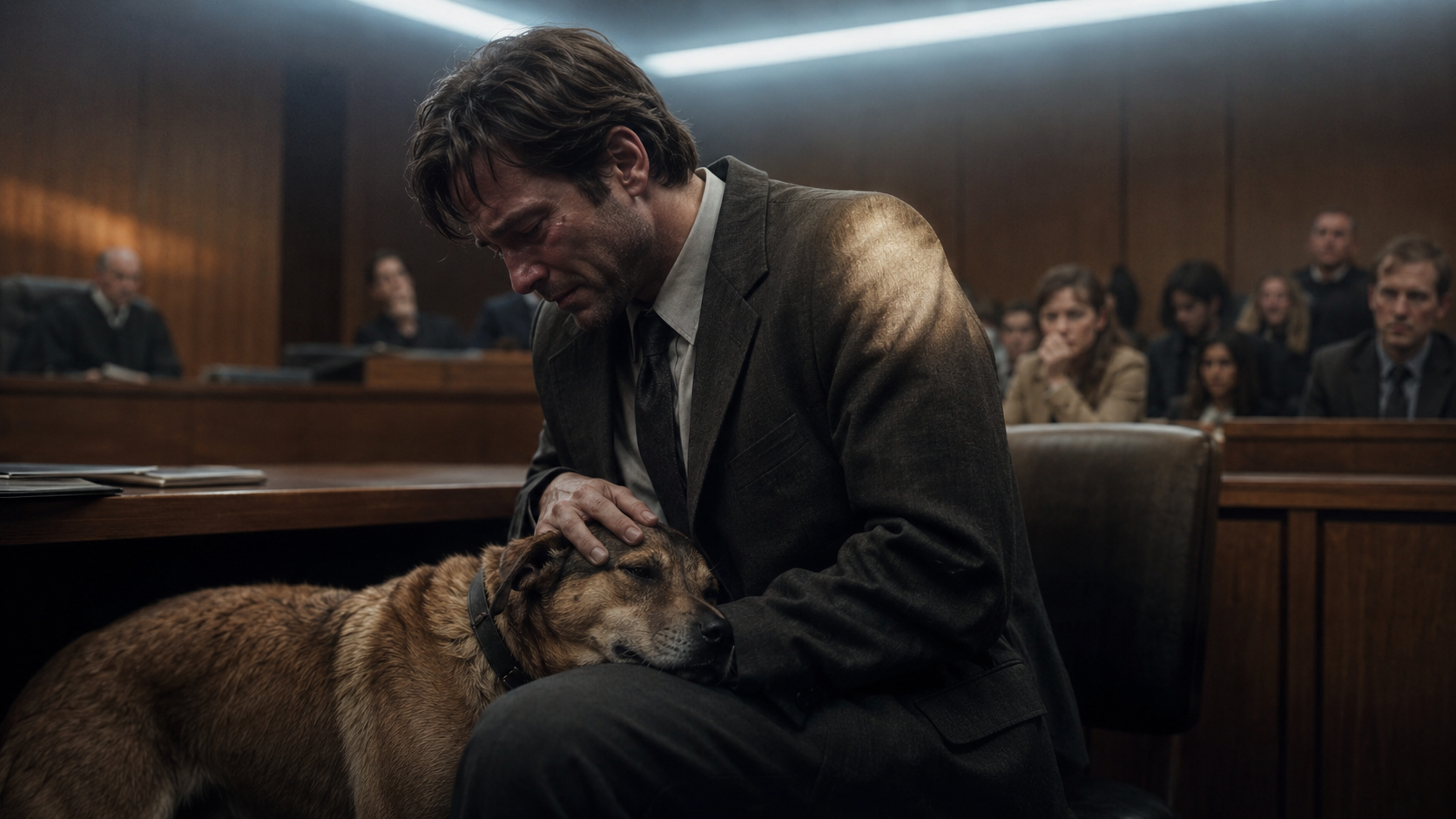
It stopped in front of him, lifted its nose, and began to sniff his hands.
Jonathan went completely still.
He felt the dog’s warm breath on his fingers. Then his wrists. Then the dog raised its head and pressed its nose gently against his face.
Jonathan closed his eyes.
He was seven years old again. There was a dog in the backyard — his parents’ dog, a mutt named Chester, who would appear every time Jonathan cried and press himself against Jonathan’s legs until the crying stopped. Jonathan had never told anyone about that. Chester disappeared when Jonathan was ten. He’d cried for weeks. Silently, at night, so no one would hear.
He hadn’t thought about Chester in twenty years.
He opened his eyes. His face was wet.
The dog sat down, pressed its flank against his calf, and placed its head on Jonathan’s knee.
The courtroom was completely silent.
Judge Harrison had his hand raised from before the recess. He slowly lowered it.
Weston sat forward in his chair, watching. His binder was still open. He didn’t move.
Amelia rose to her feet — slowly, carefully, as if she were afraid to break whatever was happening.
“Your Honor,” she said.
“I see it,” the judge said.
“This dog has no connection to this case. No one called it. No one directed it. And yet—” She paused. “It walked past every person in this room and chose to sit next to my client.”
Weston was on his feet instantly. “Objection. An animal’s behavior is not admissible—”
“I’m not submitting it as evidence, Mr. Weston,” Amelia said. “I’m asking the Court to notice what it just witnessed with its own eyes.”
Silence.
Judge Harrison looked at the dog. Then at Jonathan. Then at his own hands.
“I’ve presided over this court for twenty years,” he said, slowly. “I’ve never had to rule on a dog.” A beat. “Recess. Thirty minutes.”
In the hallway, Amelia grabbed Jonathan’s arm.
“What just happened?” he asked.
“I don’t know,” she said. “But don’t waste it.”
She pulled out her phone and started making calls. Jonathan stood near the window, watching the city outside. The dog had been collected by a bailiff — it belonged to one of the courthouse security guards, apparently. It had slipped through a door that had been left ajar.
Or that was one explanation.
When the session resumed, something had shifted in the room. Jonathan could feel it — not optimism exactly, but a different quality of attention. The jury was watching him differently. Not with suspicion. With something more like curiosity.
Judge Harrison spoke before Weston could.
“Mr. Weston, I’d like to revisit the testimony of your key witness.”
Weston blinked. “Your Honor, we’ve already—”
“I’d like to revisit it.”
Amelia had used the recess well.
She had called her investigator, who had been sitting on a piece of information for two days — a discrepancy in the witness’s phone records that Amelia hadn’t been sure was significant enough to use. Now she used it.
She put it on the screen. A timestamp. A location ping. A phone call that placed the witness somewhere other than where he claimed to be.
“Mr. Caldwell,” she said. “You testified that on the night of March fourteenth, you were at the Riverside Diner until eleven p.m.”
The witness shifted. “That’s correct.”
“Then can you explain why your phone connected to a cell tower four miles away at ten forty-three?”
Silence.
“Mr. Caldwell.”
“I—” He looked at Weston. Weston said nothing. “I may have stepped out briefly.”
“Briefly,” Amelia repeated. She let the word sit.
Weston requested a sidebar. The sidebar became a forty-minute conference. The conference resulted in the judge postponing the verdict and ordering a new investigation into the integrity of the evidence.
Jonathan sat in his chair through all of it, his hand resting where the dog had placed its head on his knee. He could still feel the warmth.
Seven days later, the investigation produced what Amelia had suspected for months but couldn’t prove: the prosecution’s key witness had been coached. Two pieces of physical evidence had been mishandled — one deliberately. Weston had known. Or had chosen not to ask.
The charges against Jonathan Parker were dropped.
He was standing on the courthouse steps when he heard the sound — a familiar click of claws on stone.
He turned.
The dog was sitting at the bottom of the steps. The security guard, an older man named Dale, was holding the leash loosely, watching Jonathan with a small smile.
“He keeps looking for you,” Dale said.
Jonathan walked down the steps and crouched in front of the dog. The dog pressed its forehead against Jonathan’s chest.
“You saved my life,” Jonathan said quietly.
Dale shrugged. “He does what he wants. Always has.”
Jonathan looked up. “Would you be willing to — I mean, if you ever—”
“You want him,” Dale said.
Jonathan didn’t answer. He didn’t need to.
Dale unclipped the leash. “His name’s been Scout. But he never seemed to answer to it much.”
Jonathan looked at the dog. The dog looked back.
“Hope,” Jonathan said.
The dog’s tail moved once. Then again.
Three months later, Jonathan woke to the sound of paws on hardwood. Hope jumped onto the bed, turned twice, and settled against his legs.
Jonathan lay there in the early light, one hand on the dog’s back, feeling him breathe.
He thought about Amelia — she had three new cases now, a small but growing reputation. He thought about Dale, who had accepted a bottle of bourbon and a firm handshake and asked for nothing else. He thought about Weston, who was under bar review, the case collapsing around him like a badly built thing always does.
And he thought about the day the doors opened and something walked in that didn’t know anything about guilt or innocence or what was at stake — only that there was a man who needed to be sat beside.
He scratched Hope behind the ear.
“Good morning,” he said.
Hope closed his eyes.
Outside, the city was already moving. But in that room, for a moment, everything was still
Original fictional stories. AI-assisted creative content.