The bench was hot from the sun when Grandpa parked the sedan beside it.
“Out, Eliza. Quick now.”
She climbed out, clutching Milo, her stuffed rabbit. “Where are we going?”
“I’m getting us ice cream. You wait right here.”
“Can I come?”
“No.” He didn’t look at her. “Stay on this bench. Don’t move. Don’t talk to anyone. You promise?”
“I promise, Grandpa.”
“Good girl.”
He slid back into the sedan. The window was already up.
“Grandpa? What flavor are you getting me?”
The car pulled away.
She watched the dust rise behind it, then settle. She told Milo it would be chocolate. Probably chocolate. Maybe strawberry, because Mama liked strawberry, and sometimes Grandpa remembered.
An hour passed. The cicadas got louder.
A blue truck slowed down. A woman leaned across the passenger seat.
“Honey, you okay out here?”
“My grandpa’s coming back.”
“You sure, sweetie? Where’s your mama at?”
“My mama’s in heaven.”
The woman’s face changed. “Baby, you want me to call somebody?”
“He told me not to talk to people.”
“Okay. Okay, you stay right there, sweetheart.”
The truck rolled on. Eliza watched it disappear and felt, just for a second, like maybe she’d done something wrong.
Two more hours. The gold sky turned orange, then gray. Mosquitoes found her ankles. Her dress stuck to her back.
“He’s coming,” she told Milo. “He said.”
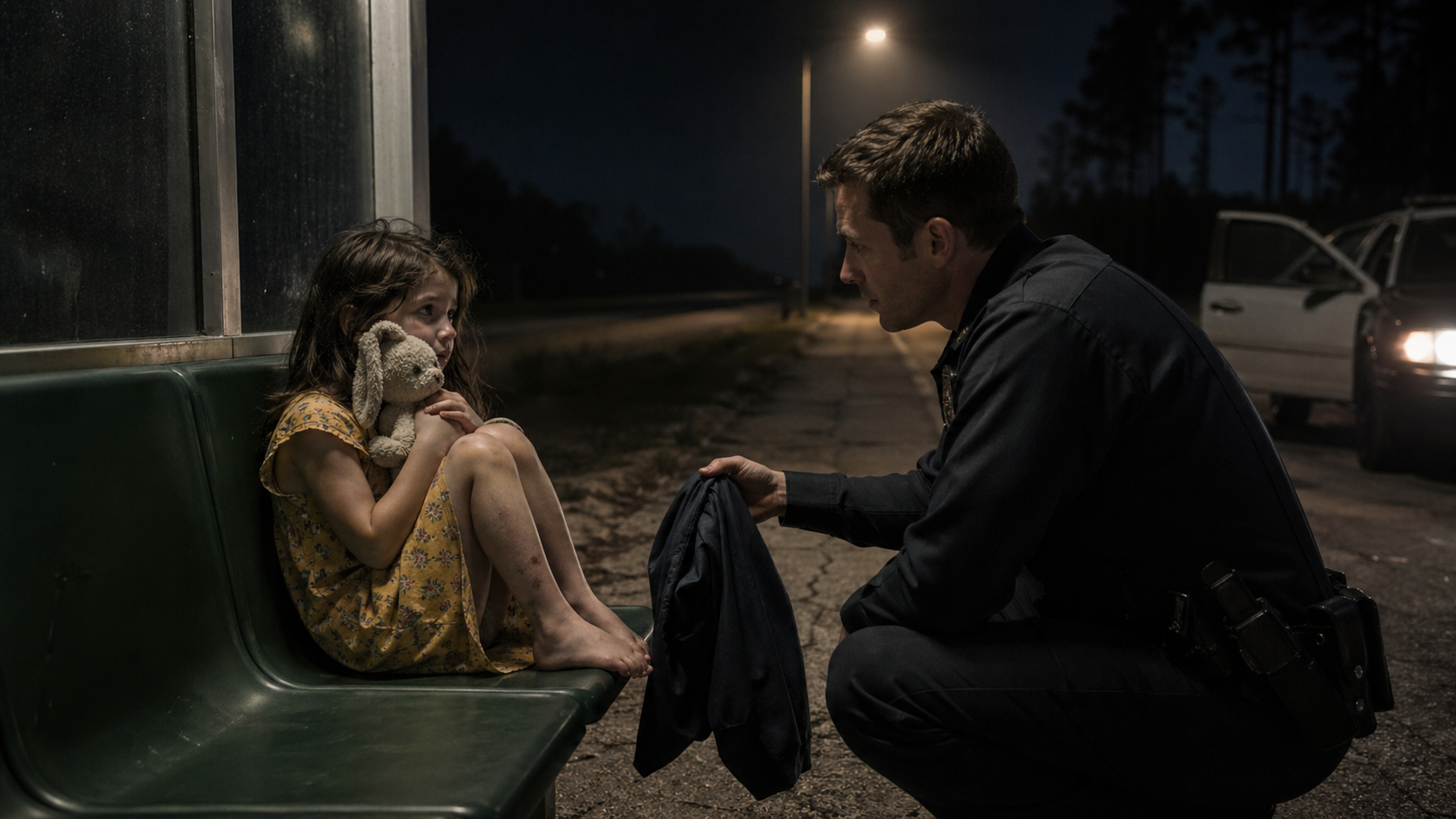
The streetlight above her flickered on. She’d never seen one come on from the outside before. It made a small electric sound, like a held breath.
By eight o’clock she was hungry. By nine she was scared. She didn’t cry, because Grandpa hated when she cried. He said it cost too much. Everything cost too much.
A patrol car eased along the shoulder. The headlights swept across her, then reversed.
Officer Caleb Foster stepped out slowly. He crouched at the bench so his eyes were level with hers.
“Hi there. I’m Caleb. What’s your name, sweetheart?”
“Eliza Monroe.”
“Eliza, how long have you been sitting here?”
“Since the sun was up.”
He kept his face calm. His hand tightened on his knee.
“Who brought you here?”
“My grandpa. He went to get ice cream.”
“What’s his name?”
“Richard Monroe.”
“Does he have a phone, honey?”
“Yes. But he turns it off when he doesn’t want to talk.”
Caleb stood. He keyed his radio without taking his eyes off her.
“Dispatch, I’ve got a six-year-old female at the old Route 17 stop. Been here since daylight. Need a welfare check at the registered address for a Richard Monroe, Savannah.”
“Copy that. Stand by.”
He came back, sat right on the dirty pavement so she didn’t feel small.
“Eliza, are you cold?”
“A little.”
He pulled his uniform jacket off and put it around her. It came down to her knees.
“Officer Caleb?”
“Yeah, sweetheart.”
“If he comes back and I’m gone, will he be mad?”
“You let me worry about that, okay?”
“Okay.”
“You did exactly the right thing waiting. But I’m going to take you somewhere with chairs and a real light. We’ll leave a note for your grandpa. Is that all right?”
She thought about it for a long time.
“He didn’t leave me a note.”
“No, baby. He didn’t.”
She let him lift her into the back seat. She kept Milo under her chin and watched the bus stop shrink in the rear window.
The station hummed with fluorescent lights. Eliza sat in a chair too big for her, swinging her feet, holding a paper cup of cocoa with both hands.
Caleb sat across from her with a notepad.
“Eliza. Has Grandpa ever left you somewhere before?”
“Just at the church. But he came back fast.”
“How fast?”
“Before the candles burned out.”
He wrote that down.
“How about your grandma? Where’s she?”
“She lives far away. Grandpa says she’s not allowed to see me.”
His pen stopped.
“Why isn’t she allowed?”
“Grandpa says she’ll take me. He says she only wants me because of Mama’s money.”
“What money, sweetheart?”
“I don’t know. He yells about it on the phone.”
“Who’s he yell at?”
“Mostly a man named Bryce. Sometimes Eleanor. Eleanor is his wife. She’s not my real grandma.”
“What does he say to Bryce?”
She lowered her voice, like she was telling a secret.
“He says, ‘I need it cleaned by Friday.’ He says, ‘The kid is the problem.'”
Caleb wrote slower this time.
“Eliza, what did Grandpa say to you today? Right before he drove off?”
She looked at Milo.
“He said things would be easier without me. He said I cost too much.”
The pen stopped again.
“He said that today?”
“He says that a lot.”
“Has he ever hit you, honey?”
“No. He doesn’t like to touch me.”
Caleb let out a slow breath.
“Eliza, I’m going to ask you one more thing. Last week, last month, did anybody come to your house you didn’t know? Strangers?”
She thought.
“A man with a clipboard. He looked at my room. He said ‘square footage’ a lot.”
“Did he say his name?”
“Mr. Hargrove. He had a sticker on his shirt.”
Caleb wrote the name down and circled it.
The front doors burst open.
Richard Monroe rushed in. Eleanor was two steps behind, dabbing at dry eyes with a tissue. Richard’s tie was loose. He hadn’t been searching all day. His shirt was crisp.
“Oh, thank God,” Eleanor cried. “Officer, where did you find her? We’ve been frantic.”
“She wandered off,” Richard said. “She’s been confused since her mother passed. We turned the whole neighborhood upside down.”
Eliza slid off her chair. She walked behind Caleb and gripped the back of his belt.
“He’s lying.”
The room went still.
“Eliza,” Eleanor said sweetly, “honey, come here.”
“He drove away. He told me to stay there. He didn’t look back.”
“She’s a child,” Richard snapped. “She doesn’t know what she’s saying.”
Caleb didn’t move.
“Mr. Monroe, where were you between three and nine o’clock this afternoon?”
Richard blinked.
“Looking for her.”
“You filed a missing person’s report?”
“We were about to.”
“At nine-thirty?” Caleb tilted his head. “After six hours?”
“We thought she’d come home on her own.”
“From a bus stop fourteen miles from your house?”
Richard’s jaw clenched.
“Officer, I want my granddaughter. Now.”
“That’s not how this works tonight, sir.”
“Excuse me?”
“You’ll have a chance to answer some questions. Have a seat.”
“I don’t have to sit anywhere. She’s my blood.”
“Mr. Monroe, sit down.”
Eleanor put her hand on Richard’s arm.
“Richard. Don’t make it worse.”
“Worse than what, Eleanor?”
She pulled her hand back like he’d burned her.
The doors opened again.
A woman walked in like she owned the floor under her feet. Silver hair pinned back. Tailored navy coat. Two attorneys behind her, one carrying a banker’s box, one carrying a leather portfolio.
“Margaret,” Richard said, and the color left his face.
Margaret Whitmore did not look at him. She crossed the room straight to Eliza and knelt.
“Hi, baby.”
“Grandma?”
“It’s me.”
Eliza dropped Milo and threw her arms around her grandmother’s neck. Margaret closed her eyes and held on.
“I am so sorry, sweetheart. I have been fighting for months to get to you.”
“You weren’t allowed.”
“I’m allowed now.”
She picked Milo up off the floor and pressed him back into Eliza’s hands. Then she stood and turned to Caleb.
“Officer, I’m Margaret Whitmore. Eliza’s maternal grandmother. These are my attorneys, Mr. Petrov and Ms. Yates. We have something you’ll want to see.”
“Margaret,” Richard said. “Don’t.”
“I’ve been polite for nine months, Richard. I’m done.”
The first attorney set the box on the desk and lifted out a binder.
“My daughter Sarah’s will named Richard Monroe as temporary trustee of Eliza’s inheritance. Eight hundred and forty thousand dollars, held for her care, education, and majority.”
Caleb glanced at Richard. Richard didn’t move.
The second attorney opened the binder.
“In the last four months, Mr. Monroe has transferred two hundred and ninety-one thousand dollars out of the trust. A new boat. A timeshare in Hilton Head. Sixty-two thousand to a personal brokerage account. Forty-eight thousand in casino markers paid to him in cash.”
“This is a private financial matter,” Richard said.
“It stops being private when it’s a child’s trust,” Yates said.
“There’s more,” Margaret said quietly. “Last week, Richard contacted a private adoption facilitator in Florida. He told them Eliza was ‘available for placement’ and asked about a relinquishment fee. Cash. Off the books.”
Caleb’s head snapped up.
“He tried to sell her?”
“He tried to give her away,” Margaret said, “for cash. And then keep the trust.”
“That is a damn lie,” Richard hissed.
The first attorney slid a folder forward.
“We have the email chain. We have his signature. We have the wire request he sent yesterday morning. We have the facilitator’s recorded call. He used his own phone.”
“Recorded?” Eleanor whispered.
“Florida is a one-party consent state for the facilitator. Yes, ma’am.”
Eleanor sat down hard in a plastic chair.
“Richard.”
“Don’t.”
“Richard. You said she was going to a family in Tampa.”
“Eleanor, shut up.”
“You said it was an adoption. You said she’d have a yard.”
“I said shut up.”
Caleb opened the folder. He read for ten seconds. He closed it.
“Mr. Monroe. The man who came to your house last week with the clipboard. Mr. Hargrove. Who was he?”
Richard didn’t answer.
“He was the appraiser,” Margaret said. “Richard was selling the house too. Eliza’s house. The one her mother left her.”
“That house is in my name,” Richard said.
“As trustee,” Yates said. “Until she’s eighteen. You don’t get to liquidate it.”
Caleb stood and keyed his radio.
“Need a second unit at the station. I’ve got two for misappropriation of a trust, child endangerment, and conspiracy to traffic a minor.”
“Trafficking,” Eleanor whispered. “Oh, God.”
“You knew, ma’am?”
“I didn’t—I didn’t know that part. I swear. He told me she’d be adopted. He told me the family was already picked.”
“Did you ask their names?”
She covered her mouth.
Richard stepped toward Eliza instead of answering.
“She’s my blood. You can’t—”
Caleb was between them before the sentence finished.
“You left a six-year-old at a bus stop for eight hours, Mr. Monroe. You’re done.”
“I told her to wait. She was supposed to be picked up.”
“By who?”
Richard’s mouth opened, then closed.
“By the buyers, sir? Was that the plan?”
“I want a lawyer.”
“You’re going to need one.”
The cuffs clicked. Eleanor was crying for real now, but nobody was looking at her except the second officer, who came through the door and put a hand on her shoulder.
“Ma’am, I need you to stand up too.”
“I didn’t know all of it. I swear to God.”
“You can tell us about it down the hall.”
As they walked Richard past the chair where Eliza had waited, she stepped out from behind Margaret.
“Grandpa.”
He stopped.
“You didn’t bring the ice cream.”
He didn’t answer. His face crumpled, but not from love. From getting caught.
“I waited a really long time.”
“Eliza—”
“I don’t want to wait for you anymore.”
She turned and walked back to Margaret without looking again.
They took him out the side door.
The station got quiet. The fluorescents buzzed. Margaret sat down on the floor next to Eliza, navy coat and all, like the floor wasn’t dirty, like nothing in the world mattered except being at her level.
“I bought a house six blocks from your old school,” she said. “Your room is yellow. I picked it because your mama’s room was yellow when she was your age.”
“Is Mama’s picture there?”
“Every wall, baby.”
“Even the bathroom?”
“Even the hallway. I’ll show you.”
Eliza thought about that. Then she held up Milo. His ear was hanging by three threads.
“Can he get fixed?”
“I have a sewing kit at home. We’re fixing him tonight.”
“Tonight tonight?”
“Tonight tonight.”
“And ice cream?”
Margaret laughed, and it cracked at the end.
“As much as you want. And I will be there when you finish it. And I will be there tomorrow. And the day after that.”
“Promise?”
Margaret shook her head slowly.
“I’m done with promises, sweetheart. I’m just going to show up.”
Eliza nodded, like she was filing that away somewhere important.
Caleb walked over with a small bandage from his first-aid kit. He held it up.
“For the patient.”
He wrapped it gently around Milo’s torn ear. Eliza watched his hands the whole time.
“Officer Caleb?”
“Yeah, sweetheart?”
“Thank you for stopping.”
“Thank you for being brave enough to tell the truth.”
“Will Grandpa go to jail?”
He looked at Margaret. Margaret nodded once.
“Yes, honey. He will. For a long time.”
“And the man with the clipboard?”
“Him too.”
“And Eleanor?”
“That’s up to a judge. But she has a lot to answer for.”
Eliza considered all of it. Then she looked up.
“Good.”
That was all. Just good. A six-year-old’s verdict, clean as a bell.
Margaret stood and held out her hand. Eliza took it.
Caleb walked them to the door. Outside, the night had cooled. A cruiser was pulling away with its lights off. Margaret’s car was at the curb, an older sedan, nothing fancy.
“Ma’am,” Caleb said. “Tomorrow we’ll need her statement on tape. With a child advocate.”
“We’ll be there at nine.”
“And the trust—”
“The petition for emergency guardianship is already filed. Judge Alden signed it an hour ago. I came here last because I wanted to come here last.”
“Yes, ma’am.”
“Officer Foster. Thank you for not driving past.”
“Yes, ma’am.”
She opened the back door. Eliza climbed in without being told. She buckled herself. She put Milo in the seat next to her, like a passenger, and patted his head.
“You can sit up front, sweetheart, if you want.”
“Milo doesn’t like the front.”
“Okay. Then you sit with Milo.”
Margaret got in the driver’s seat. She turned the key. The engine caught on the first try.
Eliza watched the bus stop sign on the way out of the parking lot. There was one across the street. She didn’t flinch.
“Grandma?”
“Yes, baby.”
“I waited a long time today.”
“I know you did.”
“I don’t have to wait anymore?”
Margaret reached back and put her hand over Eliza’s small one. She held it there at a stoplight. She held it there when the light turned green and a horn honked behind her. She held it until she was sure Eliza had heard the answer in her grip before her words.
“Not for me. Not ever.”
The car pulled away from the station, and this time, the person driving looked back in the mirror — not to check the road, but to make sure the child in the back seat was still there.
She was.
She always would be.
Original fictional stories. AI-assisted creative content.