The morning of my wedding, my father came into the kitchen with two cups of coffee.
“You sleep?” he asked.
“Not really.”
“Nerves?”
“Something like that.”
He set the coffee down in front of me. Same chipped mug I’d used in high school.
“Dad.”
“Mm.”
“Do you like him?”
He didn’t answer right away. He took a long sip. Looked out the window.
“I like that he makes you laugh.”
“That’s not an answer.”
“It’s the answer I’ve got today.”
“Dad.”
“Drink your coffee, sweetheart.”
I drank my coffee.
He reached into his jacket pocket — the old gray one he was going to wear to the reception — and pulled out a plain white envelope. He set it on the table between us.
“What’s that?”
“That’s for later.”
“For later when?”
“You’ll know when.”
“Dad, this is weird.”
“It’s not weird. It’s a wedding present.”
“Can I open it now?”
“No.”
“Why?”
“Because I said so.”
I laughed. He didn’t. He just patted my hand and stood up.
“Finish your coffee. Mara’s coming at nine for your hair.”
Then he walked out, and that envelope sat on the kitchen table like it was watching me.
The restaurant was the most expensive in the city. White tablecloths. Fresh lilies. A string quartet playing something soft in the corner.
The groom’s family filled three-quarters of the room. Loud men in tailored suits. Women dripping in gold. They laughed like they owned the place.
My side of the room was small. A few friends. My cousin Mara. Old Mr. Peterson from next door who helped me zip my dress that morning.
And my father. Quiet. In the corner. Wearing the same gray jacket he’d owned for fifteen years.
“Is that really her dad?” I heard one of Daniel’s aunts whisper. “In that jacket?”
“Poor thing,” another said. “Imagine being her.”
I pretended not to hear. I smiled through the toasts.
Daniel leaned over and squeezed my hand. “You okay?”
“I’m fine.”
“You sure? You look tense.”
“I said I’m fine.”
He studied me for a second, then went back to laughing at something his cousin said.
Across the table, my father caught my eye. He gave me the smallest nod. The kind of nod he used to give me when I was eight years old and didn’t wanted to go to school. You’ve got this.
I nodded back.
“Anna, sweetheart,” Helen called from three chairs down. “Come here a moment.”
I stood up, walked over. She pulled me close by the wrist. Not gently.
“That dress,” she whispered, smiling for the cameras. “You should have let me pay for the alterations. It’s pulling at the shoulder.”
“It’s fine, Helen.”
“Dear. People are looking.“
“Then let them look.”
I walked back to my seat. My father was watching her. Helen let go of my wrist and pretended to fix her napkin.
Then Helen’s sister tapped a glass. It was time for speeches.
Daniel’s mother stood first. Pearl necklace. Tight smile.
“To my son,” she said, lifting her glass. “Who deserves every beautiful thing in this world.”
She paused. Looked at me.
“And to his bride. Who we are… generously welcoming into our family.”
The word generously hung in the air like smoke.
“Mom,” Daniel muttered.
“What? I’m being kind.”
“You said it like she’s a charity case.”
“Daniel. Not now.”
“Then when, Mom? When is it ever the right time with you?”
“Drink your champagne, sweetheart.”
He drank. He always did.
I caught my father watching the whole exchange. His hands tightened around his water glass, then relaxed. He was waiting. I didn’t know what for. Not yet.
The gifts began.
Helen stepped forward with an envelope the size of a folder. She opened it dramatically.
“The keys,” she announced, “to a two-bedroom apartment downtown. For our son.”
The room exploded in applause. She handed the keys to Daniel. Not to me. To Daniel.
Then Daniel’s uncle stood. Heavy gold watch. He tossed a thick envelope on the table.
“A little something,” he winked. “Buy yourselves a real honeymoon. Not a Motel 6.”
Laughter everywhere.
My father stared down at his plate. His hands were folded like he was praying.
Then the host, this slick man in a bow tie, tapped his microphone.
“And now,” he announced, “a gift from the bride’s father.”
The room went quiet. The kind of quiet that’s worse than silence.
My father stood up. Slowly. He reached into his jacket pocket and pulled out a plain white envelope. No ribbon. No gold seal. Just paper.
Helen actually laughed. Out loud.
“Oh,” she said. “How… sweet.”
Her sister snickered behind a napkin. Daniel’s uncle smirked into his wine.
My father didn’t look at any of them. He walked across the room, through all those stares, and stopped in front of me.
“This is for you, sweetheart,” he said.
His voice was steady. His eyes weren’t.
“Dad, you didn’t have to—”
“Open it.”
I slid my finger under the flap. There was one piece of paper inside. Folded twice. Typed.
I started reading.
My hands began to shake before I got to the second paragraph.
“Honey?” Daniel leaned over. “What is it?”
I couldn’t speak. My throat wouldn’t work.
“Is she okay?” someone whispered.
“She looks like she’s going to faint.”
I looked up at my father. He hadn’t moved. He was just standing there, hands at his sides, watching me with this calm, certain look.
I handed the paper to Daniel without a word.
Daniel took it. Laughed a little. Started reading.
His smile dropped by the third line.
By the fifth, his face had gone white.
By the end, he lowered himself into his chair like his legs had stopped working.
“What?” Helen snapped. “What does it say? Daniel. Daniel.“
He didn’t answer her. He was still staring at the paper.
Helen snatched it out of his hand.
I watched her eyes move across the page. I watched her face change.
It was a will.
My father’s will. Drafted, notarized, stamped. Prepared over the course of seven years.
He was leaving me the house I grew up in. Already signed into my name, not his. Just waiting.
He was leaving me two plots of land outside the city — bought twenty years ago when the area was nothing but weeds. The county had just zoned it commercial. Developers were calling weekly.
He was leaving me a bank account. Not a small one. Not a showy one. Just enough that I would never, ever have to beg anyone for a roof over my head.
And at the bottom, in his careful handwriting, one line:
“All I have is yours. And if your husband ever hurts you, come home.”
Helen’s lips parted. She read it again. She read it a third time.
Then she set the paper down very carefully, like it might burn her.
“I think,” she said slowly, “there’s been some confusion.”
“About what?” my father asked.
“I— I just mean. We had no idea you were…”
“Rich?” my father finished.
“Well— comfortable.”
“I’m not.” He took his jacket off the back of his chair. “I worked double shifts at the lumber yard for thirty-one years. I never took a vacation. I ate the same lunch every day from 1994 to 2019. That’s how my daughter has what she has.”
The room was dead silent.
“Mr. Miller,” Daniel’s uncle started, “please, sit, have some—”
“I’m speaking to my daughter.”
He turned to me. His face softened.
“Sweetheart. You don’t owe anybody in this room anything. You never did.”
Helen found her voice again. Tried to laugh it off.
“Well! This is wonderful news. For the family. For our family—”
“Your family,” my father said, “spent the last hour making jokes about my jacket.”
“That’s not—”
“I heard every one. So did she.”
Daniel finally looked up at me. His eyes were wet.
“Anna. I didn’t— I never cared about—”
“You laughed, Daniel.”
“What?”
“When your uncle made the Motel 6 joke. You laughed.”
“That was just— it was just a joke, come on—”
“You laughed at my dad.”
The quartet had stopped playing. I don’t know when.
“Anna, he’s my uncle, what was I supposed to do—”
“Say something.”
“I can’t control what he says.”
“Then say something after. To me. To my father. You said nothing.”
“I didn’t think it was a big deal.”
“That’s the whole point, Daniel.”
He stared at the floor.
“Do you even see him?” I asked. “Right now. Standing there. Do you see who he is?”
“Anna, please—”
“Look at him.”
Daniel looked. For maybe the first time ever.
My father didn’t flinch. Didn’t smile. Didn’t perform. He just stood there, this quiet calloused man in a fifteen-year-old jacket, waiting.
“I see him,” Daniel said quietly.
“Now you do.”
Helen had been holding herself together by fingernails. She couldn’t anymore.
Helen lunged for damage control. “Anna, darling, let’s all just take a breath and—”
“Don’t call me darling. You’ve never called me darling.”
“I— well, I’m calling you darling now.”
“Because of the land?”
Her mouth opened. Closed.
I stood up. My dress felt heavy. My veil felt like a costume.
“Mrs. Carver,” I said. “For two years you have treated me like I was dirt your son dragged in. You told people I married up. You told Daniel I’d ‘fit in with practice.'”
“That’s a private—”
“Your cousin told me at the rehearsal dinner.”
Helen’s mouth snapped shut.
“And the whole time,” I said, “my father — the man in the old jacket — was sitting on more land than your husband will ever own.”
“Anna,” Daniel whispered. “Please.”
I looked at him. Really looked. The man I was supposed to spend my life with.
“Did you know?” I asked.
“Know what?”
“Did you ever, one time, tell your mother to stop?”
He opened his mouth.
He closed it.
“That’s what I thought,” I said.
I pulled the ring off my finger.
“Anna, wait—”
“I’m going home, Daniel.”
“This is our home now. The apartment—”
“Your mother’s apartment.”
I set the ring down on the tablecloth. Right next to the bread basket.
“Consider it returned.”
Helen stood up so fast her chair fell backwards.
“You can’t be serious. Do you understand what you’re throwing away? Do you know what our family is worth?”
My father stepped forward. Just one step. But something in the way he did it made her stop talking.
“Ma’am,” he said. “I’ve been quiet all night. I’d like to stay quiet. But if you say one more word to my daughter, I won’t.”
Helen sat back down.
Her husband — Daniel’s father, who hadn’t said a single word all night — cleared his throat.
“Helen. Enough.”
“Excuse me?”
“I said enough.”
“You don’t get to—”
“For twenty-eight years I’ve listened to you talk about people like this. I’m done.”
“Richard—”
“Sit down and be quiet.”
She sat. Her mouth opened. Closed. Opened again.
Nothing came out.
Daniel’s father looked at me. “Anna. I’m sorry. I should have said something a long time ago.”
“Yes,” I said. “You should have.”
He nodded. Accepted it.
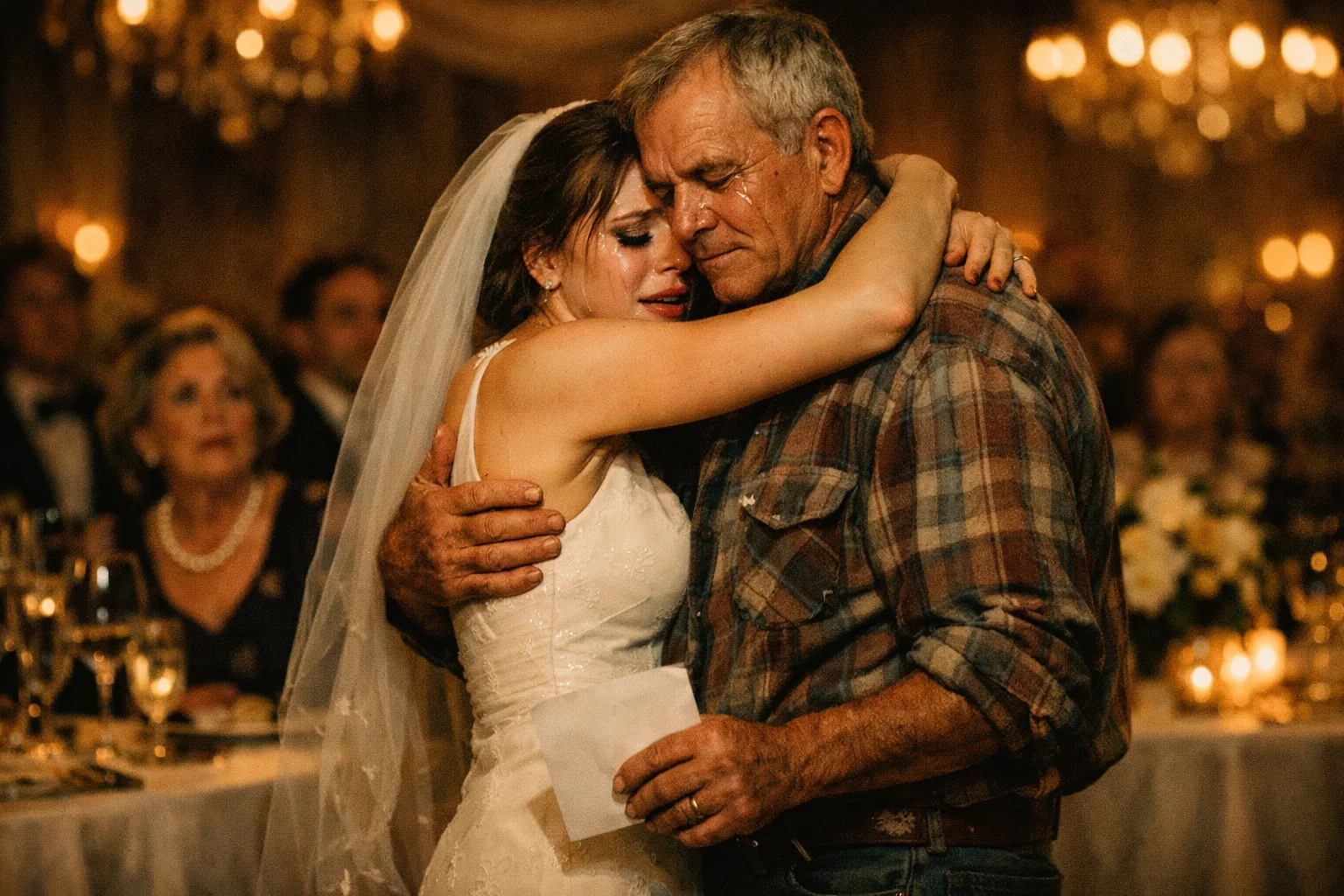
I took my father’s arm.
We walked across that room together. Past the lilies. Past the quartet. Past every person who’d whispered about his jacket.
At the door, I turned back. Daniel was still sitting there, paper in his lap, looking like someone had turned him inside out.
“Daniel,” I said.
He looked up.
“The next time someone walks into a room in a cheap jacket — ask yourself why they can afford not to care.“
Then we left.
In the parking lot, my cousin Mara caught up with us.
“Anna. Anna, hold on.”
“Mara, I can’t—”
“I’m not stopping you. I just wanted to say — I’ve been waiting two years for you to see it.”
“See what?”
“Who they were. Who he was.”
I didn’t answer.
“You deserve better than that whole room,” she said.
My father squeezed my hand.
“Mara,” he said, “thank you for being here.”
“Mr. Miller. Any time.”
We drove home in his old pickup. The same pickup he’d driven since I was in seventh grade. The heater rattled. The radio didn’t work. It had never worked.
“Dad.”
“Mm.”
“How long have you been planning that?”
“The will? Started it the year you met him.”
“What?“
“Didn’t like his mother the first time I shook her hand. She looked at me like I was the valet.”
“Dad.”
“I’m not saying I knew it’d come to tonight. I’m saying I wanted you to have a way out. Just in case.”
I stared at him. His face was lit blue-green by the dashboard.
“You’ve been preparing this for two years.“
“Seven.”
“Seven?”
“The land. I bought the second plot seven years ago. When the county was still arguing about zoning.”
“How did you know?”
“I didn’t. I hoped. Hoping’s free.”
I started crying then. Really crying. The kind you don’t try to stop.
He reached over without looking and put his hand on top of mine.
“It’s alright, sweetheart.”
“I almost married him, Dad.”
“But you didn’t.”
“I did, technically. The ceremony was this afternoon.”
“Then we’ll call a lawyer Monday.”
“Okay.”
“Okay.”
We drove the rest of the way in silence.
Three months later, the divorce was final. Uncontested. Daniel didn’t fight for anything, because there was nothing to fight for — the apartment had always been in Helen’s name, and everything I’d brought into the marriage was already locked tight in the will.
Helen tried calling me. Twice. I didn’t answer.
The third time, I did.
“Anna. Sweetheart. Please. We need to talk.”
“About what, Helen.”
“About — about the land. I have a friend. In commercial real estate. He could get you numbers you wouldn’t believe—”
“Goodbye, Helen.”
“Anna—”
I hung up. Blocked the number.
Daniel texted once, a month after that. I was a coward. I’m sorry.
I didn’t reply. There was nothing left to say that a reply would fix.
The commercial developer closed on the first plot of land in April. Seven figures. My father cried when I showed him the check. Not because of the money. Because he finally got to stop worrying.
“Dad. You can retire now.”
“I don’t want to retire.”
“You worked thirty-one years.”
“I liked the work.”
“You never took a vacation.”
“I’m taking one now.”
“Where?”
“The porch.”
I laughed.
I bought him a new jacket. He refused to wear it at first.
“It’s too nice,” he said.
“Dad. You’re allowed to have nice things.”
“The old one still works.”
“The old one has a hole in the elbow.”
“That’s character.”
“Dad.”
“Alright, alright.”
He wore it to church that Sunday.
Mr. Peterson from next door told him he looked like a movie star.
“You clean up, Frank.”
“Quit it, Pete.”
“I’m serious. Anna, your dad looks like Clint Eastwood.”
“Pete. Stop.”
“Younger Clint. Like, The Bridges of Madison County Clint.”
My father laughed — really laughed — for the first time since the wedding.
A lawyer from the developer’s firm came by the house the following week. Nice woman. Briefcase. Slacks.
“Mr. Miller. Miss Miller. I just need a few signatures and we’re done.”
“Anna handles it,” my father said.
“It’s your land, Dad.”
“It’s your name on the deed.”
“Because you put it there.”
“Right. And now you handle it.”
The lawyer looked between us, smiling. “I’ll give you two a minute.”
“No, it’s fine,” I said. “I’ll sign.”
I signed. My father watched over my shoulder like he was checking my homework.
“Dad.”
“Mm.”
“You did good.”
“I know.”
The lawyer laughed.
I heard later, through Mara, that Helen had to downsize. The apartment she’d bought her son sat empty for a year because Daniel couldn’t stand to be in it. She ended up selling it in a down market. Took a loss.
“Karma’s got good aim,” Mara said on the phone.
“I’m not glad about it.”
“You don’t have to be glad. You just have to notice.”
I noticed.
And me?
I went back to the little house I grew up in. The one he put in my name before I even knew what a deed was.
I sleep in my old bedroom now. There’s a crack in the ceiling shaped like a bird. I’ve known it since I was six.
Some nights my father and I sit on the porch and don’t say anything at all. We don’t have to.
“Dad.”
“Mm.”
“Thank you.”
“For what.”
“For the jacket. For everything.”
He didn’t answer right away. Then he just said, “That’s what fathers do, sweetheart.”
“Not all of them.”
“Then I’m sorry for the ones that don’t.”
He carried the quiet for thirty-one years so I wouldn’t have to.
Now I carry some of it back.
Original fictional stories. AI-assisted creative content.