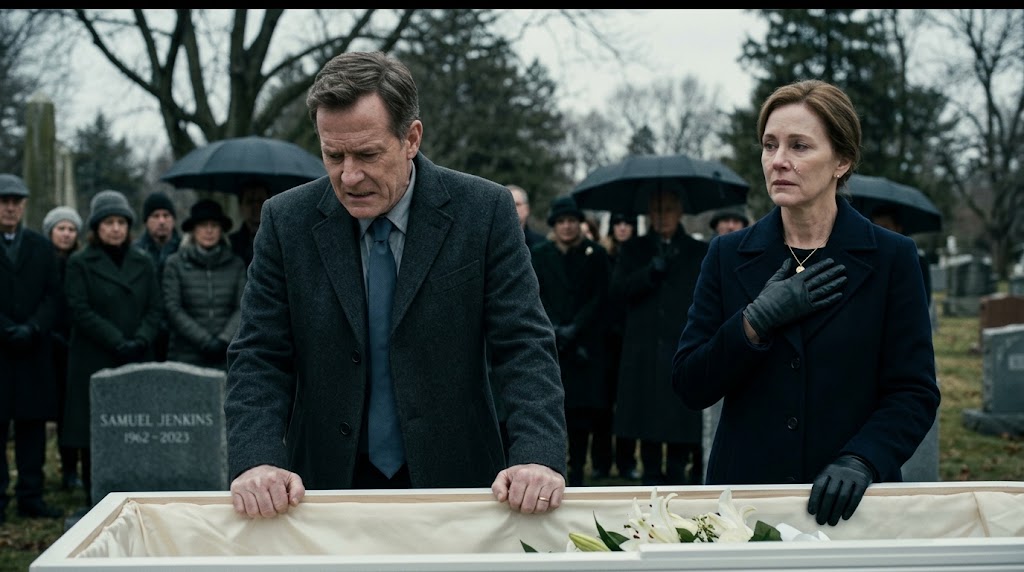
Richard was standing beside his daughter’s white coffin when the scream tore through the rain.
“STOP! DON’T BURY HER!”
Every mourner turned.
A girl no older than ten was sprinting straight toward the grave. His clothes were ripped. His face was caked in mud. One shoe was missing. He looked like he had crawled through fields and ditches just to get there.
Security grabbed him before he reached the coffin.
But the girl didn’t fight back.
He pointed at it.
“Your daughter — she’s not dead!”
Richard stared.
“What did you say?”
Somewhere behind him, a woman went very still.
The girl’s voice shook.
“I saw her move. Two nights ago. She was alive. Someone had her.”
Richard looked at the coffin.
Then at the child.
“Where?”
“The old house. By the woods.”
Something cold moved through Richard’s chest.
He raised one hand.
“Stop.”
Nobody moved.
“Nobody lowers that coffin.”
The funeral director stepped forward.
“Mr. Whitmore, I strongly advise —”
“Open it.”
The man swallowed.
“Sir, your daughter’s condition —”
Richard turned on him.
“My daughter’s condition is exactly what I’m trying to determine.”
Two cemetery workers released the fasteners.
Richard’s hands wouldn’t stop shaking.
Caroline Whitmore was twenty-eight years old. An architect. Stubborn. Funny without trying. The only person who still called him at midnight just to ask whether he’d remembered to eat.
Three days earlier, Richard had been told she was dead.
Now a ten-year-old girl covered in mud was insisting every adult in that cemetery had made a catastrophic mistake.
The coffin lid lifted.
Several mourners turned away.
Richard didn’t.
Caroline lay inside in a pale blue dress. Skin almost colorless. Eyes closed. Hands folded. Flowers arranged around her shoulders.
For one horrible second, Richard thought the child had been wrong.
Then the girl shouted.
“Look at her hand!”
Richard looked down.
Caroline’s smallest finger moved.
Barely. A single twitch. So small he almost convinced himself he’d imagined it.
“Caroline?”
Nothing.
He leaned over the coffin.
“Caroline!”
Dr. Susan Lane — an old family friend who had come to pay her respects — pushed through the crowd. She pressed two fingers to Caroline’s neck.
Waited.
Her face changed.
“Call an ambulance.”
Richard stopped breathing.
“What?”
Susan leaned closer and shouted.
“She has a pulse!”
The cemetery erupted.
Someone screamed. Someone dropped an umbrella. Richard grabbed the side of the coffin to keep himself upright.
Susan was already issuing orders.
“Get these flowers out. Give her space. Call emergency services now.”
Richard stared at his daughter’s face.
She had been declared dead. Prepared for burial. Sealed inside a coffin.
And she had a pulse.
He looked toward the girl.
The child was crying with relief.
“I told you.”
Richard whispered.
“Yes. You did.”
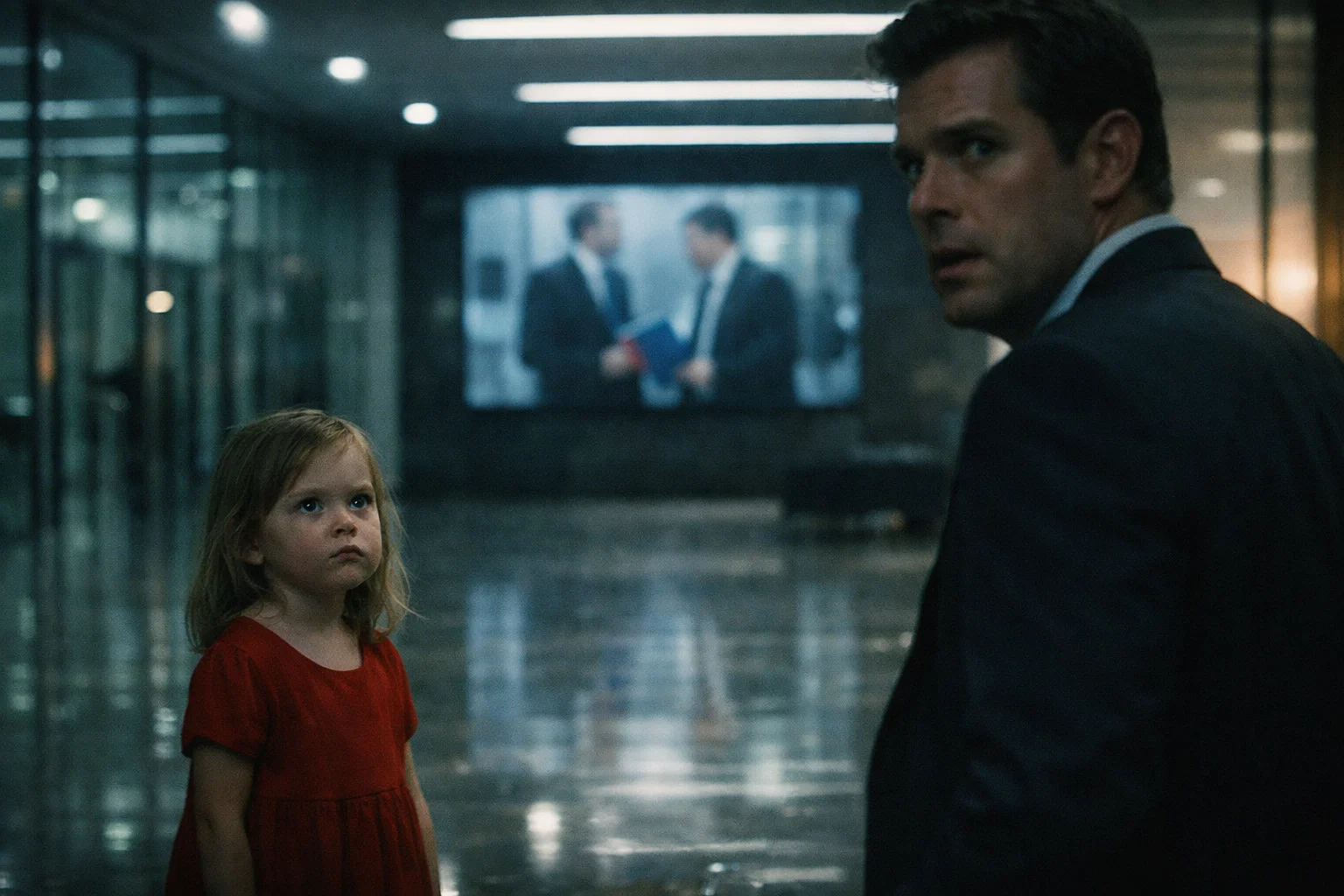
Then, across the crowd, he saw his wife backing away.
Her name was Vanessa Whitmore. They had been married six years. She had organized most of the funeral because Richard had been barely functional after the news of Caroline’s death.
Flowers. Casket. Guest list. Private burial arrangements. No hospital viewing. No open coffin. No autopsy.
At the time, every decision had sounded compassionate.
Now, suddenly, all of it sounded different.
Vanessa took another step backward.
The girl saw her.
His expression changed instantly.
She pointed.
“Her!”
Everyone turned.
Vanessa froze.
Richard stared at the child.
“What?”
The girl pointed directly at the gold pendant hanging from Vanessa’s neck.
“That lady was there. At the old house. By the woods.”
Vanessa shook her head.
“I’ve never seen this boy before in my life.”
But her voice had climbed half an octave.
The girl’s breathing came faster.
“She was with two men. They were moving her.” She pointed at the coffin. “Moving her.”
Richard looked at Vanessa.
“Vanessa.”
“Richard, this child is confused —”
“You told the men she had to stay asleep.”
Silence dropped over the entire cemetery.
Vanessa’s hand flew to her pendant.
“No.”
Security moved toward her.
She turned.
“Richard — this is insane. You’re going to believe a filthy, frightened child over me?”
He looked at her with an expression she had never seen before.
“Don’t leave.”
The ambulance arrived four minutes later.
Paramedics began working immediately.
Caroline was alive — technically, legally, definitively alive — and within the hour she was in emergency care with an IV in her arm and a heart monitor beeping beside her.
Doctors confirmed it within two hours.
She had been given a powerful sedative. Her breathing had slowed to the point of being nearly undetectable. Her temperature had dropped. A private physician — one Vanessa had called to the guesthouse three days earlier — had examined Caroline, found no detectable pulse, and signed preliminary death paperwork.
No ER. No independent examination. No hospital.
Because, Vanessa had told Richard, Caroline had a documented fear of hospitals and had requested no invasive intervention.
Richard had believed her.
He sat beside his daughter’s hospital bed and thought about that for a long time.
Detectives arrived that evening.
The girl’s name was Eva Briggs. Ten years old. Her grandfather maintained properties near the Whitmore estate, and Eva spent weekends helping him. She knew the woods. The drainage ditches. The abandoned caretaker’s cottage three miles from the cemetery.
Two nights before the funeral, Eva had been searching for his grandfather’s missing terrier near the old cottage when he saw lights.
A white van. Two men. And a woman wearing a gold pendant.
She recognized Vanessa from local newspaper photographs. The Whitmores were well known.
She hid behind a stone wall and watched.
Then he saw them carrying someone from the cottage.
At first he thought she was asleep.
Then her hand moved.
Eva moved closer.
Too close.
One of the men heard something. Eva ran. He slipped through a broken side door and found himself inside the cottage — and found Caroline on an old bed.
Barely conscious. Eyes half-open. She whispered something.
She leaned in.
“What?”
Her lips moved again.
“Dad.”
Then footsteps. Eva hid.
He heard Vanessa enter. Saw the gold pendant as she bent over Caroline.
Then he heard Vanessa say:
“Tomorrow this ends.”
One of the men asked:
“What if she wakes again?”
Vanessa didn’t hesitate.
“She won’t before the burial.”
Eva stopped breathing.
They took Caroline. Eva tried to follow. Someone spotted him. She ran. The gate was locked. He crawled under an old drainage opening — that explained the mud, the torn knees, the missing shoe.
By the time he reached his grandfather’s cabin, the van was gone.
His grandfather wasn’t home. Eva had no phone.
She spent the night terrified he had misunderstood what he’d seen.
Then the next morning he found a funeral notice on the kitchen table.
CAROLINE WHITMORE — BURIAL, 11:00 A.M.
Same face. Same woman.
Eva looked at the clock.
10:17.
The cemetery was nearly four miles away.
She ran.
The investigation moved fast once Caroline could speak.
She confirmed what Eva had witnessed.
She had been drugged. She had woken briefly in the cottage — barely aware, barely able to move — and heard voices. Men she didn’t recognize. And Vanessa.
“She said my name,” Caroline told detectives from her hospital bed. Her voice was still hoarse. “Like it meant nothing. Just a name on a list.”
The motive wasn’t complicated.
Richard Whitmore had amassed significant wealth. Caroline was his only biological child. Under the terms of his existing estate plan, upon his death the primary inheritance passed to Caroline — not Vanessa.
Vanessa had never been named as primary beneficiary.
But if Caroline predeceased Richard, the estate structure changed substantially.
Detectives found the revised will Vanessa had commissioned from a private attorney two months earlier — the version she had planned to present to Richard once the grief made him compliant.
She had also paid the physician, Dr. Malcolm Reed, sixty thousand dollars to falsify the death declaration.
His medical license was revoked. His assets frozen. His cooperation secured within forty-eight hours.
Vanessa’s attorney advised her to stay quiet.
She didn’t listen.
She told investigators Richard had always prioritized Caroline over her. That she had spent six years being treated like a guest in her own home. That Caroline had mocked her. Excluded her. Made her feel invisible.
Detectives noted she used the word “fair” eleven times across the two-hour interview.
Caroline’s attorney submitted the recorded statement as evidence at trial.
Vanessa was convicted on charges of conspiracy to commit murder, attempted murder, fraud, and filing a false death declaration.
The sentencing judge said:
“You had every advantage available to a person in this country. You chose to use those advantages to bury a living woman. The court finds no mitigating circumstances.”
Twenty-two years.
No parole for the first fifteen.
Dr. Reed received six years and would never practice medicine again.
The two men from the cottage — contracted through a criminal intermediary — received twelve years each.
Richard sat in the courtroom for every day of the proceedings.
Caroline sat beside him for most of them.
The afternoon the verdict was read, she walked out into the courthouse parking lot and stood in the sunlight for a long time without speaking.
Richard stood next to her.
Eventually she said:
“I keep thinking about what she said. That I made her feel invisible.”
“You didn’t.”
“I know. But I keep thinking about it.”
Richard put a hand on her shoulder.
“Vanessa made her own choices. Every single one of them.”
Caroline nodded slowly.
Then:
“I want to find Eva.”
“We will.”
“Today.”
“Okay.”
Eva Briggs had gone back to his grandfather’s property after giving his statement to police. His grandfather, a quiet man named Harold, had held her for a long time when Eva finally explained what had happened.
Then Harold made her eat something.
Then he made her sleep.
Then he told her she had done the right thing.
Eva wasn’t sure what to expect when Richard Whitmore arrived at the gate.
She opened it herself.
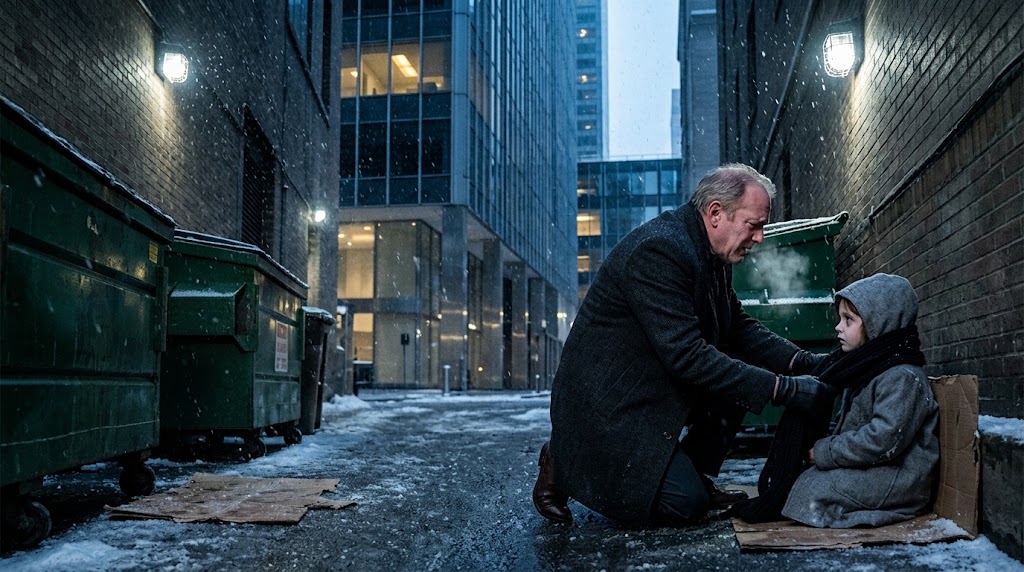
Richard crouched down to eye level.
“I owe you more than I can say.”
Eva shrugged.
“I just ran fast.”
Richard laughed despite everything.
“You did. You really did.”
He reached into his pocket and held out a folded envelope.
Eva looked at it.
“What is it?”
“An education fund. For whatever you want to study. When the time comes.”
Eva’s grandfather put a hand on the girl’s shoulder.
Eva looked at Richard.
“I didn’t do it for money.”
“I know. That’s why you deserve it.”
Caroline crouched down beside her father.
She and Eva looked at each other.
She said:
“You remember me?”
She nodded.
“The bridges.”
She blinked.
“You remember that?”
“You said good — now you know where it’s weak.”
Caroline’s jaw tightened.
“Your bridge didn’t collapse this time.”
Eva thought about it.
“I guess not.”
She held out her hand.
She shook it.
There was nothing theatrical about it. No cameras. No reporters. Just a woman who was alive and a girl who had decided she should stay that way.
The trial generated coverage for months.
Every detail of the case circulated — the falsified death certificate, the cottage, the gold pendant, the mud-covered girl sprinting through a rainstorm four miles to stop a burial.
People described it as unbelievable.
Richard didn’t use that word.
He thought it was entirely believable.
Because it had happened.
Months later, a journalist asked Richard what the hardest part of the experience had been.
He didn’t say it was opening the coffin.
He didn’t say it was learning the truth about Vanessa.
He said:
“The hardest part was the forty seconds between lifting the lid and hearing Susan say she had a pulse.”
“Why forty seconds?”
“Because in forty seconds, I had to decide whether to hope. After three days of believing she was gone.”
He paused.
“Hope is harder to feel than grief. Grief has rules. You know what it is. Hope doesn’t tell you if it’s lying.”
The journalist printed that quote in full.
Caroline read it and called him.
“That was a bit dramatic.”
“It was accurate.”
“Did you really count forty seconds?”
“I don’t know. It felt like forty.”
“It felt like a year from where I was.”
They were quiet for a moment.
Then she said:
“I was there, you know. In the dark. I could hear something but I couldn’t move. I kept trying to find my hand.”
Richard’s voice dropped.
“I know.”
“And then it was light and you were yelling my name.”
He didn’t answer right away.
“I’m sorry it took so long.”
“Dad.” She said his name like she was correcting something. “You opened the coffin.”
“A ten-year-old told me to.”
“And you listened.”
That was the part that stayed with Richard.
Not the coffin. Not the verdict. Not even Eva running through the rain.
The part that stayed with him was the moment he had a choice.
A child — mud-covered, breathless, contradicting every official document and every adult present — had said something impossible.
Richard could have had him removed.
Could have called it cruel confusion.
Could have protected the dignity of the ceremony.
Could have lowered the coffin.
Instead he said:
“Stop.”
That word saved more than a life.
It broke the momentum of a lie that had been carefully built over three days.
Because some terrible mistakes become irreversible not because nobody warned you.
But because everyone decides it is too inconvenient to check.
Eva grew up.
She studied civil engineering — the same structural principles Caroline had introduced her class to with wooden sticks and small bridges.
She sent her a photograph the day he received her degree.
She framed it.
Hung it in the architecture firm she eventually ran.
When colleagues asked about it, she said:
“Kid I know. He has good instincts.”
They asked what she did.
She said:
“He stopped something from collapsing.”
That was the story she told at work.
The full version — the one with the coffin and the rain and the mud — she kept for conversations she trusted.
Not because it was shameful.
Because it was hers.
Richard kept the white funeral program.
On the back, in his own handwriting, he had written three words the day he brought Caroline home from the hospital.
SHE WAS ALIVE.
Not to the printer.
Not to the funeral home.
To himself.
Because for three days, he had lived as though Caroline’s story was finished.
It wasn’t.
The program became a reminder of how final a final-looking thing can seem — and how completely wrong it can be.
They visited the cemetery once on the anniversary.
Stood beside the grave that had been dug for Caroline.
It had never been filled.
The plot sat empty under sunlight.
Caroline stared at it.
“Creepy.”
Richard laughed.
“Very.”
She gave him a look.
“You were really going to put me there?”
“I had strong evidence you were dead.”
“Apparently not strong enough.”
He didn’t answer that. She was right. He’d believed too quickly, grieved too quietly, and handed too much control to a woman who had engineered all of it.
That was the part he lived with.
Caroline knew.
She didn’t let him live there permanently.
“Fill it,” she said.
“What?”
“The plot.”
“With what?”
She thought.
“A tree.”
So they planted one.
A maple.
No marker. No name.
Just something growing where a coffin had once hung above an open grave.
Richard liked that.
Something alive in a place where everyone had once expected an ending.
Eva heard about the tree later.
She said it was a good idea.
Caroline told him it was her idea.
He said:
“Obviously.”
She threw a pen at him.
She ducked.
Harold laughed.
And that was how they spent the afternoon.
Not in silence. Not in ceremony.
Just in the ordinary noise of people who were still here.
Who had chosen to stay.
Who had refused — each in their own way, at their own moment, with whatever they had available — to let the worst thing finish what it had started.
Richard never forgot what Eva said when asked if he’d been afraid everyone would think he was crazy.
Eva said:
“Everybody did think I was crazy.”
“Then why keep yelling?”
He shrugged.
“She was still in the box.”
Not:
I wanted to be brave.
Not:
I knew I was right.
Just:
She was still in the box.
Someone was in danger.
That mattered more than looking foolish.
And because one mud-covered girl refused to stay quiet — Caroline Whitmore lived long enough to write the rest of her story herself.
Original fictional stories. AI-assisted creative content.