The child came out of the fog like the mountain itself was warning them.
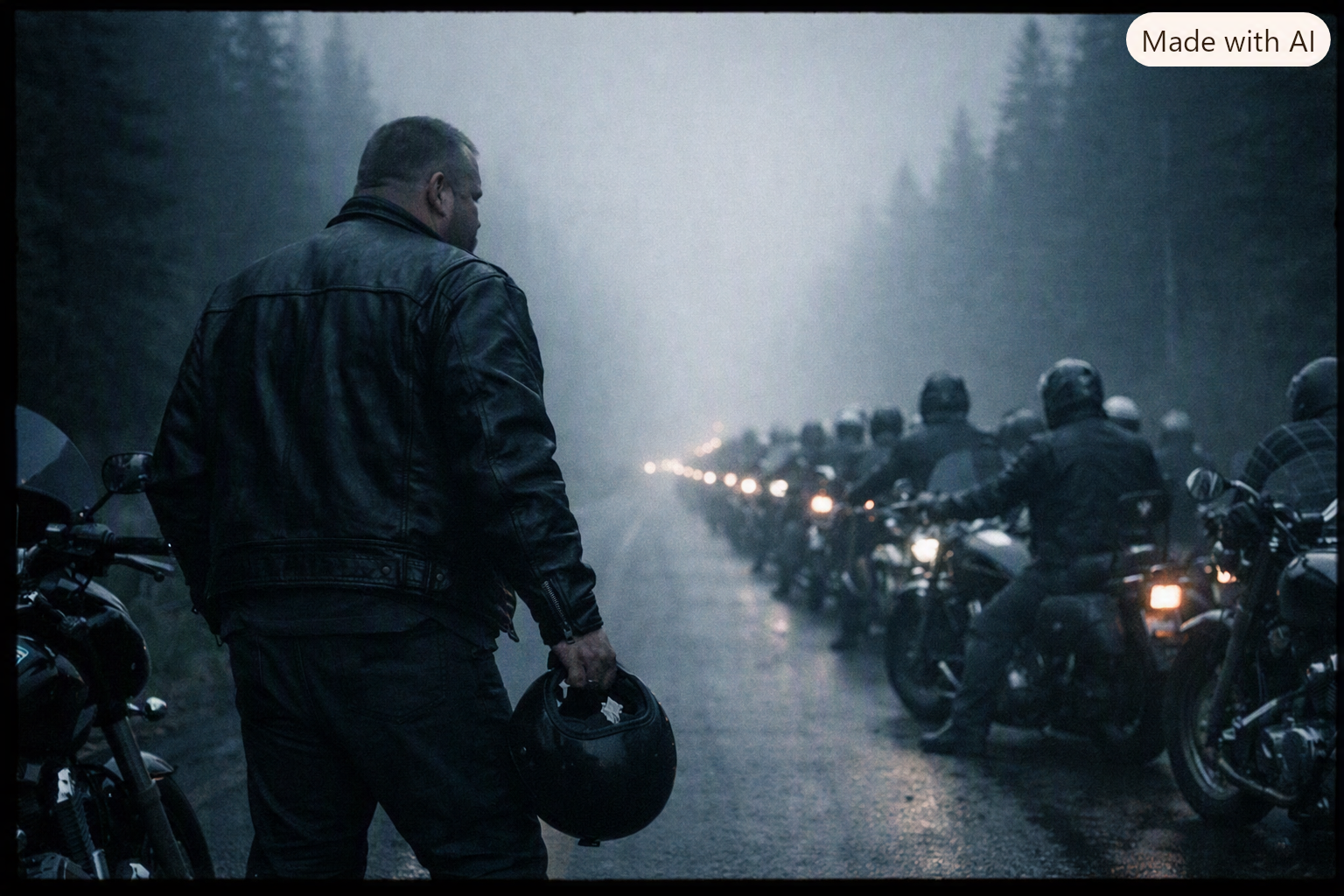
She stood in the middle of the road with both arms stretched wide, her tiny body trembling inside a coat made for a grown man. Behind her the curve disappeared into mist and pine shadow. In front of her, 114 Harley engines roared forward like thunder with headlights.
Cole Mercer saw her only seconds before his front tire reached her.
He locked the brakes. The rubber screamed across cold asphalt. His Road King stopped less than two feet from her knees. Behind him the entire Iron Shepherd convoy reacted in a chain of shouts, brakes, and controlled chaos.
Nobody went down. Nobody hit her. Nobody breathed for a moment.
The girl did not flinch.
Her lips were blue. Her sneakers were torn and caked with mud. The coat hanging from her shoulders was dark green military surplus, sleeves rolled back so many times they looked like cuffs on a doll. Cole pulled off his helmet. The engines died one by one until only ticking metal, wind in the pines, and the child’s shallow breathing remained.
He stared at her. She stared back.
Then she said five words that turned the whole morning into something none of them would ever forget.
“Please, don’t go that way.”
Her voice was barely there. Not dramatic. Not theatrical. Just cracked, hoarse, exhausted, and certain.
Cole crouched slightly. “Lily, why can’t we go that way?”
She swallowed like it hurt. “Men in the trees.”
No one behind Cole spoke.
“They have guns.” Her arms stayed stretched wide, as if she still didn’t trust the motorcycles not to surge forward. “They put things in the road. Sharp strips.”
Cole felt the man beside him change. Russ Haley, Iron Shepherd sergeant-at-arms, former combat medic. He didn’t move. He changed. The difference was invisible to most people. Not to Cole.
“How far?” Cole asked.
“After the curve. Maybe a quarter mile.”
Three riders left their bikes without being told. Danny Park led them into the trees south of the road. Cole stayed with the girl.
“You can put your arms down now.”
She did not.
“We stopped.”
She studied him with eyes too old for her face. Eyes that had learned that grown-ups made promises mostly because promises were free.
Cole softened his voice. “We are not going through that curve.”
Her arms lowered. The relief that passed through her body was so small someone else might have missed it. He unclipped his thermos and held it out. “The coffee is cold.”
She looked at the thermos, then at his face. A pause that wasn’t shyness. It was calculation. The cautious math of a child who had learned that gifts sometimes came with hooks. Then she took it with both hands and drank the cold coffee like it was soup.
The sight hit Cole harder than he expected. Not because she was hungry — he had seen hunger. Not because she was cold — he had seen cold. It was the way she accepted the drink without expecting comfort from it. A child her age should have complained about the bitterness. Lily drank it like she had already decided that bitter was better than empty.
The radio crackled.
“Four men,” Danny said. “Blue Ford pickup blocking the bend. Two long guns visible. Spike strips laid in the gravel.”
No one behind Cole needed the danger explained. Spike strips on a blind curve would have turned the first motorcycles into a pile of bodies before the back half of the convoy even knew what had happened.
Lily heard it. She did not smile. She did not look proud. She only looked tired.
“You believe me now?”
Cole looked at her torn, scraped palms. “I believed you before.”
“Why?”
“Because you didn’t tear yourself open running through these woods to play a joke on strangers.”
Something inside her loosened. Just a little. Just enough for her shoulders to drop one inch.
Cole called the county sheriff while the convoy began the careful process of rotating 114 motorcycles on a narrow mountain road wrapped in fog. By the time he ended the call, units were already moving toward the ambush site.
“You should go home,” Cole said. “Back to your people.”
Her face changed for half a second. A flicker of dread. A child’s instinctive refusal. Then it vanished. “I can go.”
“Who is at the cabin?”
Silence.
“Lily.”
She stared at the ground. “My grandma was.”
“Was?”
“Since last winter.”
Those three words carried more weight than the fog, the ambush, and every roaring engine behind him.
Not last night. Not last week. Since last winter.
Cole watched her turn toward the forest. She moved carefully, stepping with precision, as if every rock and root had betrayed her once and she remembered all of them.
He rode thirty yards. Then he stopped.
Russ pulled up beside him without asking why.
“I need to see where she is going.”
Russ had already turned his bike. “Yeah.”
The cabin appeared between the trees like something the mountain had almost finished swallowing. It leaned to one side. Moss blackened the roof. The door hung crooked on one surviving hinge. Cole stopped outside it. Then he saw the smoke stain above a gap in the roof. Someone had been burning tiny fires inside. Someone small had been fighting winter one twig at a time.
“Lily?”
She came through a gap in the back wall. She had been watching them the whole time.
“You came back.” Not a greeting. A test.
Cole crouched. “Because you should not be alone here.”
She looked at the pallet of thin blankets arranged with painful care. “I did okay.”
Those three words nearly undid him. Because they were almost true. She had survived. She had made fire. She had rationed wood and patched holes and kept herself breathing. But surviving was not the same as okay.
“Come with us,” Cole said. “On mine.”
She studied him. “Will it be loud?”
“Very.”
She thought about it. For one second she looked exactly six years old.
“Okay.”
They found a spare child-sized helmet — bright orange, left over from a charity ride. Lily accepted it gravely. Cole lifted her onto the Road King in front of him. When the engine started beneath her, she went rigid for two seconds. Then, by visible force of will, she relaxed.
He felt that tiny act of courage through the handlebars.
The convoy rolled into Harland County soaked, late, and carrying a child who had changed everything.
Gareth Euan, Eastern Chapter president, looked up from a tractor engine and read the situation without dramatics. “This is Lily,” Cole said. “She will be with us for a bit.” Gareth looked at the child. “You hungry?” “I had a protein bar.” Gareth didn’t smile. “That is not what I asked.” The corner of Lily’s mouth shifted toward something almost alive. “Yes.”
While she ate, Cole’s phone rang. Unknown number. He almost ignored it.
“Cole Mercer.”
“Name is Raymond Dawson.” The voice was rough and tired. “I think you have my niece.”
The words brought the mountain back into the room.
“Who are you?”
“Dorothy Dawson was my mother. Lily is my niece.”
Cole looked toward the kitchen door. “She said Dorothy had a son.” “She probably said I was trouble.” “She did.” A broken sound came through the phone. “She was not wrong.”
Raymond said he’d been incarcerated. Federal. Drug distribution. Four years. He claimed Dorothy never told him Lily existed. He said he’d been searching since July.
Then he said something that made Cole’s skin go tight.
“Tell her I know about the photograph. The woman in the yellow dress is my mother too.”
Cole called the county sheriff. Angela Torres confirmed Raymond was real — the record, the parole officer, the job, the formal family services inquiry. Everything on paper looked exactly like what he claimed.
That was the problem. Paper had a way of making dangerous things look orderly.
Danny Park drove to Danner Falls to meet Raymond in person. He came back three hours later with rain on his jacket and a folded document in his hand.
“He is real. That is not all.”
Cole unfolded the paper. County Family Services. Emergency family placement filing. Raymond Dawson at the top. Lily Dawson in the center. A timestamp at the bottom.
The filing had been submitted four hours earlier. Before Raymond called. Before county had any clear report that Lily had been found. Before the system knew where the child was, Raymond Dawson had already filed to claim her.
The timeline didn’t hold.
Cole thought about the ambush. He thought about the convoy route posted on the club’s internal calendar for three weeks. He thought about four armed men with spike strips. He thought about a child who had been invisible on a mountain until the exact day a man filed papers to claim her.
“The ambush was not random,” Cole said.
Danny didn’t disagree.
Someone had known the convoy would be on that road. Someone had wanted them delayed. Someone had wanted legal paperwork moving before anyone else could understand what Lily represented.
When Cole laid out the timeline in front of Gareth, Russ, Danny, and Jimmy Ror, Gareth asked the question nobody wanted to hear.
“Who had access to the internal calendar?”
Cole looked at Jimmy. “Dale Ror.”
Jimmy’s face changed. “Dale is clean.”
“Is Dale connected to Raymond Dawson?”
“I do not know.”
“Dale was living in Danner Falls.”
Jimmy swallowed hard. “He needed money eight months ago. I gave him some.”
Angela Torres confirmed it minutes later. Dale Ror had been questioned in Danner Falls six weeks earlier. The address connected to him was registered to Raymond Dawson. One of the ambush men had a prior address in the same county.
The separate pieces were no longer separate. They were a pattern.
Raymond Dawson was not just a concerned uncle. At minimum, he was close to the people connected to that morning’s attack. At worst, he was part of the machine that had nearly killed 114 riders and now had legal paperwork pointed at a six-year-old girl.
Cole looked toward the small office where Lily slept in a borrowed sleeping bag, her bandaged hands folded on top. For the first time all day she looked her age. That made the danger feel worse.
By midnight, the compound changed without appearing to. No weapons visible. No theatrics. But eyes covered every approach. The office door locked from inside. A family lawyer was on the phone with Gareth. The machinery of government moved slower than danger.
At 12:47 in the morning, a blue pickup sat on the service road with its lights off and engine running. Two occupants.
Raymond stepped out, work-built, tired, with Dorothy’s eyes.
“I would like to see her.”
“She is asleep.”
“I do not want to wake her.”
Cole studied him. “You can know she is safe from here.”
Then the passenger door opened. A woman in a county lanyard stepped into the rain. Karen Selby. Family services, Danner Falls. Emergency placement. A court order signed by Judge Wills authorizing a welfare check.
“You are legally required to allow access.”
Cole looked at the document. The timing. The jurisdiction. The midnight arrival. The caseworker riding in Raymond’s truck instead of a county vehicle. The pickup bed covered with a tarp that lay flat against something heavy underneath.
He called Angela.
Judge Wills had no jurisdiction over Harland County. “Do not allow access,” Angela said. “I need twenty minutes.”
Cole returned to the gate. “Wait twenty minutes.” Karen objected. Raymond looked at Cole for a long moment. Then said, simply, “Twenty minutes.” Not to her. To Cole. That too felt wrong.
Terry had been watching from the office window. “The suspension is riding low. That truck bed is not empty.”
Then Abe radioed. Raymond had left the gate. He was walking the fence line toward the utility access — a hidden gap in the perimeter only chapter members should have known.
Cole ran through the rain.
Raymond came through the gap and stopped four feet away, hands up. “I am not armed.” “Why are you here?” “Because I cannot tell you in front of Karen.”
“Tell me.”
“She is not county.”
The rain seemed to pause.
“Her name is Karen Selby, but she does not work for family services. She works for Victor Crane.” Raymond was breathing hard. “Crane runs distribution through three counties. Dale got involved with his people. The men on the mountain — Crane’s contractors.”
“You knew.”
“I knew too late.” He looked wrecked, but not innocent. “I connected Dale with logistics people. I did not know the target was your convoy.”
“Then why Lily?”
Raymond’s eyes closed for half a second. “Because Dorothy was a witness. A material witness in a federal investigation into Crane. She died before she testified. They called it natural causes.” His voice cracked. “I have spent three months wondering whether I believed that.”
Cole’s breath went slow. “Lily knows something?”
“Maybe. Or Crane thinks she might. Dorothy raised her. If Dorothy told anyone what she knew, it would have been Lily.”
“She is six.”
“Crane does not care.” Raymond’s face twisted. “He does not leave loose ends.”
The truth landed worse than Cole had imagined. Lily wasn’t merely a neglected child. She was a possible witness. A living memory. A tiny carrier of something her grandmother may have hidden in stories, bedtime talk, names, numbers, or a photograph nailed to a cabin wall. The woman at the gate was not there to protect her. The court order was bait. The camera equipment under that tarp was meant to capture the Iron Shepherd refusing a county document — footage that could turn protectors into criminals before the truth caught up.
Victor Crane had built a trap from law, fear, and timing.
But he had underestimated one thing. He had underestimated what happens when people who have spent their whole lives being judged by appearances learn to look past them.
Cole brought Raymond inside. Danny had already intercepted Karen near the east side of the building, where she’d stepped away to make a phone call. Angela Torres arrived eighteen minutes later, two minutes ahead of schedule, with a folder, plain clothes wet from the rain, and a face that said the night had become official.
She looked at Karen. “I spoke with state family services oversight.” Karen said nothing. “They have no Karen Selby employed in the Danner Falls regional office.”
Angela opened the folder. “Judge Wills has been suspended pending a judicial conduct inquiry tied to a federal warrant application involving Victor Crane. The order you presented exists on paper. It is not valid here.”
Karen asked for a lawyer. Angela nodded. “That is a reasonable request.”
The fake caseworker was detained without drama. The blue pickup was secured. The camera equipment was found. Raymond gave his statement voluntarily. By three in the morning, the machinery had finally begun moving in the right direction.
Lily woke before dawn.
She sat inside the office with the sleeping bag around her waist and studied Raymond in the hallway as if memorizing a face she had only known through someone else’s grief.
“You made bad choices,” she said.
Raymond swallowed. “She was right.”
“It hurt her.”
“I know.” His voice held only because he forced it to. “I am sorry for what I did to Dorothy. I am sorry I was not there. I did not know you existed.”
Lily looked at him for a long time. “You have her eyes.”
Raymond looked as if those four words had hit harder than any accusation. “People used to say that.”
“She kept a photograph of you at the old house.” Lily’s voice softened one degree. “Even when she said she was angry. I think she kept it because she hoped.”
That broke him. He turned his head and covered his mouth.
Lily watched him cry. Then she said, “Okay.”
Not forgiveness. Not trust. Not family made whole by one emotional line. Just okay. A door not closed. A beginning that understood it was fragile.
By five in the morning the rain had stopped. Karen Selby was in custody. The federal case against Victor Crane had widened. Dale Ror was cooperating. Jimmy sat with that news like a man holding something hot in both hands.
Raymond would face consequences too. He knew it. He had chosen to talk anyway.
Lily sat on the front step of the compound building wrapped in Dorothy’s coat, watching the sky change from black to deep blue.
Cole sat beside her. For a while, neither spoke.
“Are you going to keep checking?” she said finally.
“On Raymond?”
“Yes.”
“Yes.”
“On me too?”
The answer came before thought. “On you too.”
She nodded, satisfied with the shape of that.
Walt brought coffee. Lily picked it up with both hands. This time the coffee was hot. This time she didn’t drink like it might be the last warm thing in the world. She held it. She let the heat stay.
Gareth came out. Then Russ. Then Terry and Danny. Then Jimmy, who sat on a lower step and stared into his cup for a long time.
“Dale is cooperating,” Jimmy said at last. “He says he did not know about the convoy.”
“Do you believe him?”
Jimmy’s jaw tightened. “I believe he was stupid. I believe he made choices.” He exhaled. “I believe I do not know yet what to do with that.”
Cole watched the light catch on the wet motorcycles. “One day at a time.”
Jimmy nodded.
Lily looked at the quiet compound, the riders on the steps, the machines waiting in rows.
“I have never seen it from here. The sunrise.”
“Different from the mountain?”
“The mountain one is louder. Birds start before the light there.” She considered the compound’s silence. “I think I like knowing there are two kinds.”
Gareth leaned toward Cole. “She will want her own helmet. The orange one will get old.”
Lily, who heard more than most adults assumed, looked toward the orange helmet by the door. “I like orange.” Then, after a pause: “But green would also be okay.”
Walt didn’t look up from his cup. “I know a guy.”
For the first time, Lily smiled fully. It was small. It was tired. It did not erase the mountain, the hunger, the cabin, the ambush, Dorothy’s death, or the long legal road ahead. It did not make the world simple. It did something more honest than that.
It proved that after everything, something in her still knew how.
Three weeks later, Victor Crane was indicted on federal charges in three counties. The evidence included Dorothy Dawson’s sworn affidavit — recorded before her death and filed under seal with a federal agent she had trusted, waiting for the right moment to surface. The photograph on the cabin wall had been Lily’s only clue. She told Cole about the name on the back of it. That name led Angela to the agent. That agent had been waiting for someone to find the thread. Karen Selby pled guilty. Judge Wills resigned. Dale Ror received a reduced sentence for full cooperation and never showed his face in Harland County again.
Raymond Dawson was not cleared. He was honest about that. He attended every hearing, completed every requirement, and called Cole every two weeks to report exactly what Lily’s parole officer called checking in.
On the morning the court granted Cole Mercer emergency guardianship of Lily Dawson, she was sitting in the same orange helmet in the compound parking lot while Gareth adjusted the strap.
She did not say much.
She reached over and held Cole’s wrist with both bandaged hands.
That was enough.
Cole looked at the road beyond the gate. He had spent years building a life around not taking in more pain than he could survive. He had learned to ride past things that asked too much of him.
Then a six-year-old girl had stood in the fog against 114 roaring engines and taught him that sometimes the bravest thing a person can do is stop.
He had stopped.
Everything else had followed.
Original fictional stories. AI-assisted creative content.