The crate hit the platform with a hollow thud.
Sergeant Maya Voss had seen hundreds of gear inspections. She’d never flinched at one before.
This time, her hands went cold the moment the locks clicked open.
The instructor — a compact man named Garrett, gray at the temples, eyes that missed nothing — reached inside without hurry.
He pulled out a small, battered metal case.
Maya stared at it.
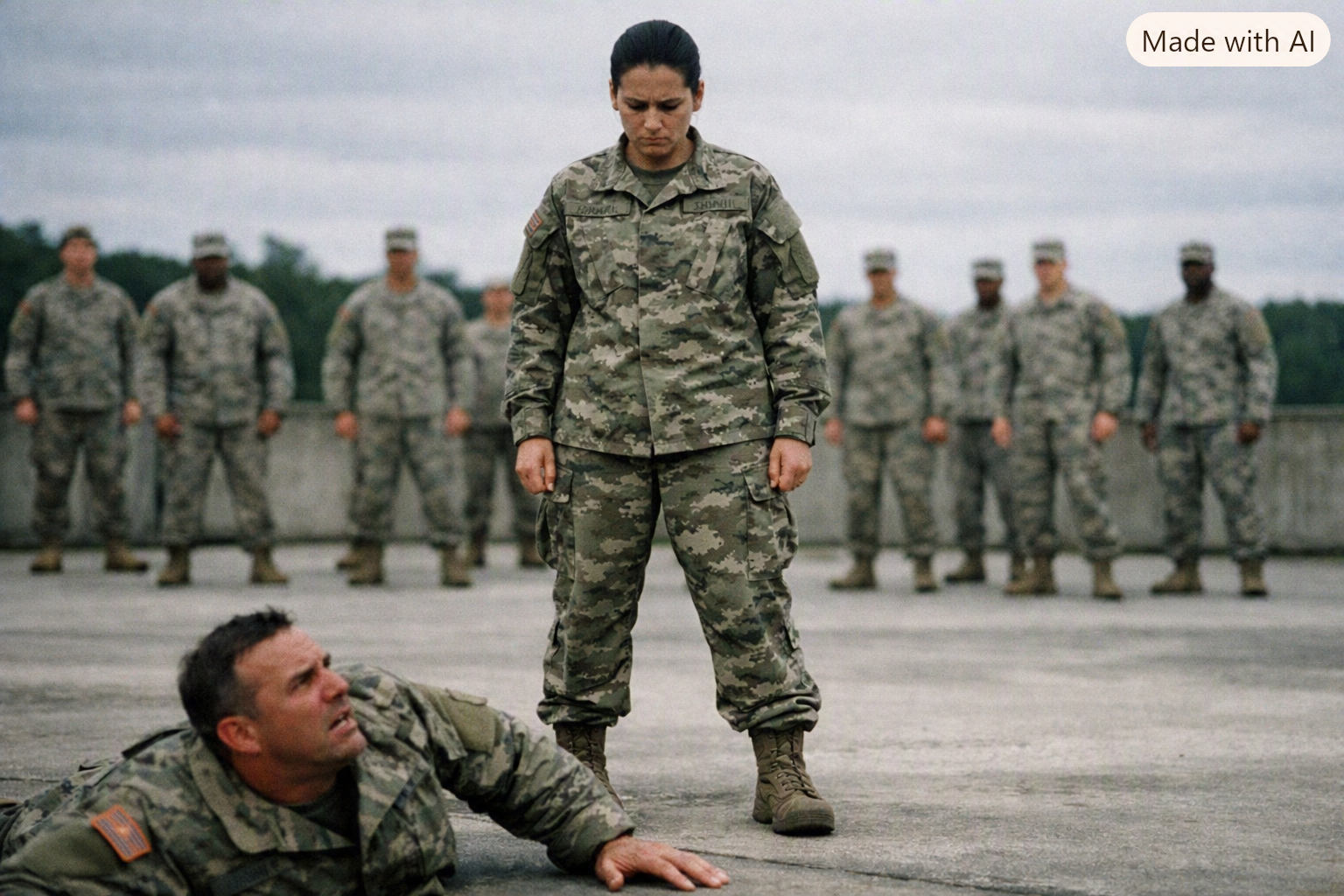
Thirty-eight soldiers stood on the training platform behind her. None of them moved.
“Recognize this?” Garrett said.
She said nothing.
“Because it recognizes you.”
Maya had transferred to Fort Caldwell six weeks earlier. Voluntary reassignment, her file said. A fresh start after years on classified ops. Nobody had asked questions. Nobody was supposed to.
She had made sure of that.
She’d built a new identity the way soldiers build cover — slowly, carefully, with the right people signing the right forms. Her past was buried under three layers of redacted paperwork and a psych eval that cleared her for active duty.
The case in Garrett’s hands was not supposed to exist.
“I don’t know what that is,” she said.
Garrett opened it.
Inside: a black unit patch, faded to gray. A photograph. And a silver identification tag, scratched almost past reading.
Maya’s breath stopped.
She knew that tag.
She had held it eight years ago on the worst night of her life. On a burning platform inside a facility that no longer existed, according to every official record she’d ever seen.
Her fingers curled into fists.
“Where did you get that?”
“Funny question,” Garrett said, “from someone who claims she doesn’t know what it is.”
A murmur moved through the soldiers behind her.
Maya glanced back. Thirty-eight pairs of eyes. Some confused. Some curious. Some already pulling out phones.
She looked at Garrett.
“What is this?”
“A conversation we should’ve had the day you arrived.”
He lifted the photograph.
It showed a military team standing outside a burning facility. Six people. Five men, one woman. The woman in the center was Maya.
She was twenty-six in that picture. Eight years younger, but clearly her.
At the bottom of the photograph was a date.
She felt the ground shift under her feet.
“I was never at that facility,” she said.
“You were.”
“I don’t remember it.”
Garrett looked at her steadily.
“That,” he said, “is exactly what they wanted.”
One of the younger soldiers behind her whispered, “Is that her?”
Another said, “She looks exactly the same.”
Maya snatched the photograph out of Garrett’s hand.
“Who sent you?”
He didn’t answer.
“Who are you working for?”
“Someone who’s been trying to reach you for three years.”
“That’s not an answer.”
“No,” he agreed. “It’s not.”
He picked up the identification tag and held it between two fingers.
“This belonged to your commanding officer.”
Maya said nothing.
“Captain Daniel Reid.”
The name escaped her lips before she could stop it.
Garrett nodded once.
“You remember him.”
She stared at the tag. The scratched surface. The bent corner. The way it caught the light.
“Reid died,” she said. “In the extraction.”
“That’s what they told you.”
“I saw the report—”
“You saw what they wanted you to see.”
She looked up sharply.
“What does that mean?”
Garrett took one step forward and lowered his voice.
“Eight years ago, an operation in a classified facility went wrong. Everyone on your team was reported killed. Remains unrecoverable.”
“I know what happened.”
“Do you?”
“I survived. I was the only—”
“No,” he said. “You weren’t.”
The silence on the platform was total.
Maya heard the wind moving through the tree line at the base perimeter. She heard her own heartbeat.
She heard nothing else.
“Reid survived the explosion,” Garrett said.
“No.”
“He survived the extraction.”
“That’s—”
“And then someone ordered his disappearance.”
Maya stared at him.
For eight years she had carried the weight of that night. The smoke and the screaming and the red emergency light pulsing above a locked steel door. The sounds of her team. Then silence.
She had been debriefed. Cleared. Reassigned. Then reassigned again, and again, and again — always to posts far from anyone who had known her before.
She had told herself that was grief. That she was running from the memory.
Now she wondered if something else had been running her.
“Why are you telling me this?” she said.
Garrett reached into the crate one final time.
He removed a small black envelope.
He held it out.
“This was supposed to reach you three years ago.”
She didn’t take it.
“What’s in it?”
“Proof.”
“Of what.”
“That Captain Reid is alive.”
She grabbed the envelope.
Before she could open it, a sound cracked from somewhere beyond the tree line.
Sharp. Clean. Familiar.
Rifle shot.
The platform erupted.
“Sniper!”
Soldiers dropped into defensive positions. Someone grabbed cover behind the equipment crates. Another sprinted toward the main building.
Garrett seized Maya’s arm and pulled her behind the steel railing.
“Down!”
A second shot. A light above the platform exploded. Glass rained across the ground.
Someone behind them was shouting coordinates into a radio.
Maya pressed her back against the railing.
“You knew,” she said.
Garrett said nothing.
“You knew this would happen.”
A third shot struck the railing six inches above her head. Metal sparked.
She looked at him.
“You set this up. All of it. The case, the photograph — you staged this whole scene to draw me out.”
“I didn’t stage anything.”
“Then how did they know—”
“Because they’ve been watching you since you arrived.”
The shouting across the platform grew louder. More shots from the tree line. Maya heard the distinct crack of return fire now — two of her unit’s sharpshooters had positioned on the roof.
She looked at the envelope in her hand.
She tore it open.
Inside was a photograph.
A man, standing beside a river. Older. Scarred along the jaw and left temple. Thinner than she remembered.
But unmistakably him.
Captain Daniel Reid.
On the back, six words in handwriting she recognized immediately:
He’s alive. But he remembers everything.
Her throat closed.
She turned the photograph over.
In the bottom corner: today’s date. This morning.
Someone had taken this picture within the last twelve hours.
Reid wasn’t somewhere in the past. He wasn’t a ghost or a file or a report. He was alive and close and he had sent this photograph directly to her.
Which meant he knew she was here.
Which meant he had been watching her too.
She looked at Garrett.
“Who is shooting at us?”
His face had changed. The careful, measured expression he’d worn through the entire confrontation was gone. Something underneath it was showing now. Something that looked like fear.
He was looking toward the dark tree line beyond the eastern fence.
Not where the shots had come from.
Somewhere else.
“Garrett.”
He raised his weapon slowly.
“It’s not Reid they’re hunting,” he said.
“Then who?”
He looked at her.
“It’s you.”
A voice called her name from somewhere in the darkness.
Not her rank. Not her last name.
Her first name. Her real name. The one she hadn’t used in eight years.
She was on her feet before she knew she’d stood.
The shooting had stopped. The soldiers on the roof were shouting that the tree line was clear. But Maya wasn’t listening to them anymore.
She was listening to the silence that followed her name.
And then she saw him.
A figure at the edge of the floodlights. Just inside the perimeter fence, where the light and the dark met. A man standing still while everyone else moved.
Older. Scarred. Familiar.
He didn’t move toward her.
He just stood there, and he looked at her, and eight years collapsed into a single moment.
“Reid,” she said.
It came out barely above a whisper.
He took one step into the light.
His voice hadn’t changed.
“You still lead with your left,” he said. “Still give your position away.”
She couldn’t speak.
“Eight years and you haven’t fixed it.”
“They told me you were dead.”
“They told you a lot of things.”
She crossed the platform in a dozen steps. She stopped two feet from him, close enough to see the new lines around his eyes, the silver in his hair, the scar that ran from his temple to his jaw.
He looked at her the same way.
“Who did this?” she said.
“The same people who buried your memory.” His voice was even, careful. “Who reassigned you six times in three years. Who put you in this unit specifically because they knew I’d eventually come for you.”
“You could have come earlier.”
“I couldn’t reach you. Every channel was monitored.”
“So you sent Garrett.”
“I needed them to see you react to the evidence.” He glanced toward Garrett, who was still watching the tree line. “I needed them to think I wasn’t here yet. That this was just a revelation. A confrontation. Not an extraction.”
Maya looked at him.
“An extraction.”
“We’re leaving this base tonight.”
“I can’t just—”
“You can,” Reid said. “Because you’re not who they say you are. You’re not whoever you’ve been pretending to be for eight years.”
She met his eyes.
“And who am I?”
“The only other person who knows what actually happened in that facility.” He held out his hand. “The one they’ve been trying to silence since.”
She looked at his hand.
She looked at the base behind her. The soldiers reforming. The lights coming back on. The radio traffic. The ordinary machinery of a life she had built carefully and deliberately over years.
She thought about the six names on the team roster in that photograph.
She thought about the five that were listed as dead.
She thought about the people who had told her Reid was one of them.
She took his hand.
They moved through the eastern perimeter before the next patrol cycle.
Garrett stayed behind to manage the incident report. He’d been prepared for this. He handed Maya a new phone, a set of coordinates, and a name — the kind of name that opened doors in certain government buildings without appointments.
They were two miles from the base when Maya finally asked the question she’d been carrying for eight years.
“The others on the team. Are any of them—”
“No,” Reid said.
She absorbed that.
“Just us.”
“Just us.”
She walked in silence for a moment.
“The people who ordered their disappearance.”
“Yes.”
“Do you know who they are?”
Reid reached into his jacket and pulled out a folded document. Thick paper. The kind used for classified briefings.
He handed it to her.
She unfolded it under the light of the phone Garrett had given her.
Names. Dates. Authorization signatures.
A chain of command that went up through three levels of oversight before it reached a single name at the top.
A name she recognized.
A man who was currently serving as Deputy Director of the agency that had cleared her, reassigned her, and scrubbed her past.
“He’s still active,” she said.
“He’s expecting a promotion next month.”
She folded the document carefully.
“Not anymore,” she said.
Three weeks later, the Deputy Director resigned without explanation.
An anonymous report, submitted through three separate secure channels, had reached the Inspector General’s office, the Senate Intelligence Committee, and a federal prosecutor who had been building a related case for four years.
The report contained photographs, identification records, a chain of classified communications, and the testimony of two individuals whose identities remained sealed.
The investigation that followed took sixteen months.
It ended with nine indictments, four convictions, and the declassification of a 2016 operation that had officially never taken place.
The final declassified document listed the names of six team members.
Five of them were reinstated to the record as killed in action — honored, officially, for the first time.
The sixth was listed as the operation’s sole survivor.
Her file, which had been altered, reassigned, and scrubbed across eleven years, was corrected.
Her real name was restored.
And somewhere in a city that wasn’t in the document — because some things still didn’t need to be written down — Maya Voss sat across from Daniel Reid at a table near a window, and drank coffee, and let the morning come in.
“You should’ve fixed that left-side tell,” he said.
She looked at him.
“I’m working on it.”
He almost smiled.
She did.
Original fictional stories. AI-assisted creative content.