The flashlight beam found him in the dark.
Leo sat hunched inside the cavity between the pine studs, knees drawn to his chest, a small black micro-recorder clutched in both fists like a weapon. His skin was the color of skim milk. His hair was matted and pale from five years without sunlight. But his eyes — dark, wide, ferociously alive — locked onto mine without flinching.
“Daddy,” Leo rasped. “You took so long.”
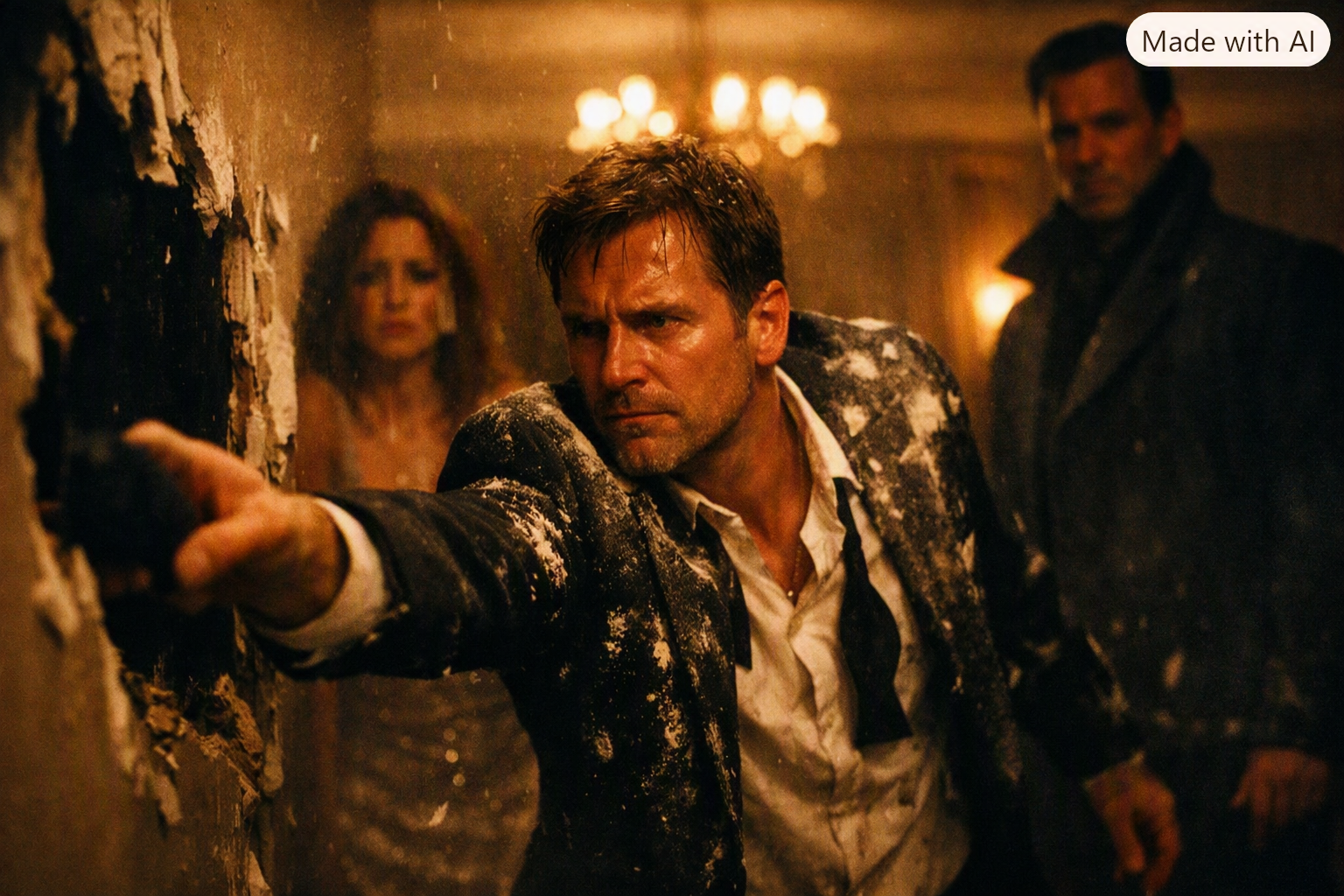
Those three words cracked something open in my chest that I didn’t know I still had. I dropped to my knees on the shattered drywall and plaster dust without feeling a thing. My hands were bleeding from tearing the wall apart with the sledgehammer. My tuxedo jacket was ruined. None of it registered.
Only the heartbeat I could feel when I pulled him against my chest.
Thump-thump, thump-thump.
He was real. Warm. Breathing.
“I’ve got you, buddy,” I choked out, pressing my face into his matted hair. “I’ve got you.”
“Don’t let her put me back,” Leo whimpered, his thin arms locking around my neck with a strength that surprised me. “Don’t let Aunt Clara put me back in the dark.”
At the sound of her name, I looked up.
Clara stood ten feet away, backed against the mahogany liquor cabinet, her hands clamped over her mouth. The expensive blue designer dress she’d worn to the charity gala was smeared with plaster dust. Her mascara had run in dark, jagged lines down her cheeks. Her eyes — usually so cool, so perfectly composed — were blown wide with raw, animal panic.
“Arthur,” she whispered. “Please. Don’t listen to him. The trauma — the oxygen deprivation in this old house — it’s making you see things. Put him down. That’s not Leo.”
I stood up slowly, putting my body between my son and the woman who had lived in my home for five years.
“Not Leo,” I repeated.
Clara nodded frantically. “We took in a sick orphan from the county clinic to help stabilize your mental health. You were losing your mind, Arthur. You wanted a replacement so badly—”
“Shut your mouth,” I said.
It wasn’t a shout. It came out flat and cold, like a door closing. Clara flinched like I’d struck her.
I took one step toward her.
She scrambled backward on her heels, sliding down the cabinet until she hit the marble floor. “Arthur, I’m warning you—”
“Warning me?” I said softly. “You locked my five-year-old son inside a hollow wall. You held a funeral. I stood at that grave and I wept, and you stood beside me with your hand on my arm and told me he was at peace.” I took another step. “You moved into my home. You poured my whiskey. And the whole time, he was breathing six feet away behind a layer of drywall.”
Clara’s composure crumbled completely. Tears streamed down her face, cutting paths through the plaster dust on her cheeks.
“It wasn’t supposed to go this far,” she gasped. “I never wanted—”
“Who planned it?” I cut across her. “Who was it?”
Before she could answer, I heard it.
A sound from behind me.
Click.
The French doors to the private courtyard swung open on silent brass hinges. A cool gust of autumn air rolled in carrying the smell of pine and damp earth. Framed in the doorway stood a tall, broad-shouldered man in a dark cashmere overcoat, collar turned up against the wind.
Julian Vance. My CFO. My most trusted advisor. The man who had stood beside me at the graveside five years ago, holding a black umbrella over my head while I wept over an empty coffin.
He stopped when he saw the gaping hole in the drawing room wall.
His eyes moved from the cavity to Clara on the floor to Leo in my arms. For three seconds, nobody moved.
Then Julian’s expression shifted. The deferential corporate mask dissolved, replaced by a cold, calculating stillness.
“Well,” Julian said quietly. “I wondered how long that drywall would hold. Termites are terrible this time of year.”
“Julian,” I whispered.
“Me,” he confirmed. He unbuttoned his overcoat without hurry, reaching inside his breast pocket for a cigarette case he didn’t open. “You know, Arthur, you really should have invested in better contractors. I told Clara five-ply pine was too thin for a permanent partition, but she insisted you were too frugal to ever check the structural integrity of the west wing.”
“You were part of this,” I said. “From the beginning.”
“From the very beginning,” Julian agreed pleasantly. He tilted his head, studying the situation with the detached precision of a man reviewing a quarterly report with unfavorable numbers. “The question is what happens next.”
Leo shifted in my arms. “Daddy,” he murmured against my neck. “He’s the bad man. He came with Aunt Clara on Tuesdays. He talked through the drywall. He talked about the bank accounts. He talked about making you sign papers.”
Julian glanced at the boy with a flicker of annoyance. “Pesky kid. I told Clara we should have sent him to a boarding school in Vermont under a false name. But she was sentimental. Wanted him close.”
“Sentimental?” Clara shrieked from the floor, scrambling upright on unsteady legs. “I didn’t want him dead, Julian! You were the one who wanted the estate fully liquidated! You said Arthur would never sign over the corporate trust while there was a living legal heir!”
Julian didn’t look at her. “Shut up, Clara. You’re unraveling.”
“You promised nobody would get hurt!” Clara’s voice tore itself into something raw and desperate. “You promised we would just hide him until Arthur signed the merger papers!”
“People always get hurt when this kind of money is involved,” Julian replied calmly. He turned his gaze back to me, and for the first time I saw the calculation behind his eyes clearly — like watching a clock mechanism you’d always assumed was decorative actually turning. “Four hundred million dollars in unliquidated assets, Arthur. Coastal real estate. Venture capital portfolios that have been appreciating quietly for five years under my very careful management.”
“So you faked my son’s death,” I said. “To access the Carter Holdings trust.”
“When Clara came to me — complaining that you were planning to cut her out of the will after the divorce — we realized we had a unique opportunity. If Leo died tragically, you’d enter a state of prolonged psychological collapse. You’d sign a power of attorney over the estate’s daily operations. Who better to manage it than your loyal CFO and your devoted sister-in-law?” Julian spread his hands in a gesture of almost gentle reasonableness. “It wasn’t personal, Arthur. It was architecture.”
“Architecture,” I repeated.
“And now, unfortunately, the structure has developed some unexpected load-bearing problems.” Julian’s hand emerged from his coat holding a matte-black Walther PPK with a cylindrical suppressor fitted to the barrel. He leveled it at my chest with the ease of a man who had done this before. “I think it’s time we concluded the board meeting.”
Leo whimpered and pressed his face harder into my shoulder. His small hand tightened around the micro-recorder.
“Wait,” Leo said.
His voice was small. But it was steady.
Julian paused, eyebrow lifting. “Last words, kid?”
Leo’s dark eyes locked onto Julian with a composure that had no right existing in a ten-year-old’s face. Slowly, he lifted the black micro-recorder.
“You forgot something, Mr. Vance,” Leo said.
Julian frowned. “What are you talking about?”
“Every Tuesday night,” Leo said clearly, “when Aunt Clara brought me the bread — you came with her. You stood outside the drywall. And you talked.”
Julian’s jaw twitched.
“You talked about the bank accounts in the Caymans,” Leo continued, his voice dropping to a near-whisper that carried perfectly in the silent room. “You talked about how you forged the adoption papers. You talked about the sanitarium in upstate New York. You talked about the demolition crew arriving next spring and what they’d find in the drywall.”
“Give me that device,” Julian said. His smooth voice had cracked. Something ugly was pushing through underneath.
“No need,” Leo said.
His thumb pressed the play button.
Click.
Julian’s own voice filled the drawing room — warm, corporate, relaxed, the voice he used in board meetings.
“Once the merger papers are signed, Arthur will be legally incapacitated due to acute nervous exhaustion. We commit him to the private sanitarium in upstate New York, liquidate the remaining Carter Holdings shares, and transfer the forty million to the Zurich account. The boy stays behind the wall until the demolition crew arrives next spring. Nobody will look twice at a pile of old drywall.”
A second voice — Clara’s, trembling with nerves.
“And if he screams? If Arthur hears him at night?”
Julian’s recorded voice, completely cold: “He won’t hear anything. The acoustic foam we installed behind the paneling absorbs everything. And if Arthur starts asking questions, we increase the sedative in his evening whiskey. He’ll think he’s losing his mind.”
Click. The recording stopped.
The silence afterward was absolute.
Julian stood motionless in the center of the room, the Walther still pointed at my chest, but his gun hand had developed a fine, uncontrollable tremor. He stared at the small black recorder in Leo’s hand. Then he looked at Clara.
Clara looked like a woman watching the world she’d built fold in on itself. Her jaw hung slack. Her skin had gone the color of old bone.
“You had that,” Clara breathed. “The whole time. Every Tuesday.”
“You thought I was sleeping in the dark,” Leo said quietly. “Every time you left the pantry slot open I crawled as close as I could to the drywall. I knew if I didn’t keep a record, nobody would ever know I existed.”
Julian’s eyes snapped back to me. The corporate veneer was gone entirely. What was left was naked and desperate.
“Arthur. Let’s be reasonable. Seventy percent of the holdings — all of it, every share, every asset, whatever you want. Just give me the recorder and a thirty-minute head start, and—”
He didn’t get to finish.
My right hand had been moving slowly behind my back while Julian was talking, my fingers closing around the heavy iron fireplace poker I’d set against the wall when I first came through the French doors.
I hurled it.
Julian’s reflexes saved his skull by a fraction. He jerked sideways and the iron bar caught him in the shoulder with a crack of bone loud enough to echo off the walls. The Walther flew from his hand and skidded across the marble floor, spinning under the antique sideboard.
Julian screamed, clutching his shattered shoulder, staggering backward against the French doors.
I set Leo down. Not gently. Urgently.
“Stay here,” I told him.
Then I crossed the room.
Julian saw me coming and tried to push off the doorframe with his good arm. He made it two steps out onto the stone courtyard patio before I caught him by the collar.
I hit him.
The first blow drove him backward. The second dropped him. I straddled his chest on the cold patio stone and let five years of grief and guilt and phantom nightmares pour out of my fists.
“You locked him away!” I roared, striking him again. “Five years! You stole my life! You stole my son!”
“Arthur! Stop! You’ll kill him!” Clara’s voice from the French doors, strangled with terror.
“That’s the plan!” I shouted back.
From somewhere in the darkness beyond the courtyard wall, I heard it.
Gravel crunching under tires. Then the unmistakable bark of a police radio.
Red and blue light exploded across the stone walls, washing the courtyard in violent, strobing color.
“Police! Hands! Let me see your hands!”
Three state troopers surged through the courtyard gate, tactical lights sweeping the scene. One caught me directly in the face, blinding white.
I released Julian. Raised my hands.
“The wall!” I shouted, struggling against the grip of the nearest trooper. “Look inside the wall! My son was locked inside it for five years! That man and the woman in the drawing room — they faked his death! They stole the estate!”
The lead trooper angled his flashlight through the French doors into the drawing room. The beam swept across the gaping cavity in the exposed wall, landing on the cramped interior — old blankets, empty water bottles, a plastic cup, a makeshift sleeping mat fashioned from moving pads.
The trooper’s face changed. The professional hardness cracked. Something like disgust — genuine, visceral disgust — moved behind his eyes.
He pressed his shoulder radio.
“Dispatch, this is Unit Four. We have an active extraction scene at the Carter estate. Requesting immediate backup, forensics unit, and an ambulance to the main drawing room. We have a child victim recovered from a concealed partition. Repeat — child victim.”
Behind me, Julian groaned on the cold patio stone, blood tracking down the side of his face onto his expensive suit. “I want… a lawyer. My constitutional rights—”
“Shut up,” the trooper said flatly. He kicked Julian’s legs apart and locked the cuffs on with a hard metallic snap that rang across the courtyard. “You’ll get your lawyer.”
Inside the drawing room, two officers approached Clara. She didn’t fight. She didn’t make a sound. She simply sank to her knees on the marble floor and stared at the stone as the handcuffs closed around her wrists, like a woman who had finally run out of things to say.
Across the room, Leo stood near the paramedics, the emergency foil blanket already draped over his narrow shoulders, the micro-recorder still in his hand.
A female paramedic knelt beside him, her voice low and careful.
“Hey there, buddy. Are you Leo?”
He nodded.
“We’re going to take you out to the ambulance, okay? Get you some warm water. Make sure you’re safe.”
Leo didn’t answer her immediately. He turned his head, looking past her across the room toward where I stood between two troopers.
“Daddy?” he called.
I pulled free from the troopers’ grip. They shouted. I ignored them. I dropped to my knees on the ruined drywall in front of my son, wrapped the foil blanket tighter around his thin shoulders, and pressed my forehead against his matted hair.
“I’m here, buddy,” I said. My voice broke somewhere in the middle of the sentence, and I let it break. “I’m right here. And I am never, ever letting you go.”
The trial of Julian Vance and Clara Evans ran for eleven weeks and became national news under the headline: The Corporate Conspiracy and the Boy in the Wall.
The prosecution’s case was airtight. Leo’s micro-recorder contained forty-seven individual recordings spanning three years of Tuesday-night visits. Forensic accountants reconstructed the full scope of the scheme: the forged adoption paperwork, the sedative compounds added to my evening whiskey, the offshore accounts in the Cayman Islands, the sealed demolition contract for the west wing — scheduled for the following March.
Julian received three consecutive life sentences. No parole.
Clara received two. Her attorney argued she had not known the full extent of Julian’s plan. The judge acknowledged the argument and sentenced her accordingly.
The jury needed four hours.
Six weeks after the verdict, I sat at the oak dining table of the Carter estate with a cup of black coffee and watched my son eat a bowl of cereal.
Leo looked like a different child. His hair was neat. His skin had color. He wore a soft blue cotton sweater that fit him properly instead of the overlarge clothes Clara had pushed through the pantry slot. He was still quiet sometimes — still prone to long pauses where his eyes went somewhere else, checking the walls. But he was sleeping through the night. He was eating full meals. And he had learned, slowly and incrementally, how to smile again.
“Daddy,” Leo said, looking up from his cereal.
“Yeah, buddy?”
“Are we going to stay in this house?”
I looked around the dining room. The high ceilings. The crystal chandelier. The expensive artwork. For five years this estate had been a monument to a grief I now knew was manufactured — a stage set built around a living child to keep me confused and compliant.
“No,” I said. I reached across the table and ruffled his clean dark hair. “We’re selling it. All of it. The estate, the holdings, the shares. We’re packing our bags this weekend.”
Leo’s eyes went wide. “Where are we going?”
“Anywhere you want,” I said. “I was thinking the coast. Small house. Big windows facing the water. No locked doors, no dark hallways, no secret panels. Just beach, sun, and the two of us.”
Leo considered this with the gravity only a ten-year-old can bring to the question of real estate.
Then: “Can we get a dog?”
I laughed. It came from somewhere real — somewhere that had been sealed off for five years and was only now letting in air.
“We can get two dogs,” I said.
My attorney arrived the following Saturday morning while the moving trucks were loading the last of the furniture. He walked briskly up the front steps and handed me a sealed manila folder.
“The final asset liquidation for Carter Holdings cleared this morning,” he said. “Trust fully dissolved. Funds transferred to your personal account. Julian’s assets were seized by federal receivership at nine a.m.”
“Thank you, David,” I said. I slid the folder into my briefcase without opening it.
“You’re not going to look at it?”
“No.”
He smiled, shook my hand. “Enjoy the coast, Arthur. You and your boy earned it.”
I walked back down the steps to where the car was waiting. Leo was already in the passenger seat, holding a brand-new golden retriever puppy in his lap, laughing as it licked his chin.
I got in. Buckled my seatbelt. Put the car in drive.
I took one last look at the Carter estate in the rearview mirror — the high brick facade, the iron gates, the west wing with its freshly replastered wall, clean and white and sealed over the wound.
Then I drove down the gravel driveway and didn’t look back.
The Pacific coastline in Northern California in late autumn smells like pine, salt, and cold clean air.
Our new house was a single-story wooden structure with wide glass windows facing the ocean. No iron gates. No brick walls. No partitions or hidden rooms. Just the rhythmic crash of waves and the sound of a boy running barefoot across a wooden deck.
“Catch him, Buster! Catch the ball!”
Leo was tanned and loud and brimming with a vitality that still caught me off guard every time I saw it — the way joy does when you’ve spent years convinced it was gone forever.
I stood on the back deck with a mug of coffee and watched the retriever barrel across the boards in pursuit of a tennis ball, Leo three steps behind, his laughter carrying out over the water.
He stopped. Looked up. Found my eyes across the deck.
Waved his whole arm, enthusiastically, the way kids do when they’re not self-conscious yet.
“Come on, Daddy! The waves are amazing!”
I set my coffee down on the railing. I walked down the steps. I kicked off my shoes on the bottom step, feeling warm sand shift between my toes.
Behind me, the house stood open to the wind and the light.
I ran across the sand to join my son in the sun.
Original fictional stories. AI-assisted creative content.