I’ve been riding with my motorcycle club for twenty-three years. I’ve sat in rooms where the wrong word got men hurt. I’ve stared down federal agents. I don’t scare easy, and I don’t shock easy.
But nothing in two decades on the road prepared me for the eyes of a 72-year-old man trembling in the doorway of Mae’s Diner.
His name was Harold Bennett. Gray hair, flannel shirt buttoned wrong, khaki pants belted too tight. And a left-leg limp so deep that every step looked like a private negotiation with pain.
His eyes were moving too fast. Scanning the door. Scanning the room. Scanning the door again.
That’s the look of a man who doesn’t know if he’ll make it back before anyone notices he’s gone.
I watched him approach the first table. Two guys in baseball caps, coffee mugs full.
“Excuse me,” Harold said quietly. “Could I sit with you?”
“Sorry, pal. Just finishing up,” one of them said.
Harold nodded like he expected it. He moved to the next table. Then the next. Then the next.
I watched that broken old man drag his bad leg across the entire diner — seven tables, seven rejections. By the time he ran out of options, he was gripping the backs of empty chairs just to stay upright.
Then he looked at my table. The last table. The dark corner where a solitary biker in a club vest was clearly the last person any sane human being approached.
Harold was out of tables. From the look on his face, he was out of time.
He dragged himself across the floor and stopped in front of me.
I looked at him for exactly three seconds. Then I stood up, reached across the table, and pulled out the empty chair — angling it so he wouldn’t have to twist his bad leg.
“Sit,” I said.
Harold dropped into the chair like the strings holding him up had just been cut. His shoulders fell half an inch for the first time in what looked like months.
When the waitress came over, he stared at the menu like he’d forgotten how to read. “Just some toast, please. And water.”
“Get him eggs,” I told her. “Scrambled, bacon, coffee.”
“I don’t have much on me,” Harold panicked.
“I didn’t ask.”
He ate like a man rationing for survival. Small, controlled bites. Eyes on the plate. Waiting for someone to snatch it away.
I’ve seen that behavior in men coming out of county lockup. I let him finish in silence.
“I shouldn’t be here,” Harold finally said, setting his fork down.
“Why is that?”
“My grandson says I’m not safe on my own. Says I get confused. Wander off.”
My eyes dropped to his wrists. Circular bruising. Yellow at the edges. The kind that comes from being grabbed and held, not from a slip and fall.
“You get confused a lot?” I asked, keeping my voice flat.
Harold’s eyes snapped to mine. And through the polite, frightened shell, something sharp and absolutely intact cut straight through.
“I worked thirty-one years as a civil engineer,” he said. “I can still calculate load-bearing tolerances in my head. I know exactly where I am, what day it is, and what I had for dinner three nights ago — half a can of soup, because that’s what was left.”
He paused. “I’m not confused. He tells people I’m confused. There’s a difference.”
The air between us shifted.
“Who is he?” I asked.
“My grandson. Ryan. He moved in two years ago after my wife passed. Said he wanted to help.” Harold glanced at the door again. “First he handled the bills. Then he took my phone. Then my car keys and my ID. He told the neighbors I was having episodes. Told my church I was declining.”
He looked down at his empty plate. “One day I realized I hadn’t left the property in five weeks. And the back door had a new lock on it. From the outside.”
Under the table, my boot pressed hard into the floor.
“How’d you get here today?”
“He left for work. I’ve been picking the latch with a butter knife for two weeks. Walked a mile and a half to the highway and caught a ride with a trucker.”
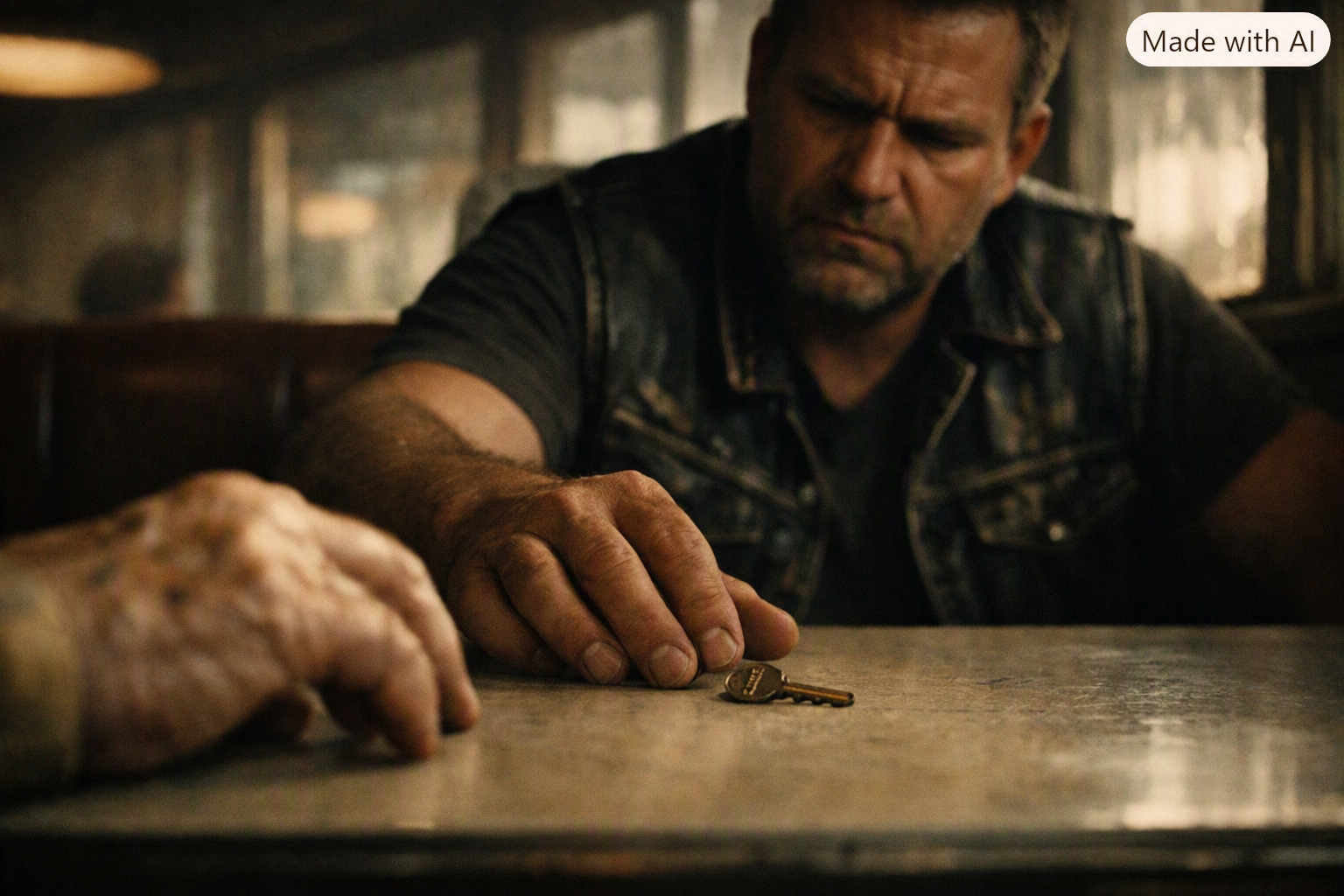
Harold reached into his coat pocket. His fingers fumbled with something small. It hit the table with a faint metallic ping.
A brass key. Paper tag attached. Unit 42, Mesa Ridge Storage.
“I rented it eight months ago,” Harold whispered. “Ryan doesn’t know. My notes, my records — everything he doesn’t want anyone to see. If something happens to me… somebody needs to know that unit exists.”
He pushed the key across the table toward me.
“Why me?” I asked. “You asked seven other people.”
Harold looked at me steadily. “Because they all said no. And because a man who pulls out a chair for a stranger isn’t the man most people think he is.”
I picked up the key. Cold and small and heavy as an anchor.
I slipped it into the inside pocket of my vest.
“You need to go back right now,” I said, low. “Before he knows you left.”
Harold flinched. But he understood. He had to walk back into the cage and pretend the lock still held.
He stood, thanked me, and limped out into the afternoon sun.
I sat alone with a cold cup of coffee and a secret that weighed everything.
I pulled out my phone and called my brothers from the club.
I had a storage unit to open.
Two nights later, I was in Unit 42 with Dex and Roach, reading Harold’s notebook out loud under a single flashlight.
Dex was the sharpest legal mind I knew — three years of law school before he quit and found out he liked motorcycles more than courtrooms.
Roach was patience and precision. Hands like a surgeon, temper like a grenade with the pin already loose.
The cardboard box inside that unit told a story that would have broken most men to read.
Bank statements — Harold’s savings drained systematically over twenty months. Ryan’s name on every transfer.
A life insurance policy — four hundred and fifty thousand dollars. Originally payable to Harold’s church. Then a change-of-beneficiary form, three months after Ryan moved in. The church erased. Ryan Caldwell, sole beneficiary.
Medical records from a Dr. Elaine Prescott: Moderate to severe cognitive decline. Frequent episodes of acute confusion. Paranoia regarding family members. Recommendation for full-time supervised care and transfer of legal and financial autonomy to next of kin.
“He’s got a doctor in on it?” Dex said.
“Or a doctor he played perfectly,” I replied. “You feed a busy physician a convincing sob story before the patient opens his mouth, and she’s already diagnosing dementia before the exam starts.”
Then, at the bottom of the box — a thin spiral-bound notebook. Dollar store. Cardboard cover worn soft from handling.
I opened it.
On the first page, in sharp, precise engineer’s script: If anything happens to me, this is why.
I read it out loud. All of it.
March 14th. Ryan took my checkbook today. He raised his voice when I argued. It was the first time he grabbed my arm.
April 2nd. Haven’t left the house in three weeks. Ryan threw away the casserole Mrs. Patterson brought. I didn’t get any.
May 19th. Found the life insurance paperwork in the trash under wet coffee grounds. He changed the beneficiary three months ago.
June 7th. The heavy lock is on the back door now. He told neighbors I tried to walk into highway traffic. I didn’t. I was just standing on the porch looking at the birds.
Dex turned away at that one. He walked to the back of the unit and stood in the dark.
Roach just stared at the concrete floor, jaw clenched so hard I could hear his teeth.
I closed the notebook and looked at both of them.
“We can’t take this to the local sheriff,” I said. “Ryan volunteers with their auxiliary unit. He drinks beers with these deputies. If we walk in there wearing our leather, they’ll bury it — or worse, give Ryan a heads-up phone call, and Harold disappears.”
“So where does it go?” Dex asked.
“Lina,” Roach said quietly. He was already pulling out his phone.
Lina Castillo. Fourteen years in the Coconino County Prosecutor’s Office. Roach’s cousin. She knew every judge in the county — and more importantly, exactly which ones were clean.
Roach called her right there in the storage unit.
Six a.m. the next morning.
We handed over everything.
Two days after we met with Lina, I drove back to Harold’s neighborhood alone. No vest. Plain black t-shirt, jeans. I parked down the street.
I found the shed in the backyard through a gap in the fence line.
A wooden structure, about ten feet by ten feet, that should have been used for lawn equipment and old holiday boxes.
The window was covered from inside with thick plywood, sealed at every edge.
A heavy commercial padlock, the kind used on loading docks, hung on the outside of the door.
I took photographs. Close-ups of the padlock, the sealed window, the bolt latch.
Then I found the gap in the back wall — a knot-hole, maybe an inch wide. I pressed my phone against it and took a photograph blind.
When I enlarged the image in Roach’s kitchen, I could see the interior.
A thin camping cot. A plastic bucket in the corner. An empty soup can on the floor. A military surplus wool blanket that had been balled up and pressed against the door crack to keep the cold from coming in.
And on the back wall, scratched into the drywall with something small and sharp and desperate — letters that looked like they had been made over many nights, gouged one millimeter at a time.
I AM STILL HERE.
Roach’s hands stopped moving when he got to that photograph. He put the phone face-down on the table. He stared at his kitchen wall for a full minute without speaking.
“I’m calling Lina right damn now,” he said.
Friday morning.
I was awake at four a.m. in my kitchen, listening to the desert silence, waiting for a phone call I had no control over.
Lina had been clear: Stay away from the property. If a Hells Angels member was anywhere near that house during the raid, Ryan’s defense attorney would shred the case as biker intimidation.
At 10:04 a.m., my phone rang.
“They’re at the house,” Lina said. “Sedona substation deputies, Adult Protective Services, a victim’s advocate. Ryan answered the door. He’s cooperating. Playing the loving grandson.”
“The shed?” I asked.
“They’re moving to the back door now. They have the emergency warrant. Hang tight.”
The line went dead.
Fourteen minutes.
I cross-threaded a bolt on a motorcycle frame and hurled the wrench across the garage. It hit the far wall and clattered to the concrete.
Dex and Roach pulled up right at that moment. They walked in, saw my face, and sat down on metal stools without saying a single word.
We waited together.
At 10:18, Lina called back.
I put her on speaker.
“They found him,” she said.
“Is he alive?”
“He’s alive.” Her voice cracked. “He was in the shed. Ryan had put a fresh padlock on the door that morning. Deputies used bolt cutters to break it.”
“Is he okay?”
Lina paused. Fourteen years in the prosecutor’s office, and she choked on a sob.
“Severely dehydrated. Drastically underweight. Ambulance is transporting him now.” She steadied herself. “Cole, he was holding something when they broke the door open.”
“What?”
“The butter knife. He was sitting on that cot, shivering, gripping the butter knife. And when the door opened and the sunlight hit his face, the first thing he asked the deputies was —”
She stopped.
“What did he say, Lina?”
“He asked, ‘Is it Friday?'”
Dex walked out into the back lot. Roach stared at the floor, jaw locked.
Harold had held on. He had survived because a stranger in a dark corner had kept his word.
“And Ryan?” I managed.
“He tried to block the back door. Told deputies the shed was storage. Said Harold just liked to sit out there sometimes. Then he claimed the padlock was to keep raccoons out.” Lina’s voice went cold and precise. “The deputy asked why there was a bucket of human waste inside a raccoon-proof garden shed. Ryan stopped talking. He invoked his right to an attorney.”
“Good,” I said.
“His accounts are frozen. Phone, computer, tablet — all seized. Charges are being drafted now.”
I slid down the side of my workbench until I was sitting on the cold concrete floor.
“One more thing,” Lina said softly. “When the paramedics were loading Harold onto the stretcher, he grabbed the EMT’s sleeve and asked him a question.”
I waited.
“He asked, ‘Can you tell the man at the diner that I am still here?'”
I pressed my palm flat against my chest, right where the brass key had been.
“Tell him I know,” I said.
The charges came down Monday. Elder abuse. Aggravated financial exploitation. Unlawful confinement. Grand theft. Medical fraud.
Ryan Caldwell was arrested at his desk at 11:15 a.m. in front of his coworkers and clients. He stood up, placed his hands behind his back, and let them cuff him with the same calm, polished expression he wore to church potlucks.
His attorney, Garrison Wells, held a press conference on the courthouse steps by Wednesday. Custom three-piece suit. Highway billboard energy.
“These charges are the result of reckless investigation driven by the confused ramblings of a sick old man,” Wells announced, “tainted by the direct involvement of known criminal elements.”
Known criminal elements. He looked right into the camera when he said it.
I watched it on my phone in the shop and said nothing.
Ryan ran a GoFundMe by Thursday. Raised forty-two thousand dollars from neighbors who had believed his story for two years.
But that same week, Lina called with the results of Harold’s independent cognitive assessment at the hospital.
“His mind is flawless,” she said. “The neurologist used the word remarkable. Harold scored in the ninety-second percentile for his age group in recall, logical reasoning, and verbal fluency.”
“So he’s perfectly sane.”
“Sharper than most forty-year-olds,” Lina said. “Which means Prescott’s diagnosis was a deliberate fabrication. And Cole — the Medical Board raided her clinic yesterday. They found five other elderly patients in the last three years, all diagnosed with sudden cognitive decline by Prescott, all with younger family members who immediately took financial control.”
The floor felt like it was dropping out from under my boots.
“This is a ring,” I said.
“An organized, predatory ring,” Lina confirmed. “Prescott identifies wealthy seniors at free community health screenings. Builds their trust. Then connects them with Ryan or his associates. Ryan moves in. Prescott provides the legal cover.”
“How many victims?”
“Seven confirmed. But there’s one more thing.” Her voice dropped. “A man named Walter Briggs. Eighty-one years old. He died of hypothermia last January. Official cause — wandered out in the snow during a dementia episode. His life insurance paid out two weeks later. Beneficiary had been changed nine months prior.”
“Was he locked in?” I asked.
“The State Attorney General’s office is upgrading it to a homicide investigation.”
I closed my eyes. Pictured Harold eating his half-can of soup in the dark.
“Harold would have been next,” I said.
“Yes,” Lina said quietly. “If you hadn’t been at that table, he would have been dead by winter.”
The trial started on a cold Wednesday morning.
I wasn’t in the courtroom. Lina’s orders. I stayed at the shop while Dex texted me live from the back row.
But Dex told me everything.
Harold sat in the third row. He had gained fifteen pounds. His shirt was buttoned correctly. His hands rested still in his lap. He stared straight ahead with the quiet dignity of a man who had survived the worst and was done apologizing for still breathing.
Ryan sat at the defense table in a charcoal suit, still projecting calm confidence.
The assistant county attorney, Carla Medina, didn’t yell. She didn’t perform. She laid out the timeline, showed the bank statements and the insurance documents, and then put the photographs of the shed on the courtroom screen.
The gallery gasped at the sealed window. At the plastic bucket. At the words scratched into the drywall.
I AM STILL HERE.
“The defendant didn’t just steal Harold Bennett’s savings,” Medina told the jury. “He stole his credibility. He weaponized this man’s age. He turned Harold’s dignity into a punchline — and he did it while smiling at you in the grocery store.”
Garrison Wells tried the caregiver burnout angle. It dissolved the moment Dr. Elaine Prescott took the stand.
She had flipped a week before trial, facing decades in federal prison, realizing Ryan was going to let her burn alone.
For three hours, she dismantled the entire scheme from the inside.
Medina’s final question: “Dr. Prescott — was Harold Bennett ever, at any point, cognitively impaired?”
Prescott looked away from the jury. She found Harold’s eyes in the third row.
“No,” she said quietly into the microphone. “Harold Bennett was one of the most lucid patients I have ever examined in my career. I knew he was fully competent. Ryan knew. I falsified the records anyway for the money.”
Dex texted me the moment it happened.
His hand is shaking. The mask just broke.
The jury deliberated four hours. Guilty on all counts. The judge revoked bail immediately, and two bailiffs walked Ryan toward the side door in handcuffs.
He stopped and looked back at Harold one last time. Maybe he wanted to say something. Maybe he was searching for one final excuse.
Harold looked back at him with absolute, unbreakable clarity. Not rage. Not hatred. Just the steady gaze of a man looking straight through someone who no longer had any power over him at all.
Ryan looked at the floor and let the bailiffs take him through the door.
Twenty-two years. Maximum sentence on every count.
Dr. Prescott received seven years and testified against three other coordinators in the network, bringing the entire operation down.
Two weeks after sentencing, a county demolition crew drove a bulldozer into Harold’s backyard and turned that wooden shed into a pile of splintered debris.
Three days after the shed came down, I rode my motorcycle across town and pulled into the gravel parking lot of Mae’s Diner.
Quiet Tuesday afternoon. Lunch rush long gone.
I walked through the glass door, heard the bell jingle overhead, and went to the back corner table — the one under the burned-out light — and sat down.
I ordered a black coffee. And I waited.
Ten minutes later, a dark blue sedan pulled in. Harold stepped out. His limp was still there — the arthritis wasn’t going anywhere — but he walked tall. Shoulders back. Head up.
The waitress looked up from the counter and smiled wide. “Welcome back, sweetie,” she said.
Harold smiled back. He spotted me in the corner, walked over, and sat in the chair that was already pulled out.
His hands were completely steady on the Formica table.
“You look a hell of a lot better,” I said.
“I eat three hot meals a day now,” Harold replied, his eyes crinkling at the corners. “And I sleep in a real bed.”
“Good.”
He picked up the laminated menu. “I’m having a lot more than dry toast this time.”
When the waitress came, Harold ordered scrambled eggs, crispy bacon, a stack of pancakes with syrup, hash browns, and a large orange juice. He ordered it the way a free man orders — like nobody on this earth was going to take the plate away.
He ate every bite. Buttered his pancakes, ate the bacon with his fingers, savored every mouthful.
I drank my coffee and felt something I don’t feel very often. Peace.
“I heard Ryan got twenty-two years,” Harold said, wiping his mouth with a napkin.
“He earned every day of it,” I said.
Harold nodded, looking down at his mug. “Lina told me about the others. About Walter Briggs.”
My jaw tightened. “Yeah.”
Harold looked up at me. His eyes were wet. “Walter Briggs died alone in the snow because everyone around him decided a comfortable lie was easier than a difficult truth.”
He leaned forward and pointed one steady finger at my chest.
“If I hadn’t gotten that latch open with a butter knife. If I hadn’t walked a mile and a half on a bad knee. And if you hadn’t been sitting at this exact table —” his voice broke slightly — “I would be Walter Briggs.”
“But you’re not,” I said.
“No. I’m not.” He wiped his cheek. “And it’s because of you.”
I shook my head. “No, Harold. You kept the notebook. You rented the storage unit. You scratched your own name into a wall just to prove you existed. You never gave up. I just happened to be sitting here.”
“You didn’t just happen to be here,” Harold said, that sharp engineer’s fire back in his eyes. “Seven people in this room said no. You said yes. That was a choice, Cole.”
We sat in silence for a long moment. The silverware clinked softly across the room.
“Can I ask you something?” Harold said.
“Go ahead.”
“Why did you pull the chair out for me? You didn’t know me. You didn’t owe me a thing. A man wearing your patches, in a dark corner — you could have told me to get lost and nobody here would have blamed you. Why did you do it?”
I looked at him for a long time. I thought about every dark thing I’d seen in twenty-three years. About how easy it is to look away.
“Because you asked,” I said.
Harold waited. “That’s it?”
“That’s it. You asked for a seat. You needed somewhere safe to sit down. I had an empty chair.” I shrugged. “It’s just what you’re supposed to do for people.”
Harold stared at me. And then, for the first time since I’d met him, he laughed.
Not a bitter laugh. Not a broken chuckle. A full, rich, booming laugh that startled the waitress across the room. He laughed until his eyes watered.
“You are really something else, Cole Mercer,” he said.
“I’ve been told,” I said.
We stayed for another hour. We talked about the Arizona Diamondbacks. Classic cars. The weather. Two free men with nothing left to run from.
When the tab came, Harold reached for his wallet before I could.
“Let me do this,” he said firmly.
I looked at his steady hands and the absolute pride in his posture. I understood what this was.
“Alright, brother,” I nodded. “It’s all yours.”
He walked to the counter, paid the tab, and left a massive tip for the waitress. Then he stopped at my table on his way to the door.
“Same time next week?” he asked.
I leaned back in my chair, crossed my arms over my leather vest, and smiled.
“The chair will be out, Harold.”
He nodded once, turned around, and walked out into the bright Arizona sun. And for the very first time since I had met him, he didn’t look over his shoulder.
I sat alone, finishing my cold coffee, looking at the empty chair across from me.
The difference between a tragedy and a rescue isn’t always about money, or power, or the law. Sometimes it’s just about one person refusing to look away when a terrified stranger asks, Can I sit with you?
Original fictional stories. AI-assisted creative content.