Terminal C was running like a machine that didn’t care what it crushed.
Ethan Brooks had learned to be invisible. At twenty, he’d figured out that a maintenance uniform was basically a cloaking device. People stepped around him, dropped trash in sections he’d just mopped, and never once looked at his face.
He was fine with that.
Tonight, he just needed to finish the floor, clock out, and get home. His mom’s electricity bill was three weeks overdue.
Then he heard the cough.
A second cough followed. Then the scrape of a shoe — the sound of someone trying not to fall.
Ethan turned.
An elderly man, maybe seventy-eight, stood gripping the back of an airport seat with both hands. White hair. Silver beard. A wool coat that had seen better decades. His legs were shaking.
Twenty feet away, two airline employees were arguing with a passenger about an oversized bag. A businessman walked past the old man without slowing. A couple glanced over, then kept moving toward their gate.
Ethan put down the mop.
He was halfway across the terminal when his supervisor’s voice cut through everything.
“Ethan.”
Lisa Turner walked toward him with her checklist pressed to her chest and her expression already set to no.
“Your section isn’t finished.”
“He almost fell,” Ethan said.
“Call passenger assistance.”
“There’s no one here yet.”
“Then notify security.”
The old man’s fingers slipped slightly from the seat.
Ethan spotted an empty wheelchair beside the airline desk. He moved toward it.
Lisa stepped directly into his path.
“Don’t get involved.”
He stared at her. For a second he thought he’d misunderstood.
“He needs help.”
“You are not trained for medical assistance.”
“I’m not treating him. I’m getting him a chair.”
“If something happens while you move him, the airport could be liable.”
The words were logical. Reasonable, even. And they were completely wrong.
Ethan thought about his grandfather. Two years ago. A grocery store parking lot. Security footage later showed seven people walk past before someone stopped.
By the time help arrived, it was already too late.
“I’ll finish the floor after,” Ethan said.
“That is not the point.”
“It is to him.”
He stepped around her.
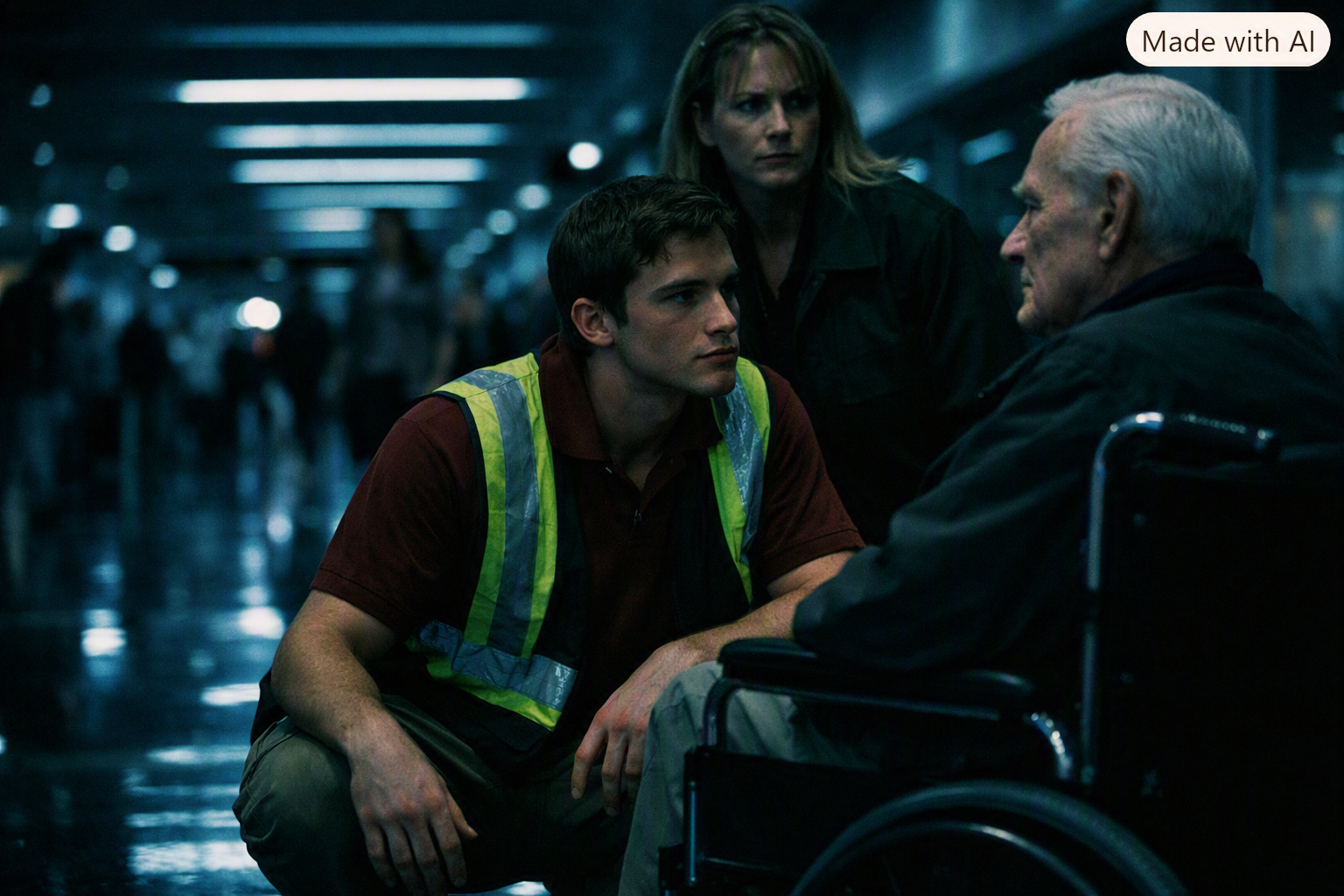
The wheelchair’s wheels whispered across the polished floor. When Ethan reached the old man, he locked the chair in place and crouched down.
“Sir, my name is Ethan. I’m going to help you sit.”
The man looked at Ethan’s uniform, then at Lisa standing behind him.
“You may get into trouble.”
“Take your time, sir.”
The old man was lighter than Ethan expected. Too light. He settled into the chair and closed his eyes for a long moment.
“Thank you, son.”
“Are you having chest pain?”
“No.”
“Have you eaten?”
A pause. “Not since this morning.”
Ethan reached into his jacket pocket and pulled out a granola bar he’d been saving for his break. He held it out.
“You’ve already done enough,” the man said.
“Please.”
The old man accepted it. His fingers were cold.
“What’s your name, sir?”
“Harold. Harold Grant.”
Before Ethan could ask more, Lisa arrived. Her face was tight. A small crowd had gathered — travelers who’d slowed down, a woman holding a toddler, a security officer hanging back near a column.
“Ethan.” Her voice dropped to a warning. “Get back to work.”
“He hasn’t eaten. He nearly collapsed.”
“Medical services have been contacted.”
“Good. I’m staying until they arrive.”
“No,” she said. “You’re not.”
She stepped closer. “This is your final instruction. Return to your assigned area.”
Ethan felt every eye in the vicinity settle on him.
He thought about his mother. His sister’s medication. His savings — less than four hundred dollars.
Lisa knew all of it.
She was using it.
“I’m staying,” he said.
Her expression hardened into something final.
“Then you’re done here.”
The departure announcements kept running overhead, but the terminal suddenly felt very quiet.
“You’re firing me?” Ethan said.
“You’ve ignored repeated warnings, abandoned your duties, and directly refused a supervisor’s order.”
“I helped someone who was falling.”
“You violated procedure.”
Ethan looked at Harold. Then at the mop bucket across the terminal. Then back at Lisa.
He unclipped his employee badge.
His hand was steady.
He held it out. Lisa took it.
“Can I stay until medical arrives?”
“You’re no longer an employee.”
Ethan looked at Harold.
“Then I’m staying as a passenger.”
Lisa opened her mouth. Nothing came out.
Harold watched Ethan with an expression that had shifted — less exhaustion, more attention.
“You lost your job because of me,” Harold said quietly.
“I lost it because I made a choice.”
“Do you regret it?”
Ethan looked around the terminal. At the people who had watched. At those who’d walked past. At Lisa, holding his badge.
“No, sir.”
Harold reached into his trousers and pulled out a slim black phone. The device looked expensive — oddly modern against his worn coat and old leather bag. His posture changed as he unlocked it. Shoulders back. Something quiet and authoritative in his face that hadn’t been there before.
He raised the phone to his ear.
“This is Harold Grant.”
A pause.
“I’m ready now.”
He ended the call.
Lisa frowned. “Ready for what?”
The glass security doors at the far end of the terminal opened.
Three airport executives. Two federal security officers. A group of airline representatives. And at the center of them, walking fast, the airport director.
All of them moving directly toward Harold.
The color left Lisa Turner’s face.
Harold rested his hand on the wheelchair arm.
“You stayed when everyone else walked away,” he said, not looking at Ethan.
His voice was quiet.
“But before this night is over, everyone in this airport will know exactly what that choice was worth.”
The airport director reached Harold first and came to a stop with the kind of body language people use around someone who signs their paychecks.
“Mr. Grant. Are you hurt?”
“No.”
“Do you require medical attention?”
“I required a chair.” Harold glanced at Ethan’s empty badge clip. “One of your employees provided it. Then his supervisor fired him for doing so.”
The director looked at Lisa. Something in his face tightened.
“What happened?”
No one spoke first.
Harold spoke for the record.
“This employee saw me lose my balance. He brought me a chair, gave me food, and remained beside me. His supervisor ordered him to leave. When he refused, she terminated him.”
Lisa tried to recover. “Mr. Grant, there are procedures for exactly this—”
“Was he attempting medical treatment?” the director interrupted.
“No, but—”
“Did Mr. Grant fall?”
“No.”
“Was he injured?”
“No.”
Each answer landed softer than the last. The director turned to Harold.
“Were you harmed by his assistance?”
“Quite the opposite.”
A woman nearby whispered something to her husband. The security officer who’d been watching from a column looked at the floor.
The director extended his hand toward Lisa.
“May I see that badge?”
She handed it over.
“Ethan Brooks. How long have you worked here?”
“Eleven months,” Ethan said.
“Any serious disciplinary actions?”
Lisa answered. “Three written warnings.”
“For what?”
She stayed quiet. Ethan spoke.
“First time, I helped a passenger with a stroller when the escalator was broken. Second time, I stayed with a lost child until security arrived. Third time — tonight.”
The director’s expression darkened. He turned on Lisa.
“You classified those as misconduct?”
“They caused delays in his assigned cleaning schedule.”
Harold’s voice came in quietly.
“There it is.”
Everyone looked at him.
“The disease,” Harold said. He pushed himself slightly upright. “An institution begins to fail the moment it values the appearance of efficiency more than the people it’s supposed to serve.”
The director lowered his eyes. “Yes, sir.”
A woman with a black portfolio stepped forward.
“Mr. Grant. I have the employment report you requested.”
Lisa turned sharply. “What report?”
“A review of maintenance staff turnover, disciplinary patterns, and employee complaints in Terminal C.”
Harold took the pages and read in silence.
The terminal held still.
“Twenty-three employees have resigned from this terminal in eighteen months.” He turned a page. “Eleven cited hostile supervision. Seven reported being discouraged from helping passengers outside narrow job descriptions. Four stated that emergency concerns were ignored because responding would interfere with performance targets.”
The director’s voice went cold. “Why was I not informed?”
“The complaints were handled at the contractor level,” the woman said. “Most were closed as unsubstantiated.”
Harold folded the report and looked at Lisa.
“Were they unsubstantiated?”
Her composure cracked. “I was under enormous pressure. We were short-staffed. Metrics were failing. Corporate kept demanding better numbers with fewer people.” She looked toward the director. “I was told delays were unacceptable.”
“You were not told to punish employees for helping passengers.”
“No, but every time a worker left a zone, the reports came back to me.” Her voice shook. “I had to choose between compassion and keeping the terminal functional.”
Harold set down the papers.
“You believed compassion and function were opposites,” he said. “That belief nearly caused an elderly man to fall while your staff watched.”
She closed her eyes.
“Lisa Turner.” The director stepped forward. “Effective immediately, you’re suspended pending a full investigation.”
“Suspended?” She turned to Harold. “Please. I’ve worked here seventeen years.”
“Then you’ve had seventeen years to understand what this place is for.”
Two security officers moved slightly. Lisa noticed.
“Am I being escorted out?”
“Yes,” the director said.
The humiliation crossed her face in stages.
Ethan watched the travelers raise their phones.
Something felt wrong about it.
He thought about how it had felt ten minutes ago — standing there with his badge gone, his bills flashing through his head, surrounded by people who wouldn’t look at him. He remembered the weight of it.
“Wait.”
Everyone turned.
“She shouldn’t be taken out like this,” Ethan said.
Lisa stared at him.
The director frowned. “Ethan, this is an administrative matter.”
“I know. But humiliating her in front of everyone won’t fix anything.”
He looked directly at Harold.
“Send her home. Investigate her. Do whatever the rules require. But don’t turn her into a public spectacle.”
For a long moment, Harold said nothing.
Slowly, the phones came down.
Lisa looked at Ethan like she was seeing him for the first time.
“You’re defending me?”
“No.” His voice was gentle. “I’m asking them not to treat you the way you treated me.”
The words hit harder than any accusation would have.
Lisa’s shoulders began to shake.
Harold turned to the director. “No escort through the terminal. She leaves through the staff corridor. And no final employment decision until the investigation is complete.”
The director looked surprised. “Mr. Grant?”
“She will be accountable. But accountability isn’t revenge.”
He glanced at Ethan.
“Apparently I needed a twenty-year-old janitor to remind me of that.”
Lisa pressed her hand over her mouth. When she lowered it, her voice was almost gone.
“I’m sorry.”
Ethan didn’t answer right away.
She tried again. “I knew you needed this job. I knew about your mother. Your sister. I knew you couldn’t afford to lose the income.” Her voice broke. “And I used that fear to make you obey me.”
The terminal was very quiet.
Ethan looked at her for a long time.
“I know.”
She flinched.
“But you fired me anyway,” he said, “and I still stayed.”
Harold recovered in a private lounge while Ethan sat in a chair outside it, still in his maintenance uniform, badge-less, unemployed, holding a cup of coffee someone had handed him.
The airport director emerged first.
“We’d like to offer you your position back. Full reinstatement. No record of discipline.”
Ethan looked at his cup. “That’s not necessary.”
“Mr. Grant specifically—”
“What Mr. Grant thinks of me means a lot,” Ethan said. “But I’m not going back to the same role for the same reasons.”
The director studied him. “What do you mean?”
“I mean I’ve been here almost a year. I’ve helped three people who needed it. I got written up every time.” He set the cup down. “I want the job I was doing — helping people. Not the job on paper.”
A long pause.
“I’ll take that to Harold,” the director said.
He came back out seven minutes later.
“Harold wants to see you.”
The private lounge was quiet. Harold sat in a wide chair near the window, the leather bag at his feet, watching planes move across the tarmac in the dark.
He didn’t turn when Ethan entered.
“Sit down.”
Ethan sat.
“The director tells me you don’t want your old job back.”
“Not unless something changes.”
Harold finally turned. His eyes were sharp despite the exhaustion in the rest of his face.
“What would you change?”
“The system that punished people for doing the right thing,” Ethan said. “Not just here. In all your terminals.”
Silence.
“You think you could do that?” Harold asked.
“No. But I think someone could. If you gave them a reason to try.”
Harold looked at him for a long time.
“You’re twenty years old.”
“Yes, sir.”
“You don’t have a degree.”
“Not yet. I postponed twice.”
“Why?”
“Bills.”
Harold nodded. He reached into his coat and removed a small envelope, sealed, and held it out.
“What is this?” Ethan asked.
“Open it later.”
Ethan put it in his jacket pocket.
“Will you tell me one thing?” Harold said.
“Sure.”
“When you gave me that granola bar — did you know who I was?”
Ethan looked at him like the question was strange.
“No. You were just someone who hadn’t eaten.”
Harold exhaled slowly.
“That,” he said, “is why I’m asking you to take the envelope seriously.”
Three days later, the investigation into Terminal C’s supervision practices was made public internally.
Eleven of the twenty-three resigned employees were contacted directly.
Lisa Turner was formally terminated — not in a hallway with strangers recording her, but in a private meeting with HR and a union representative. The decision was documented, processed, and final.
The new terminal operations manager sent an all-staff message the following week. It said, in part: Helping a passenger in need is never a disciplinary matter in this terminal. If anyone tells you otherwise, bring it to me directly.
That message was signed by a name most employees had never heard before.
Ethan Brooks, Senior Coordinator of Passenger Experience, Terminal C.
He wasn’t an executive yet.
He still walked the concourse every morning, greeted the cleaning staff by name, thanked the baggage handlers, and asked travelers if they needed anything.
His desk had a window that looked over the waiting area near Gate C18.
He rarely sat at it.
The envelope Harold had given him that night contained two things: a signed letter of acceptance to an aviation operations program, and a handwritten note on plain paper that said simply:
You already know how to do this job. Now go learn why it works.
Ethan had framed the note.
It hung on the wall above his desk, next to a bronze plaque that had gone up above the employee entrance the previous autumn.
It read:
Service begins the moment someone chooses to care.
Every new employee stopped to read it on their first day.
Most never knew where it came from.
But the older staff remembered.
They remembered a young janitor in a burgundy polo, standing in the middle of a busy terminal, holding a wheelchair he had no permission to touch — while everyone else kept walking.
Original fictional stories. AI-assisted creative content.