“Kid, do you honestly think you know anything about cars?”
The question echoed through the most expensive showroom in Dallas.
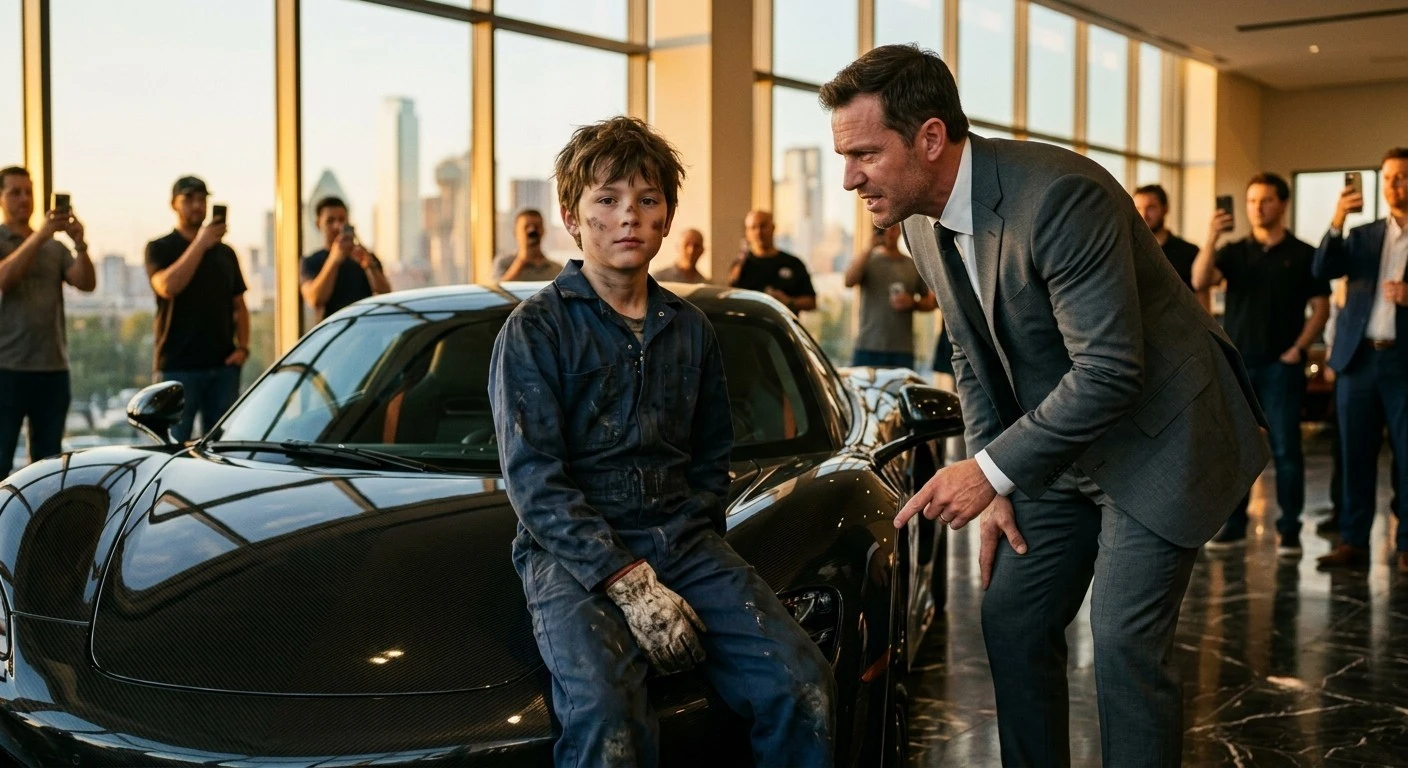
Mason Caldwell leaned toward the grease-covered eleven-year-old sitting on the hood of a black supercar and laughed loudly enough for the customers to hear.
Eli Carter did not look like someone who belonged beneath the crystal lights of Caldwell Sterling Motors.
His blue mechanic’s coveralls were stained with oil. His sneakers were worn at the toes, and a dark streak of grease ran across one side of his face. His hands were small, but the calluses along his fingers came from real tools, not toys.
Mason looked entirely at home.
He wore a custom gray suit, polished Italian shoes, and a watch worth more than most of the vehicles parked outside. As director of the company’s flagship showroom, he had spent years perfecting the expression of a man who could decide whether another person deserved to remain in the room.
The car beneath Eli was called the Aegis X1.
Only one existed.
Its carbon-fiber body reflected the showroom lights like black glass. The electric performance system had been developed in secret, and the vehicle was expected to sell for more than two million dollars after its official unveiling.
Employees had been warned not to touch it without authorization.
Mason pointed toward the floor.
“Get off the car before your father spends the rest of his life paying for the fingerprints.”
Eli remained still.
“My father is dead.”
For half a second, several employees stopped smiling.
Mason’s expression barely changed.
“Then find whichever mechanic brought you inside.”
A few salespeople laughed nervously.
They did not find the joke funny.
They laughed because Mason noticed people who did not.
Eli looked around the showroom.
Customers stood near luxury sedans and limited-edition sports cars. Several had already raised their phones to record the confrontation.
Mason enjoyed the attention.
He stepped closer.
“You know what happens to people who touch things they cannot afford?”
Eli slowly removed one dirty glove.
He set it on his knee.
“You’ll find out.”
The laughter ended.
Mason’s face tightened.
“You have five seconds to get down.”
Eli reached into the pocket of his coveralls and removed a sleek black key fob.
It carried no manufacturer’s logo.
Only a small silver symbol shaped like a shield.
Mason recognized it immediately.
“That key doesn’t belong to you.”
Eli pressed the upper button.
The Aegis’s headlights came alive.
A second later, the vehicle’s electric system produced a deep synthetic growl that rolled through the showroom floor.
Mason stumbled backward.
A woman near the reception desk gasped.
The car had not yet been publicly activated.
Only four people were supposed to possess functioning authorization keys.
Mason grabbed Eli’s wrist.
“Where did you steal that?”
“Take your hand off him.”
The voice came from the showroom entrance.
An older man stood between the glass doors with two attorneys, the company’s chief engineer, and a pair of federal investigators behind him.
Henry Carter was seventy-one.
His silver hair was neatly combed, and he wore a dark blue suit without a tie. Age had bent his shoulders slightly, but nothing had weakened the authority in his voice.
Forty-two years earlier, Henry had built the first Carter performance engine inside a rented machine shop.
The company now employed more than six thousand people.
Mason released Eli immediately.
“Mr. Carter.”
Henry looked at the red handprint forming around his grandson’s wrist.
Then he looked at Mason.
“My grandson spent the morning helping our engineers inspect this prototype.”
Mason’s face lost color.
“Your grandson?”
Eli climbed down from the hood.
“My father designed the Aegis drive-control system before he died.”
Henry rested one hand on Eli’s shoulder.
“Lucas Carter also left his controlling shares to his son.”
Mason stared at the boy.
The child he had just humiliated owned a larger percentage of Carter Automotive than any current executive.
But Eli was not smiling because of the inheritance.
He opened the driver’s door and reached beneath the dashboard.
When he pulled his hand back, he was holding a recording device no larger than a pack of gum.
“I found this connected to the diagnostic port.”
Dr. Priya Shah, Carter Automotive’s chief engineer, stepped forward and examined it.
Her expression changed immediately.
“This is not a tracking unit.”
“What is it?” Henry asked.
“A data siphon. It has been copying prototype software every time the system powers on.”
Henry turned toward Mason.
“You told the board our design files were stolen through a foreign cyberattack.”
Mason’s mouth opened.
“I can explain.”
Eli pressed another button on the key fob.
The Aegis’s speakers activated.
Mason’s voice filled the showroom.
“Sell the software before the launch. Once Carter’s stock falls, Northstar purchases the company for nothing.”
Phones turned toward Mason.
A sales manager stepped away from him.
One of the federal investigators moved closer.
Mason lunged toward Eli.
The second investigator blocked him.
Henry did not raise his voice.
“You asked whether the boy knew anything about cars.”
He looked at the recording device.
“My grandson knew enough to discover what every adult in this showroom was too frightened to report.”
Mason’s confidence disappeared.
Then Eli climbed into the driver’s seat and opened the prototype’s diagnostic records.
A hidden file appeared on the central display.
It showed that Mason had not merely copied the vehicle’s software.
Someone had entered the Aegis control system the previous night and disabled the emergency braking response before a scheduled high-speed test.
The driver assigned to perform that test was listed at the bottom of the screen.
HENRY CARTER.
Henry stared at his name.
Eli looked up at his grandfather.
“He wasn’t only trying to steal the company.”
Then he turned toward Mason.
“He was trying to inherit it.”
Special Agent Ruiz stepped fully into the light, badge held low but visible.
“Mr. Caldwell, I need you to step away from the vehicle.”
Mason’s eyes darted toward the shuttered exits, calculating, the way a man calculates when he still believes there’s an angle left to play.
“You don’t have a warrant.”
“I don’t need one,” Ruiz said. “I have a recorded confession, a data siphon pulled from a company asset, and thirty witnesses. Step away from the vehicle.”
Mason looked at Henry instead of the agent, an old habit of asking permission from the person who actually held power in the room.
“Henry, this doesn’t have to happen this way. We built half this showroom’s revenue together.”
“You built half of it lying to my board,” Henry said. “I built the other half trusting you not to.”
Mason’s jaw worked, searching for a lever that wasn’t there anymore.
One investigator reached for Mason’s arm.
Before he could place him in handcuffs, a woman’s voice cut across the showroom.
“No one is arresting anybody.”
Every employee became still.
Margaret Carter descended the curved staircase overlooking the showroom.
She was sixty-eight, elegant, and dressed in a cream-colored suit. A silver Carter emblem rested at her collar.
To the public, Margaret was the graceful wife who had stood beside Henry from the company’s earliest years.
Inside the corporation, she was vice chair of the board.
To Eli, she was Grandma Margaret.
She had attended every Christmas dinner, mailed birthday cards, and cried at Lucas’s funeral.
Now she held a second Aegis key fob in her hand.
Henry stared at her.
“Margaret, step away from the security controls.”
She looked at Eli instead.
“I warned Mason that the boy was too much like his father.”
Eli’s breathing stopped.
Margaret pressed the lower button.
Metal security shutters dropped across the showroom’s glass doors.
Every exit locked.
The crystal lights dimmed.
The Aegis display went black.
Customers began shouting.
Margaret’s eyes remained on her grandson.
“Lucas never knew when to stop asking questions either.”
Henry took one step toward her.
“What did you do to my son?”
The question landed like a slap.
Margaret’s chin lifted, but her hand trembled around the fob.
“I did what this family needed.”
“That’s not an answer.”
“Lucas found the same file your grandson just found,” Margaret said. “Three years ago. He came to me with it instead of you, because he trusted me.”
Her voice cracked once, then steadied.
“I told him to bury it.”
Henry’s face went pale.
“He didn’t bury it.”
“No,” Margaret said quietly. “He didn’t.”
Somewhere behind Henry, one of the attorneys pulled out his phone and began recording, low and discreet, angled at Margaret.
Eli’s hands curled into fists on the steering wheel.
“You knew about the brakes.”
Margaret did not look at him.
“I didn’t know the details. I knew there was a problem. I knew Mason needed time to fix it before the board found out the prototype wasn’t safe.”
“The prototype was safe,” Dr. Shah said sharply. “Someone made it unsafe. On purpose. The night before Lucas’s test drive.”
The showroom went silent except for the low hum of the dimmed lights.
Henry’s voice dropped to almost nothing.
“Are you telling me my son died because his own mother chose a schedule over his life?”
Margaret flinched.
“I’m telling you I chose the company. The same company you chose over Christmas dinners for forty years. Don’t stand there and act like sacrifice is a language I invented.”
“This isn’t sacrifice,” Henry said. “This is murder.”
The word hit the room like a dropped glass.
One of the federal investigators stepped toward the security panel near the reception desk, feeling along its edge.
“Ma’am, I need you to lower the shutters. Now.”
Margaret’s grip on the fob tightened.
“If those shutters go up, every camera in this building starts streaming to the press the moment Mason’s confession finishes playing. I’ve already seen the headline. Carter heir dead because grandmother stayed quiet. I am not opening those doors until I decide how this ends.”
“You don’t get to decide that,” Eli said.
His voice was small in the big room, but it carried.
Margaret finally looked at him directly.
“You’re eleven.”
“I’m the only person in this building who read the whole diagnostic log,” Eli said. “Not just the part about the brakes.”
Margaret’s eyes narrowed.
“What else is on it?”
Eli turned the display toward her.
A second file glowed on the Aegis’s screen, timestamped two nights earlier, an hour after visiting hours ended at Baylor Scott & White.
It was a message thread between Mason and someone saved only as M.C.
Margaret’s face changed before anyone read a single word aloud.
Mason’s voice broke the silence first.
“Don’t.”
“You told him the security code for my dad’s hospital room,” Eli read. “The night before the accident.”
Henry’s hand found the edge of the Aegis and gripped it.
“Margaret.”
“I wanted him to fix the safety data before your son drove that car again,” Margaret said, faster now, words tumbling. “I didn’t want anyone hurt. I wanted the truth delayed, not erased.”
“Lucas wasn’t in a hospital room because of a car,” Eli said. His voice shook, but he kept reading. “He was in a hospital room because somebody ran his motorcycle off Highway 75 four days before that. And two nights later, somebody let a stranger walk past his security guard.”
The room tilted.
Margaret’s mouth opened and closed.
“That’s not what happened.”
“Then tell us what did,” Henry said.
Mason answered instead, quiet, defeated.
“Northstar needed him gone before the shareholder vote. Not hurt. Gone. I told them a scare would be enough. I never authorized anything at the hospital.”
“You authorized the code,” Margaret snapped.
“I authorized you to talk him out of testifying,” Mason shot back. “I never told you to hand his room number to men who —”
He stopped.
Realized what he had just said in front of two federal investigators, three attorneys, and a dozen recording phones.
One investigator finally reached the panel Margaret had locked and pried the access cover open with a multitool.
“Ma’am, step back from the console.”
Margaret did not move.
She was staring at Henry.
“I loved that boy,” she said. “I have loved him since the day you carried him into this house wrapped in a blue blanket, forty-two years old and crying because you finally had a son to leave all of this to.”
Her voice broke completely.
“I only ever wanted there to be something left to leave him.”
Henry’s eyes were wet, but his voice did not waver.
“There was something left to leave him. His son. And you let a stranger walk past a guard to reach that son’s father.”
Margaret’s hand opened.
The fob slipped from her fingers and clattered against the marble floor.
The shutters did not move on their own, so the investigator finished forcing the panel and manually released the lock.
Sunlight cut back into the showroom in a single hard line, then widened as the metal slid upward.
Customers near the door pushed out into the parking lot, phones still raised.
Two uniformed officers were already waiting outside, radios crackling, having been alerted the moment the first shutter sensor tripped a silent alarm built into the building’s own security system — a system Henry had personally approved eight years earlier, after a break-in at a rival dealership.
Margaret had forgotten about that alarm.
Mason had never known about it.
The first officer through the door went straight for Mason.
He did not resist.
He simply looked at Eli one more time, the eleven-year-old boy he had told to get off a car he was never allowed to touch.
“You really did know something about cars,” Mason said.
Eli did not answer him.
He was already looking past him, at his grandfather, whose hand still rested on the hood of the Aegis like it was the only steady thing left in the room.
The second officer approached Margaret more carefully, the way people approach a grieving widow, because for one confusing second that was still all she looked like.
“Mrs. Carter, I need you to come with us.”
Margaret’s eyes found Eli one last time.
“I never wanted him hurt,” she whispered. “Not really. I told myself it was only ever supposed to be a warning.”
“He’s dead,” Eli said. “Warnings don’t kill people.”
Margaret had no answer for that.
She let the officer take her arm.
A commotion broke out near the side entrance before the officer could lead her through the open shutters.
A woman in a paint-stained flannel shirt pushed past the security desk, breathing hard, a phone clutched white-knuckled in one hand.
“Eli!”
Sarah Carter had been on her lunch break at the billing office across town when her son’s friend texted her a livestream link three minutes into the standoff.
She had run four red lights getting here.
Eli slid off the Aegis and crossed the floor before Henry could say a word. Sarah dropped to her knees on the marble and pulled her son into her arms, not caring that the grease on his coveralls smeared across her shirt.
“I’m okay,” Eli said into her shoulder. “I’m okay, Mom.”
Sarah looked up at Henry over her son’s head, her jaw tight, three years of complicated history compressed into a single look.
“You told me this internship was safe.”
“It was,” Henry said quietly. “Until it wasn’t. I’m sorry.”
Sarah’s eyes moved to the officers walking Margaret toward the door, and something in her expression cracked open.
“Margaret.”
Margaret stopped, just for a second.
“I never wanted this, Sarah.”
“You let a stranger into Lucas’s hospital room,” Sarah said, voice shaking. “I sat with him every night for six weeks. I held his hand while he apologized to me for asking too many questions about that car. He wasn’t scaring me. He was trying to protect his son.”
Margaret didn’t answer.
She let the officer guide her out through the open shutters into the daylight, and this time nobody in the room laughed, and nobody looked away.
Sarah held Eli at arm’s length, checking him over the way mothers do once the danger has already passed, when the checking is more for themselves than for the child.
“Are you hurt?”
“No.”
“Then why does your wrist look like that?”
Eli glanced down at the fading red mark where Mason had grabbed him.
“It’s fine, Mom.”
Henry stepped forward, hands open, careful.
“Sarah, I owe you more than an apology, and I intend to give it. Whatever Eli wants going forward — this internship, a seat on the board someday, any of it — happens only with your permission. Not mine.”
Sarah studied him for a long moment, the same unflinching way Eli had studied Mason twenty minutes earlier.
“He’s eleven, Henry. He should be worrying about a spelling test, not a shareholder vote.”
“I know.”
“But he’s also the only person in this building who caught what six thousand employees missed for three years.” Sarah exhaled, some of the fight leaving her shoulders. “So we’re going to talk. All three of us. About what any of this looks like going forward. Not today. Today I’m taking my son home.”
Henry nodded, and for the first time that afternoon looked less like the founder of an automotive empire and more like a grandfather who had nearly lost the only piece of his son still left in the world.
“Take him home.”
Sarah put an arm around Eli’s shoulders and walked him toward the door, past the empty space on the marble where Margaret’s key fob still lay, and Eli didn’t look back at it once.
The showroom stayed frozen for a long moment after the doors closed behind them, everyone waiting to see if the floor was actually still solid.
Henry finally exhaled, the sound of a man who had been holding his breath for three years without knowing it.
He crouched down, wincing at his knees, until he was eye level with his grandson.
“I should have listened to your father when he came to me the first time.”
“He didn’t come to you,” Eli said. “He went to her.”
“Then I should have been someone he trusted enough to come to instead.”
Eli looked down at his hands, still streaked with the grease from that morning’s engine inspection.
“He talked about you every day. He just thought you were too busy building the company to survive losing part of it.”
Henry closed his eyes.
“He was wrong.”
“I know,” Eli said. “I told him that once.”
For the first time since walking through the door, Henry smiled, small and tired and real.
Dr. Shah cleared her throat gently.
“Mr. Carter, I need to lock down every prototype system in this building before Northstar’s people realize their contact just got arrested on camera.”
Henry nodded, straightening.
“Do it. And call the board. Every member. Tonight.”
He looked around the showroom, at the frozen customers, the trembling sales staff, the empty space at the top of the staircase where his wife had stood twenty minutes earlier believing she still controlled the outcome.
“We’re not hiding this,” Henry said. “Not the way we hid the accident report. Not the way we hid the buyout offer. Every employee in this building is going to hear exactly what happened here today, from me, before they hear it from a headline.”
One of the attorneys stepped forward.
“Sir, that kind of transparency could tank the stock before the Aegis even launches.”
“Then it tanks,” Henry said. “I already lost the only thing that mattered more than this company. I’m not losing what’s left of my family’s name to protect a number on a screen.”
He turned back to Eli.
“Get up on the hood.”
Eli blinked.
“What?”
“Get up on the hood,” Henry said again, gesturing at the Aegis. “You built half the confidence to sit on a two-million-dollar prototype this morning because you knew exactly what it was worth and exactly what you were worth sitting on it. I want a picture of that, before the world decides to make you into a headline instead of a person.”
Eli climbed back onto the hood, slower this time, uncertain.
Henry stood beside him, one hand resting on his grandson’s shoulder, and nodded at Dr. Shah, who lifted her phone.
The photo that went out with Carter Automotive’s official statement that evening was not staged, not polished by a marketing team, not softened for shareholders.
It showed a boy in grease-stained coveralls sitting on the hood of the only Aegis X1 in existence, his grandfather’s hand steady on his shoulder, both of them looking directly into the camera instead of away from it.
The caption Henry approved himself, three words, no explanation attached.
He knew cars.
By morning, the photo had been shared more than two million times.
News vans lined the street outside the Carter family’s house before Sarah had even finished making breakfast.
She pulled the blinds shut in the kitchen and set a plate of eggs down in front of her son.
“You don’t have to talk to any of them.”
“I know,” Eli said, poking at his eggs. “I don’t want to.”
His phone buzzed on the counter, a message from a number he didn’t recognize.
He almost ignored it, then read it anyway.
My dad worked on the line at Carter for nineteen years. He got laid off last spring in the round Mason approved. Thank you for making somebody finally pay attention.
Eli set the phone down, throat tight.
Sarah noticed.
“What is it?”
“Nothing,” Eli said. “Just — a lot of people had a worse three years than we did.”
Sarah sat down across from him, reaching over to wipe a smear of grease he’d missed near his ear the night before.
“That doesn’t make yours count less.”
“I know,” Eli said. “It just makes it count different.”
He didn’t touch his phone again that morning.
But he kept the message.
Three weeks later, the boardroom on the fortieth floor was quieter than the showroom had ever been.
Mason’s chair sat empty at the far end of the table, a small paper sign taped over the nameplate reading UNDER INDICTMENT, left there by someone on the legal team with a dark sense of humor Henry had not yet found the energy to object to.
Margaret’s seat had simply been removed.
Henry stood at the head of the table instead of sitting, because standing felt like the only posture that matched what he needed to say.
“Northstar’s acquisition offer is officially withdrawn,” he said. “Their general counsel resigned yesterday, two hours before federal investigators arrived at their headquarters with a warrant tied to Mason Caldwell’s phone records.”
A murmur moved through the room.
“The board has three options in front of it,” Henry continued. “We restructure leadership from the outside, bring in an interim director while the criminal cases proceed. We promote from within, from a leadership bench that failed to report two years of irregular data transfers because they were too afraid of Mason Caldwell to ask questions. Or we do something this company has never done in forty-two years.”
He let the silence sit for a moment.
“We let the person who actually caught it lead the review.”
Every head in the room turned toward the glass door at the back, where Eli stood in a clean set of coveralls, holding a tablet loaded with the same diagnostic software he had used three weeks earlier.
He was not smiling.
He walked to the front of the room and set the tablet on the table.
“I’m not old enough to run a company,” he said. “I know that.”
A few board members exchanged uneasy glances.
“But I read the Aegis system faster than anyone in this building because my dad built half of it with me at our kitchen table, explaining every line so I’d understand it someday. I think that’s worth something. Not running the company. But being in the room when decisions get made about it.”
Henry placed a hand on the tablet.
“I’m proposing a seat. Non-voting until he’s eighteen. Advisory on every engineering and security decision until then.”
One board member, a sharp-eyed woman named Diane Okafor who had voted against every one of Mason’s initiatives for the past two years and been quietly overruled each time, spoke first.
“I second it.”
Henry looked at her, surprised by how quickly the words had come.
“You don’t want time to think it over?”
“I’ve had two years to think it over,” Diane said. “Every time I flagged an irregular transfer in Mason’s division, I got told I was being difficult. I have eleven emails in my archive I never had the nerve to forward to the full board. I’m done being difficult quietly. This boy did more with one morning than I did with two years of memos.”
A few other board members shifted uncomfortably in their seats, recognizing themselves in her confession.
The vote passed without a single objection.
Afterward, in the elevator down to the garage, Henry looked at his grandson’s reflection in the polished steel doors.
“Your father would have hated the paperwork part of this.”
Eli almost smiled.
“He hated meetings more than anything.”
“Then it’s a good thing,” Henry said, “that you’re better at meetings than he was.”
The elevator doors opened onto the garage level, where a black tarp covered a shape near the loading dock, guarded by two security officers who nodded at Henry as he passed.
Eli stopped walking.
“Is that —”
“The Aegis X2,” Henry said. “Development started the week after your father died. Priya’s team never stopped, even when they thought no one who mattered was paying attention.”
He pulled the corner of the tarp back just enough to reveal a sharp, low silhouette beneath the fluorescent lights.
“Your father’s name is on the patent filing for the drive system. Not mine. Not the company’s. His.”
Eli reached out and touched the cold metal edge of the frame, the same way he’d touched the Aegis X1’s hood three weeks earlier, except this time no one told him to get down.
“When does it launch?”
“When you’re old enough to stand next to it and answer the questions the press is going to ask,” Henry said. “Which, by my calculation, gives Dr. Shah about seven years to finish it properly.”
Eli let out a short laugh, the first real one Henry had heard from him since the funeral.
“He’d have liked that.”
“He’d have liked knowing his son finally got to sit on a car nobody told him to get off of,” Henry said.
Outside the garage, the Dallas afternoon sun caught the edge of the covered prototype, and for the first time in three years, the name Carter felt less like a debt Henry was still paying off and more like something worth building forward again.
Six months later, a Dallas courtroom held none of the crystal-light glamour of the showroom, only fluorescent panels and the low hum of an air conditioner working too hard against the August heat.
Mason Caldwell stood at the defense table in a suit that no longer looked tailored to fit him, flanked by two attorneys who kept their eyes on their notes.
The judge read the plea agreement into the record: conspiracy to commit corporate espionage, wire fraud, and obstruction of a federal investigation. Fourteen years, with the possibility of parole after nine.
Mason did not turn around when the sentence was read.
He didn’t have to.
The only people in the gallery who had ever mattered to him weren’t there. Northstar’s executives had scattered to separate legal teams weeks earlier, each one blaming the others in signed statements that filled three banker’s boxes of evidence.
Margaret’s hearing was scheduled for the following week in a separate courtroom, on a separate set of charges that included accessory after the fact in her son’s death — charges her attorneys had spent six months trying, and failing, to get reduced.
Henry did not attend either hearing.
He sent word through the family’s lead counsel that he had no statement to make and nothing left to say to either of them that hadn’t already been said on a showroom floor in front of thirty witnesses and a security camera.
Eli attended Mason’s hearing.
He sat in the back row in a clean shirt his mother had ironed that morning, and when the bailiff led Mason out in handcuffs, Mason’s eyes found him across the gallery for exactly one second.
Eli didn’t look away this time either.
Outside on the courthouse steps, Sarah squeezed her son’s shoulder.
“How do you feel?”
Eli thought about it for a long moment, the way his father used to before answering questions that mattered.
“Lighter,” he said finally. “Not happy. Just lighter.”
Sarah nodded, like that was exactly the right answer.
Because it was.
The showroom reopened the following Monday.
Mason’s old office had been converted into a small engineering workspace with a single desk, a whiteboard, and a nameplate that read simply: E. CARTER — SYSTEMS.
He was there most afternoons after school, grease still under his fingernails, learning to read financial reports the same patient way his father had once taught him to read wiring diagrams.
No one ever told him to get off anything again.
Original fictional stories. AI-assisted creative content.