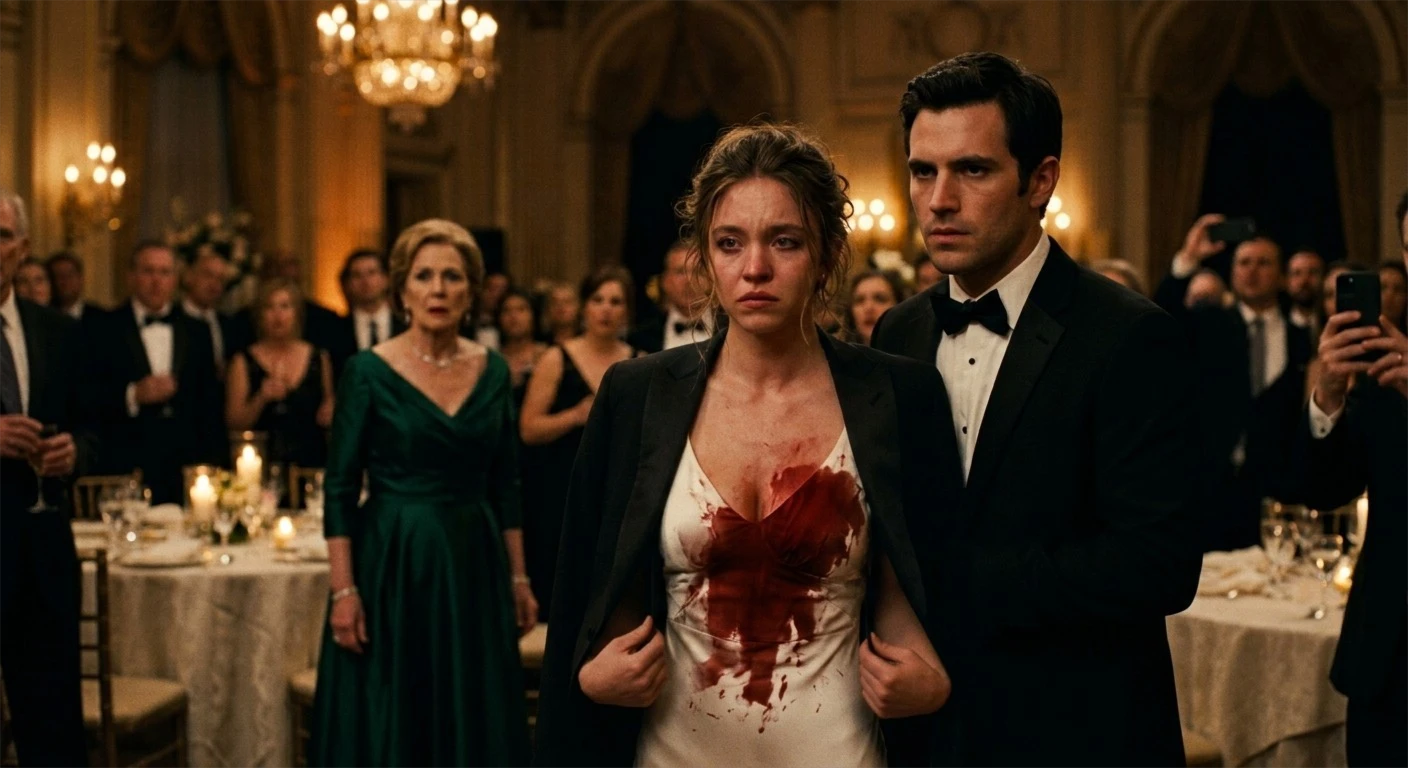
My future mother-in-law smiled before throwing an entire glass of red wine across my white engagement dress.
For one terrible second, nobody inside the Palace of Light moved.
Three hundred faces turned toward me. The orchestra kept playing for two more bars before the violinist noticed and stopped.
Eleanor Whitmore did not apologize. She never did.
I had known her for eight months by then, and in that time she asked whether I had ever eaten in a formal dining room. She gave me a designer handbag, then announced in front of everyone that it was from last season.
Arthur often defended me. But I kept asking him not to fight with his mother.
“She will accept me eventually,” I told him.
I was wrong.
The engagement party was supposed to be a fresh start. Arthur had chosen white and pale pink roses because they were my favorite. The orchestra played the song we heard on our first date. Nearly three hundred guests had come to celebrate us.
I spent most of the evening trying to make Eleanor feel included. I thanked her for hosting. I invited her to stand beside us for photographs. I even wore the diamond earrings she gave me, although she had already told several guests they were “only temporary family jewelry.”
Then I began speaking with Arthur’s business partners. They asked about the community center where I worked as a financial counselor. I told them about helping older people protect themselves from scams and dishonest relatives.
People listened. A few laughed at one of my stories. For ten minutes, I forgot to be nervous.
That was when Eleanor approached with the wine.
She pretended to trip. But I saw her hand move. The glass tilted directly toward me. Red wine poured across my chest and down the front of my dress.
“Oh, how careless of me,” she said. Her voice contained no apology.
I stood frozen. My eyes filled with tears, but I refused to give her the satisfaction of watching me collapse.
Then Arthur appeared carrying a bouquet of white roses. He dropped them when he saw me.
“What happened?”
Eleanor lifted one shoulder. “Clara stood too close.”
A guest near us shook his head. “We all saw what you did.”
Arthur removed his jacket and placed it around my shoulders. Then he faced his mother.
“Apologize.”
Eleanor laughed. “To her?”
“To the woman I am going to marry.”
She looked around at the guests. “Arthur, do not embarrass yourself. This girl is not part of our world.”
Arthur took my hand. “No. She is better than it.”
The ballroom became silent.
Eleanor’s face hardened. “If you leave this party with her, do not expect this family to finance your life.”
Arthur looked almost amused. “You still believe I need your money.”
He turned toward the stage and asked the musicians to stop playing. Then he took the microphone.
“Thank you all for coming,” he said. “The engagement party is over.”
His mother stared at him. “You cannot cancel my event.”
“It was supposed to be our event.” He looked toward me. “And no celebration continues after the woman I love is publicly attacked.”
Eleanor stepped closer. “Arthur, think carefully. Clara will leave the moment she realizes you are no longer receiving your inheritance.”
Arthur reached inside his jacket and removed a folded document. “I already rejected the inheritance.”
The room filled with shocked whispers. His mother went pale.
“What did you say?”
“I signed the papers this morning.”
Eleanor grabbed the document. Under the family trust, Arthur had been expected to inherit nearly forty million dollars. But the money came with conditions. His wife had to be approved by Eleanor. Eleanor would choose where they lived. She would control any trust created for their future children. And if Arthur married without her approval, the family could remove him from the company.
Arthur had refused everything.
Eleanor looked at him as though he had lost his mind. “You gave up forty million dollars for her?”
“No,” Arthur replied. “I gave it up for myself.” He placed his hand over mine. “I will not build a marriage where my mother has the power to punish my wife.”
Eleanor’s expression changed. For the first time, she looked frightened instead of angry.
“You don’t understand what you signed.”
“I understand perfectly.”
“No, you don’t.” She turned toward me. “You think you have won?”
“I never believed this was a competition.”
“It became one the day you met him.”
Arthur’s family attorney approached us from the edge of the ballroom. He carried a sealed envelope.
“Mr. Whitmore,” he said quietly, “there is a problem with the trust documents.”
Eleanor quickly stepped between them. “This is not the time.”
The attorney ignored her. “Your mother asked me to prepare a different agreement last week.”
Arthur’s eyes narrowed. “What agreement?”
The attorney handed him the envelope. Inside was a prenuptial contract carrying my name. According to the document, I had agreed to leave the marriage with nothing if Arthur ever lost his family position.
There was only one problem. I had never seen it. The signature at the bottom was not mine.
Arthur looked at his mother. “You forged Clara’s signature?”
Eleanor stopped speaking. The older woman beside her quietly moved away.
Then the attorney removed a second page. It showed that Eleanor had hired a private investigator to follow me for six months. She had searched my bank records. Contacted my employer. And paid one of my coworkers to report every conversation I had about Arthur.
But that was not the worst part. The investigator had discovered that someone had been secretly depositing large amounts of money into an account opened in my name. More than one million dollars had appeared over eight months. The payments were designed to make it look as though I had accepted money to marry Arthur.
I stared at the records. “I have never seen this account.”
Arthur looked at his mother. “You were creating evidence against her.”
Eleanor tightened her grip on the papers. “I was protecting you.”
“By framing the woman I love?”
“You don’t know who she really is.”
“No,” the attorney said. “But we now know who created the account.”
He turned the final page toward us. The deposits had not come directly from Eleanor. They came from a company owned by the woman standing beside her. The same woman who had laughed when the wine hit my dress.
Arthur stared at her. “Aunt Margaret?”
She began backing toward the ballroom exit. Security guards quietly closed the doors.
Margaret looked at Eleanor. “You said the forged account could never be traced.”
Every guest heard her. Eleanor’s face went white.
Arthur handed the microphone to the attorney. “Tell everyone why my mother and aunt were so desperate to stop this marriage.”
The attorney opened one final document. It was not about Arthur’s inheritance. It was a hospital record from twenty-seven years earlier. My father’s name appeared at the top. And beneath it was proof that the Whitmore family fortune had been built using a patent stolen from him.
Eleanor had not hated me because I was poor. She hated me because marrying Arthur would give me legal access to the evidence that could cost her family everything.
For a moment, no one in the ballroom breathed.
Then a guest near the bar lifted her phone higher. She had been recording since the wine hit my dress.
“Turn that off,” Eleanor snapped.
“No,” the woman said. “I don’t think I will.”
Arthur held up the hospital record so the room could see the letterhead. “Riverside Medical Center. Twenty-seven years ago.”
“That means nothing,” Eleanor said.
“It means everything,” the attorney said. “It’s the intake record for a man named Thomas Hail. Admitted after a workplace injury. Employed at the time by Whitmore Manufacturing.”
I felt my chest tighten. “That’s my father.”
The attorney nodded slowly. “Six weeks before that injury, your father filed an internal design proposal for a low-cost water filtration cartridge. Whitmore Manufacturing owns the patent today. It’s their single most profitable product line.”
Margaret tried to laugh. “Old factory paperwork. It proves nothing.”
“It proves your husband’s signature is on the original assignment form,” the attorney said, turning to her now instead of Eleanor. “Forcing an injured employee to sign away a patent while sedated in a hospital bed is not a business decision, Mrs. Colt. It’s fraud.”
The room went rigid.
Arthur’s voice was quiet. “Aunt Margaret. Was that your husband?”
Margaret didn’t answer. She didn’t have to. Her face already had.
“My father never filed a lawsuit,” I said. “He never had the money for one. He died still paying off the hospital bill from the injury the company caused.”
Eleanor’s composure finally cracked. “You have no proof any of that reached me.”
The attorney lifted a printed email chain. “This does.”
He read the sender line aloud. “Eleanor Whitmore, to Margaret Colt. Subject: Hail file — keep buried.”
Gasps rippled through the crowd.
“Where did you get that?” Eleanor’s voice had lost its polish.
“From the same investigator you hired,” the attorney said. “He kept copies. Insurance, in case you ever decided not to pay him.”
Eleanor turned toward Arthur, and for the first time in my life, I watched her try to sound like a mother instead of a queen. “I did this to protect the family name. Your grandfather built this company. I was not going to let some financial counselor’s daughter tear it down.”
“She’s not tearing anything down,” Arthur said. “You built the company on a lie, and you’ve spent twenty-seven years hoping nobody would ask where the money came from.”
“You would throw away everything we have for a stranger?”
“She’s not a stranger. She’s the only person in this family who never lied to me.”
Security guards moved toward Margaret as she edged closer to a side exit. One of them extended an arm, not touching her, simply blocking the path.
“You can’t hold me here,” Margaret said.
“We’re not holding you,” the guard said. “The police are three minutes out. Mr. Whitmore called them before the toast.”
Arthur nodded once. “I did.”
Eleanor spun toward him. “You called the police on your own family? At your own engagement party?”
“You threw wine on my fiancée in front of three hundred people,” Arthur said. “You forged her signature on a legal contract. You paid to plant fraudulent deposits in her name. And you buried evidence that this company was built by stealing an invention from a man who died broke because of it. I didn’t destroy this family tonight, Mother. You did. Years ago.”
I stood there in a ruined white dress, wine soaking through the silk, and for the first time all evening, I wasn’t shaking.
“There’s one more thing,” I said.
Every head turned toward me.
“My father kept a notebook,” I said. “Sketches, measurements, testing notes. I always thought it was just something to remember him by. I never understood why a factory floor supervisor would fill three hundred pages with filtration diagrams.”
Eleanor’s face lost the last of its color. “You have his notebook?”
“I’ve had it since I was nineteen,” I said. “I never knew what it proved. I only knew it was his.”
The attorney looked at me carefully. “Ms. Hail, would you be willing to have that notebook authenticated?”
“Yes,” I said. “Tonight, if that’s what it takes.”
Eleanor’s mouth opened, then closed. For the first time since I’d met her, she had nothing to say.
Two police officers entered through the side doors the guards had been watching. The ballroom lights caught the badges on their chests before anyone spoke a word.
“Margaret Colt?” one officer asked.
Margaret’s shoulders dropped. “This is a misunderstanding.”
“You can explain that downtown.”
She looked at Eleanor one last time, waiting for her to intervene. Eleanor said nothing.
“You’re not going to help me?” Margaret asked.
“I can’t,” Eleanor said quietly. “Not anymore.”
The officers led Margaret out through the same doors where guests had entered an hour earlier expecting champagne and toasts. Phones followed her the entire way.
Eleanor remained standing in the center of the ballroom, alone for the first time all night. The guests who had once fought for her attention now stood in small clusters, whispering, filming, waiting.
Arthur turned to me. “Are you all right?”
“I don’t know yet,” I said honestly. “But I’m still standing.”
He wrapped his jacket tighter around my shoulders. “Let’s get you home.”
“Not yet,” I said. “There’s one more thing I need to say.”
I stepped toward the microphone the attorney still held. Arthur didn’t stop me.
“My father spent his whole life being told his ideas didn’t matter,” I said. “He died believing that. I became a financial counselor because I wanted to help people who’d been cheated by someone they trusted. I never imagined I’d end up proving my own father was one of them.”
I looked directly at Eleanor. “You spent a fortune trying to make me disappear. You could have spent a fraction of that giving my father credit for what he built. You chose fear instead. I hope it was worth it.”
Eleanor said nothing. There was nothing left to say.
The following morning, three law firms called Arthur before nine o’clock. Two represented Whitmore Manufacturing’s board of directors. One represented Margaret.
None of them called on Eleanor’s behalf. She hadn’t asked anyone to.
Arthur met me at my apartment carrying two coffees and a folder an inch thick.
“The board called an emergency session,” he said. “They want the patent history reviewed by outside counsel. Today.”
“Because of the notebook?”
“Because of everything,” he said. “The email, the forged signature, the falsified account, the assault charge Margaret is now facing for orchestrating a fraud scheme. The board doesn’t want to be the next headline.”
“What happens to your mother?”
“She’s not chair anymore,” Arthur said. “The board suspended her an hour ago, pending investigation.”
I set my coffee down. “You don’t sound satisfied.”
“I’m not,” Arthur admitted. “I wanted my mother to lose because she was wrong, not because a spreadsheet told the board she was a liability.”
“Sometimes justice doesn’t feel clean,” I said. “It just has to be real.”
He nodded slowly. “The attorney wants to meet with you this afternoon. About the notebook.”
“I’m ready.”
The meeting took place in a glass conference room eleven floors above the city. Two forensic document specialists examined my father’s notebook page by page while a stenographer typed everything into the record.
“The graphite dates to the correct period,” one specialist said. “The paper stock matches manufacturing logs from that decade. And this—” she turned to a diagram near the back “—this is the original filtration valve design. Nearly identical to the patented version, six years before the patent was ever filed.”
The Whitmore family’s outside counsel, a sharp older woman named Diane Foster, studied the page in silence.
“This isn’t circumstantial,” Foster finally said. “This is the strongest prior-invention evidence I’ve seen in twenty years of patent litigation.”
“What does that mean for Clara?” Arthur asked.
“It means Thomas Hail’s estate has a legitimate claim to co-inventorship, back royalties, and potentially damages for fraudulent concealment,” Foster said. “Given the scale of the product line, we’re not talking about a symbolic settlement.”
I felt my throat tighten. “I don’t want revenge. I want my father’s name attached to what he built.”
Foster looked at me for a long moment. “Ms. Hail, I’ve represented families like the Whitmores for two decades. I have never once heard someone in your position say that first.”
“It’s what he would have wanted,” I said. “The rest is just paperwork.”
Eleanor did not go quietly.
Two days after the board suspended her, a story appeared in a local business blog. The headline claimed Arthur’s fiancée had “manufactured a scandal” to seize control of a family fortune.
Arthur showed me his phone at breakfast, his jaw tight. “She placed this herself. I recognize her publicist’s writing style.”
“Let her write it,” I said. “The truth doesn’t need a press release.”
But by afternoon, three more outlets had picked up the story. My photo, taken from an old community center newsletter, sat beside a headline calling me a “gold-digging conspiracy theorist.”
My phone rang without stopping. Reporters. Old classmates. A woman from my building I’d spoken to twice.
“Clara Hail?” a reporter asked when I finally answered one. “Can you confirm you fabricated evidence against Eleanor Whitmore?”
“I can confirm I have a notarized forensic report, a signed confession from Margaret Colt, and an email chain written by Eleanor herself,” I said. “Everything else is speculation.”
“Would you like to comment further?”
“No,” I said. “I’d like you to read the court filing instead of the blog post.”
I hung up and looked at Arthur. “She’s trying to make this about my credibility instead of her crimes.”
“It’s the only move she has left,” Arthur said. “Discredit the messenger.”
That evening, Diane Foster called an emergency conference call.
“There’s something you both should know,” she said. “The private investigator Eleanor hired — the one who compiled the original file on Clara — reached out to my office today.”
“Why?” Arthur asked.
“Because Eleanor stopped paying him after Margaret’s arrest,” Foster said. “He’s decided his loyalty doesn’t extend past his invoice. He’s prepared to give a sworn statement confirming Eleanor personally directed the surveillance, personally approved the fabricated deposits, and personally instructed him to plant a version of the story with a friendly reporter if the situation ever became public.”
“Can we use that?” I asked.
“We already are,” Foster said. “It goes to the board first thing tomorrow morning.”
The following day, the investigator’s affidavit was filed alongside the board’s internal review. By noon, the same outlets that had printed Eleanor’s version of events ran corrections. One published a follow-up headline: “Whitmore Matriarch Directed Smear Campaign, Documents Show.”
Eleanor’s response was to hire a new attorney and file a motion challenging the authenticity of my father’s notebook, claiming it had been altered.
“She’s stalling,” Foster said during our next call. “But we anticipated this. I already commissioned a second, independent forensic review before the board hearing, specifically because I knew she’d try this.”
The second report arrived four days later. It matched the first, page for page, ink for ink.
“Two independent experts, six years apart in credentials, same conclusion,” Foster said. “There’s no version of this where a judge finds in her favor.”
Eleanor withdrew the motion less than an hour after receiving the second report. She did not issue a statement.
That silence, more than anything that had come before it, told me the fight was over.
Before the settlement was finalized, the board called Arthur to testify at a formal hearing. I sat in the third row beside Diane Foster, watching him take a seat at a long table facing eleven directors.
“Mr. Whitmore,” the interim chair began, “you’re aware this hearing could result in significant financial exposure for the company.”
“I’m aware,” Arthur said.
“And you’re proceeding regardless, against your own mother’s objections.”
“My mother’s objections are the reason we’re here,” Arthur said. “She spent twenty-seven years protecting a lie instead of correcting it. I’m not willing to make the same choice.”
A director near the end of the table leaned forward. “Ms. Hail’s claim only covers one patent. Are you aware of any other cases where employee inventions were absorbed without credit?”
“I wasn’t, until three days ago,” Arthur said. “Our internal counsel found two more filings from that same decade with irregular assignment paperwork. Both employees are deceased. Both have surviving family.”
A murmur passed through the room.
“That significantly expands the company’s liability,” the chair said.
“It significantly expands the number of families who deserve an apology,” Arthur said. “I’d rather we be the ones who find that out, instead of a journalist.”
Foster leaned toward me. “That’s not the answer his mother would have given.”
“No,” I whispered. “It’s the answer his father should have.”
The board voted eight to three to accept the full findings and pursue restitution for all affected families, not just mine. It was the first time in the entire ordeal that I felt something other than exhaustion. It felt, briefly, like the beginning of an actual correction instead of a single, isolated win.
That weekend, Arthur and I drove two hours to the small cemetery where my father was buried. I hadn’t been in almost a year.
“He would have hated all the attention,” I said, kneeling to clear leaves from the stone.
“He would have hated the wine dress story going viral more,” Arthur said, and for the first time in weeks, I laughed.
“He used to say the truth doesn’t need volume,” I said. “Just time.”
“He was right.”
I traced the letters of his name. Thomas Hail. Beloved father. Devoted engineer.
“They’re changing the second line on the patent record,” I said. “Co-inventor. Officially, permanently, in writing.”
“How does that feel?”
“Like something that should have happened twenty-seven years ago,” I said. “But it’s happening now. That has to be enough.”
Arthur crouched beside me. “For what it’s worth, I think he’d be proud of how you did this. Not with anger. With proof.”
“I learned that from him,” I said. “He always said the people who yell the loudest are usually the ones with the weakest case.”
We sat there a long while, not speaking, just letting the quiet settle over both of us the way it hadn’t been able to for months.
Three weeks later, the settlement was finalized. Whitmore Manufacturing formally credited Thomas Hail as co-inventor on the original filtration patent. A trust was established in his name, funded by a decade of back royalties, to be used for community programs supporting workers injured on the job.
Margaret pleaded guilty to wire fraud and identity theft in exchange for a reduced sentence. Her husband’s role in the original patent theft, though beyond the statute of limitations for criminal charges, was entered into the public record as part of the civil settlement.
I attended Margaret’s sentencing hearing, though no one asked me to.
“Ms. Hail,” the judge said, noting my presence in the gallery. “Would you like to make a statement?”
I hadn’t planned to. I stood anyway.
“I’m not here for revenge,” I said. “I’m here because for eight months, a woman I trusted like family spent someone else’s money trying to make me disappear. I want the record to show that it didn’t work. Not because I’m strong. Because the truth doesn’t need me to be.”
Margaret didn’t look at me. The judge sentenced her to eighteen months, followed by five years of probation and full restitution.
Outside the courthouse, a reporter caught up to me on the steps. “Do you feel like justice was served today?”
“I feel like a chapter closed,” I said. “That’s different from justice, but it’s close enough to build on.”
Eleanor resigned from the board entirely rather than face a formal removal vote. The company’s new chair, a cousin Arthur barely knew, issued a brief statement acknowledging “historical wrongdoing” and pledging transparency going forward.
I saw Eleanor once more, by accident, at a pharmacy near the old estate seven months later. She looked smaller than I remembered, standing in line without an assistant, without an entourage, without the practiced composure that had once filled every room she entered.
She saw me and stiffened.
“Clara,” she said, like the name cost her something.
“Eleanor.”
“I heard about the scholarship fund,” she said. “It’s a good thing you’re doing.”
“It’s my father’s thing,” I said. “I’m just making sure people finally hear about it.”
She nodded, glancing at the prescription bag in her hand. “Arthur is well?”
“He is.”
“Good,” she said quietly. “That’s — good.”
There was no apology. I hadn’t expected one. But for the first time, there was no venom in her voice either. Just a woman standing in a pharmacy line, smaller than the story she used to tell about herself.
“Take care, Eleanor,” I said, and meant it, in the smallest possible way a person can mean something like that.
She didn’t answer. I didn’t wait for her to.
We were married in early spring, in a small garden behind the community center where I still worked three days a week. There was no orchestra, no three hundred guests, no wine list curated by someone else’s mother.
There were forty people who actually loved us, a cake made by my neighbor, and a framed page from my father’s notebook displayed near the guest book, so everyone who came could see, in his own handwriting, where it had all really started.
Arthur’s toast was short. “A year ago, my mother threw a glass of wine at the woman I love because she thought it would make her disappear. Instead, it introduced the world to my father-in-law’s work, corrected a twenty-seven-year-old wrong, and gave me the only family I actually wanted to keep. Some people spend fortunes trying to erase the truth. I’m grateful mine failed.”
The garden laughed, and for a moment, it didn’t feel like the ending to a scandal. It felt like the beginning of something that had simply taken the long way to arrive.
Eleanor sent a card. No signature, just three words: I was wrong.
I kept it. Not because I forgave her that easily, but because some victories deserve a receipt.
The trust in my father’s name funded its first scholarship that same year, for the daughter of a factory worker studying mechanical engineering. When she received the letter, she called the community center in tears, asking if it was real.
I told her it was. I told her some inventions take longer to be recognized than others, but the truth eventually finds its way to the surface, no matter how long someone tries to keep it buried.
A year after the wedding, the fund had grown enough to support four full scholarships and a small legal aid program for workers disputing wage theft and unfair contracts. I ran it two evenings a week from the same community center where I’d once counseled retirees out of scams. The chair on the other side of my desk was rarely empty for long.
“You could hire someone to do the intake calls,” Arthur told me one night, watching me highlight case files at the kitchen table.
“I know,” I said. “But I like doing it myself. It reminds me why we did any of this.”
“You don’t need reminding anymore,” he said. “You’ve had worse reminders than most people get in a lifetime.”
“Maybe,” I said. “But it keeps me honest. Money doesn’t fix people. It just gives them room to become who they already were. I’d rather stay who I was before any of this started.”
He kissed the top of my head and didn’t argue.
On the first anniversary of the settlement, I visited my father’s grave again, alone this time. I brought the framed patent certificate, the one with his name finally listed first, and set it against the stone for a moment before packing it carefully back into its case.
“We got there,” I said quietly. “It took twenty-seven years and one ruined dress, but we got there.”
There was no answer, only wind moving through the cemetery trees, but I didn’t need one. Some truths don’t require a response. They just require enough time, and someone willing to hold the line until the world caught up.
Arthur squeezed my hand under the table that night, back home, the case files still spread across the kitchen counter.
“No Part 2 required,” he said quietly, echoing something I’d said to him once, half-joking, in the middle of the worst week of our lives.
“No,” I agreed. “This one’s finished. And it ended exactly the way it should have.”
Original fictional stories. AI-assisted creative content.