The ballroom smelled of money — warm candles, expensive perfume, the kind of silence that settles over a crowd when they don’t know whether to laugh or gasp.
Nobody laughed.
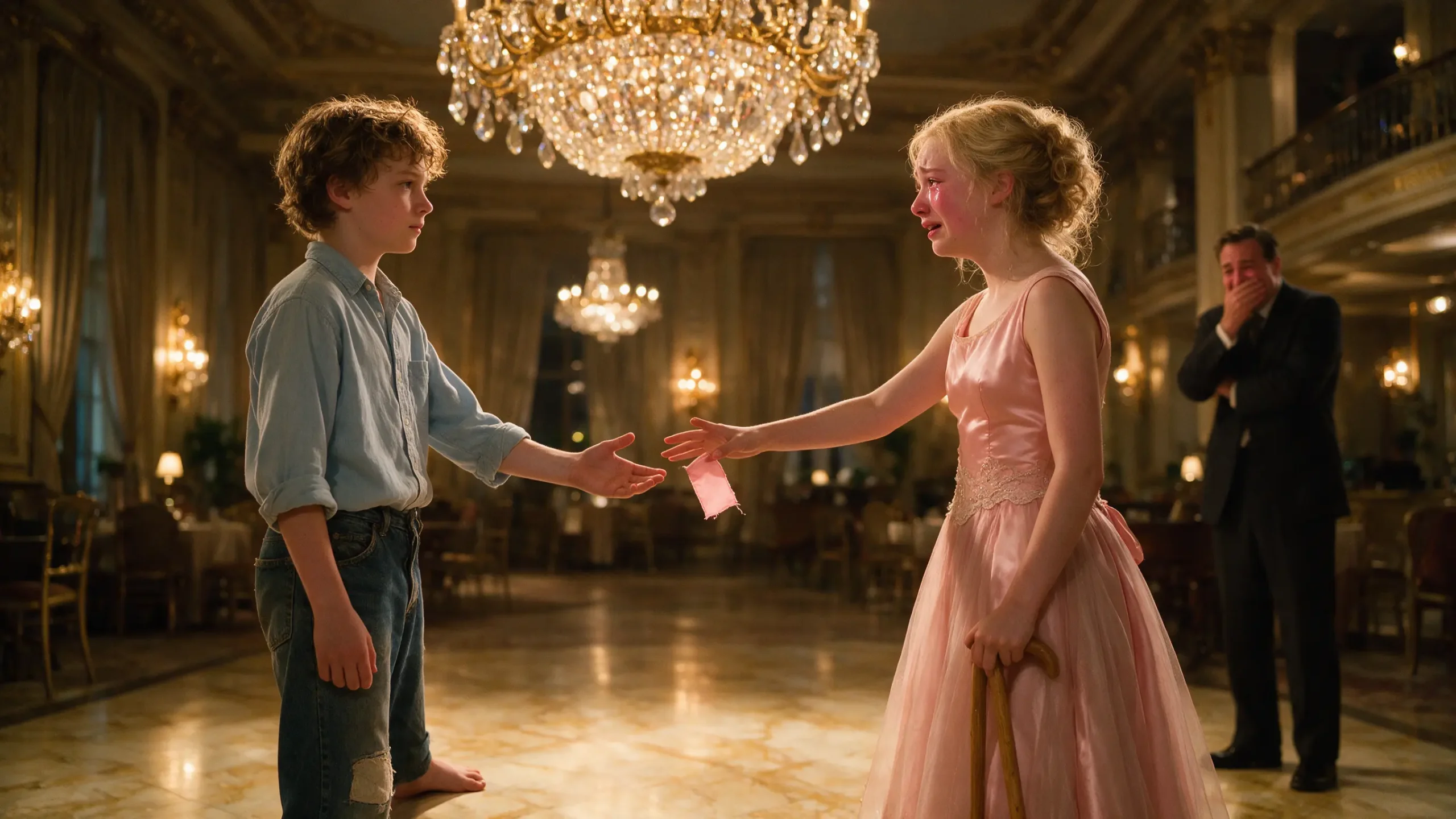
The boy had no shoes. His feet left faint prints on the marble floor, small and apologetic, like he already knew he didn’t belong here. His pants had a patch on the left knee. His shirt was clean but faded, the kind of clean that takes real effort when you don’t have much.
He had walked straight in through the service entrance, following the sound of music.
The girl saw him first.
She was standing near the edge of the floor with her father, wearing a pink dress that her aunt had altered twice because she’d grown — but not in the way they’d hoped. She walked with a cane. Not always. Not forever, the doctors said. But tonight, yes. Tonight the cane was part of her.
She was fourteen, and she had not danced in two years.
The boy stopped in front of her. He looked at her with the direct, unembarrassed gaze of someone who had never learned to pretend.
“Are you the girl in pink?” he asked.
Her father stiffened. “Excuse me — who are you?”
“My name’s Danny.” He looked at the girl again. “I think I have something that belongs to you.”
The girl’s breath caught. “What do you mean?”
Danny reached into his pocket — slowly, carefully, the way you reach for something you’ve been guarding for a long time — and pulled out a small square of pink ribbon, folded into a neat rectangle, creased white at the folds from being opened and refolded too many times.
The father went completely still.
Because he knew that ribbon.
He had watched his wife tie it. Her hands shaking — not from fear but from the morphine, from the effort of staying present when her body was already making different plans. She had tied it around their daughter’s wrist in a hospital room on a Tuesday afternoon in October, and she had said, You are braver than you know. Don’t let anyone tell you otherwise. Not even yourself.
It was one of the last things she ever did.
“Where did you get that?” the father said. His voice came out wrong. Too thin. Too exposed.
“A woman gave it to me,” Danny said. “Outside St. Catherine’s Hospital. About eight months ago. I was sitting on the steps because I’d been inside with my grandma and I hadn’t eaten since morning and I didn’t want to go back in and see her like that.”
He paused. Swallowed.
“The woman sat down next to me. She didn’t ask if I was okay. She just gave me half her sandwich.” He almost smiled at the memory. “Turkey. It was really good.”
The girl made a small sound. Her hand found her father’s arm.
“She talked to me for a while,” Danny continued. “She asked about my grandma. She asked about me. She said she had a daughter about my age who was learning something hard — that being brave doesn’t mean you’re not scared. It means you do the thing anyway.”
The father pressed one hand over his mouth.
“Before she left, she gave me the ribbon. She said — ” Danny looked down at the marble floor for just a moment, then back up. “She said if I ever ended up somewhere with music and rich people, I should find the girl in pink and ask her to dance. She said maybe both of us needed somebody to believe in us that night.”
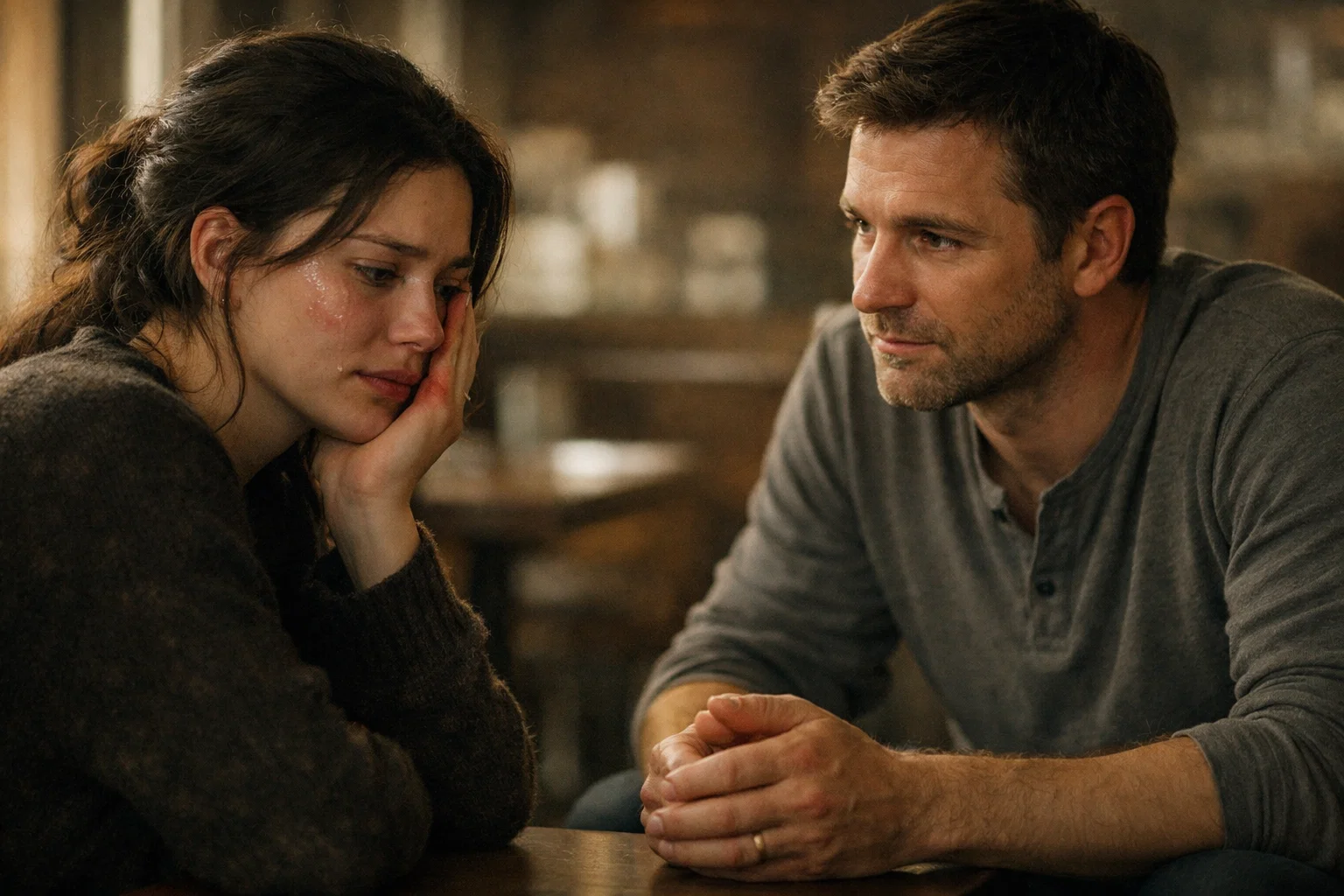
The girl was crying now. Not dramatically. Silently — the kind of crying that happens when something you buried a long time ago suddenly surfaces and you realize you never actually let yourself feel it.
“She died three weeks later,” the girl whispered.
“I know,” Danny said quietly. “I figured.”
Nobody in the ballroom moved. Somewhere near the back, a woman in a silver dress reached out and took her husband’s hand without looking at him.
The father knelt down — right there on the ballroom floor, in his rented suit, without caring what anyone thought — and he took his daughter’s hand in both of his.
“I have been so afraid,” he said. “I’ve been so afraid of watching you get hurt again that I forgot to let you try.”
She looked at him. “I know, Dad.”
“I don’t know how to stop being afraid.”
“You don’t have to stop,” she said. “You just have to let me go anyway.”
He squeezed her hand. He nodded. He stood up.
Danny was still waiting. Patient the way only children who’ve spent time in hospital waiting rooms learn to be patient.
He held out his hand.
“I should tell you,” he said, “I don’t actually know how to dance.”
The girl almost laughed. “Neither do I. Not anymore.”
“Then we’ll be bad at it together.”
She took his hand.
It was not graceful. There was no music cue, no movie moment where everything aligned — the lighting didn’t shift, the crowd didn’t part, the orchestra didn’t swell at exactly the right second. She took one step and her cane scraped the marble and she lurched sideways and Danny grabbed her arm without flinching, without making it weird, just held on.
“I’ve got you,” he said.
“Okay,” she said.
They tried again.
Three steps. Slow. Uncertain. Her free hand gripping the cane, his hand at her elbow, both of them moving in a kind of rhythm that had nothing to do with the music playing and everything to do with just — continuing.
Her father stood watching with tears streaming openly down his face and for once in two years he didn’t try to stop them or apologize for them or wipe them away before anyone could see.
On the fourth step, something changed.
It wasn’t a miracle. She didn’t drop the cane and start waltzing. She didn’t suddenly move the way she used to. But something in her face shifted — the tight, careful, watchful expression she’d been wearing since the accident — that mask of someone perpetually braced for the next fall — it softened.
She was present. Fully, actually present.
“She knew,” the girl said, almost to herself.
“Yeah,” Danny said. “I think she did.”
Around them, the crowd began to move again. Slowly at first. People turning back to their conversations, their drinks, their evenings — but something had changed in the room. Several people were quietly wiping their eyes. The woman in the silver dress had not let go of her husband’s hand.
The music played on.
The girl in pink and the barefoot boy from the hospital steps moved in their small, imperfect circle on the edge of the ballroom floor, not dancing exactly, but doing something better than dancing — something that didn’t have a name but felt like proof.
Proof that love doesn’t stop when the person does.
Proof that some messages travel farther than we think, carried by the kindest possible messengers: a hungry boy, a folded ribbon, a sandwich shared on a Tuesday.
Proof that a mother who loved her daughter well enough — who paid attention well enough — could reach across eight months and a ballroom full of strangers and say: I kept my promise. Now keep yours.
Three weeks later, the father found Danny again — it took some asking around, some calls to the hospital’s social work office — and learned that his grandmother had died the same month. That he was living with a cousin in a crowded apartment. That he’d never been enrolled in the after-school programs the county offered because no one had known to ask.
He enrolled him.
It wasn’t charity. The father was careful about that. He asked Danny first, explained what it was, gave him the choice. Danny said yes because the program had a music component and he’d always wanted to learn guitar.
The girl and Danny texted sometimes. Not constantly. Not the way kids who’ve been friends for years text. But enough. She sent him a photo in December — her at the ice rink, no cane, one hand on the rail, one hand raised, grinning like she’d just won something.
He sent back: your mom would’ve said something embarrassing here
She replied: she absolutely would have. something like “that’s my girl” but louder than necessary
He sent back a single laughing emoji.
She sent back the ribbon emoji. The only pink one she could find.
The father kept the original ribbon. Not hidden — displayed, on the small shelf in the hallway where they kept the few photographs. Next to a picture of his wife in summer, laughing at something off-camera, her head tilted back, completely unguarded, completely herself.
He stopped apologizing for being afraid.
He started, instead, letting his daughter try.
That was the promise she had actually asked him to keep — not to be fearless, but to be faithful. To her. To the girl who was still in there, still reaching, still looking for the music in rooms that hadn’t been built for her.
She found it.
Every time.
Original fictional stories. AI-assisted creative content.