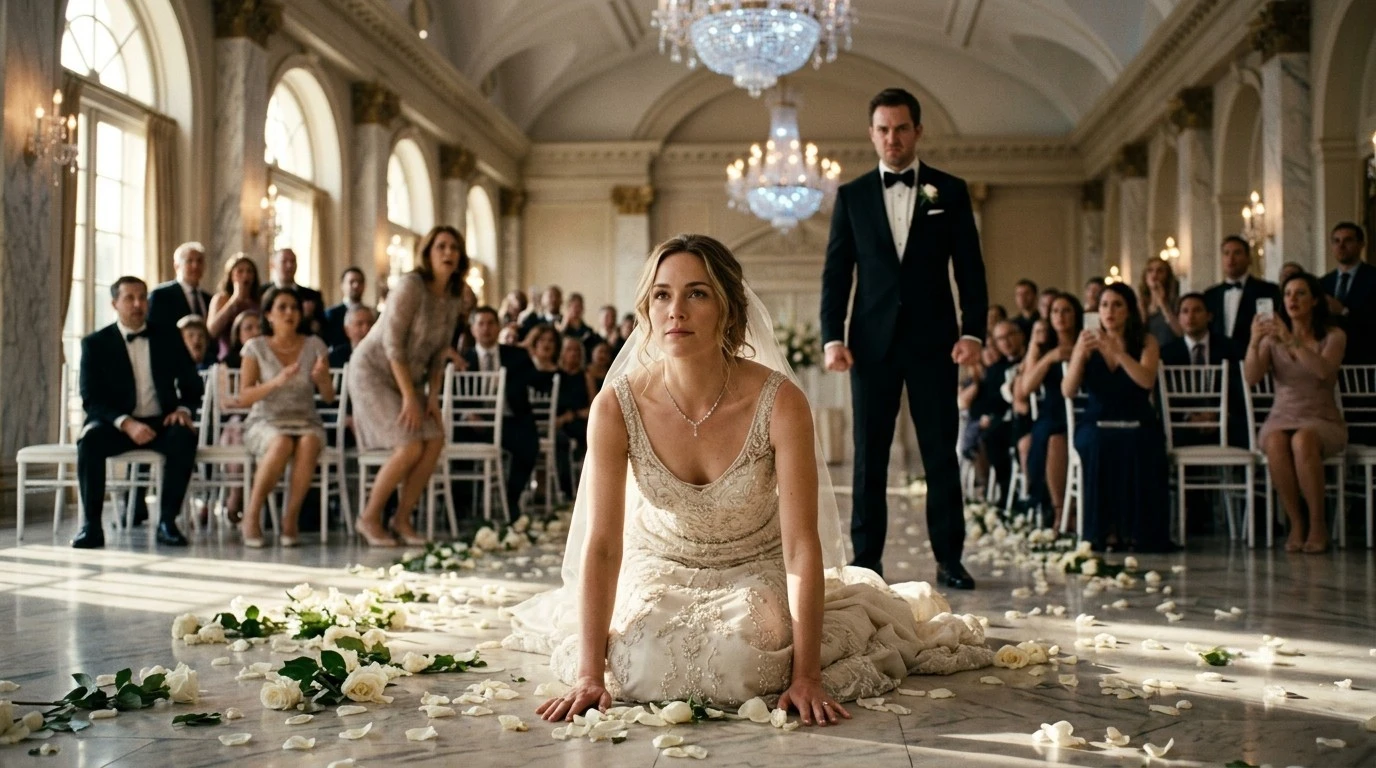
The cathedral ballroom glittered under three crystal chandeliers.
Five hundred guests filled the white chairs. A string quartet played low and sweet. Somewhere near the back, a photographer adjusted his lens for the perfect shot.
It was supposed to be the wedding of the year.
Daniel Crawford stood at the altar in a tailored black tuxedo, jaw clenched, eyes flat. Beside him, Phoebe waited in a beaded ivory gown, her hands folded, her bouquet trembling just slightly.
She didn’t know yet that trembling was the last soft thing she’d allow herself that day.
The officiant opened his book. “Dearly beloved—”
“Stop.” Daniel’s voice cut through the music like a blade.
The quartet faltered into silence.
Phoebe blinked. “Daniel?”
He turned to face her fully, and something in his expression made the front row go still.
“You really thought this was about love?” he said.
A woman near the aisle gasped. Someone’s phone camera turned, instinctively, toward the altar instead of away from it.
Phoebe’s smile cracked at the edges. “What are you talking about?”
“I’m talking,” Daniel said, stepping back from her, “about the fact that I don’t need you anymore.”
He shoved her.
It wasn’t a small push. It was hard enough that her heels caught the hem of her gown, hard enough that her bouquet flew from her hands and hit the marble in a spray of white roses.
She went down.
The sound of five hundred people inhaling at once filled the ballroom.
Two men in the third row half-rose from their seats before their wives grabbed their arms and pulled them back down.
Phoebe lay on the cold marble floor in her wedding dress, staring up at the chandeliers, the room spinning slightly.
“Get up,” Daniel said, not offering a hand. “You’re embarrassing yourself.”
She looked up at him through tears she refused to let fall. “You just pushed me. In front of everyone.”
“Save the tears.” His voice was ice. “I’m marrying someone who actually matters.”
The side doors opened.
A blonde woman in a shimmering gold gown walked in like she owned the marble beneath her heels. She smiled at the stunned crowd as if she’d been waiting her whole life for this exact entrance.
Daniel reached out and took her hand.
“Everyone,” he announced, “meet Vivienne. The woman I should have married from the start.”
From the front row, an older woman rose slowly. Daniel’s mother. She began to clap, slow and mocking, the sound echoing off the vaulted ceiling.
“Finally,” she said. “Someone with actual breeding.”
A few relatives laughed nervously. Most looked away, unsure where to put their eyes.
Phoebe stayed on the floor a moment longer than she needed to.
Then she did something no one expected.
She laughed.
It wasn’t loud. It wasn’t bitter. It was quiet, almost gentle, and it made Daniel’s smug expression falter for the first time.
“What’s funny?” he asked.
“Nothing,” Phoebe said, wiping her cheek with the back of her hand. “Everything.”
She reached for her bouquet, gathered the scattered roses, and rose to her feet without help from anyone.
She straightened her gown.
She lifted her chin.
And she turned — not toward Daniel, not toward his mother, not toward the whispering crowd — but toward an elderly man standing quietly near a side column.
Nobody had paid him much attention all ceremony. Gray suit, plain tie, the kind of face that blended into any room. Guests had assumed he was someone’s uncle, maybe a family friend seated near the back out of politeness.
Phoebe walked toward him, roses still in her hands, gown trailing marble dust.
She looked him directly in the eye.
“Cancel the merger,” she said. “Right now.”
The ballroom went dead silent.
The old man didn’t hesitate, didn’t ask which merger, didn’t blink in confusion. He simply nodded once, like a soldier receiving an order he’d been expecting for years.
“Right away, Miss Sterling.”
Daniel’s head snapped toward them. “What merger?”
Nobody answered him.
The old man pulled a phone from his jacket pocket, dialed a single contact, and spoke calmly into it while five hundred people watched in frozen silence.
“This is Charles. Terminate all negotiations with Crawford Industries, effective immediately.”
A pause.
“No. Full withdrawal. Every investment, every credit line, every signed letter of intent.”
He ended the call.
The silence that followed had weight to it, the kind that presses down on a room until someone finally breaks.
Daniel’s father was the one who broke it. He stood so fast his chair toppled backward.
“What have you done?” he said, staring not at his son but at the old man.
Charles turned to face the room fully for the first time.
“I don’t believe we’ve been introduced,” he said, his voice mild, almost polite. “Charles Sterling. Chairman of Sterling Enterprises.”
Gasps rippled through the crowd like wind through wheat.
“And this,” he said, gesturing toward Phoebe with quiet pride, “is my granddaughter. Phoebe Sterling. Sole heir to everything my family has built over the last sixty years.”
Daniel’s face went the color of the marble floor.
“You—” he started.
“I had no idea who you were,” Phoebe said, cutting him off before he could finish. Her eyes never left his. “And you know why? Because you never once asked.”
“Phoebe—”
“For two years,” she said, “you introduced me to your business partners as ‘my fiancée, she does something in nonprofits.’ You never asked what company I ran. You never asked whose name was on the building where your father’s firm rents its top floor.”
Vivienne’s confident smile had disappeared entirely. She took a small step away from Daniel, as if putting distance between herself and a building about to collapse.
“I made a mistake,” Daniel said, his voice cracking for the first time. “Phoebe, I made a mistake, we can fix this—”
“No,” Phoebe said, calm as still water. “You didn’t make a mistake. You revealed exactly who you are. Those are two very different things.”
She turned to walk toward the exit, her grandfather falling into step beside her.
No tears.
No hesitation.
Behind them, phones across the Crawford side of the ballroom began buzzing in unison — texts, calls, alerts, all carrying the same three words in different fonts: contracts, canceled, immediately.
Daniel stood alone at the altar in his tailored tuxedo, surrounded by five hundred witnesses to his own downfall.
He hadn’t lost a wedding.
He’d lost the one person quietly holding his family’s entire future together, and he hadn’t even known her name was the only thing keeping it standing.
The story could have ended there. Six words. One walkout. A ruined wedding.
But empires don’t collapse in a single afternoon. They collapse in stages, each one worse than the last, and the Crawfords were about to learn that the hard way.
By Monday morning, Crawford Industries’ stock had dropped eleven percent.
By Wednesday, the drop was twenty-three percent.
Reporters camped outside the Crawford corporate offices in downtown Chicago, cameras aimed at the revolving glass doors like hunters waiting for prey to emerge.
Inside, Daniel’s father, Richard Crawford, sat behind his mahogany desk with three phones ringing at once and no good news on any of them.
“Sterling Group has formally withdrawn,” his CFO said, standing in the doorway like he was afraid to come any closer. “Not just the merger. Every line of credit tied to Sterling capital. We have ninety days to refinance four hundred million dollars or we default.”
“Ninety days,” Richard repeated, like the words themselves were foreign.
“Ninety days,” the CFO confirmed.
Richard’s hands, usually steady enough to sign hundred-million-dollar contracts without a flicker, were shaking.
“Get Daniel in here,” he said.
“He’s not answering his phone.”
“Get him in here,” Richard said again, louder, “or there won’t be a company left for him to inherit.”
Daniel wasn’t answering his phone because he was standing outside a modern glass office tower downtown, staring up at a name freshly etched into the lobby directory.
STERLING ENTERPRISES — FLOOR 40.
He’d walked past this building a hundred times. He’d never once looked up.
He pushed through the revolving doors before he could talk himself out of it.
The lobby was all white marble and soft light, the kind of space designed to make visitors feel small the moment they stepped inside.
A receptionist looked up. “Can I help you?”
“I need to see Phoebe Sterling.”
“Do you have an appointment?”
“No. Tell her it’s Daniel.”
The receptionist’s expression flickered — recognition, maybe, or contempt, or both — before she picked up her phone and murmured something too quiet for him to hear.
She hung up. “Miss Sterling says she’s not available.”
“Tell her it’s important.”
“She heard you the first time,” the receptionist said, not unkindly. “She said to tell you the same thing you told her at the altar. Save your tears.”
Daniel felt his face burn.
He didn’t leave.
He sat in the lobby for three hours until a security guard finally asked him, politely but firmly, to move along.
That night, Daniel sat alone in his apartment with a glass of scotch he hadn’t touched and his phone lighting up every few minutes with headlines he couldn’t stop reading.
CRAWFORD INDUSTRIES STOCK IN FREEFALL AFTER WEDDING SCANDAL.
GROOM HUMILIATES BRIDE — TURNS OUT SHE WAS HIS FAMILY’S LIFELINE.
STERLING HEIRESS WALKS AWAY FROM $2B WEDDING IN VIRAL VIDEO.
The video had eleven million views by midnight. By morning it would have thirty.
Someone in the crowd — nobody ever confirmed who — had filmed the entire thing on their phone, from the shove to the six words to Phoebe’s calm walk out the door. It had spread across every platform overnight, stitched and reacted to and dissected by strangers who now knew Daniel’s face better than his own mother did.
His phone rang. Vivienne.
He answered on the first ring. “Hey. I’ve been trying to call you all day.”
“I saw the video,” Vivienne said, her voice flat, distant. “Everyone’s seen the video, Daniel.”
“I can explain—”
“Explain what? That you didn’t know your own fiancée’s family owned half the deals that fund your company?”
“I didn’t know,” he said. “I swear to you, I had no idea.”
“That’s almost worse,” Vivienne said. “Do you understand how this looks for me? My father’s business partners are calling him right now asking if we’re associated with the Crawford collapse.”
“So that’s what this is about. How it looks.”
“Don’t,” she snapped. “Don’t turn this around on me. I think we should take a break. This is a lot right now.”
“A break,” Daniel repeated.
“A break,” she confirmed. “Call me when the stock stops falling. Or don’t call me at all.”
The line went dead.
He stared at the screen for a long moment before setting it face-down on the counter.
Two days ago he’d had a company, a fiancée waiting to be married again, and a merger that would have made his family untouchable for another generation.
Now he had a viral video, a collapsing stock price, and a woman who wouldn’t take his calls.
He poured the scotch down the drain. He didn’t want it anymore. He wanted the last week back, and no amount of alcohol was going to give him that.
Phoebe’s grandfather found her in her office two floors above the lobby, staring out a window at the city skyline, still in the sweatshirt she’d changed into after the wedding.
“You didn’t have to see him,” Charles said. “You could have let security handle it.”
“I know.”
“Then why didn’t you?”
Phoebe turned from the window. “Because I wanted to know if he’d come to apologize or to save himself.”
“And?”
“He didn’t ask about me once,” she said. “Not how I was doing. Not whether I was okay after what he did in front of five hundred people. He asked to speak to Phoebe Sterling. Not Phoebe.”
Charles was quiet for a moment. “Your grandmother used to say that’s how you tell the difference between someone who loves you and someone who loves what you can do for them. One asks about your heart. The other asks about your bank account.”
“I wish she’d told me that two years ago.”
“She tried,” Charles said gently. “You weren’t ready to hear it. Most people aren’t, when they’re in love with the wrong person.”
Phoebe managed a small, tired smile. “I’m not in love with him anymore.”
“No,” Charles agreed. “I don’t think you are.”
Two days after the wedding, Phoebe’s assistant, Maya, knocked on her office door holding a tablet like it might explode in her hands.
“You need to see this,” Maya said.
“I really don’t.”
“You really do. The video has nine million views. There’s a hashtag. It’s trending in four countries.”
Phoebe closed her eyes briefly. “Which hashtag?”
Maya turned the tablet around. “SixWordsSterling.”
“Of course it is.”
“There’s also a reporter from the Tribune camped outside the building lobby. And two from local news. And someone from a national morning show emailed asking if you’d do a sit-down interview.”
“Tell them no.”
“All of them?”
“All of them,” Phoebe said. “I’m not turning my worst day into content for a morning show.”
Maya hesitated. “Charles thinks you should say something. Just a short statement. He says silence lets other people write the story for you.”
Phoebe considered that. “Fine. One statement. Short. And I write it myself.”
The statement she gave, two hours later, standing on the front steps of the Sterling building in front of a small cluster of reporters, lasted less than a minute.
“I’m not going to discuss the details of my personal life,” Phoebe said, her voice steady, her grandfather standing just behind her shoulder. “What I will say is this: Sterling Enterprises makes business decisions based on integrity, not sentiment. When a partner’s conduct raises serious concerns about their character, we act accordingly. That’s not personal. That’s simply how we do business.”
A reporter shouted a question. “Miss Sterling, is it true the merger was worth two billion dollars?”
“I won’t be discussing figures.”
Another voice. “Do you have any response to Daniel Crawford directly?”
Phoebe paused just long enough for the moment to land.
“Only that I hope he learns something from this,” she said. “Though I won’t be the one teaching him.”
She turned and walked back inside without taking another question, and the clip of those two sentences would go on to outlast the original wedding video by weeks.
A week later, Richard Crawford requested — and was denied — a meeting with the Sterling board.
Two weeks later, three of Crawford Industries’ largest remaining investors pulled their capital, citing “reputational risk” in language that made the company’s lawyers wince.
By the end of the month, Crawford Industries had laid off four hundred employees, sold its downtown headquarters, and moved operations into a leased floor in a building half the size of the one they used to own.
The final board meeting in the old headquarters was, by every account, brutal.
“We need to talk about leadership,” one board member said, sliding a folder across the table toward Richard. “The Sterling withdrawal wasn’t a one-time event. Two other partners have quietly reached out about restructuring their positions with us.”
“Give me sixty days,” Richard said. “I can find new financing.”
“You had ninety,” another board member replied. “You used forty of them making phone calls nobody returned.”
“This company has survived worse than a canceled merger.”
“Has it?” the first board member asked. “Because from where I’m sitting, this company survived because your father built something with actual substance behind it. What almost took us down wasn’t the market. It was a decision your son made in under thirty seconds at his own wedding.”
Richard’s jaw tightened. “My son’s personal life isn’t a board matter.”
“It became one,” the board member said, “the moment it cost this company four hundred jobs and half our market cap. We’re not voting on your son’s love life, Richard. We’re voting on whether this leadership team can be trusted with what’s left of the business.”
The vote, when it came, wasn’t close.
Richard Crawford remained on the board, technically, as a minority stakeholder with no operational authority. The new majority owners installed their own CEO within the month — a woman from outside the family entirely, brought in specifically because she had no connection to the wedding, the scandal, or the Crawford name.
Daniel watched his father sign the restructuring papers from a chair in the corner of the room, saying nothing, because there was nothing left to say.
Richard Crawford aged a decade in six weeks. His hair, once dyed a careful chestnut brown, grew out silver at the roots because he’d stopped caring enough to book the appointment.
He finally cornered his son in the half-empty office they now called headquarters.
“You knew,” Richard said, voice low and shaking. “You had to have known there was something more to her. Nobody just walks into a room and cancels a merger with six words unless they’ve had that power the entire time.”
“I didn’t know,” Daniel said. “I swear to you, I didn’t know.”
“Then why,” Richard said, each word landing like a stone, “did you humiliate the one person holding a knife over our entire future?”
Daniel had no answer for that. He’d asked himself the same question every night for a month and never found one that didn’t make him feel sick.
“I thought Vivienne’s family connections were worth more,” he finally admitted. “I thought Phoebe was — replaceable.”
Richard laughed, but there was no humor in it. It was the laugh of a man watching his life’s work disintegrate because of a decision his son made in under thirty seconds.
“She wasn’t replaceable,” he said. “She was the only irreplaceable thing in this entire company. And you threw her away in a ballroom in front of cameras.”
He walked out without another word, and Daniel sat alone in an office that no longer smelled like success, just like the slow, quiet scent of an ending.
Six months passed.
Crawford Industries survived, technically, though “survived” was generous. It existed in a smaller form, under new ownership after a forced restructuring, with Richard Crawford holding a minority stake in the very company his father had built from nothing.
Daniel worked in that smaller company now, in a mid-level role he wouldn’t have looked twice at a year earlier. He answered to a board that included people who used to answer to him.
His new supervisor was a woman named Karen Ruiz, who had worked under him for three years before the restructuring. She called him into her office on a Tuesday morning, a quarterly report open on her screen.
“Your numbers are behind, Daniel.”
“I know. I’m working on the Fenwick account. It should close by Friday.”
“You said that last Friday.”
“Karen, I’m doing everything I—”
“I’m not trying to make this harder for you,” Karen said, and there was something almost gentle in it, which somehow made it worse. “But I have a board looking at every underperforming line item, and your line is one of them. You used to sign my checks. Now I sign yours. I don’t enjoy it. But I need the Fenwick account closed by Friday, actually closed, or I have to write you up.”
Daniel nodded, throat tight. “Understood.”
“For what it’s worth,” Karen added as he reached the door, “I don’t think you’re a bad worker. I think you got used to people needing you instead of you needing to earn it. That’s a hard habit to break at your age. But it’s not impossible.”
“Thanks, Karen.”
“Close the account, Daniel.”
He closed the account by Thursday.
Vivienne had long since moved on to someone whose last name still meant something in the right rooms.
Daniel’s mother, Eleanor Crawford, learned her own lesson in a quieter room, months earlier.
She had spent thirty years chairing the Winterset Charity Gala, the kind of event where her name on the invitation meant something. The week after the wedding video went viral, she received a call from the gala’s board president.
“Eleanor, I’ll be direct,” the woman said. “The board voted this morning. We’re asking you to step down as chair this year.”
“Step down? Margaret, I’ve chaired this gala for three decades.”
“I know. And normally that would be the end of the conversation. But half our major donors have called asking whether an association with the Crawford name right now is good for their own reputations. I have three sponsors threatening to pull funding entirely if your name stays on the program.”
“Because of a wedding,” Eleanor said, disbelief creeping into her voice.
“Because of a video, Eleanor, where you stood up and applauded your son humiliating his bride on the floor. That clip has been played on national television. People remember what they see.”
“I was defending my son.”
“You were mocking a woman while she was on the ground,” Margaret said, not unkindly, just factually. “I watched it eleven times before I could bring myself to make this call. I’m sorry. Truly. But the board’s decision is final.”
Eleanor sat in silence after the call ended, staring at an invitation list she had curated personally for thirty years, realizing for the first time that the clapping she’d done in that ballroom had cost her something she couldn’t easily rebuild.
Phoebe, meanwhile, sat across a boardroom table from her grandfather, reviewing quarterly numbers that had climbed every month since the wedding that never happened.
“The Whitfield acquisition closed this morning,” Charles said, sliding a folder across the table. “You negotiated better terms than I would have.”
“I had a good teacher.”
“You had good instincts,” Charles corrected. “The teaching just helped you trust them.”
Phoebe flipped through the folder, her expression calm, focused, entirely her own. There was no trace left of the woman who’d knelt on a marble floor in a wedding gown six months earlier.
“Can I ask you something?” Charles said.
“Always.”
“Do you regret it? Any of it?”
Phoebe considered the question seriously, the way she considered everything now.
“I regret two years,” she said finally. “I don’t regret the wedding. If he hadn’t done what he did in front of everyone, I might have spent a lot longer figuring out who he really was in private, where nobody would have believed me.”
“So he did you a favor.”
“An expensive one,” Phoebe said, “but yes. In a strange way, he did.”
The final piece of the story came, fittingly, at another event — a charity gala hosted by the Sterling Foundation, the kind of event where the city’s wealthiest gathered to be photographed doing good.
Daniel hadn’t been invited. He came anyway, slipping in on the arm of a colleague who had a spare ticket, hoping to catch five minutes with Phoebe in a room full of witnesses this time, on purpose, so she couldn’t simply walk away.
He found her near the silent auction tables, in a deep emerald dress, laughing at something her grandfather had said.
“Phoebe.”
She turned, and for a moment something flickered across her face — not fear, not anger, just recognition, like seeing an old photograph of a stranger.
“Daniel.”
“I need thirty seconds,” he said. “That’s all I’m asking.”
Charles moved to step between them, but Phoebe raised a hand, stopping him gently.
“It’s fine,” she said. “Thirty seconds.”
Daniel exhaled like he’d been holding his breath for six months. “I’ve had a long time to think about what I did. I know sorry doesn’t undo it. I know I destroyed something I didn’t understand I even had. I just — I wanted you to know I’m not the same person who stood at that altar.”
Phoebe studied him for a long moment.
“Maybe you’re not,” she said. “But that person is still the reason I’m standing here in this dress, at this gala, running a company you once assumed I couldn’t possibly be smart enough to run.”
“I never said that.”
“You didn’t have to say it,” Phoebe said. “You showed it. Every time you introduced me as your fiancée who ‘does something in nonprofits.’ Every time you didn’t ask a single question about my work in two years. Your silence said it plainly enough.”
Daniel had nothing to offer against that. It was true, and they both knew it.
“For what it’s worth,” Phoebe said, softer now, “I hope you build something real out of what’s left. I really do. But it won’t be with me watching from the front row, and it definitely won’t be with me signing the checks.”
She turned back to the auction table, back to her grandfather, back to a life that no longer had room in it for a man who’d once decided, in front of five hundred people, that she didn’t matter.
Daniel stood there a moment longer.
Then he did the only thing left to do.
He left.
Outside, the city lights blurred against a light rain, and for the first time since the wedding, Daniel didn’t reach for his phone to check the stock price or the headlines or the messages that never came.
He’d learned, finally, the lesson his father had tried to teach him in a half-empty office six months earlier — that some mistakes don’t just cost you money. They cost you the one person who was quietly making everything else possible.
Inside, Phoebe raised a glass with her grandfather, toasting a foundation that would fund a hundred futures better than the one she’d walked away from.
“To new beginnings,” Charles said.
“To knowing exactly who you’re dealing with,” Phoebe corrected, smiling for real this time.
They drank.
Somewhere across the room, a photographer caught the moment — Phoebe Sterling laughing, radiant, untouchable — and it ran in the paper the next morning under a headline that needed no further explanation.
THE HEIRESS WHO WALKED AWAY — AND WON.
The greatest loss, it turned out, doesn’t announce itself with thunder or tears.
Sometimes it walks calmly out of a ballroom in a wedding gown, and by the time you understand what you’ve lost, the doors have already closed behind her for good.
Original fictional stories. AI-assisted creative content.