At 6:42 a.m., the ocean looked black.
Not dark blue. Not gray. Black, like polished obsidian stretching past the horizon.
Site Seven sat alone on a rocky island thirty miles off the coast. No tourists. No press. Just steel, checkpoints, and secrets worth billions.
Officially it was Oceanic Materials Development Center 7. Inside the company, everyone just called it Site Seven — birthplace of Project Leviathan, the deep-sea vessel meant to reach places no submarine ever had.
Governments wanted it. Militaries wanted it. Energy companies wanted it.
Which was exactly why security had gotten obsessed with control.
Maybe too obsessed.
—
Briggs liked control. He liked the way people flinched when they saw the badge on his chest.
Chief Security Supervisor. Not an impressive title anywhere else. Inside Site Seven, it might as well have been king.
New hires feared him. Contractors avoided him. Briggs took that as proof he was doing his job right.
He stood in the lobby that morning, coffee in hand, watching the guard feed.
“Anything overnight?” he asked.
“Quiet,” said Reyes, the younger guard. “Some contractor van got flagged at the gate. Cleared it myself.”
“You cleared it,” Briggs repeated.
“Yes, sir.”
“I clear things here. Not you.”
Reyes said nothing. Nobody argued with Briggs. That was the whole point of him.
At 7:58 a.m., the front doors opened.
An older woman walked in. Gray coat. Plain black bag. No badge.
She moved like she’d walked through a hundred lobbies exactly like this one and found all of them slightly disappointing.
Briggs set down his coffee.
“Ma’am, this is a restricted facility.”
“I’m aware.”
“Then you’re aware you need clearance.”
“I have a meeting.”
“With who?”
“The people running this facility.”
One of the guards laughed. Site Seven employed three thousand people. Nobody talked about “the people running this facility” like that. Visitors named departments. Names. Appointments.
Not this.
Briggs stepped closer. “Name.”
“Evelyn.”
“Last name?”
“Evelyn is sufficient.”
Reyes smothered a laugh badly. Briggs already disliked her — the calm, the refusal to explain herself.
“I need identification,” Briggs said.
“Of course.”
She reached into her bag. Briggs expected a license, a passport, a visitor form.
Instead she produced a plain black card. No logo. No photo. Just a silver symbol — a sea serpent coiled around a trident.
Briggs frowned at it. The symbol looked familiar. He couldn’t place it.
“What is this supposed to be?”
“A credential.”
“This isn’t a credential.”
“It is.”
“No.”
He handed it back. “Try again.”
For half a second, something flickered behind her eyes. Not anger. Disappointment — like she’d expected better from him.
That annoyed Briggs more than the card ever could.
—
Employees had started arriving for the morning shift. People slowed near the lobby, sensing tension the way office buildings always do.
Nobody interrupted. Nobody ever interrupted Briggs.
Evelyn glanced around — marble floor, glass walls, the holographic display above reception rotating a model of Project Leviathan. A submarine built to survive pressure that could crush steel like a soda can.
She studied it a long moment.
“They’re behind schedule,” she said quietly.
Briggs blinked. “What?”
“The pressure hull. Six months behind.”
Silence. An engineer crossing the lobby froze mid-step, because she was right, and that number wasn’t public. Half the executive floor didn’t even know it.
Briggs caught the engineer’s reaction and his face went hard.
“Who told you that?”
Evelyn didn’t answer. She looked up toward the executive floor instead, and sighed — a long, disappointed sigh, like a parent finding a child had broken something expensive.
That, somehow, was worse than anything she’d said.
“Listen carefully,” Briggs said, voice dropping. “You don’t belong here.”
Evelyn met his eyes. “I wonder how many times you’ve said that to the wrong person.”
The lobby went completely still. Somebody’s shoe stopped squeaking on the marble. Nobody breathed.
Briggs stepped forward, face reddening. “Excuse me?”
She opened a small notebook, wrote one line, closed it again.
“What did you write?” he demanded.
“An observation.”
“What observation?”
“The quality of leadership,” she said, “often reveals itself at the front gate.”
The sentence landed like a slap. A few employees exchanged glances they thought no one saw.
Briggs felt every eye in the room. Judging him. Waiting.
He hated being judged. Especially by a stranger. Especially by an old woman who wouldn’t flinch.
His pride made the next decision for him.
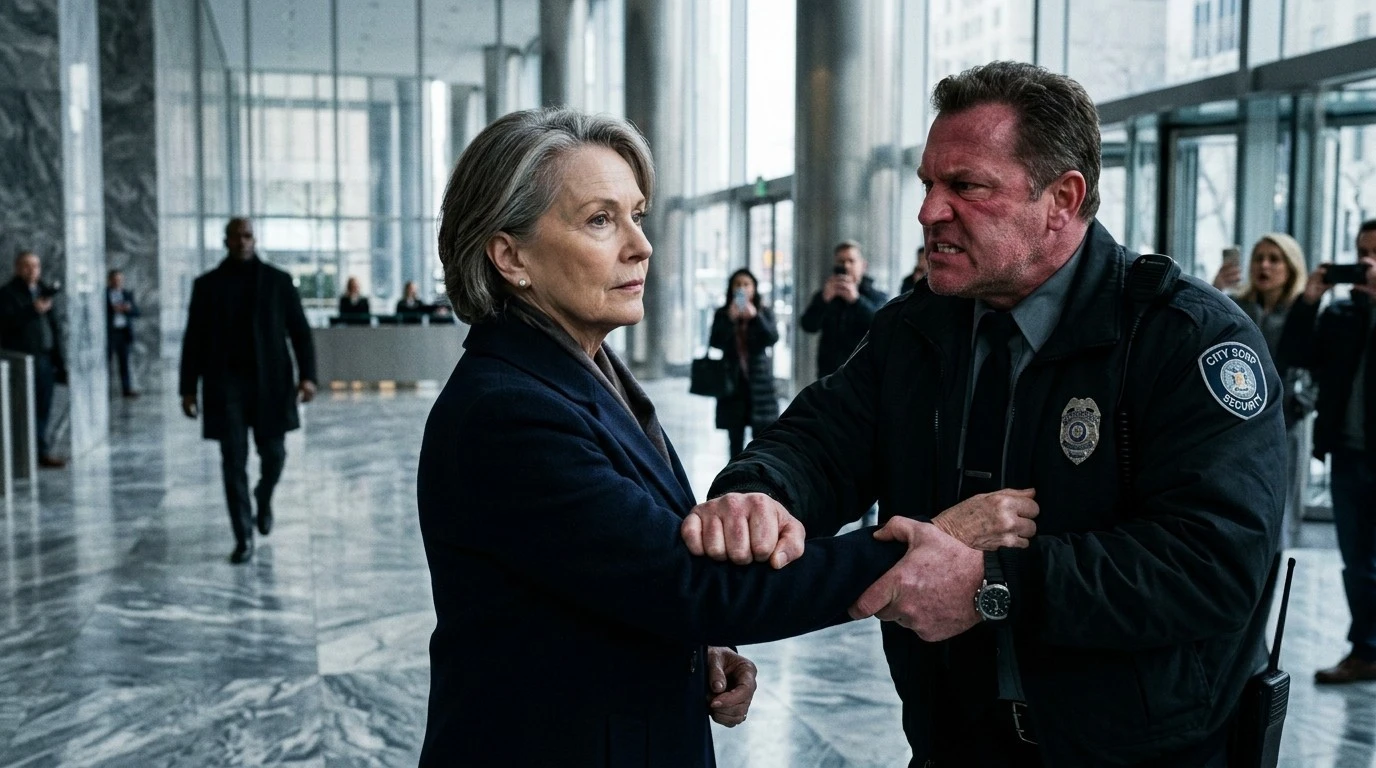
He grabbed her arm. Hard.
Gasps rippled across the lobby. A receptionist actually stood up. An engineer near the elevators dropped his coffee cup, and it cracked against the marble like a gunshot.
Evelyn didn’t react to the pain. She looked down at the hand on her arm, then slowly lifted her eyes — not to Briggs.
To someone behind him.
A tall man in a dark coat stood near the entrance. He’d been there the whole time. Silent. Watching.
The moment he saw Briggs’s hand close around her arm, he started walking.
—
“Let go of her,” the man said. Calm. Quiet. The kind of quiet that made people listen harder, not less.
Briggs didn’t let go. “Who the hell are you?”
“Kael.”
Just the one word. Reyes, the younger guard, went pale.
“Sir,” Reyes said, “maybe we should—”
“Shut up,” Briggs snapped.
Kael stopped three feet away. He didn’t raise his voice. He didn’t need to.
“You have five seconds to remove your hand,” Kael said, “or I remove it for you.”
Briggs laughed — short, ugly. “You’re threatening me? In my own building?”
“It’s not your building,” Evelyn said quietly. “That’s rather the point.”
Briggs’s grip tightened instead of loosening. That was his mistake.
Kael moved.
It happened fast enough that half the lobby only registered the end of it — Briggs’s wrist twisted back at an angle wrists don’t go, his hand snapping open, Evelyn’s arm free.
Briggs staggered back, cradling his hand, face white with pain and rage.
“You just assaulted a federal contractor’s chief of security,” he spat. “You’re done. Both of you.”
“No,” Kael said. “You just assaulted a board member on video, in front of forty witnesses, six months after corporate counsel warned this facility about exactly this kind of conduct complaint.”
Briggs froze. “Board member.”
“Founding board member,” Evelyn corrected. “I stepped back from daily operations nine years ago. I did not step back from the company.”
—
The elevator chimed. Everyone in the lobby turned.
Marcus Hale, the site’s executive director, walked out flanked by two assistants, phone already in his hand, face already pale.
“Ms. Calloway,” he said. “I wasn’t told you were arriving today.”
“That was intentional,” Evelyn said.
“Sir,” Briggs cut in, cradling his wrist, “this woman refused to identify herself, refused standard clearance, and this man assaulted me—”
“Marcus,” Evelyn said, ignoring him entirely, “walk with me. I have questions about a pressure hull that’s six months behind schedule and a budget report that says it isn’t.”
Hale’s jaw tightened. “That’s a scheduling matter, I can explain—”
“You can explain it to the board. On Thursday. With documentation.” She held up the black card again, and this time Hale’s face changed completely — recognition, and something close to fear.
“That’s a Calloway Trust audit credential,” he said quietly.
“It is.”
“Nobody said there was an audit.”
“That’s also intentional.”
Briggs’s mouth opened and closed. He looked at the card. He looked at the symbol he hadn’t been able to place ten minutes earlier — the same symbol stamped, small and easy to miss, on the corner of every badge in the building, including his own.
The company crest.
He’d been staring at the founder’s personal seal the entire time and called it fake.
—
“This is insane,” Briggs said. “Nobody told me who she was.”
“No one had to,” Kael said. “You’re supposed to treat every visitor like they might matter. That’s the job.”
“I don’t answer to you.”
“You don’t,” Evelyn agreed. “You answer to the board. As of about ninety seconds ago, so do I, actively, again.”
Hale stepped in, trying to smooth it over. “Ms. Calloway, I understand this looks bad, but Briggs is one of our most experienced—”
“He grabbed me hard enough to bruise,” Evelyn said, “in a lobby with a working camera system, thirty seconds after I told him I had a meeting with the people running this facility. He’s not experienced. He’s unsupervised.”
Reyes, the young guard, spoke up before he could stop himself. “She’s right. He does this. Not just today.”
Briggs turned on him. “Watch it.”
“No,” Evelyn said, “watch him talk. I’d like to hear it.”
Reyes hesitated, then didn’t stop. “There’s a file. HR calls it ‘informal complaints.’ Contractors, mostly. New hires. Anybody who doesn’t push back. It never goes anywhere because he signs off on his own incident reports.”
The lobby had gone dead silent again, but it was a different silence now. Not fear of Briggs.
Recognition of him.
—
Hale tried once more. “Ms. Calloway, let’s take this upstairs, privately, and—”
“No,” Evelyn said. “We’re doing this here. In the lobby. Where he did it.”
She turned to Briggs.
“Six months ago, this facility spent four hundred thousand dollars on a ‘security modernization initiative’ that never modernized anything. I have the invoice. I have the vendor, who happens to share an address with your brother-in-law’s LLC. I have the budget line it was quietly folded into so it wouldn’t show up as a separate item.”
Briggs’s face drained of color.
“That’s not—” he started.
“It’s exactly what it looks like,” she said. “You didn’t just get comfortable with fear. You monetized it. Every person in this lobby who was too scared to question you made it easier to hide four hundred thousand dollars.”
“You can’t prove—”
“I can,” she said. “It’s in the notebook. Along with today’s date, today’s witnesses, and today’s assault.”
—
Two real security officers — company security, not Briggs’s people — arrived within the minute, radios crackling. Hale had made the call himself, phone still shaking slightly in his hand.
“Escort Mr. Briggs to his office,” Hale said. “Full suspension, effective immediately, pending the board review.”
“You’re firing me over an old woman’s temper tantrum?” Briggs shouted.
“I’m firing you,” Hale said, “over an assault on camera, a fraud investigation with your name on it, and eleven years of complaints nobody let reach my desk. The tantrum was yours.”
Briggs looked around the lobby — at Reyes, who wouldn’t meet his eyes, at the employees who weren’t lowering theirs anymore, at the crowd he used to be able to silence with one step forward.
Nobody stepped back this time.
“This isn’t over,” he said.
“It is, actually,” Kael said. “That’s the part you’re not understanding yet.”
—
They walked him out under his own badge scanner, the one he’d made a hundred people flinch under. It didn’t beep for him on the way out. Someone had already deactivated it.
Evelyn watched from the lobby, rubbing the faint red mark on her arm without drama, like it was a minor inconvenience rather than an injury.
“You didn’t have to let him grab you,” Kael said quietly, once the doors closed behind Briggs. “I was two seconds from stopping it before it happened.”
“I know,” she said. “I needed the witnesses to see it land before they saw the consequence. People don’t believe the fall unless they see the push first.”
Reyes lingered near the desk, looking like he wasn’t sure if he was in trouble too.
“You,” Evelyn said. “You told the truth in a room where nobody else would. That matters more than you think it does.”
“I should’ve said something a long time ago,” he admitted.
“Yes,” she said. “But you said it today, in front of the person who could actually do something about it. That’s not nothing.”
—
By Thursday, the board review confirmed everything the notebook already knew. Briggs was terminated for cause, the diverted funds referred to the company’s fraud counsel, and Hale — who’d signed off on the “modernization initiative” without asking questions he should have asked — was formally reprimanded and placed under new financial oversight.
The pressure hull schedule got fixed the honest way: real budget, real vendor, four months of lost time recovered inside of six weeks once the money stopped disappearing.
Reyes got Briggs’s old position. Temporary, then permanent, once it was clear he ran it the way Evelyn actually wanted it run — with badges that meant something and a chain of command that didn’t end in fear.
Evelyn didn’t come back to run daily operations. She didn’t need to. She came back often enough that everyone remembered the lobby had cameras, and memories, and a founder who noticed things.
Kael stayed close, the way he always had, watching every room the way he’d watched that one — quietly, patiently, and only ever moving once.
The last time anyone saw Briggs, he was in a downtown office answering questions from a company attorney about vendor invoices with his brother-in-law’s name on them, no badge on his chest, no lobby full of people afraid to meet his eyes.
Just a man, finally being looked at the way he’d once looked at everyone else.
Original fictional stories. AI-assisted creative content.