The old man always sat in Booth Nine.
Same diner. Same black coffee. Same quiet way of watching the rain.
His name was Earl Donovan.
He was seventy-one years old, and he had lived in Briar Ridge his entire life—except for three years in the early 1970s when he followed a friend out to Sacramento and came back quieter than he’d left.
He’d been a carpenter. A good one. Built half the porches on the east side of town before his knees gave out, then spent the next decade doing estimates and supply runs until even that got to be too much.
His wife, Margaret, had passed nine years ago. Pancreatic cancer, six weeks from diagnosis to funeral.
After that, Earl sold the big house on Elm and moved into the smaller one on Maple Creek Road. Just him and the dog, until the dog went too.
Now it was just him.
He came to the diner every Friday at 1:15. He ordered the same thing—black coffee and tomato soup. He read the paper from front to back and left a four-dollar tip regardless of the bill.
The waitresses liked him. The regulars nodded at him. Nobody bothered him.
Until Derek Holt moved back to Briar Ridge.
Derek had grown up here. Left at nineteen. Came back at forty-six with a busted knee, a bankruptcy filing, and the kind of anger that builds quietly in a man for years until it has nowhere left to go.
He’d had plans once. A construction business out in Phoenix. Three trucks, a crew of eight, decent contracts. But the market dried up, his partner walked, and Derek spent two years chasing payments that never came before finally letting it collapse.
He blamed a lot of people for that.
He blamed his ex-wife, who took the house. He blamed his former partner, who he said had skimmed the accounts. He blamed the banks, the economy, the whole crooked structure of things.
And now he was back in the town he’d left, renting a room above the hardware store, working odd jobs, watching a seventy-one-year-old man sit peacefully in a diner every Friday—in the same booth where Derek’s own father used to take him for pancakes—while Derek himself had nothing.
The house on Maple Creek Road had once belonged to Derek’s uncle.
Earl had bought it fair, twenty years ago, at market price, through a realtor. But Derek had convinced himself otherwise. He’d been building that story for months.
Owen Briggs had never been to Briar Ridge before that Friday.
He was twenty-four years old and had driven up from Columbus for a job interview at an engineering firm two towns over. The interview had gone well—he thought. He wasn’t sure. He was never sure about those things.
He was the kind of person who second-guessed every interaction for hours afterward. Who replayed conversations in the shower. Who had spent most of his life being overlooked or underestimated and had quietly decided, sometime around his junior year of college, that being overlooked wasn’t the same as being powerless.
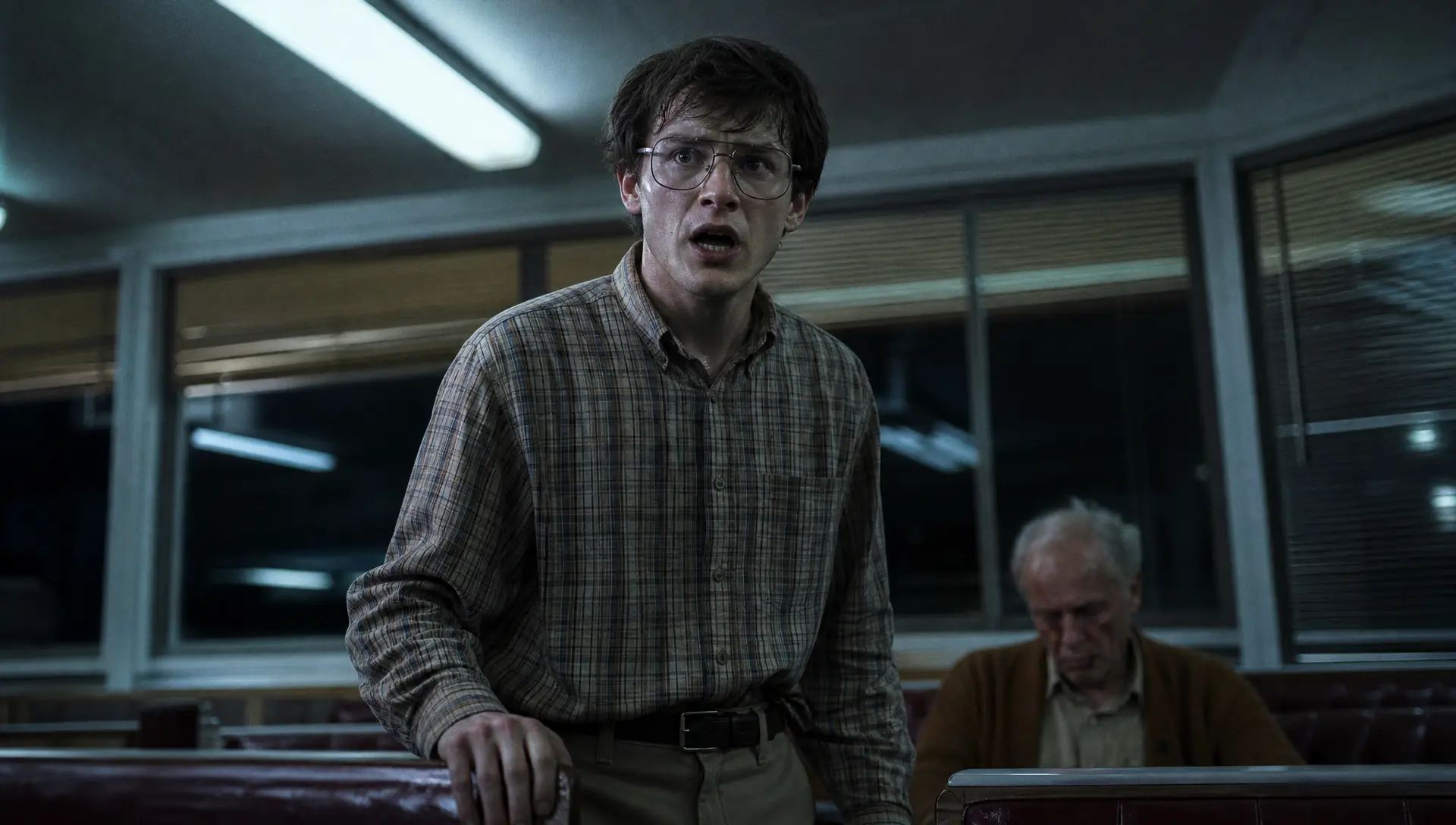
He wore the same glasses he’d worn since eighth grade—big wire-rimmed frames that his roommate called “professor glasses” and that Owen had never bothered to replace because they worked fine and he didn’t really care.
He’d pulled off the highway because he needed coffee and his GPS had flagged the diner.
He wasn’t looking for anything. He wasn’t expecting anything.
He just wanted to sit down for twenty minutes before the drive home.
He found a spot near the window, two booths down from an old man reading a newspaper.
He ordered a coffee.
He waited.
People in Briar Ridge didn’t know much about Earl. He spoke politely, tipped fairly, and left without drawing attention.
That Friday afternoon felt like any other.
Until it didn’t.
Derek Holt walked in with heavy steps. Mid-forties, faded jacket, eyes already angry.
He walked straight toward Booth Nine.
“You’re still here?” Derek said loudly.
The diner went quiet.
Earl looked up slowly. “Good afternoon.”
Derek scoffed. “Don’t act like everything’s fine. You think you can just ignore people forever?”
Earl folded his hands. “I’m not ignoring anyone.”
Derek leaned closer. “That house. You’re still holding onto it like it matters.”
“It does,” Earl said calmly.
Derek let out a bitter laugh.
Then he shoved the table.
The bowl tipped. Soup spilled across the newspaper. The coffee cup shattered on the floor.
Earl flinched but didn’t stand.
Derek stepped closer. “Maybe now you’ll understand. Nobody’s coming to help you.”
The door opened again.
A man stepped inside.
Tall. Wire-rimmed glasses catching the fluorescent light. Dark peacoat still damp from rain. Careful, measured steps.
His name was Owen Briggs.
He didn’t rush.
His eyes moved once across the diner. Broken glass. Spilled food. An old man sitting still.
Then he saw Derek.
Owen walked forward slowly.
Derek turned, annoyed. “What are you looking at?”
Owen stopped beside the booth. His voice was low but steady. “You knocked over his food.”
Derek rolled his eyes. “And?”
Owen didn’t blink. “Pick it up.”
The diner held its breath.
Derek laughed. “You serious?”
Owen took one step closer. Not aggressive. Just enough to make the space feel different.
“You have two choices,” Owen said quietly.
Derek crossed his arms. “Oh yeah?”
Owen adjusted his glasses slightly. “You clean this up and apologize.”
“Or what?”
Owen’s voice stayed calm. “Or you leave here remembering this moment longer than you want to.”
Derek looked around for support. No one met his eyes.
He grabbed his jacket. “This is ridiculous.”
Owen stood. “You’re leaving.”
“You don’t get to tell me what to do,” Derek said.
Owen looked at him calmly. “No. But I get to decide what happens next.”
Behind him, two more people had quietly stepped inside. Both wearing glasses. Both standing still.
Derek looked around. Still no one supported him.
He picked up his keys. “This isn’t over.”
Earl met his eyes. “Maybe not. But today is.”
Derek left. The door closed.
As the tension broke, Earl slowly lifted his eyes to Owen.
And something changed.
His gaze moved to Owen’s collar, where a silver pin caught the light.
A silver hawk.
Earl’s breath caught.
“Daniel…?” he whispered.
Owen froze.
He turned slowly. “What did you say?”
Earl blinked, confused. “I’m sorry… I thought…”
But Owen didn’t let it go.
Something inside him had shifted.
Earl reached into his coat with trembling fingers.
He pulled out an old wallet and unfolded a photograph worn thin by time.
He placed it on the table.
Owen leaned closer.
The photo showed a young man beside a motorcycle, smiling. One arm rested around a woman with bright eyes.
Owen’s breath slowed.
The woman—
He knew her.
“That’s my mother,” he said quietly.
Earl’s eyes filled. “Her name was Ruth.”
Owen nodded, stunned. “Yes.”
Earl swallowed. “Then you’re his son.”
Owen’s voice tightened. “My mother told me my father left.”
Earl shook his head slowly. “No. He didn’t leave. He never got the chance to come back.”
The diner felt smaller. Quieter.
Owen stared at the photo. “He knew about me?”
Earl didn’t hesitate. “He knew. And he wanted you more than anything.”
Owen sat down across from Earl.
For a long moment, neither spoke.
Then Earl asked softly, “What’s your name?”
“Owen Briggs.”
Earl nodded. “Briggs… your mother’s name.”
Owen looked down. “Did he ever choose a name for me?”
Earl smiled faintly, though his eyes were still wet. “He did.”
Owen looked up. “What was it?”
Earl’s voice trembled. “Samuel.”
Owen exhaled slowly, like something inside him had finally been given shape.
They sat together long after the diner quieted again.
A new cup of coffee. A fresh bowl of soup.
Owen helped clean the table. Not because he had to. Because it felt right.
Earl watched him with peace he hadn’t known in years.
“I thought I had lost everything,” he said quietly.
Owen shook his head. “Not everything.”
Earl looked at him. Really looked at him.
And this time, he didn’t see a stranger.
He saw something familiar. Something returned.
A few days later, Owen stood outside Earl’s home on Maple Creek Road.
The house was old. Weathered. But still standing.
Just like the man who lived inside it.
Earl opened the door. “You came.”
Owen nodded. “I said I would.”
Inside, the air smelled like wood and time. And something else.
Something that felt like belonging.
The waitress brought fresh towels and helped wipe the table. “On the house,” she said to Earl with a warm smile.
Derek never came back to the diner. Word got around quickly. Three days later, Earl received a formal apology letter and a check for damages.
The note was brief: “I was wrong. I’m sorry.”
Owen visited every Tuesday after that. Sometimes they talked. Sometimes they just sat.
Earl showed him old letters his father had written. Plans he’d made. Dreams he’d held.
One Tuesday, Owen brought tools. “That porch step is loose.”
Earl watched him work. “You don’t have to do this.”
Owen tightened a bolt. “I know.”
They worked side by side until sunset.
Two months later, Owen moved into the upstairs room. Earl didn’t ask him to. Owen just brought his things one Saturday morning.
“If you’ll have me,” Owen said.
Earl couldn’t speak. He just nodded.
The house on Maple Creek Road stopped feeling empty.
Derek, meanwhile, left town six months later. The legal trouble from his harassment finally caught up with him when three other people came forward with complaints.
The judge wasn’t sympathetic. Derek lost more than just his temper that day in the diner—he lost his credibility.
Owen stood beside Earl in court the day Derek was ordered to pay restitution.
Afterward, Earl put his hand on Owen’s shoulder. “Thank you. For everything.”
Owen smiled. “You already thanked me. About a hundred times.”
“One more won’t hurt.”
They walked out together into the afternoon light.
Owen had spent thirty years not knowing his father. But now he knew the man who’d loved him most—the one who’d kept the memory alive.
And Earl, who’d carried grief alone for so long, finally had someone to share it with.
The house didn’t change. The town didn’t change.
But the two men sitting in Booth Nine every Tuesday—they were different now.
Whole, in a way they hadn’t been before.
Sometimes the people we defend turn out to be family. And sometimes, justice is quieter than we think—but it arrives exactly when it should.
Original fictional stories. AI-assisted creative content.